


Related Tags
You wake up after holding a winning long position overnight, check your balance, and notice that your available funds have decreased even though the market barely moved. That unexpected deduction was not an exchange trading commission or a blockchain transaction fee. Instead, it was the funding rate crypto mechanism in action, a periodic payment exchanged between long and short traders in perpetual futures markets to keep contract prices aligned with the underlying spot market.
In traditional commodities and equities, futures contracts carry a hard expiration date where buyers and sellers settle physical goods or cash. Perpetual futures in crypto do not expire, meaning traders can theoretically hold positions indefinitely. The funding rate acts as the economic tether preventing perpetual contract prices from permanently drifting away from the actual spot market price.
How Does the Funding Rate Crypto Mechanism Anchor Perpetual Contracts?
Under the funding rate crypto mechanism, long and short traders exchange a recurring peer-to-peer payment directly to keep perpetual contract prices pegged to the underlying spot index price. Exchanges do not collect or pocket this fee. Instead, capital shifts between traders based on which side of the market is currently overpaying relative to spot value.
When traders push perpetual contract prices higher than the spot index, buyers must compensate sellers to incentivize counter-positions and pull futures back to parity. Conversely, when aggressive selling pushes futures contracts below spot value, short holders pay long holders to rebalance the order book. Without this continuous cash flow, perpetual markets would decouple from reality, trading solely on speculative sentiment without spot market grounding.
Mark Price vs Index Price: The Engine Behind Funding
Understanding the funding rate crypto mechanism requires knowing how two key pricing benchmarks work: the index price and the mark price. The index price represents a weighted average of spot prices across major exchanges, reducing the influence of price manipulation on any single platform. Meanwhile, the mark price estimates the perpetual contract’s fair value by smoothing out short-term order book anomalies, helping protect traders from unfair liquidations.
The gap between the perpetual contract’s trading price and the index price forms the premium index. If the perpetual trades at a premium to the spot index, the funding rate generally turns positive. If it trades at a discount, the rate turns negative. Many centralized exchanges settle funding on an eight-hour interval, while some decentralized venues settle every hour. During periods of extreme market volatility, exchanges may also shorten the settlement cycle to every four hours or even one hour.
This mechanism contrasts sharply with decentralized automated market makers, where an automated liquidity pool balances asset ratios through algorithmic pricing curves rather than recurring cash payments.
Positive vs Negative Funding Rate: How to Read Market Sentiment
Funding rates provide a transparent window into market positioning, revealing whether leveraged sentiment leans heavily bullish or aggressively bearish. Rather than guessing crowd direction, you can read capital flows directly from the funding ticker across derivatives exchanges.
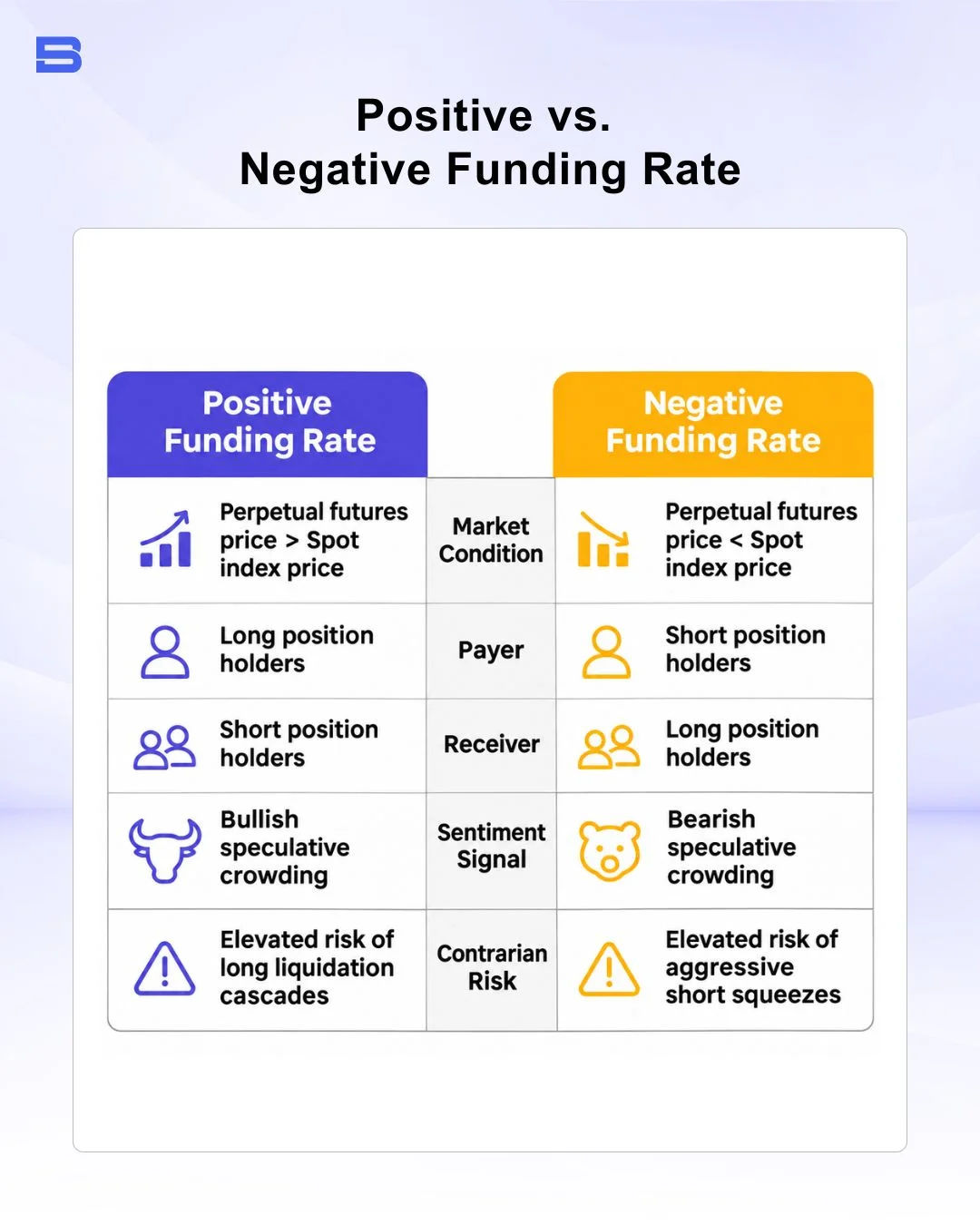
A positive funding rate signals that the market is predominantly bullish. Long traders willingly pay short traders a periodic fee simply to keep their leveraged upside open. When positive funding spikes significantly above baseline levels, it may indicate speculative euphoria, with retail and institutional longs piling into leverage.
A negative funding rate reflects strong bearish sentiment. Perpetual contracts trade at a discount to spot, requiring short sellers to pay long holders to sustain their downside exposure. This regime typically appears during sustained market capitulations or panic sell-offs.
Sharp imbalances frequently function as contrarian market signals. When funding rates reach historical extremes, crowded trades become highly vulnerable to abrupt reversals. Historically, a sudden price drop in a heavily positive funding environment can trigger cascading margin liquidations among over-leveraged longs, which may accelerate sharp sell-offs.
Macro trends and asset supply dynamics, including structural token release schedules detailed in an asset’s tokenomics, often exacerbate these leveraged imbalances during major unlock events. Research by the Bank for International Settlements (BIS) highlights how leveraged positions across crypto derivatives can rapidly transmit market shocks and accelerate liquidation spirals.
The Hidden Holding Drag: Calculating Perpetual Futures Costs and Leverage
A common and costly misconception among newer derivatives traders is assuming funding rates apply only to initial margin collateral. In reality, funding fees are calculated strictly against your total notional position value. Leverage acts as a direct cost multiplier, accelerating both your returns and your capital decay.
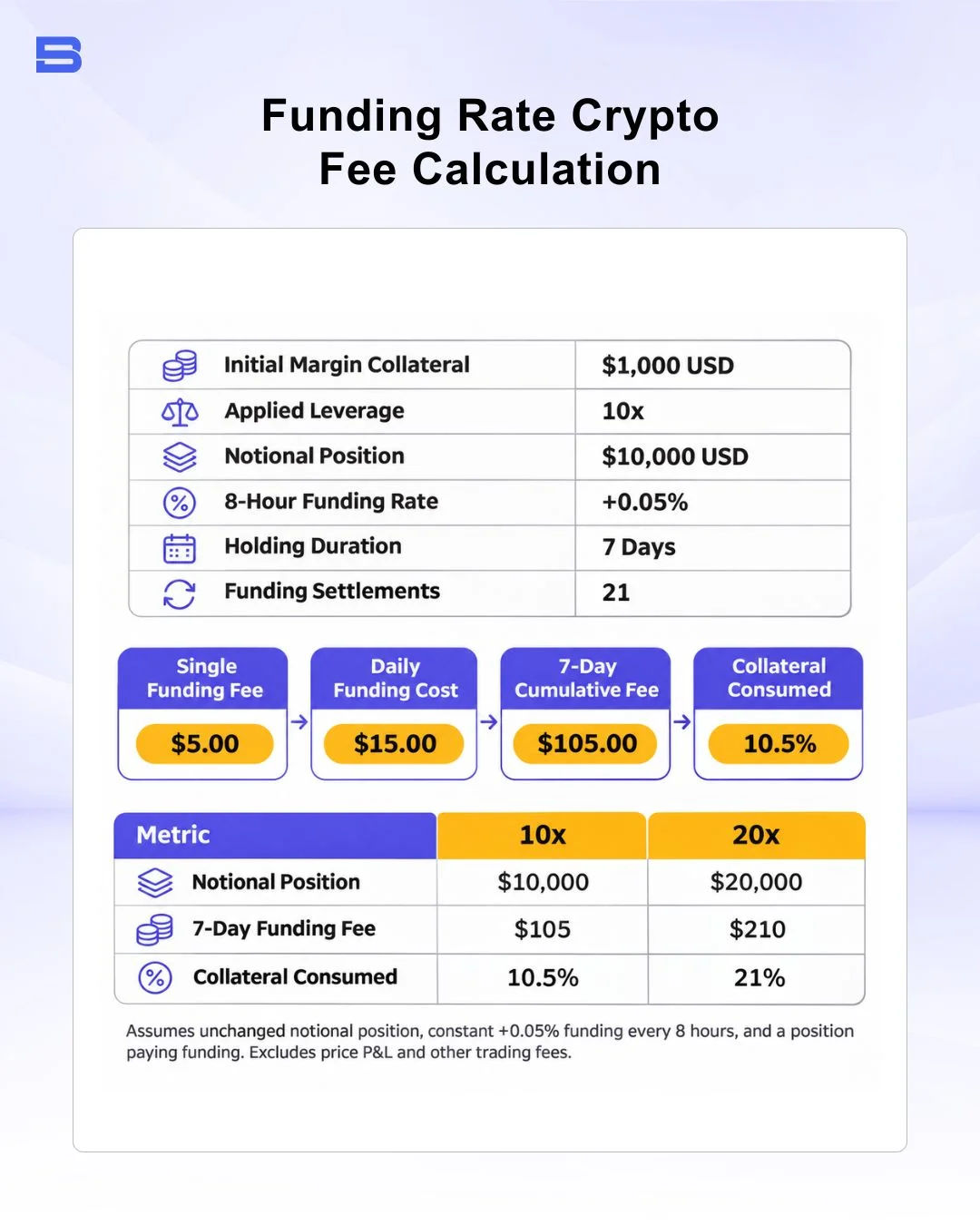
Consider a concrete trading scenario with Bitcoin perpetual futures:
- Initial Margin Collateral: $1,000
- Applied Leverage: 1:10
- Total Notional Position Size: $10,000 ($1,000 × 10)
- Average 8-Hour Funding Rate: +0.05%
- Holding Duration: 7 Days (21 funding settlements total)
Here is how the cumulative holding drag breaks down mathematically:
Single Funding Fee = $10,000 x 0.0005 = $5.00
Daily Funding Cost (3 intervals) = $5.00 x 3 = $15.00
7-Day Cumulative Fee = $15.00 x 7 = $105.00
While a $5 fee per interval may seem negligible, paying $105 over a single week represents a 10.5% loss of your original $1,000 margin collateral, even if Bitcoin’s market price remains completely flat. If leverage is increased to 1:20, that fee drag doubles to $210, consuming over a fifth of your collateral in seven days.
Regulatory reports from the International Organization of Securities Commissions (IOSCO) continuously emphasize that retail investors frequently underestimate how leverage amplifies hidden financing drag, turning sideways price action into substantial portfolio losses.
Practical Applications and Derivative Trading Risks
Active swing traders and position traders must incorporate funding rate crypto costs into their trading strategies and execution plans. For example, when an asset experiences strong bullish momentum but carries an annualized funding cost exceeding 50%, holding a leveraged long position for several weeks can result in significant negative carry (a holding cost that steadily reduces your returns).
These recurring payments may gradually erode trading profits, making funding costs an important consideration when evaluating entry timing, position duration, and overall risk exposure.
Disciplined traders often evaluate closing or rotating leveraged exposure ahead of high-cost settlement snapshots, or they utilize spot markets instead to hold directional exposure without ongoing funding bleed.
Before trading perpetual futures, check whether the exchange is licensed by the financial regulator in your country, since some crypto derivatives venues operate offshore and may offer limited investor protection.
Delta-Neutral Funding Rate Arbitrage: Opportunities and Hidden Pitfalls
Sophisticated traders frequently pursue delta-neutral "cash-and-carry" arbitrage to capture high positive funding rates while neutralizing directional market risk. The strategy involves buying spot Bitcoin while simultaneously opening an equal-sized short perpetual contract on a derivatives exchange. Because you hold matching long and short legs, fluctuations in Bitcoin’s spot price offset each other, allowing you to collect eight-hour funding payouts from long traders.
Traders often compare this baseline yield against decentralized alternatives, such as staking in crypto to earn network validation rewards or providing capital through yield farming protocols. However, funding rate arbitrage carries severe operational risks that can quickly turn a profitable hedge into a realized loss.
Execution slippage and spot-futures trading fees can consume multiple weeks of anticipated funding yield before a position breaks even. More critically, sharp upward price spikes expose the short futures leg to liquidation risk.
Although the spot holding may gain the same market value, exchange margin systems operate independently. If you cannot transfer additional collateral quickly enough, your short position may be liquidated, leaving you with an unhedged spot asset just as the market corrects. Additionally, the funding rate crypto mechanism can quickly shift from positive to negative during market downturns, turning previously expected funding income into a recurring expense that further reduces your overall returns.
Conclusion
Understanding funding rate crypto mechanics is essential for managing the costs and risks of perpetual futures trading. These periodic payments between long and short traders help keep perpetual contract prices aligned with the underlying spot market while influencing the cost of holding leveraged positions.
By monitoring funding rates, interpreting positive and negative readings, and accounting for payment intervals, traders can make more informed decisions about position sizing and trade duration. Ultimately, funding rates should be treated as an important part of risk management rather than a standalone signal for predicting market direction.
- What Can You Trade? A Guide to Forex, Stocks, and More
- CFD Trading for Beginners
- What is CFD Trading and How Does It Work?
- Forex vs. Stocks: Which Market Suits You Best?
- How to Diversify a Portfolio Across Asset Classes
- How Dividend Stocks Work: Yields, Risks, and Strategies
- Silver Trading Explained: A Guide for Retail Investors
- Precious Metals Trading: A Complete Guide for Beginners
- Natural Gas Trading: A Guide to the Market
- Structured Warrants Malaysia: How They Work and Risks
- What Is the KLCI Index and How to Trade It
- Gold Investment in Malaysia: A Complete Guide for Beginners
- What Is Kijang Emas and How to Invest in It
- Value Investing Explained: How to Find Undervalued Stocks
- How to Trade Bitcoin Safely: A Complete Market Guide
- Growth Investing Explained: Strategies, Metrics, and Risks
- What Is Digital Gold Malaysia and How to Invest
- Crypto Trading Strategies for Beginners
- Gold vs Bitcoin: Key Differences, Risks, and Strategies
- Sukuk: A Guide for Beginners to Islamic Bonds
- What Is FCPO (Crude Palm Oil Futures) and How to Trade It
- How to Identify and Invest in Shariah-Compliant Stocks
- Timber Investment: Is It Worth It?
- Gold ETF Malaysia: A Guide for Beginners
- What Are Malaysian Government Securities (MGS)?
- Corporate Bonds Malaysia: A Guide for Beginners
- China A-Shares Trading Guide for Malaysian Investors
- What Is a Silver ETF and How to Invest in It?
- How to Trade XRP: A Practical Guide for Retail Investors
- How to Trade Solana (SOL): A Guide for Beginners
- What Are Gold Futures and How Do They Work?
- Money Market Fund in Malaysia: A Guide for Beginners
- Property Investment Malaysia: Direct Real Estate or M-REITs?
- What Is Binance Coin and How Does It Work?
- Green Sukuk: A Guide for Beginners to Islamic ESG Investing
- What Is Shiba Inu (SHIB) and How to Trade It
- What Is USDT? A Complete Guide to Tether for Beginners
- What Is Dogecoin and How to Trade It Safely for Beginners
- Cardano: A Guide for Beginners to Trade This Cryptocurrency
- Polkadot: A Guide to Trading This Cryptocurrency
- Tron: A Guide for Beginners to Trading This Cryptocurrency
- What Is Litecoin (LTC)? A Guide to Trading Digital Silver
- What Is Chainlink (LINK) and How to Trade It
- How to Trade Pepe Coin: Spot, Leverage, and Risk Management
- Near Protocol: A Guide to Trading This Cryptocurrency
- Trading Polygon Crypto: A Practical Guide for Beginners
- Trade Toncoin: Understanding the TON Ecosystem and Risks
- Cosmos Crypto: Ecosystem Architecture, Tokenomics, and Risks
- Stellar Crypto: A Guide to Trading This Cryptocurrency
- Avalanche Crypto Explained: A Practical Guide for Traders
- What Is Worldcoin? How to Trade WLD and Manage Risk
- Aptos: A Guide for Beginners to Trading This Cryptocurrency
- Sui Crypto Explained: Tokenomics and Trading Guide
- Celestia: A Guide to Trading This Cryptocurrency
- Decentraland: A Guide to Trading This Cryptocurrency
- What Is Arbitrum? How to Trade the Leading Layer 2 Network
- Sei Crypto: A Guide to Trading This Cryptocurrency
- What Is Injective Protocol and How to Trade INJ Safely
Disclaimer: The content on this page is intended for educational and informational purposes only. It does not constitute financial, investment, tax, or legal advice, and should not be interpreted as a recommendation to buy, sell, or hold any financial instrument or asset. Trading and investing involve significant risk, including the possible loss of your entire capital. Products such as forex, CFDs, and cryptocurrencies carry additional risks due to leverage, high volatility, and limited regulatory protection in some jurisdictions. Past performance of any financial instrument does not guarantee future results. Any market views, forecasts, or opinions expressed are those of the author at the time of writing and may not reflect current market conditions. Platform features, fees, and regulatory status are subject to change — always verify information directly with the relevant provider or regulator before making any financial decision. BrokerSpecs may receive compensation from third parties featured on this site. Always conduct your own due diligence and consider seeking advice from a licensed financial professional before investing. Portions of this article were prepared with the assistance of AI tools and reviewed by our editorial team before publication.