


- How to Start Trading: A Step-by-Step Guide for Beginners
- Demo Trading Accounts: Safe Practice for Beginners
- Understanding How Much Capital You Need to Start Trading
- How to Set Realistic Trading Goals as a New Trader
- How to Open a Trading Account in Malaysia (Step-by-Step)
- How to Start Trading in Malaysia: A Guide for Beginners
- How to Create a Trading Plan Before You Start Trading
- What Is a Trading Account? Everything You Need to Know
- How to Learn Trading: Step-by-Step Beginner Roadmap
- What Is Stop Loss in Trading and How Does It Work?
- Why Every Trader Needs a Trading Journal
- Islamic Forex Account Explained: How Swap-Free Trading Works
- Funded Trading Account: Rules, Splits & Risks
- Master Money Management: Practical Capital Protection Rules
- Overtrading Explained: Common Causes, Signs, and How to Stop
- How Risk-Reward Ratio Works: A Guide to Trading Risk
- How to Open a Brokerage Account as a Beginner
- What Is a Cent Account Forex and How Does It Work?
- What Is an ECN Account and How Does It Work?
- What Is Cashback Forex and How Does It Work?
- Fixed Deposit vs Unit Trust: Key Differences for Investors
- Welcome Bonus Forex: What It Is and What to Watch For
- Forex Deposit Bonus: How It Works
- What Is Forex Rebate and How Does It Work?
- What Is Forex Free Credit and How Does It Work?
- Trading Webinars: Are They Worth Attending?
- Trading for Beginners PDF: What to Look For in a Good Guide
- Trading 101: How to Start Trading Safely and Effectively

Entering a market trade without an exit strategy is like driving a high-performance vehicle without brakes. Volatility can turn a promising market setup into a significant capital drawdown within seconds. Sudden geopolitical announcements, unexpected macroeconomic releases, or sudden liquidity shifts can rapidly push market prices against your position.
Managing market volatility requires automated discipline rather than emotional decision-making. Utilizing a stop loss order allows you to define your maximum acceptable downside risk before you open a trade, protecting your account balance from an outsized loss.
What Is a Stop Loss Order and How Does It Work?
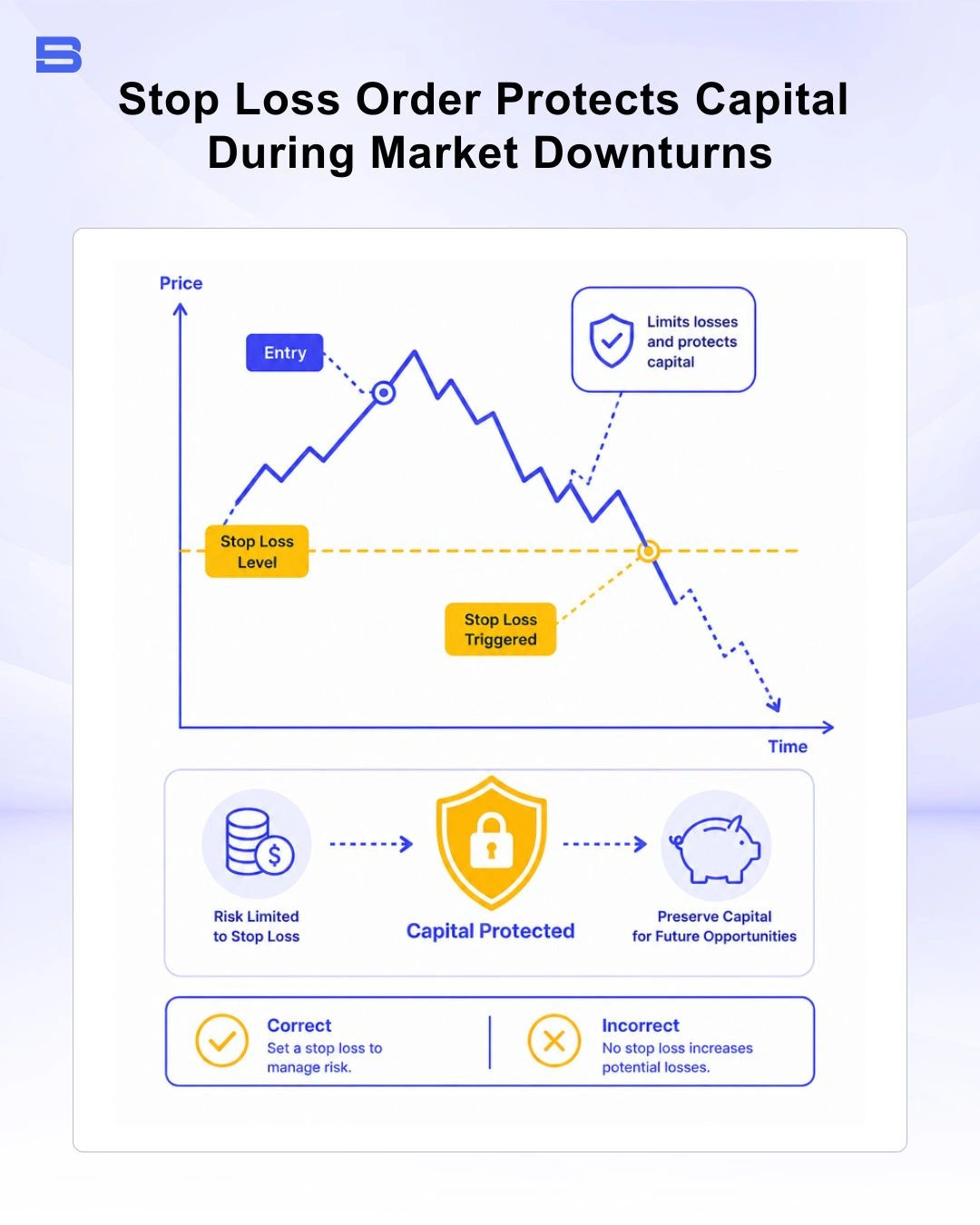
A stop loss (or stop loss order) is an automated instruction submitted to your brokerage platform to close an open trading position once the asset reaches a specific, predefined price trigger.
When learning what is stop loss in trading, it helps to understand its primary mechanical function: it limits an investor's loss on a security position. If you open a long position (buying an asset expecting its value to rise), your order trigger is placed below the current market price. Conversely, if you open a short position (selling an asset expecting its value to fall), your order trigger sits above the current market price.
Once the market price reaches or crosses your designated trigger price, the brokerage platform automatically converts your order into an executable instruction to close the trade immediately. This process eliminates human hesitation, emotional attachment, and the need to monitor price charts manually 24 hours a day.
Stop Loss vs. Stop Limit Order
Understanding order execution mechanics is critical to avoiding unexpected fills. Traders primarily choose between two main risk-management order types:
- Stop Loss (Market) Order: Once the activation price is hit, the trade turns into a standard market order, executing immediately at the best available price. Execution is guaranteed, but the exact price is not—especially during sudden price spikes.
- Stop Limit Order: Once activated, the trade converts into a limit order. It will only close at your specified limit price or better. While this prevents selling at an unintended discount, execution is not guaranteed; if the price jumps past your limit price, your position remains open during a market crash.
Trailing Stop Loss
A trailing stop is a dynamic variant of the standard stop order. Instead of remaining fixed at a single price level, a trailing stop automatically follows the market price by a set distance or percentage as long as the market moves in your favored direction.
If the market turns around and reverses against your position by the specified trailing distance, the trade closes automatically. This structure allows traders to lock in floating profits while keeping downside protection active.
How to Calculate and Set a Stop Loss
Setting your cut-off level should never be a random guess. Professional traders determine exit points using technical structure—such as placing order triggers just beyond key support or resistance levels, or using volatility metrics like the Average True Range (ATR), which measures how much an asset's price typically moves over a given period.
Proper execution relies heavily on position sizing. Your cut-off distance determines your lot size, ensuring that your overall risk remains consistent regardless of market noise.
Worked Calculation Scenario
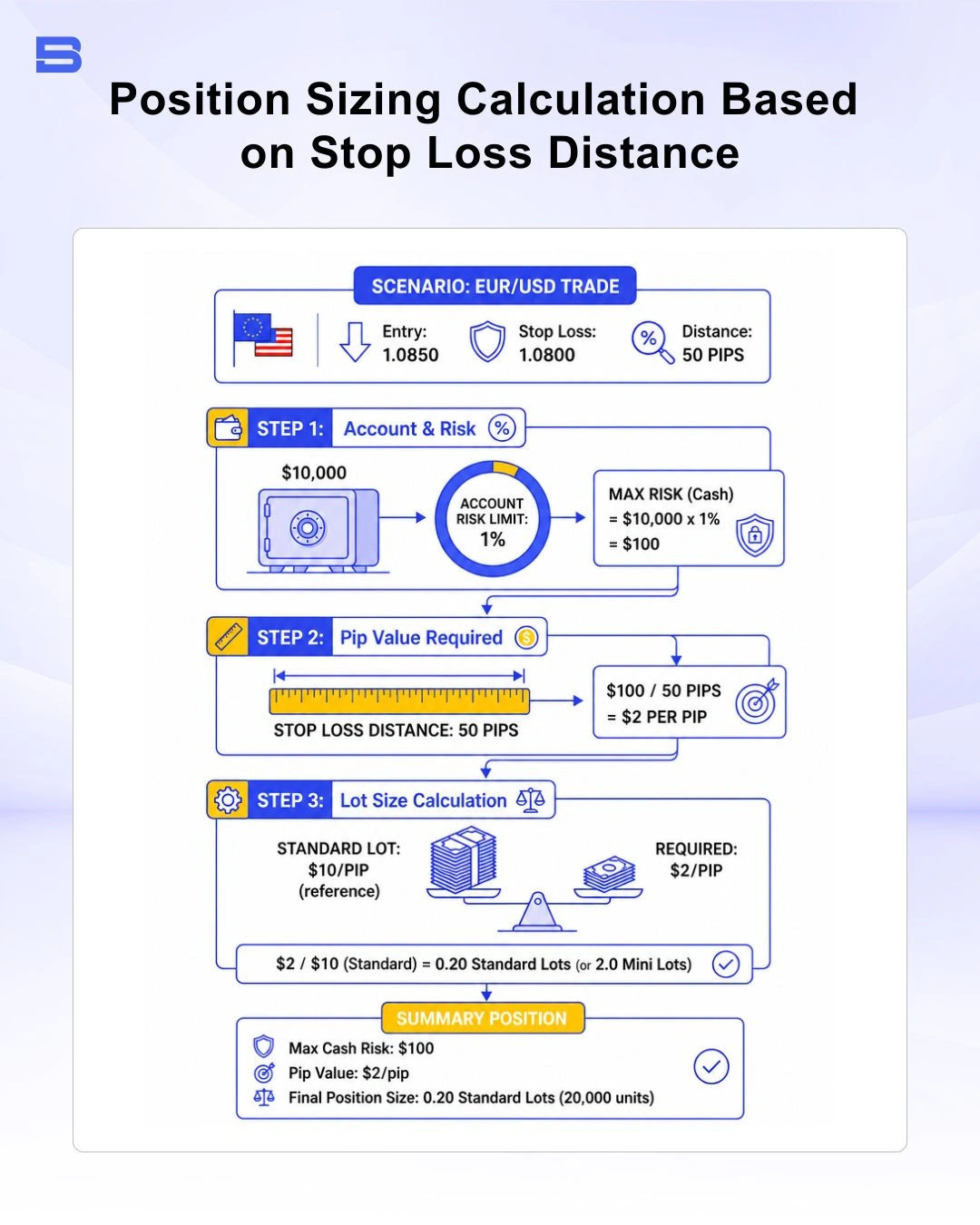
Consider a trading account with a balance of $10,000. Applying a strict 1% risk management rule per trade, your maximum allowed risk per position is:
Maximum Risk = $10,000 x 0.01 = $100
Suppose you decide to trade Euro and US Dollar (EUR/USD) with an entry price of 1.0850. Based on market support levels, you place your exit order 50 pips away at 1.0800. To find the correct position size so that a 50-pip drop equals exactly $100:
- Determine Pip Value Required: $100 / 50 pips = $2 per pip
- Calculate Lot Size: Since a Standard Lot (100,000 units) equals roughly $10/pip on EUR/USD, a $2/pip value requires a position size of 0.20 Standard Lots (20,000 units).
By linking your exit distance directly to position size, you systematically align your trades with a favorable risk-reward ratio (such as 1:2 or 1:3), ensuring potential gains outweigh potential losses over time.
Risks and Execution Limits: Slippage and Market Gaps
While automated risk exits are essential safety tools, they do not offer absolute immunity from market mechanics. Investors must account for structural execution risks during periods of sharp market movement.
During major news events, rate decisions, or earnings announcements, high market volatility can cause rapid price jumps. Slippage in trading occurs when your exit order triggers at a designated price, but high-speed market movement forces the actual execution to take place at a noticeably worse price.
Furthermore, markets can experience price gaps over weekends or major market closures. If a stock closes on Friday at $50 and opens on Monday morning at $42 due to severe geopolitical news, your exit order set at $48 will execute at the opening price of $42. Regulatory agencies like the U.S. Securities and Exchange Commission (SEC) and the Securities Commission Malaysia (SC) frequently highlight order execution risks in retail market investor notices.
Stop Loss vs. Take Profit: Managing Your Trades
A complete trading setup requires managing both sides of the price distribution curve: limiting capital destruction on the downside and securing realized gains on the upside.
Incorporating both automated exit order types directly into your comprehensive trading plan protects your psychological discipline. Establishing defined exit boundary limits before trade entry removes emotional interference, aligns execution with your target risk tolerance, and reinforces systemic money management strategies across changing market cycles.
The Bottom Line
A stop loss order is a fundamental capital preservation tool for any active trader. While it cannot eliminate execution risks such as slippage during major price gaps, automating your exit criteria ensures that a single bad trade will not destroy your account. Pair your exit orders with proper position sizing to manage market volatility with confidence.
Disclaimer: The content on this page is intended for educational and informational purposes only. It does not constitute financial, investment, tax, or legal advice, and should not be interpreted as a recommendation to buy, sell, or hold any financial instrument or asset. Trading and investing involve significant risk, including the possible loss of your entire capital. Products such as forex, CFDs, and cryptocurrencies carry additional risks due to leverage, high volatility, and limited regulatory protection in some jurisdictions. Past performance of any financial instrument does not guarantee future results. Any market views, forecasts, or opinions expressed are those of the author at the time of writing and may not reflect current market conditions. Platform features, fees, and regulatory status are subject to change — always verify information directly with the relevant provider or regulator before making any financial decision. BrokerSpecs may receive compensation from third parties featured on this site. Always conduct your own due diligence and consider seeking advice from a licensed financial professional before investing.