


- What Can You Trade? A Guide to Forex, Stocks, and More
- CFD Trading for Beginners
- What is CFD Trading and How Does It Work?
- Forex vs. Stocks: Which Market Suits You Best?
- How to Diversify a Portfolio Across Asset Classes
- How Dividend Stocks Work: Yields, Risks, and Strategies
- Silver Trading Explained: A Guide for Retail Investors
- Precious Metals Trading: A Complete Guide for Beginners
- Natural Gas Trading: A Guide to the Market
- Structured Warrants Malaysia: How They Work and Risks
- What Is the KLCI Index and How to Trade It
- Gold Investment in Malaysia: A Complete Guide for Beginners
- What Is Kijang Emas and How to Invest in It
- Value Investing Explained: How to Find Undervalued Stocks
- How to Trade Bitcoin Safely: A Complete Market Guide
- Growth Investing Explained: Strategies, Metrics, and Risks
- What Is Digital Gold Malaysia and How to Invest
- Crypto Trading Strategies for Beginners
- Gold vs Bitcoin: Key Differences, Risks, and Strategies
- Sukuk: A Guide for Beginners to Islamic Bonds
- What Is FCPO (Crude Palm Oil Futures) and How to Trade It
- How to Identify and Invest in Shariah-Compliant Stocks
- Timber Investment: Is It Worth It?
- Gold ETF Malaysia: A Guide for Beginners
- What Are Malaysian Government Securities (MGS)?
- Corporate Bonds Malaysia: A Guide for Beginners
- China A-Shares Trading Guide for Malaysian Investors
- What Is a Silver ETF and How to Invest in It?
- How to Trade XRP: A Practical Guide for Retail Investors
- How to Trade Solana (SOL): A Guide for Beginners
- What Are Gold Futures and How Do They Work?
- Money Market Fund in Malaysia: A Guide for Beginners
- Property Investment Malaysia: Direct Real Estate or M-REITs?
- What Is Binance Coin and How Does It Work?
- Green Sukuk: A Guide for Beginners to Islamic ESG Investing
- What Is Shiba Inu (SHIB) and How to Trade It
- What Is USDT? A Complete Guide to Tether for Beginners
- What Is Dogecoin and How to Trade It Safely for Beginners
- Cardano: A Guide for Beginners to Trade This Cryptocurrency
- Polkadot: A Guide to Trading This Cryptocurrency
- Tron: A Guide for Beginners to Trading This Cryptocurrency
- What Is Litecoin (LTC)? A Guide to Trading Digital Silver
- What Is Chainlink (LINK) and How to Trade It
- How to Trade Pepe Coin: Spot, Leverage, and Risk Management
- Near Protocol: A Guide to Trading This Cryptocurrency
- Trading Polygon Crypto: A Practical Guide for Beginners
- Trade Toncoin: Understanding the TON Ecosystem and Risks
- Cosmos Crypto: Ecosystem Architecture, Tokenomics, and Risks
- Stellar Crypto: A Guide to Trading This Cryptocurrency
- Avalanche Crypto Explained: A Practical Guide for Traders
- What Is Worldcoin? How to Trade WLD and Manage Risk
- Aptos: A Guide for Beginners to Trading This Cryptocurrency
- Sui Crypto Explained: Tokenomics and Trading Guide
- Celestia: A Guide to Trading This Cryptocurrency
- Decentraland: A Guide to Trading This Cryptocurrency
- What Is Arbitrum? How to Trade the Leading Layer 2 Network
- Sei Crypto: A Guide to Trading This Cryptocurrency
- What Is Injective Protocol and How to Trade INJ Safely

Entering the financial markets for the first time often brings you to a critical crossroads: should you delegate your money to professional managers through pooled investments, or take full direct control of your portfolio by active stock trading?
In Malaysia, retail investors frequently weigh the hands-off convenience of unit trusts against the autonomy and lower ongoing friction of direct trading accounts. Both paths offer distinct advantages depending on your time commitment, risk profile, and long-term financial objectives.
In short: unit trusts suit hands-off beginners who want instant diversification, while direct trading suits those who want full control over their own portfolio — the right fit depends on your time, risk tolerance, and cost preferences.
What Is Unit Trust in Malaysia and How Does It Work?
A unit trust is a collective investment scheme that pools money from thousands of individual investors to form a substantial capital fund. A professional fund management company then allocates this collective pool across various asset classes—such as equities, fixed income securities, or real estate—in line with the fund's specific mandate.
When you invest in a unit trust, your capital is converted into "units." The value of each unit is determined by the fund's Net Asset Value (NAV) per unit, calculated at the end of each business day by taking the total market value of the fund's underlying assets, subtracting any liabilities, and dividing the balance by the total number of outstanding units.
To protect retail investors, Malaysian unit trusts operate under a dual-oversight regulatory framework. The fund management company manages the investment strategy, but the underlying cash and assets are held separately by an independent custodian known as a trustee.
This ensures your capital remains safeguarded even if the fund management company faces operational or financial distress.
In Malaysia, this regulatory ecosystem is strictly supervised by the Securities Commission Malaysia (SC) under the Capital Markets and Services Act 2007. Distribution practices, agent conduct, and industry standards are further governed by the Federation of Investment Managers Malaysia (FIMM).
Key Types of Unit Trust Funds in Malaysia
Unit trust funds are categorized by their risk profile, asset focus, and investment objectives. Matching the fund type to your personal horizon is critical to constructing a resilient financial plan.
- Equity Funds: These funds invest primarily in publicly listed shares on Bursa Malaysia or international exchanges. They aim for long-term capital appreciation but carry higher market volatility.
- Fixed Income Funds: Investing in Malaysian Government Securities (MGS), corporate bonds, and corporate debt instruments, these funds aim to deliver a steady income stream with lower risk than equities.
- Money Market Funds: Focused on ultra-short-term liquid assets such as bank deposits and commercial paper, money market funds prioritize capital preservation and offer liquidity similar to fixed deposits.
- Balanced Funds: These funds hold a blend of equities and fixed-income assets to balance growth with downside protection.
- Shariah-Compliant Funds: Certified by independent Islamic advisory boards, these funds invest strictly in Shariah-compliant equities, sukuk (Islamic bonds), and liquid instruments, excluding business activities involving alcohol, gambling, conventional banking, or non-halal products.
Understanding Total Investment Costs: Sales Charges vs. Trading Commissions
Fee drag is one of the most significant factors affecting your long-term compounding efficiency. Unit trusts and active brokerage accounts handle administrative and transaction costs in fundamentally different ways.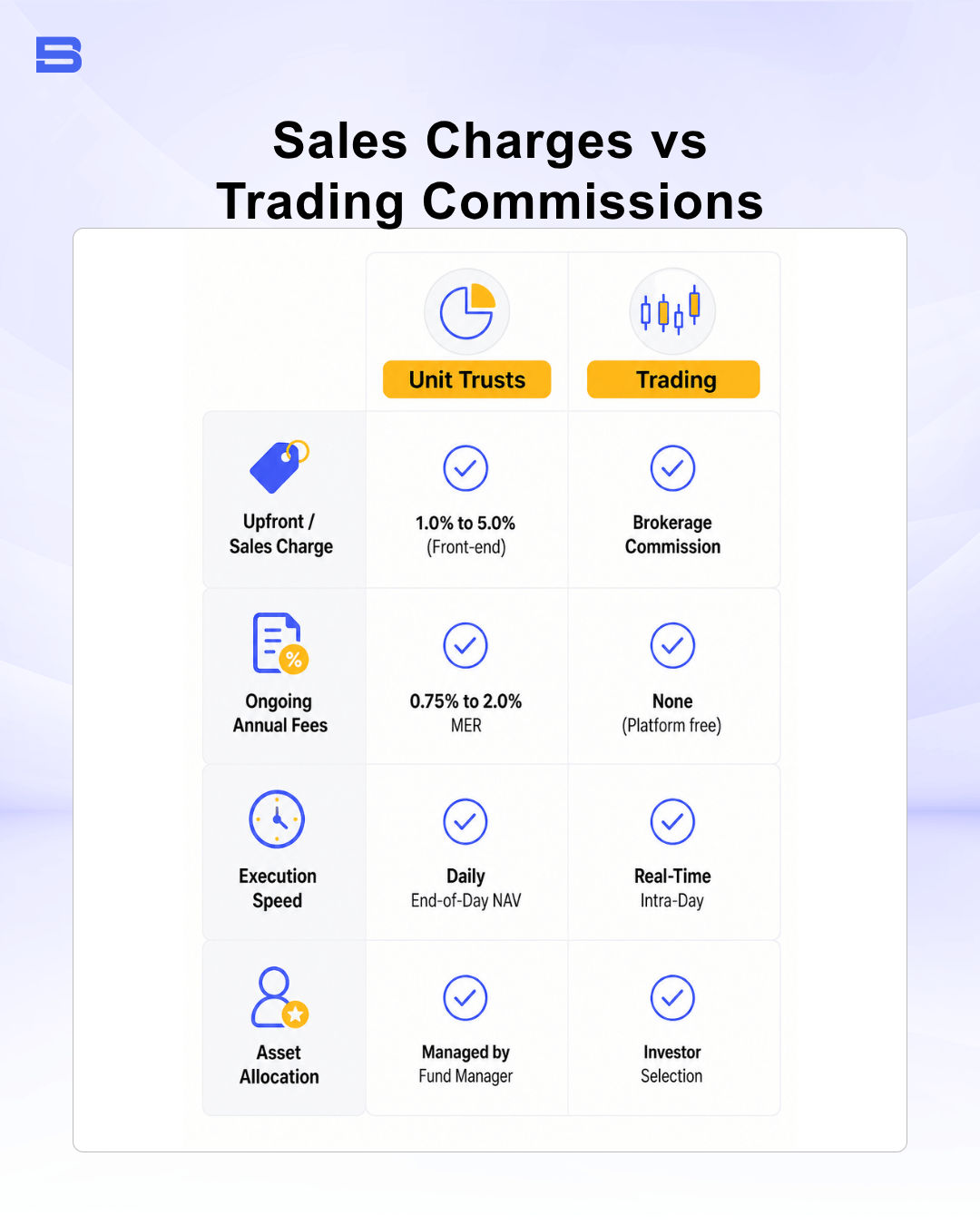
Cost Breakdown: Sales Charges and Management Fees
According to fee benchmarks published by the Federation of Investment Managers Malaysia (FIMM), a front-end sales charge typically ranges from 1.0% to 5.0% through conventional agents, though direct online platforms have compressed this to between 0.0% and 2.0%.
The Management Expense Ratio (MER)—which covers fund manager fees, trustee fees, and administrative expenses—typically ranges from 0.75% to 2.0% annually, a range consistent with fund fact sheets reviewed by the Securities Commission Malaysia.
Consider a worked scenario where you invest RM10,000 into an equity unit trust with a 5.0% upfront sales charge and a 1.5% annual MER:
- Upfront Load: A 5.0% sales fee deducts RM500 immediately, leaving your net invested capital at RM9,500.
- Annual Fee Drag: Over a 10-year period, a 1.5% annual MER continuously reduces the compounding base of your total asset value every single day.
By comparison, direct trading via a local brokerage requires paying a transactional commission—commonly cited by Bursa Malaysia-registered brokers as ranging from 0.05% to 0.42%, or a flat minimum fee per order
While direct trading incurs friction every time you buy or sell, it charges no ongoing annual management fees on held assets, allowing your capital base to compound without annual MER deductions.
Unit Trust vs Direct Trading: Which Strategy Fits Your Goals?
Choosing between managed unit trusts and self-directed trading depends on how much personal time you can dedicate to fundamental analysis, market execution, and risk mitigation.
Managed Delegation vs. Personal Control
Unit trusts offer instant diversification across dozens of holdings with a single transaction, making them suitable for hands-off investors who prefer delegating research to full-time professionals. However, unit trust investors surrender control over specific stock selection, trade timing, and execution price, relying entirely on the daily end-of-day NAV calculation.
Direct stock trading allows you to construct a custom portfolio, select specific growth or dividend companies, and implement precise entry or exit triggers in real time. Direct trading demands disciplined risk management—such as setting mandatory stop-loss orders—to prevent unmanaged losses during sudden market pullbacks.
The Role of ASNB Investments in Malaysia
Malaysians also have access to public unit trust structures offered by Amanah Saham Nasional Berhad (ASNB). Funds such as an ASB account (Amanah Saham Bumiputera) or conventional variable-priced funds provide accessible avenues for retail wealth accumulation.
Unlike private unit trust funds that charge high commercial sales loads, fixed-price ASNB investment units carry no upfront sales load and feature minimal administrative costs, offering a stable foundation for capital preservation within a diversified local portfolio.
How to Invest in Unit Trusts in Malaysia
If you decide that pooled fund management fits your investment strategy, getting started involves three steps:
- Select Your Distribution Channel: You can invest directly through Unit Trust Management Companies (UTMCs), Institutional Unit Trust Advisers (IUTA banks and digital wealth platforms), or through the Employees Provident Fund (EPF) i-Invest portal.
- Evaluate Fund Performance and Prospectuses: Review fund factsheets, historical benchmark comparisons, fee structures, and asset allocations rather than relying solely on past short-term returns.
- Automate Capital Contributions: Establish automated monthly standing instructions to implement a dollar-cost averaging strategy, reducing the emotional friction of trying to time market highs and lows.
Which Suits You Better?
Unit trusts provide an automated, hands-off path to instant portfolio diversification for investors who prefer professional management over daily charting and market research. Direct stock trading offers complete portfolio autonomy, real-time market execution, and freedom from annual fund management fees.
Evaluating your risk tolerance, time availability, and net cost structure will guide you toward the approach that best serves your wealth-building goals.
Disclaimer: The content on this page is intended for educational and informational purposes only. It does not constitute financial, investment, tax, or legal advice, and should not be interpreted as a recommendation to buy, sell, or hold any financial instrument or asset. Trading and investing involve significant risk, including the possible loss of your entire capital. Products such as forex, CFDs, and cryptocurrencies carry additional risks due to leverage, high volatility, and limited regulatory protection in some jurisdictions. Past performance of any financial instrument does not guarantee future results. Any market views, forecasts, or opinions expressed are those of the author at the time of writing and may not reflect current market conditions. Platform features, fees, and regulatory status are subject to change — always verify information directly with the relevant provider or regulator before making any financial decision. BrokerSpecs may receive compensation from third parties featured on this site. Always conduct your own due diligence and consider seeking advice from a licensed financial professional before investing.