



Related Tags
You watch the price ticker tick upward, click a button to buy an asset, and within seconds, it appears in your account balance. You now own it completely. Whether you are exchanging local cash for physical foreign currency at an airport booth or using an online platform to purchase digital assets, you are participating in one of the oldest financial activities in existence.
This process is known as spot trading, and understanding what is spot trading forms the bedrock of global financial markets, serving as the foundation upon which more complex financial instruments are built. Understanding how it operates is crucial for anyone looking to navigate the markets effectively.
Before diving into strategy, it helps to answer the basic question directly: what is spot trading, and how does it differ from the derivative products you may have heard about?
Understanding the Spot Market Mechanics
At its core, spot trading is the purchase or sale of a financial instrument for immediate delivery. The marketplace where these transactions occur is called the spot market. When you execute a trade here, the transaction is settled "on the spot," meaning ownership transfers from the seller to the buyer right away.
The transaction relies on the spot price, which represents the current market value of an asset for immediate settlement. This price shifts constantly throughout the day based on the laws of supply and demand. If more people want to buy an asset than sell it, the price moves up; if sellers outnumber buyers, the price falls.
While the trade agreement happens instantly, the physical transfer of funds and assets follows standard industry settlement rules. In traditional stock markets, this timeline is frequently referred to as T+2, meaning the formal settlement occurs two business days after the trade date. In contrast, crypto spot trading often achieves settlement almost instantly, updating blockchain ledgers in real time.
In traditional stock markets, this timeline is frequently referred to as T+2 settlement, meaning the formal settlement occurs two business days after the trade date.
How Spot Trading Works in Practice
To see how these mechanics play out, let's look at a concrete example using a stock transaction.
Imagine you want to buy shares of a company, and the current spot price is quoted at $100 per share. You decide to buy 50 shares.
Here is how the math breaks down:
- The Setup: You commit $5,000 from your available cash balance to buy 50 shares at $100 per share.
- The Execution: The platform matches your order with a seller willing to part with 50 shares at that exact price.
- The Result: $5,000 is deducted from your account, and 50 shares are credited to your portfolio.
You now hold full ownership of those shares. If the company pays dividends, you are entitled to receive them.
If the price per share rises to $120, your 50 shares are now worth $6,000, netting you a $1,000 unrealized profit. Conversely, if the price drops to $80, your investment value falls to $4,000, representing a $1,000 unrealized loss.
Crucially, because you own the asset outright without borrowing funds, your investment cannot be liquidated by a broker even if the price drops significantly.
Futures vs Spot: Key Differences Defined
Beginner traders often confuse the spot market with derivative markets, particularly futures. While both allow you to gain exposure to asset price movements, their core mechanics, ownership structures, and risk profiles differ completely.
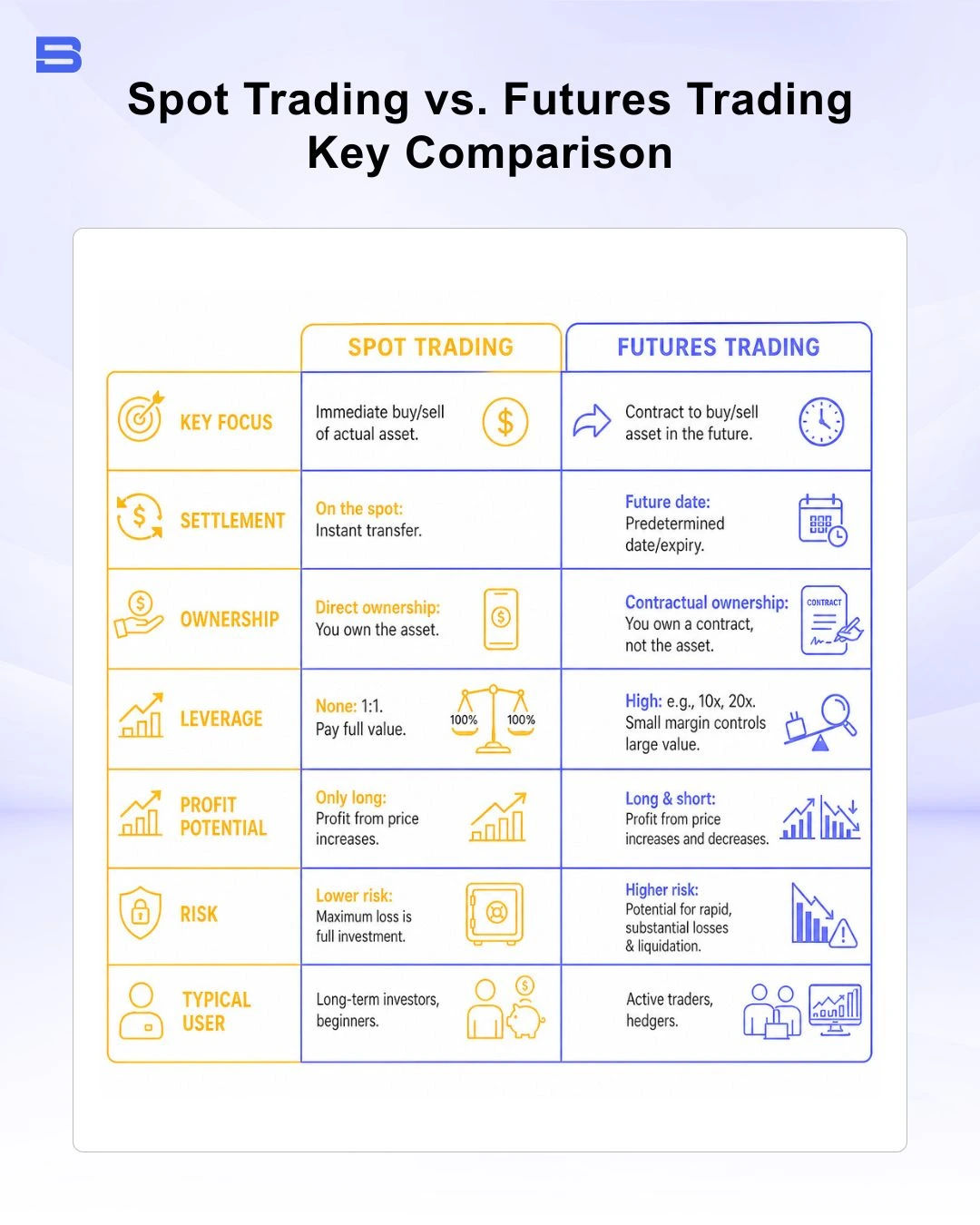
When you engage in spot transactions, you are trading the actual underlying asset for immediate delivery and full ownership. In contrast, futures trading involves buying or selling a contract that obligates you to buy or sell an asset at a predetermined price on a specified date in the future. You do not own the underlying asset when you trade a futures contract; you merely own a legal agreement tied to its future price.
Another major distinction lies in leverage. Spot trading generally requires you to pay the full value of the trade upfront using your own capital. Futures markets inherently use leverage, allowing you to control a large position with a relatively small amount of margin. While leverage can multiply gains, it also drastically elevates risk, introducing the potential for rapid liquidation if the market moves against you.
The Risks and Benefits of the Spot Market
Every trading environment involves trade-offs. Spot markets are highly favored for their transparency and simplicity, but they are not entirely free of risk.
The Advantages
Asset Ownership: Buying an asset means you own it outright, allowing you to transfer it to private storage or hold it long-term.
No Leverage Risk: When traded without leverage — as is typical for beginner spot trading — you cannot lose more than your initial capital investment. Note that some platforms also offer margin or leveraged spot trading, which removes this protection and carries additional risk beyond what is covered in this guide.
Lower Holding Costs: Unlike derivatives, spot positions do not incur overnight funding charges, maintenance margins, or contract expiration rolls, making them highly cost-effective for long-term investing strategies.
The Disadvantages
Capital Inefficiency: You must put up 100% of the trade value upfront, which limits the total size of the positions you can take compared to leveraged markets.
Limited Short Selling: Profiting from falling markets is much more complex in spot markets, as you generally must buy an asset first before you can sell it.
Market Volatility: Spot prices can experience severe fluctuations based on news, economic data, or shifting market sentiment, exposing your capital to direct market risk.
Key Takeaways: Getting Started with Spot Trading
So, what is spot trading, in short? It serves as the foundational starting point for market participants because it provides direct asset ownership and straightforward mechanics. By eliminating the complexities of leverage, contract expirations, and margin calls, it allows you to focus purely on understanding price movements and managing core market risks. Whether you plan to buy and hold assets for years or transition later into advanced derivative strategies, establishing a firm grasp of the spot market is an essential step in your trading journey.
- What Is Trading and How Does Trading Work?
- Trading Fundamentals: A Guide for Beginners
- Trading vs. Investing: What Are the Key Differences?
- Trading Terms and Terminologies Every Beginner Should Know
- Common Trading Mistakes Beginners Make and How to Avoid
- Understanding Risk and Reward in Trading: A Complete Guide
- Guide to the Different Types of Financial Markets
- Investment Basics: Definition, Strategies, and How to Invest
- Benefits of Investing: Financial Growth and Security
- What Is Swing Trading? A Practical Guide For Beginners
- What Is Spot Trading? A Guide for Beginners
- What Are Futures in Trading? A Guide for Beginners
- Understanding Bull Markets: Growth & Strategy
- How to Read a Candlestick Chart: A Guide for Beginners
- Is Trading Gambling? The Truth About Risk
- Pip in Forex: How It Works & How to Calculate It
- What Is the Bid-Ask Spread in Trading? A Guide for Beginners
- What Is a Margin Call? A Guide for Beginners
- Market Volatility Explained: What It Is and How to Trade It
- Drawdown in Trading: Meaning, Math, and Risk
- Understanding Slippage in Trading: Causes and Control
- Forex Lot Size Explained: Standard, Mini & Micro
- Trailing Stop vs Stop Loss: Essential Risk Strategy
- How Asset Allocation Works: Strategies Explained
- Understanding Market Trading Hours & Sessions
- Market Makers Explained: A Trader's Guide
- Portfolio Diversification: A Strategy Guide
- Capital Gains Explained: How Investment Taxes Work
- Stock Market Circuit Breakers: How Trading Halts Work
- What Is an IPO? How Initial Public Offerings Work
- What Is a Secondary Market? A Complete Guide
- What Is a Stock Exchange? Functions and Overview Explained
- Understanding Ticker Symbols: A Market Guide
- How Clearing Houses Work in Financial Markets
- Stock Market After Labor Day: Trends and What To Expect
Disclaimer: The content on this page is intended for educational and informational purposes only. It does not constitute financial, investment, tax, or legal advice, and should not be interpreted as a recommendation to buy, sell, or hold any financial instrument or asset. Trading and investing involve significant risk, including the possible loss of your entire capital. Products such as forex, CFDs, and cryptocurrencies carry additional risks due to leverage, high volatility, and limited regulatory protection in some jurisdictions. Past performance of any financial instrument does not guarantee future results. Any market views, forecasts, or opinions expressed are those of the author at the time of writing and may not reflect current market conditions. Platform features, fees, and regulatory status are subject to change — always verify information directly with the relevant provider or regulator before making any financial decision. BrokerSpecs may receive compensation from third parties featured on this site. Always conduct your own due diligence and consider seeking advice from a licensed financial professional before investing.