



Related Tags
Imagine reviewing two equity index funds with nearly identical historical returns, but one holds major oil refiners while the other excludes them in favor of solar suppliers and ethical lenders. You want your capital to grow over time, but you also care about the operational sustainability and real-world impact of the businesses your money funds.
This dilemma leads many modern investors to explore ESG investing as a structured evaluation tool. Rather than relying solely on traditional financial balance sheets, this approach evaluates non-financial metrics to identify broader business risks and long-term operational durability.\
What Does ESG Stand For in Investing?
ESG investing is an investment framework that evaluates corporate Environmental, Social, and Governance non-financial metrics alongside standard financial data to manage broader portfolio risk. By looking beyond net profit margins, investors gain insight into how resilient a business is against non-financial operational threats.
- Environmental (E): Measures how a company impacts the physical environment. Key evaluation factors include carbon footprint size, water conservation efforts, hazardous waste management, and renewable energy adoption.
- Social (S): Evaluates how a company manages relationships with human workforce and community stakeholders. Key factors include workplace health and safety standards, fair labor practices, customer data protection, and diversity initiatives.
- Governance (G): Examines internal leadership rules, corporate ethics, and operational integrity. Key focus areas include executive compensation limits, board oversight independence, financial audit transparency, and shareholder voting rights.
While evaluating these pillars helps highlight well-managed companies, ESG integration does not eliminate equity market risk or guarantee higher financial performance during market downturns.
Understanding ESG Risk Ratings and Scoring Frameworks
When comparing ESG investing to conventional stock-picking, the key difference lies in how non-financial risk is scored.
Independent rating agencies, such as MSCI and Sustainalytics, assign ESG risk scores to publicly traded companies by quantifying their exposure to industry-specific sustainability hazards. A lower risk score indicates that a company proactively mitigates potential regulatory fines, supply chain disruptions, or reputational damage.
Investors should distinguish between financial materiality and values-based screening. Financial materiality evaluates how sustainability issues directly affect a firm's balance sheet and cash flows, whereas values-based screening excludes specific business activities solely because they conflict with personal ethics.
Rating agency methodology inconsistencies present a notable operational challenge for retail investors. Because different scoring providers weigh criteria independently, a corporation might receive a high rating from one agency and a median rating from another.
Investors can consult analytical standards established by the CFA Institute to better understand how non-financial data integrates into fundamental analysis.
How ESG Integration Intersects with Value Investing
Traditional value investing, when paired with ESG investing principles, focuses on identifying undervalued stocks trading below their intrinsic worth using financial ratios like price-to-earnings (P/E) and discounted cash flow models. Modern fundamental analysts increasingly use ESG scoring as an additional risk-mitigation filter within value strategies.
Evaluating non-financial data helps value investors avoid "value traps"—companies that appear cheap on paper but carry severe unpriced liabilities like environmental remediation costs or pending regulatory penalties.
Consider two manufacturing firms trading at identical 10x P/E multiples. Firm A actively upgrades its facility energy efficiency, whereas Firm B faces imminent government carbon taxes due to aging infrastructure. Incorporating ESG risk factors reveals that Firm B carries higher tail risk (the chance of a rare but severe loss), making Firm A the more durable long-term value allocation.
Comparing ESG Screening with Shariah Compliant Stocks
In regional markets across Southeast Asia, investors frequently compare ESG investing frameworks with Islamic financial principles. While both evaluate non-financial standards, their core methodologies differ fundamentally in scope and execution.
Shariah screening applies strict negative screens, prohibiting investments in businesses involved in interest (riba), gambling, pork, alcohol, or excessive debt leverage.
Conversely, ESG screening relies primarily on relative scoring to measure operational sustainability, permitting investments in diverse industries provided operational risks are actively managed.
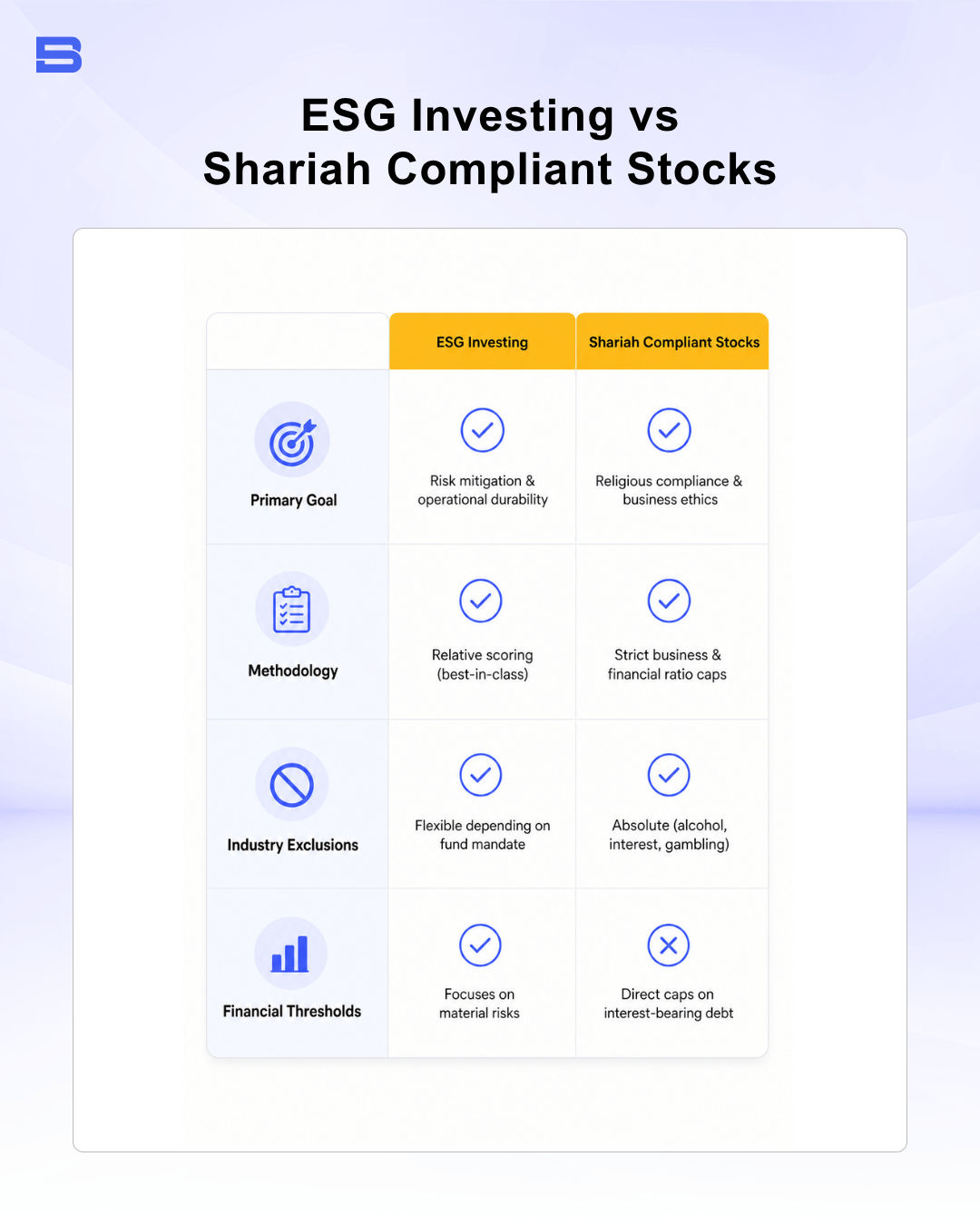 Many regional funds in Malaysia now implement dual-screening models to satisfy both sets of standards simultaneously. Guidance published by the Securities Commission Malaysia (SC) provides regulatory frameworks for Sustainable and Responsible Investment (SRI) funds operating in local capital markets.
Practical Investment Vehicles: ESG ETFs and Mutual Funds
Retail investors can access sustainable markets through diversified collective investment schemes rather than picking individual equities. Broad market funds allow investors to maintain asset allocation while integrating sustainability metrics automatically.
- ESG ETFs: Exchange-traded funds track sustainability indexes, offering real-time exchange liquidity and lower management fees.
- Equity Mutual Funds: Managed portfolios where fund managers actively select companies meeting specific sustainability criteria, commonly available as a unit trust—a pooled fund structure widely used across Malaysia and other Commonwealth markets.
- Green Sukuk: Fixed-income Islamic instruments designed specifically to fund eco-friendly infrastructure projects, such as solar power parks and water treatment facilities, providing predictable yields.
While sustainable funds provide broad sector exposure, investors must monitor tracking error against mainstream benchmarks. Sector exclusions can cause fund performance to diverge significantly during market cycles when excluded industries, such as traditional fossil energy, experience sharp rallies.
How to Spot Greenwashing Red Flags
As investor demand for sustainable assets grows, some asset managers engage in "greenwashing"—exaggerating environmental credentials to attract capital. Retail investors can protect their portfolios by applying a strict verification process.
- Verify Top Holdings: Review the fund's actual asset disclosure list rather than relying on marketing names. If a "green" fund holds major fossil fuel producers without clear engagement goals, question the asset allocation.
- Check Fee Differences: Compare management expense ratios against standard index funds. Unjustified premium management fees for passive screening suggest marketing rebrandings rather than rigorous active research.
- Cross-Reference Independent Scores: Verify fund sustainability claims against independent database ratings from MSCI, Sustainalytics, or Morningstar Direct.
Regulatory oversight is tightening globally to curb misleading fund marketing. Disclosure rules enforced by authorities like the US Securities and Exchange Commission (SEC) require funds using ESG terminology in their titles to invest at least 80% of their assets in line with those defined standards.
Understanding ESG Investing
ESG investing offers a structured method to align your investment portfolio with long-term operational durability and personal values. By evaluating environmental risk, social responsibility, and corporate governance alongside standard balance sheet metrics, you gain a clearer picture of a firm's true risk exposure.
However, sustainable screening is a risk-management tool, not a guarantee against market losses or economic downturns. Maintaining a disciplined asset allocation, verifying holdings against independent rating databases, and accounting for tracking error remain essential practices for building a resilient financial plan.
- What Can You Trade? A Guide to Forex, Stocks, and More
- CFD Trading for Beginners
- What is CFD Trading and How Does It Work?
- Forex vs. Stocks: Which Market Suits You Best?
- How to Diversify a Portfolio Across Asset Classes
- How Dividend Stocks Work: Yields, Risks, and Strategies
- Silver Trading Explained: A Guide for Retail Investors
- Precious Metals Trading: A Complete Guide for Beginners
- Natural Gas Trading: A Guide to the Market
- Structured Warrants Malaysia: How They Work and Risks
- What Is the KLCI Index and How to Trade It
- Gold Investment in Malaysia: A Complete Guide for Beginners
- What Is Kijang Emas and How to Invest in It
- Value Investing Explained: How to Find Undervalued Stocks
- How to Trade Bitcoin Safely: A Complete Market Guide
- Growth Investing Explained: Strategies, Metrics, and Risks
- What Is Digital Gold Malaysia and How to Invest
- Crypto Trading Strategies for Beginners
- Gold vs Bitcoin: Key Differences, Risks, and Strategies
- Sukuk: A Guide for Beginners to Islamic Bonds
- What Is FCPO (Crude Palm Oil Futures) and How to Trade It
- How to Identify and Invest in Shariah-Compliant Stocks
- Timber Investment: Is It Worth It?
- Gold ETF Malaysia: A Guide for Beginners
- What Are Malaysian Government Securities (MGS)?
- Corporate Bonds Malaysia: A Guide for Beginners
- China A-Shares Trading Guide for Malaysian Investors
- What Is a Silver ETF and How to Invest in It?
- How to Trade XRP: A Practical Guide for Retail Investors
- How to Trade Solana (SOL): A Guide for Beginners
- What Are Gold Futures and How Do They Work?
- Money Market Fund in Malaysia: A Guide for Beginners
- Property Investment Malaysia: Direct Real Estate or M-REITs?
- What Is Binance Coin and How Does It Work?
- Green Sukuk: A Guide for Beginners to Islamic ESG Investing
- What Is Shiba Inu (SHIB) and How to Trade It
- What Is USDT? A Complete Guide to Tether for Beginners
- What Is Dogecoin and How to Trade It Safely for Beginners
- Cardano: A Guide for Beginners to Trade This Cryptocurrency
- Polkadot: A Guide to Trading This Cryptocurrency
- Tron: A Guide for Beginners to Trading This Cryptocurrency
- What Is Litecoin (LTC)? A Guide to Trading Digital Silver
- What Is Chainlink (LINK) and How to Trade It
- How to Trade Pepe Coin: Spot, Leverage, and Risk Management
- Near Protocol: A Guide to Trading This Cryptocurrency
- Trading Polygon Crypto: A Practical Guide for Beginners
- Trade Toncoin: Understanding the TON Ecosystem and Risks
- Cosmos Crypto: Ecosystem Architecture, Tokenomics, and Risks
- Stellar Crypto: A Guide to Trading This Cryptocurrency
- Avalanche Crypto Explained: A Practical Guide for Traders
- What Is Worldcoin? How to Trade WLD and Manage Risk
- Aptos: A Guide for Beginners to Trading This Cryptocurrency
- Sui Crypto Explained: Tokenomics and Trading Guide
- Celestia: A Guide to Trading This Cryptocurrency
- Decentraland: A Guide to Trading This Cryptocurrency
- What Is Arbitrum? How to Trade the Leading Layer 2 Network
- Sei Crypto: A Guide to Trading This Cryptocurrency
- What Is Injective Protocol and How to Trade INJ Safely
Disclaimer: The content on this page is intended for educational and informational purposes only. It does not constitute financial, investment, tax, or legal advice, and should not be interpreted as a recommendation to buy, sell, or hold any financial instrument or asset. Trading and investing involve significant risk, including the possible loss of your entire capital. Products such as forex, CFDs, and cryptocurrencies carry additional risks due to leverage, high volatility, and limited regulatory protection in some jurisdictions. Past performance of any financial instrument does not guarantee future results. Any market views, forecasts, or opinions expressed are those of the author at the time of writing and may not reflect current market conditions. Platform features, fees, and regulatory status are subject to change — always verify information directly with the relevant provider or regulator before making any financial decision. BrokerSpecs may receive compensation from third parties featured on this site. Always conduct your own due diligence and consider seeking advice from a licensed financial professional before investing.