



Related Tags
Browsing through an online pitch deck late at night, you spot a promising local tech startup looking to expand across Southeast Asia. In the past, early-stage private equity deals were reserved strictly for institutional venture funds and wealthy accredited individuals.
Venture capital funds pool millions of ringgit from high-net-worth clients to negotiate board seats, liquidation preferences (priority claims on sale or wind-down proceeds), and operational veto power.
Equity crowdfunding in Malaysia changes that dynamic, allowing everyday retail investors to buy genuine equity stakes in private growth businesses.
What Is Equity Crowdfunding Malaysia and How Does It Work?
Equity crowdfunding in Malaysia is a Securities Commission-regulated digital mechanism that enables unlisted private companies to raise early-stage capital from individual retail and institutional investors.
Instead of borrowing money from a commercial bank or taking out debt, businesses offer early corporate equity or preference shares in exchange for capital. Most campaigns operate under an "all-or-nothing" funding model.
If an issuer sets a minimum target of RM500,000 and raises only RM450,000 by the deadline, all invested funds are returned in full to backer accounts. When a campaign succeeds, the platform issues shares to investors, diluting existing founders proportionately while transferring private equity ownership into retail hands.
Securities Commission Investment Limits for ECF
To prevent retail overexposure while encouraging private capital formation, the SC enforces tiered annual investment caps—for example, a lower cap for retail investors, a higher cap for angel investors, and no statutory cap for sophisticated/accredited investors. Confirm the current SC-published figures before investing, as these thresholds are reviewed periodically.
SC Registered ECF Platforms and Regulatory Safeguards
Crowdfunding platforms in Malaysia must hold a Recognized Market Operator (RMO) license issued by the Securities Commission Malaysia (SC).
Licensed platforms carry out preliminary background checks, financial audits, and anti-fraud verification before listing a candidate company. However, platform due diligence does not guarantee commercial viability or eliminate the high chance of business failure.
Regulated operators hold investor monies in escrow accounts until campaign targets are met, ensuring capital remains segregated from platform operating expenses.
Equity Crowdfunding vs Venture Capital Malaysia: Key Differences
Evaluating early-stage assets requires knowing how public retail platforms differ from institutional venture funds. The primary distinction lies in deal access, investment size, and operational control.
Venture capital funds pool millions of ringgit from high-net-worth clients to negotiate board seats, liquidation preferences, and operational veto power. Crowdfunding democratizes access to early growth equity, allowing small-ticket retail investors to participate alongside professional funds.
Accessing Alternative Assets: ECF vs Private Equity Malaysia
Both instruments grant exposure to unlisted private equities, but their structure and minimum entry limits differ dramatically.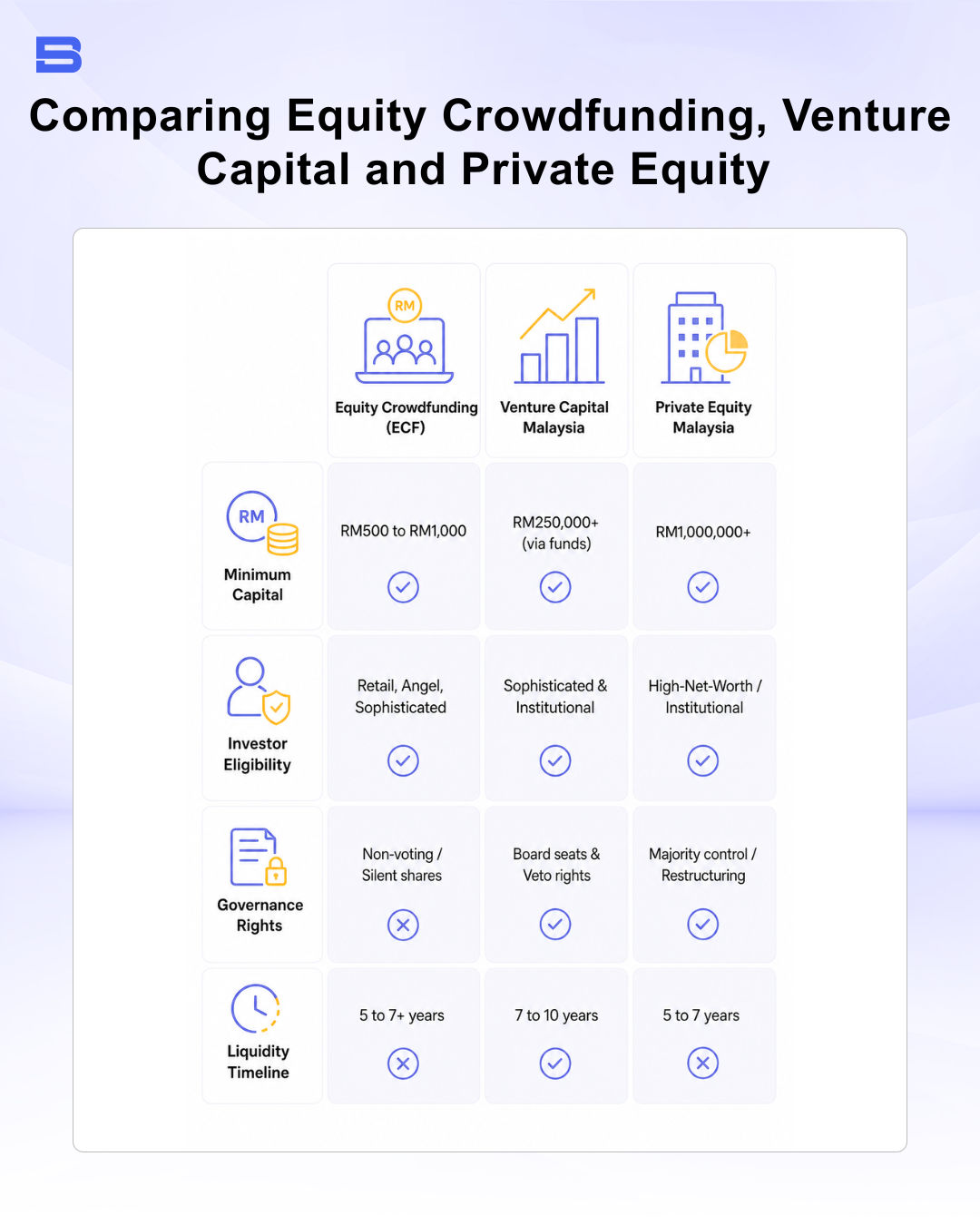 Understanding these structural variances helps retail market participants assess whether unlisted holdings align with their long-term risk profile before allocating funds. Exploring broader asset classes like private equity or institutional venture capital models highlights how capital requirements dictate deal structures.
Equity Crowdfunding vs P2P Lending Malaysia
Investors looking for alternative assets often weigh early equity ownership against debt-based lending models. The trade-off centers on predictable fixed income versus unlimited upside potential.
P2P platforms connect individual lenders to small businesses needing short-term working capital or debt financing. In contrast, ECF provides permanent risk capital in exchange for private company shares. While debt platforms pay periodic interest, equity platforms yield returns only when a company pays dividends or achieves a successful corporate exit.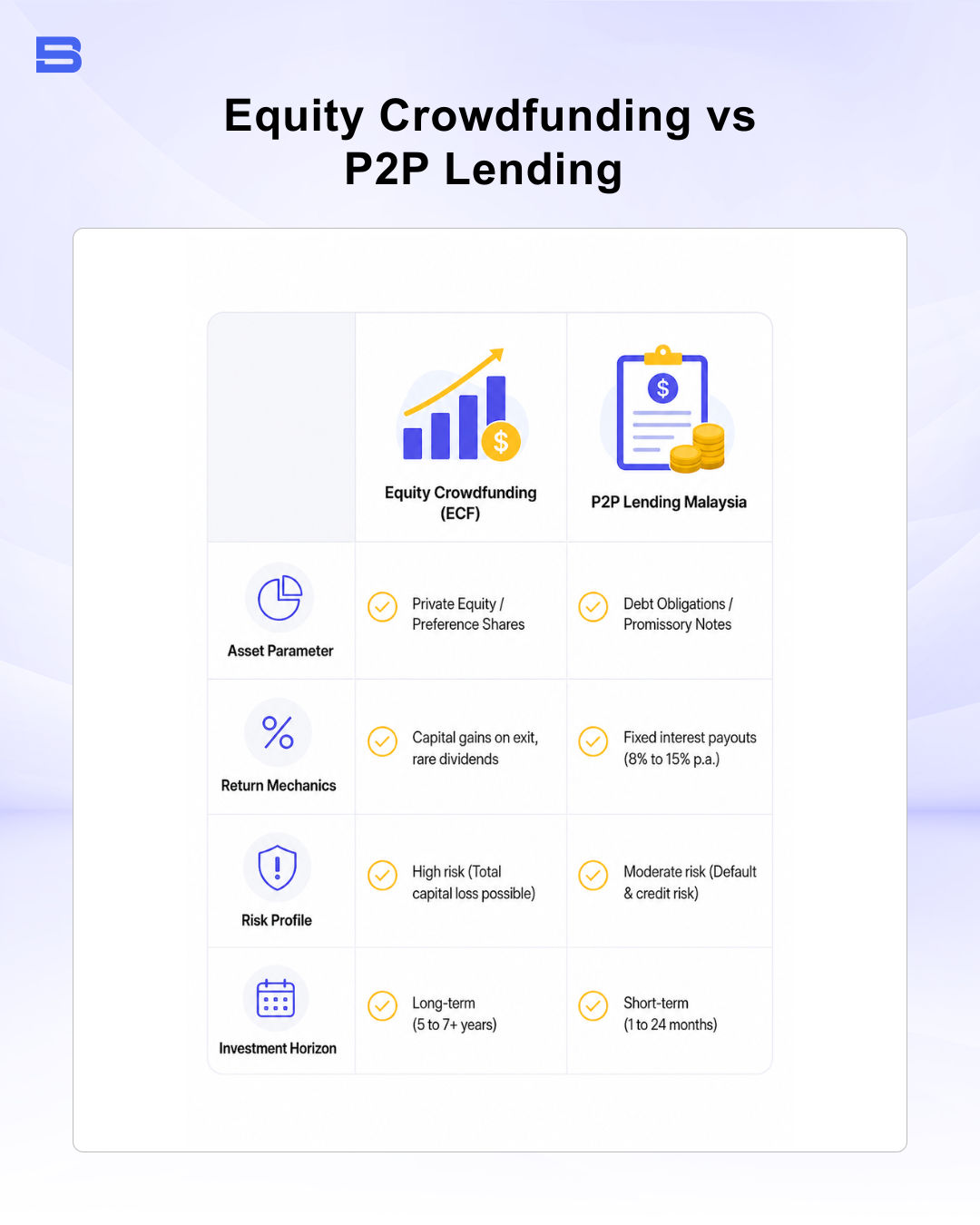
Investors seeking predictable cash flow might evaluate debt solutions like invoice financing, whereas those pursuing exponential growth often lean toward early equity positions. Navigating alternative debt markets like P2P lending models requires a clear understanding of loan default rates compared to total equity failure.
Is Equity Crowdfunding Risky? Core Pitfalls and Loss Mitigation
Is equity crowdfunding risky for beginners? Early-stage private equity is inherently speculative, carrying a high rate of commercial failure and complete illiquidity.
Many early startups fail to reach profitability, which can result in a total loss of invested capital. Private shares cannot be traded on public stock exchanges, meaning your money remains locked until a liquidation event occurs.
Subsequent funding rounds can also dilute your ownership percentage if the business issues new shares at lower valuations. To visualize portfolio outcomes, consider a realistic allocation scenario across 5 early-stage campaigns:
- Initial Allocation: RM10,000 total capital divided equally into 5 ECF deals at RM2,000 per company.
- Startup Failures: 4 startups fail completely within 4 years, resulting in a loss of RM8,000.
- Successful Exit: 1 startup achieves a 5x buyout exit after 6 years, returning RM10,000.
- Portfolio Result: RM10,000 total returned (net breakeven), illustrating how single-winner concentration offsets multi-company capital losses.
Private equity investments involve unlisted, illiquid securities where full capital loss is possible and secondary market transactions are strictly restricted. Diversifying allocations across multiple non-competing campaigns helps cushion portfolios against high individual startup failure rates.
Investor Returns and Exit Strategies for ECF
Realizing financial gains from private equity requires a clear exit pathway, as unlisted shares do not yield daily market price quotes.
How Returns Work: Dividends vs Liquidation Events
Early-stage growth companies rarely distribute earnings as dividends, preferring to reinvest operational cash flow back into scaling business operations. Consequently, the primary return driver is capital growth realized during corporate liquidation events. This occurs when an established firm acquires the startup, or when the business completes an initial public offering on an exchange.
Exit Pathways: Secondary Markets and LEAP Market 2.0
The regulatory landscape in Malaysia continues to evolve to expand liquidity options for private equity holders. The Securities Commission and Bursa Malaysia have proposed LEAP Market 2.0, a package of enhancements intended to improve exit pathways for ECF-funded companies.
Confirm the initiative's implementation status before relying on it, as it remained under public consultation and had not yet taken full effect as of mid-2026.
This allows successful ECF-funded companies to transition directly onto public market boards, providing retail investors with organized secondary liquidity.
Emerging secondary trade windows operated by licensed platform operators also facilitate private share transfers between eligible buyers and sellers. Exploring structural changes like LEAP Market 2.0 initiatives gives early backers clearer visibility on potential public market transitions.
Tax Exemption Incentives for ECF Investors in Malaysia
To encourage local participation in startup funding, eligible retail and angel investors can claim tax relief incentives. Under Malaysia's Income Tax (Exemption) Order administered by LHDN, qualifying individual ECF investors may claim an income tax exemption on 50% of their invested amount, subject to an annual cap—confirm the scheme's current eligibility period directly with LHDN before relying on it.
Participating in qualifying rounds grants access to ECF tax exemption malaysia schemes, helping offset initial risk exposure through reduced income tax liabilities.
Democratizing Private Equity
Equity crowdfunding democratizes early-stage private equity, allowing Malaysian retail investors to support scaling businesses while pursuing multi-fold capital returns. However, high startup failure rates and multi-year illiquidity necessitate cautious position sizing and strict adherence to annual investment caps. Balancing speculative crowdfunding allocations with traditional liquid instruments ensures your broader wealth plan remains resilient.
- What Can You Trade? A Guide to Forex, Stocks, and More
- CFD Trading for Beginners
- What is CFD Trading and How Does It Work?
- Forex vs. Stocks: Which Market Suits You Best?
- How to Diversify a Portfolio Across Asset Classes
- How Dividend Stocks Work: Yields, Risks, and Strategies
- Silver Trading Explained: A Guide for Retail Investors
- Precious Metals Trading: A Complete Guide for Beginners
- Natural Gas Trading: A Guide to the Market
- Structured Warrants Malaysia: How They Work and Risks
- What Is the KLCI Index and How to Trade It
- Gold Investment in Malaysia: A Complete Guide for Beginners
- What Is Kijang Emas and How to Invest in It
- Value Investing Explained: How to Find Undervalued Stocks
- How to Trade Bitcoin Safely: A Complete Market Guide
- Growth Investing Explained: Strategies, Metrics, and Risks
- What Is Digital Gold Malaysia and How to Invest
- Crypto Trading Strategies for Beginners
- Gold vs Bitcoin: Key Differences, Risks, and Strategies
- Sukuk: A Guide for Beginners to Islamic Bonds
- What Is FCPO (Crude Palm Oil Futures) and How to Trade It
- How to Identify and Invest in Shariah-Compliant Stocks
- Timber Investment: Is It Worth It?
- Gold ETF Malaysia: A Guide for Beginners
- What Are Malaysian Government Securities (MGS)?
- Corporate Bonds Malaysia: A Guide for Beginners
- China A-Shares Trading Guide for Malaysian Investors
- What Is a Silver ETF and How to Invest in It?
- How to Trade XRP: A Practical Guide for Retail Investors
- How to Trade Solana (SOL): A Guide for Beginners
- What Are Gold Futures and How Do They Work?
- Money Market Fund in Malaysia: A Guide for Beginners
- Property Investment Malaysia: Direct Real Estate or M-REITs?
- What Is Binance Coin and How Does It Work?
- Green Sukuk: A Guide for Beginners to Islamic ESG Investing
- What Is Shiba Inu (SHIB) and How to Trade It
- What Is USDT? A Complete Guide to Tether for Beginners
- What Is Dogecoin and How to Trade It Safely for Beginners
- Cardano: A Guide for Beginners to Trade This Cryptocurrency
- Polkadot: A Guide to Trading This Cryptocurrency
- Tron: A Guide for Beginners to Trading This Cryptocurrency
- What Is Litecoin (LTC)? A Guide to Trading Digital Silver
- What Is Chainlink (LINK) and How to Trade It
- How to Trade Pepe Coin: Spot, Leverage, and Risk Management
- Near Protocol: A Guide to Trading This Cryptocurrency
- Trading Polygon Crypto: A Practical Guide for Beginners
- Trade Toncoin: Understanding the TON Ecosystem and Risks
- Cosmos Crypto: Ecosystem Architecture, Tokenomics, and Risks
- Stellar Crypto: A Guide to Trading This Cryptocurrency
- Avalanche Crypto Explained: A Practical Guide for Traders
- What Is Worldcoin? How to Trade WLD and Manage Risk
- Aptos: A Guide for Beginners to Trading This Cryptocurrency
- Sui Crypto Explained: Tokenomics and Trading Guide
- Celestia: A Guide to Trading This Cryptocurrency
- Decentraland: A Guide to Trading This Cryptocurrency
- What Is Arbitrum? How to Trade the Leading Layer 2 Network
- Sei Crypto: A Guide to Trading This Cryptocurrency
- What Is Injective Protocol and How to Trade INJ Safely
Disclaimer: The content on this page is intended for educational and informational purposes only. It does not constitute financial, investment, tax, or legal advice, and should not be interpreted as a recommendation to buy, sell, or hold any financial instrument or asset. Trading and investing involve significant risk, including the possible loss of your entire capital. Products such as forex, CFDs, and cryptocurrencies carry additional risks due to leverage, high volatility, and limited regulatory protection in some jurisdictions. Past performance of any financial instrument does not guarantee future results. Any market views, forecasts, or opinions expressed are those of the author at the time of writing and may not reflect current market conditions. Platform features, fees, and regulatory status are subject to change — always verify information directly with the relevant provider or regulator before making any financial decision. BrokerSpecs may receive compensation from third parties featured on this site. Always conduct your own due diligence and consider seeking advice from a licensed financial professional before investing. Portions of this article were prepared with the assistance of AI tools and reviewed by our editorial team before publication.