



Related Tags
Entering the world of private investments often feels like stepping behind a closed door reserved for institutional titans and high-net-worth families. While public stock markets allow you to buy fractional shares of established corporations with the click of a button, private markets operate on a fundamentally different engine.
In Southeast Asia's rapidly expanding financial landscape, private equity has quietly driven some of the region's largest corporate transformations, infrastructure expansions, and digital turnarounds.
Understanding how private equity works in Malaysia gives you a clearer view of how capital moves outside traditional stock exchanges—and how qualified investors gain exposure to unlisted growth companies.
What Is Private Equity and How Does It Work in Malaysia?
Private equity (PE) refers to investment funds that acquire equity stakes in private companies—or buy out public companies to take them private—with the goal of restructuring operations, accelerating growth, and eventually selling the business for a profit.
Unlike public equity investors who trade shares daily on Bursa Malaysia, private equity firms take an active, multi-year operational role in the businesses they acquire.
In Malaysia, the private equity model typically follows three core investment strategies:
- Growth Equity: Injecting capital into mature private businesses seeking expansion, regional acquisition, or technological updates without taking total voting control.
- Buyouts (Leveraged Buyouts - LBOs): Acquiring a controlling stake in a cash-generative business, often using a mix of equity and debt, to overhaul management and streamline costs.
- Distressed / Turnaround Capital: Purchasing underperforming assets or financially troubled businesses at a discount to restore operational solvency.
The central mechanic of private equity is direct value creation. A fund manager (General Partner) raises capital from institutional investors (Limited Partners) to execute a targeted turnaround. Consider a practical scenario: a private equity firm acquires an established Malaysian mid-market logistics provider for RM10 million.
Over a 5-year investment period, the PE firm replaces legacy operational systems, expands distribution hubs into regional markets, and doubles operating margins. It then exits the investment through a trade sale to an international conglomerate for RM25 million.
Private Equity vs. Venture Capital in Malaysia
While both private equity and venture capital deploy money into unlisted entities, their target stages, funding sizes, and risk profiles differ significantly.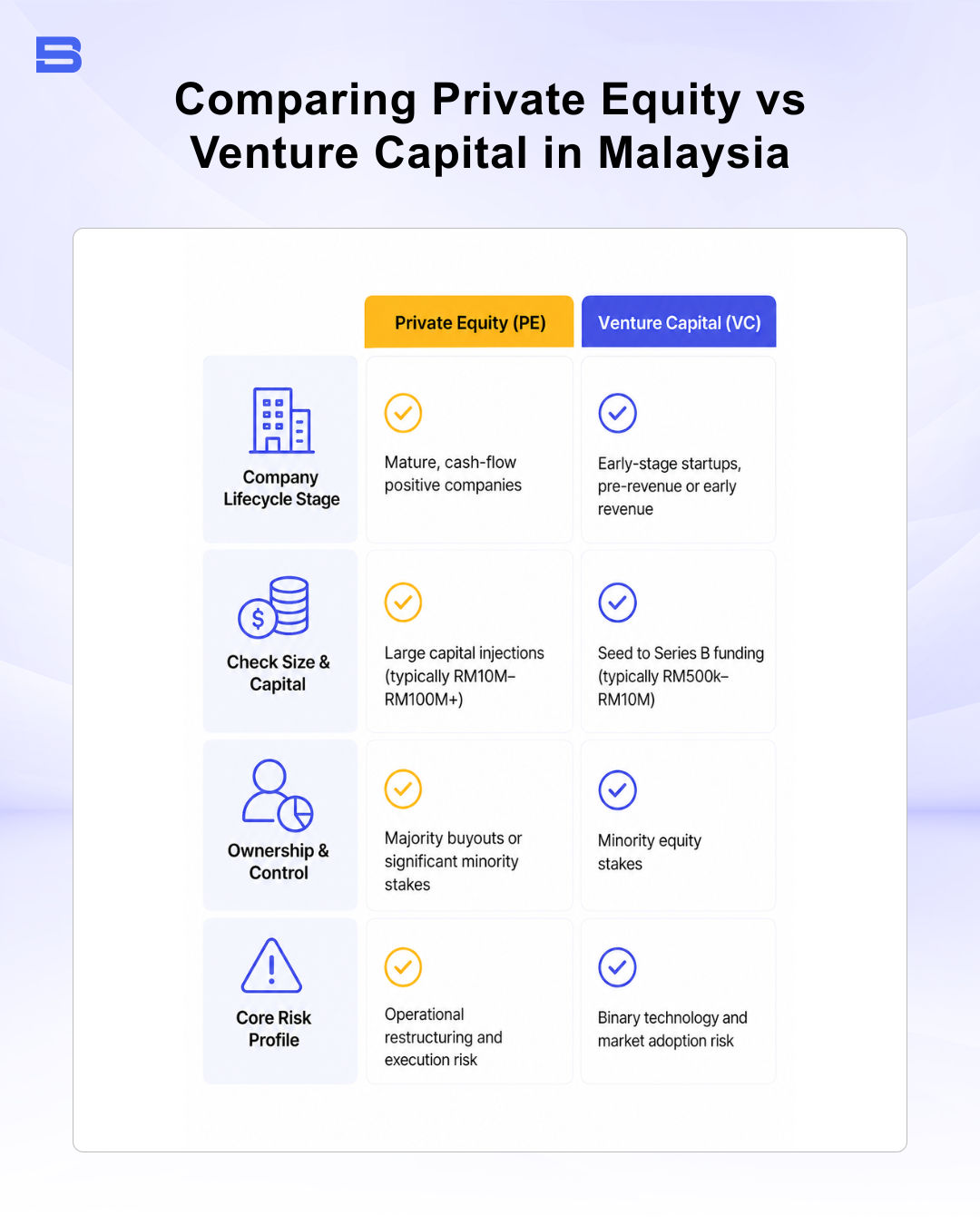
Regulatory Framework: Securities Commission Malaysia Oversight
Private equity operations in Malaysia are governed under a robust legal structure established by the Securities Commission Malaysia (SC). Capital market activities surrounding private funds fall under the purview of the Capital Markets and Services Act 2007 (CMSA).
Entity registration standards are explicitly laid out under the SC’s Guidelines on the Registration of Venture Capital and Private Equity Corporations and Management Corporations. Under this framework, entities operating in the private market space generally register under specific legal classifications:
- Private Equity Management Corporation (PEMC): The management entity responsible for investment decisions, fund administration, and portfolio operations.
- Private Equity Corporation (PEC): The dedicated fund vehicle established to pool investor capital for deployment into target companies.
Cross-border private transactions involving foreign currency transfers or overseas equity acquisitions are subject to regulatory oversight managed alongside policy framework defined by Bank Negara Malaysia (BNM). These oversight mechanisms ensure proper anti-money laundering (AML) controls, leverage limits, and systematic capital reporting across private capital structures.
Minimum Capital Requirements and Sophisticated Investor Standards
Private equity funds are designated as unlisted wholesale funds. Because private companies lack the continuous public reporting requirements mandated on stock exchanges, regulatory authorities restrict direct fund participation exclusively to qualified individuals and entities.
Under the SC's Guidelines on Unlisted Capital Market Products under the Lodge and Launch Framework, direct participation in a private equity fund requires qualification as a Sophisticated Investor. An individual meets this classification if they fulfill at least one of the following capital thresholds:
- Net Personal Assets: Holding personal net assets (or joint assets with a spouse) exceeding RM3 million (or its equivalent in foreign currencies).
- Gross Annual Income: Demonstrating an annual gross income exceeding RM300,000 (or RM400,000 jointly with a spouse) in the preceding 12 months.
- Transaction Threshold: Executing a primary fund subscription check size of at least RM250,000 (or foreign currency equivalent) per investment.
How Can Retail Investors Access Private Equity in Malaysia?
Because direct institutional private equity deals mandate multi-hundred-thousand-ringgit entry limits, retail investors cannot subscribe directly to institutional PE partnerships. However, evolving capital market mechanisms have introduced alternative pathways for individual investors to gain exposure to private business growth.
Alternative Private Assets: P2P Lending and Equity Crowdfunding
For investors who do not meet the RM3 million net asset threshold, regulated alternative finance avenues provide fractional entry into private markets starting from accessible budgets:
- Equity Crowdfunding (ECF): SC-licensed ECF platforms allow retail investors to purchase direct equity stakes in early-stage and growth-focused Malaysian private businesses starting from as little as RM500.
- Peer-to-Peer (P2P) Lending & Invoice Financing: Rather than equity, registered P2P platforms allow individuals to fund debt obligations and short-term capital needs for Malaysian SMEs.
- PE-Focused Unit Trust & Co-Investment Funds: Certain wholesale unit trusts licensed in Malaysia co-invest alongside established private equity managers, giving qualified retail clients indirect access.
Risks, Capital Lock-ups, and the J-Curve Effect
Private market investing carries elevated structural risks compared to publicly traded stocks. Understanding these factors is critical before committing capital to long-term funds.
- Extended Liquidity Lock-ups (5 to 10 Years): Private equity investments are highly illiquid. Capital is committed for multi-year terms while fund managers execute company operational turnarounds. You cannot sell your holding on a public order book if you require quick cash liquidity.
- Capital Call Structures: Investors sign a binding legal commitment. Capital is not transferred all at once; instead, the fund manager issues "capital calls" periodically as target acquisitions are identified.
- Fee Structure (2/20 Model): PE management usually incurs a 2% annual management fee on committed capital alongside a 20% performance fee ("carried interest") above an agreed benchmark hurdle rate (typically 8%).
- Operational & Execution Failures: Restructuring an unlisted firm does not guarantee operational success. Poor management execution or unexpected industry shifts can result in severe capital impairments.
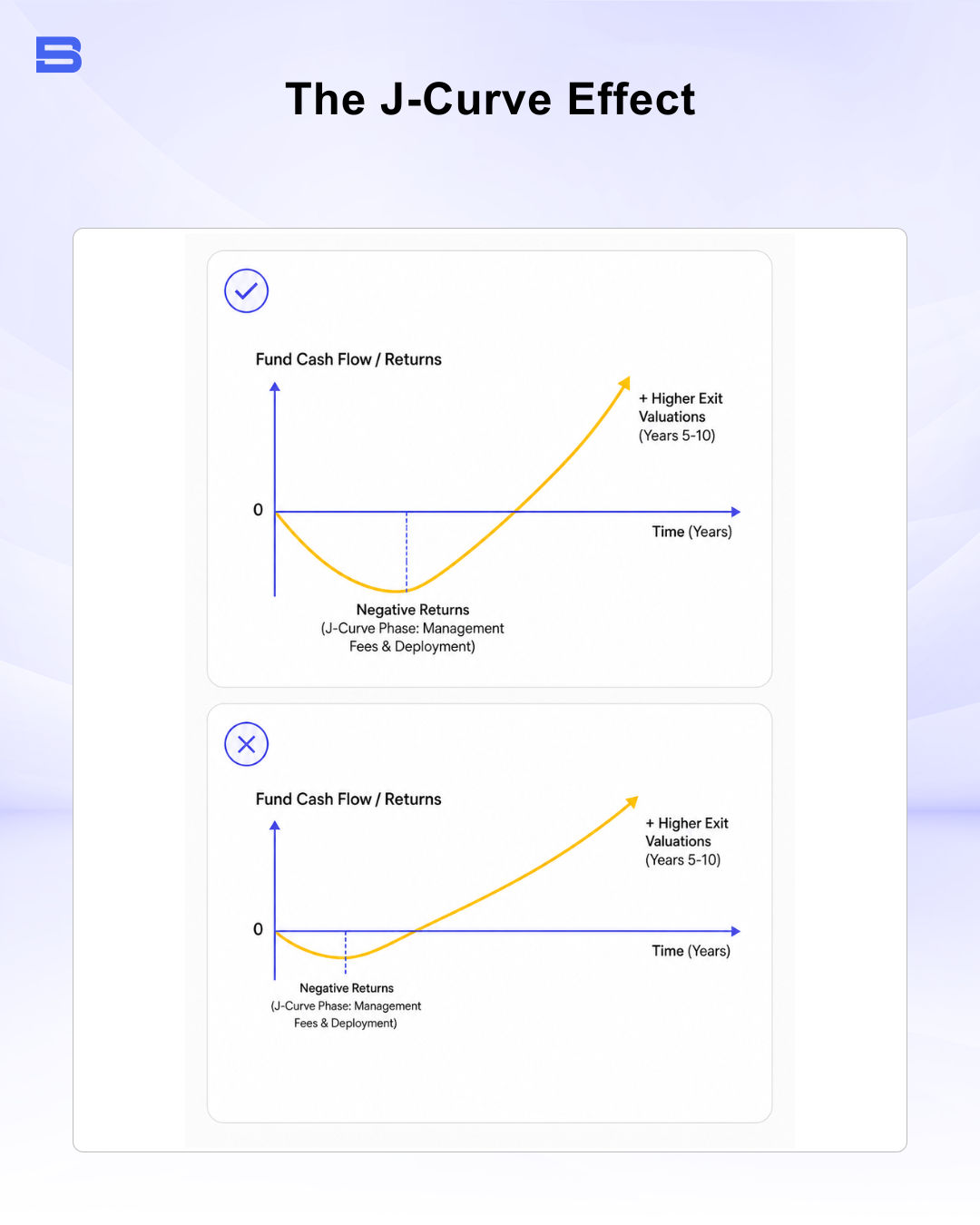
The diagram above illustrates the traditional J-Curve Effect in private equity funds. In the initial 1 to 3 years, fund cash flows are negative due to upfront management fees, acquisition costs, and capital deployment into underperforming businesses. Positive investment returns materialize only in later years as operational efficiencies take effect and businesses are sold through trade sales or public stock exchange listings.
Major Institutional and Regional Private Equity Players
The private market ecosystem in Malaysia is backed by major sovereign wealth institutions and specialized regional fund managers:
- Government-Linked & Sovereign Institutional Capital: Sovereign bodies such as Khazanah Nasional, the Employees Provident Fund (EPF), and Ekuiti Nasional Berhad (Ekuinas) play a central role in funding national strategic initiatives, mid-market buyouts, and Bumiputera corporate development.
- Regional Private Equity Managers: Established growth capital firms—such as Creador—manage multi-million-dollar regional funds targeting consumer, healthcare, financial technology, and business services sectors across Malaysia and Southeast Asia.
- International Buyout Firms: Global private equity entities periodically execute large-scale joint ventures and infrastructure acquisitions alongside domestic partners.
The Utility of Private Equity
Private equity serves as a vital growth engine within Malaysia’s financial system, providing mature unlisted businesses with the capital and operational leadership required to scale.
While structural illiquidity and high sophisticated investor capital hurdles restrict direct fund participation to high-net-worth entities, alternative platforms like equity crowdfunding continue to broaden access for retail market participants.
Balancing long-term capital lock-ups against potential operational growth remains the fundamental step in evaluating private market opportunities.
- What Can You Trade? A Guide to Forex, Stocks, and More
- CFD Trading for Beginners
- What is CFD Trading and How Does It Work?
- Forex vs. Stocks: Which Market Suits You Best?
- How to Diversify a Portfolio Across Asset Classes
- How Dividend Stocks Work: Yields, Risks, and Strategies
- Silver Trading Explained: A Guide for Retail Investors
- Precious Metals Trading: A Complete Guide for Beginners
- Natural Gas Trading: A Guide to the Market
- Structured Warrants Malaysia: How They Work and Risks
- What Is the KLCI Index and How to Trade It
- Gold Investment in Malaysia: A Complete Guide for Beginners
- What Is Kijang Emas and How to Invest in It
- Value Investing Explained: How to Find Undervalued Stocks
- How to Trade Bitcoin Safely: A Complete Market Guide
- Growth Investing Explained: Strategies, Metrics, and Risks
- What Is Digital Gold Malaysia and How to Invest
- Crypto Trading Strategies for Beginners
- Gold vs Bitcoin: Key Differences, Risks, and Strategies
- Sukuk: A Guide for Beginners to Islamic Bonds
- What Is FCPO (Crude Palm Oil Futures) and How to Trade It
- How to Identify and Invest in Shariah-Compliant Stocks
- Timber Investment: Is It Worth It?
- Gold ETF Malaysia: A Guide for Beginners
- What Are Malaysian Government Securities (MGS)?
- Corporate Bonds Malaysia: A Guide for Beginners
- China A-Shares Trading Guide for Malaysian Investors
- What Is a Silver ETF and How to Invest in It?
- How to Trade XRP: A Practical Guide for Retail Investors
- How to Trade Solana (SOL): A Guide for Beginners
- What Are Gold Futures and How Do They Work?
- Money Market Fund in Malaysia: A Guide for Beginners
- Property Investment Malaysia: Direct Real Estate or M-REITs?
- What Is Binance Coin and How Does It Work?
- Green Sukuk: A Guide for Beginners to Islamic ESG Investing
- What Is Shiba Inu (SHIB) and How to Trade It
- What Is USDT? A Complete Guide to Tether for Beginners
- What Is Dogecoin and How to Trade It Safely for Beginners
- Cardano: A Guide for Beginners to Trade This Cryptocurrency
- Polkadot: A Guide to Trading This Cryptocurrency
- Tron: A Guide for Beginners to Trading This Cryptocurrency
- What Is Litecoin (LTC)? A Guide to Trading Digital Silver
- What Is Chainlink (LINK) and How to Trade It
- How to Trade Pepe Coin: Spot, Leverage, and Risk Management
- Near Protocol: A Guide to Trading This Cryptocurrency
- Trading Polygon Crypto: A Practical Guide for Beginners
- Trade Toncoin: Understanding the TON Ecosystem and Risks
- Cosmos Crypto: Ecosystem Architecture, Tokenomics, and Risks
- Stellar Crypto: A Guide to Trading This Cryptocurrency
- Avalanche Crypto Explained: A Practical Guide for Traders
- What Is Worldcoin? How to Trade WLD and Manage Risk
- Aptos: A Guide for Beginners to Trading This Cryptocurrency
- Sui Crypto Explained: Tokenomics and Trading Guide
- Celestia: A Guide to Trading This Cryptocurrency
- Decentraland: A Guide to Trading This Cryptocurrency
- What Is Arbitrum? How to Trade the Leading Layer 2 Network
- Sei Crypto: A Guide to Trading This Cryptocurrency
- What Is Injective Protocol and How to Trade INJ Safely
Disclaimer: The content on this page is intended for educational and informational purposes only. It does not constitute financial, investment, tax, or legal advice, and should not be interpreted as a recommendation to buy, sell, or hold any financial instrument or asset. Trading and investing involve significant risk, including the possible loss of your entire capital. Products such as forex, CFDs, and cryptocurrencies carry additional risks due to leverage, high volatility, and limited regulatory protection in some jurisdictions. Past performance of any financial instrument does not guarantee future results. Any market views, forecasts, or opinions expressed are those of the author at the time of writing and may not reflect current market conditions. Platform features, fees, and regulatory status are subject to change — always verify information directly with the relevant provider or regulator before making any financial decision. BrokerSpecs may receive compensation from third parties featured on this site. Always conduct your own due diligence and consider seeking advice from a licensed financial professional before investing. Portions of this article were prepared with the assistance of AI tools and reviewed by our editorial team before publication.