


Related Tags
When you trade stocks or other assets through a brokerage, you typically start with a standard cash account where every purchase is funded entirely with your own capital. However, as you gain market experience, you may encounter opportunities that require more buying power than your available balance permits. This is where a margin account comes into play.
A margin account allows you to borrow capital directly from your broker to trade larger position sizes or execute short sales. While leverage magnifies your prospective gains when the market moves in your favor, it equally accelerates your capital losses if prices move against you. Understanding how margin borrowing works, the interest fees involved, and broker liquidation rules is essential before opening one.
What Is a Margin Account and How Does Margin Trading Work?
A margin account is a regulated brokerage account that allows investors to borrow cash from the broker to purchase securities or financial instruments, using their existing cash and assets as collateral.
Unlike trading solely with your settled cash balance, trading on margin leverages your portfolio's purchasing power. The cash or eligible securities in your account act as collateral for the loan. For example, under standard United States Regulation T (Reg T) guidelines established by the US Securities and Exchange Commission (SEC) and FINRA, investors can borrow up to 50% of the purchase price of eligible securities.
When you execute a trade using margin, your broker covers a portion of the transaction cost while charging interest on the borrowed amount for as long as the position remains open. If the asset's price appreciates, your profit percentage on your invested equity increases.
Conversely, if the asset declines in value, your losses accumulate on the full value of the position, rapidly eroding your account equity.
Initial Margin vs. Maintenance Margin Requirements
Brokerage firms and financial regulators enforce two key threshold levels to manage credit risk:
- Initial Margin: The minimum percentage of equity required in your account to open a new position. Under standard Reg T rules, this is typically set at 50% for equity purchases.
- Maintenance Margin: The minimum percentage of total account equity required to keep a position open after purchase. Regulatory standards set the baseline maintenance margin at 25%, though individual brokers often set higher internal thresholds (e.g., 30% to 40%) depending on asset volatility.
Step-by-Step Worked Example:
- Account Setup: You deposit $5,000 cash into a margin account.
- Position Purchase: With 50% initial margin, you buy $10,000 worth of stock XYZ (5,000 your cash + $5,000 borrowed from the broker).
- Upside Scenario (+20% Price Move): Stock XYZ rises to $12,000. You sell the shares, repay the $5,000 loan (plus accrued interest), leaving $7,000 equity. Your net gain is $2,000—a 40% return on your $5,000 cash, compared to 20% in a cash account.
- Downside Scenario (-20% Price Move): Stock XYZ drops to $8,000. Your account value is now $8,000. After subtracting the $5,000 broker loan, your remaining equity is $3,000. Your loss is $2,000—a 40% loss on your invested capital.
Cash Account vs. Margin Account: Key Differences
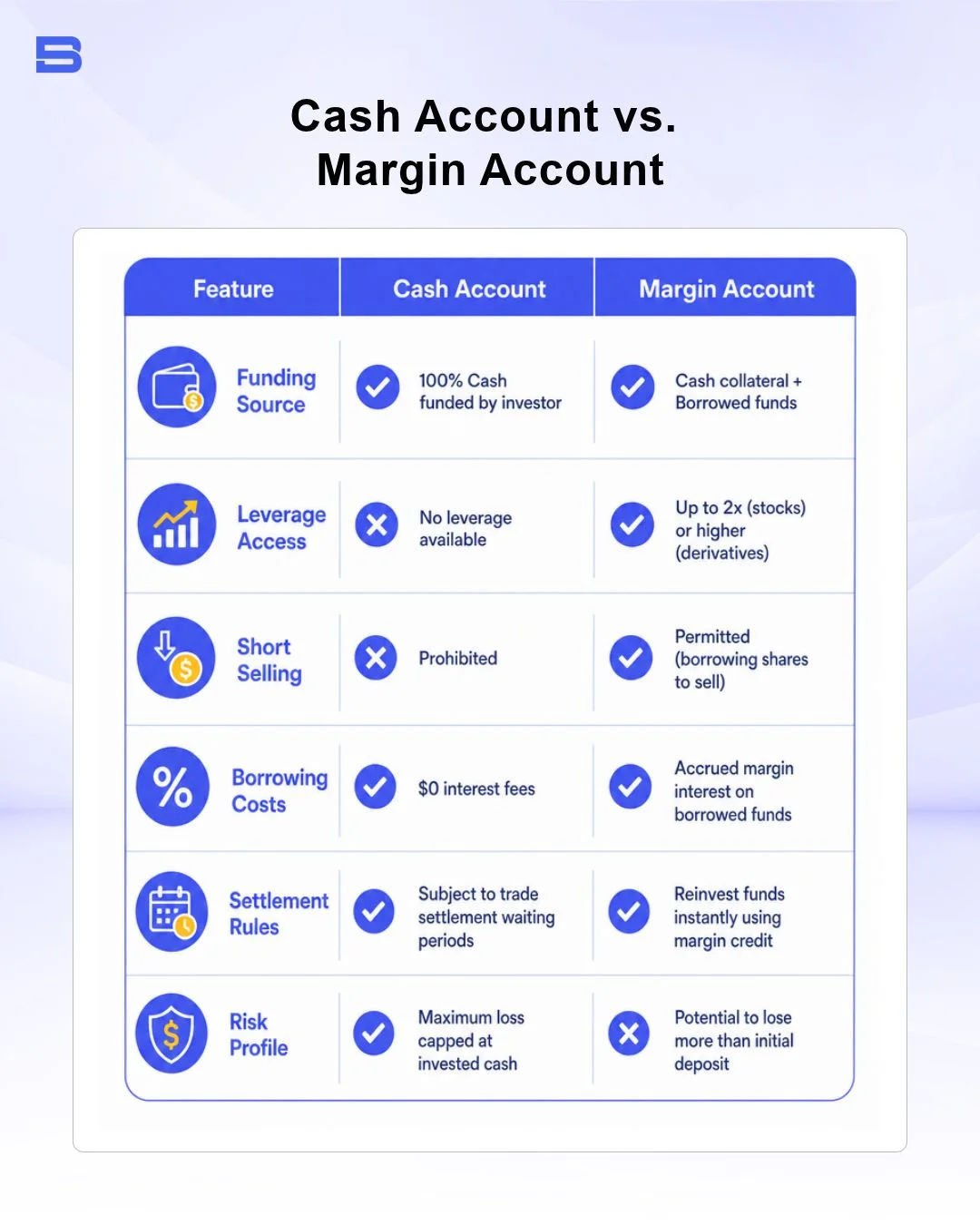
Choosing between a cash account and a margin account depends on your risk tolerance, trading frequency, and financial objectives.
In a cash account, you must pay for all securities purchases in full using settled funds. You cannot borrow money from the broker, short sell stocks, or trade on leverage. Furthermore, trades must abide by standard settlement cycles (such as T+1), meaning funds from sold assets must settle before they can be reinvested.
In contrast, a margin account provides instant access to buying power without waiting for transaction settlement. It also grants access to advanced trading strategies, including short selling and options trading, while incurring borrowing costs.
The Hidden Costs: Margin Interest Rates and Borrowing Fees
Borrowing money from a brokerage is not free. When holding leveraged positions overnight, you incur margin interest (also referred to as overnight financing or swap fees).
Brokerages calculate margin interest daily based on your outstanding loan balance and charge the accumulated fee monthly. Interest rates vary by broker and are typically structured in tiers—traders with larger borrowed balances often receive lower annual interest rates.
Daily Margin Interest Fee = Borrowed Balance x Annual Margin Rate / 360 (or 365 days)
For instance, if you borrow $10,000 at an annual margin interest rate of 8%, your daily interest charge is approximately 2.22 (800 / 360 days). Over several months, these borrowing costs accumulate and offset trading profits.
Consequently, margin borrowing is primarily designed for short-term tactical trades rather than multi-year buy-and-hold investing.
Understanding Margin Calls and Forced Liquidation
The primary risk of margin trading is a margin call. A margin call occurs when your account equity falls below the broker’s mandatory maintenance margin requirement due to adverse price movements.
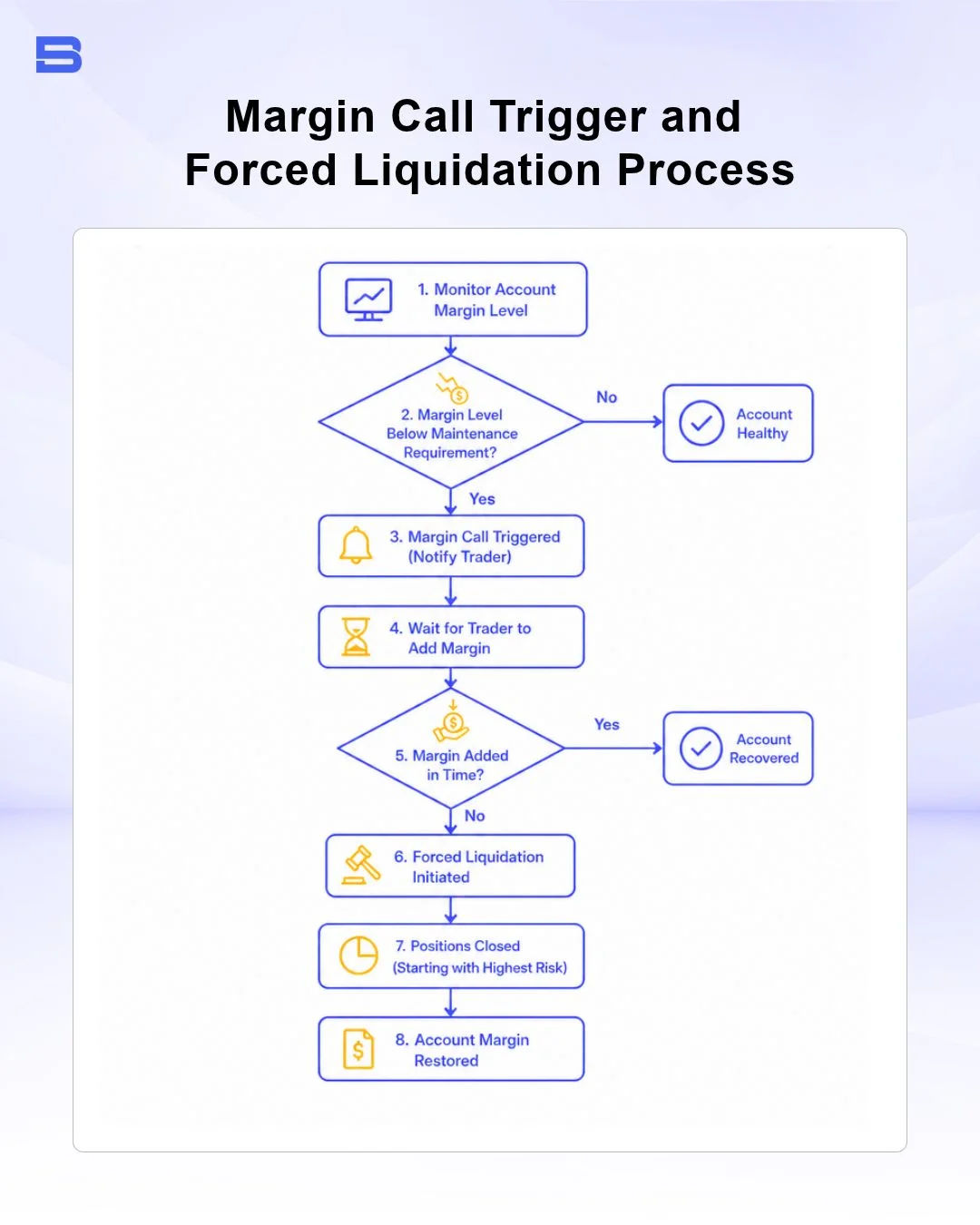
When a margin call is triggered, your broker requires you to take immediate action:
- Deposit additional cash into the account.
- Transfer eligible marginable securities into the account.
- Voluntarily liquidate open positions to reduce margin debt.
Forced Liquidation Mechanics
If market volatility causes your equity to drop rapidly, or if you fail to fulfill a margin call within the specified timeframe, the broker has the legal right to execute forced liquidation. Under standard brokerage agreements, the firm can sell your assets without prior notice or consent to cover the outstanding loan.
You are responsible for any remaining deficit if the liquidated assets do not cover the loan balance.
Risk Management Best Practices
To mitigate margin call exposure:
- Maintain Equity Buffers: Keep account equity comfortably above the minimum maintenance requirement (e.g., maintaining 50% equity rather than the 25% minimum).
- Use Stop-Loss Orders: Set automated exit levels to limit downside losses before account equity triggers a liquidation threshold.
- Monitor Borrowing Costs: Factor margin interest rates into your risk-reward calculations before entering long-term trades.
Related Broker Account Types: Margin vs. PAMM Accounts
When exploring broader forex account types, margin trading is the underlying mechanism powering most self-directed trading setups. However, it differs significantly from delegated account structures like a PAMM (Percentage Allocation Management Module) account.
In a self-directed margin account, you manage your own positions, order execution, and collateral risk. In a PAMM account, your capital is pooled with other investors under a professional money manager who executes leveraged trades on your behalf.
Understanding whether you prefer self-directed execution or managed capital helps determine which brokerage account structure aligns with your skills. Additionally, retail investors working with an introducing broker should verify the underlying account execution terms and leverage caps before funding an account.
Conclusion
A margin account is a powerful financial tool that provides increased buying power, short-selling access, and settlement flexibility. However, borrowing funds from a broker introduces significant exposure to leverage risk, overnight interest charges, and forced liquidation during market downturns.
By understanding initial and maintenance margin requirements and implementing strict stop-loss rules, traders can utilize margin responsibly while protecting their investment capital.
- Proprietary Trading Explained: What It Is and Its Key Benefits
- TradingView: Features, Broker Integration, and Strategies
- cTrader: How It Works and How It Compares
- What Is a VPS for Trading and Do You Need One?
- Thinkorswim Trading: Features, Tools, and Availability
- Trading Platform Malaysia: What to Look For
- Bursa Anywhere: A Guide to Managing Shares in Malaysia
- What Is Forex Factory and How Do Traders Use It?
- Delta App: Multi-Asset Portfolio Tracker for Crypto & Stocks
- What Is Trading Central and How to Use It?
- What Is Simply Wall St and How to Use It
- What Is Seeking Alpha and How to Use It
- What Is MarketWatch and How to Use It
- What Is Barchart and How to Use It
- Google Finance Explained: How to Track Stocks and Markets
- What Is Finviz and How to Use It for Stock Screening
- What Is Yahoo Finance and How to Use It
- What Is TradingEconomics and How to Use It
- StockCharts Review 2026: Features, Pricing, and Performance
- What Is ZuluTrade and How Does Copy Trading Work on It?
- What Is Investing.com and How to Use It?
- What Is Myfxbook and How Do Traders Use It?
- What Is CoinGecko? A Complete Guide to Crypto Data Tracking
- What Is CoinMarketCap and How to Use It
- What Is CoinStats and How to Use It for Portfolio Tracking
- What Is Sharesight and How to Use It for Portfolio Tracking
- What Is Personal Capital and How to Use It
- What Is a Low Spread Broker? How It Affects Your Trading
- What Is an Introducing Broker (IB) in Forex?
- What Is Social Trading? How Copy Trading Platforms Work
- What Is a PAMM Account? How Managed Forex Accounts Work
- What Is a Margin Account and How Does Margin Trading Work?
- What Are Trading Signals and How Do They Work?
- What Is an Expert Advisor (EA) in Forex Trading?
Disclaimer: The content on this page is intended for educational and informational purposes only. It does not constitute financial, investment, tax, or legal advice, and should not be interpreted as a recommendation to buy, sell, or hold any financial instrument or asset. Trading and investing involve significant risk, including the possible loss of your entire capital. Products such as forex, CFDs, and cryptocurrencies carry additional risks due to leverage, high volatility, and limited regulatory protection in some jurisdictions. Past performance of any financial instrument does not guarantee future results. Any market views, forecasts, or opinions expressed are those of the author at the time of writing and may not reflect current market conditions. Platform features, fees, and regulatory status are subject to change — always verify information directly with the relevant provider or regulator before making any financial decision. BrokerSpecs may receive compensation from third parties featured on this site. Always conduct your own due diligence and consider seeking advice from a licensed financial professional before investing. Portions of this article were prepared with the assistance of AI tools and reviewed by our editorial team before publication.