


Related Tags
Imagine sitting in front of your trading workstation as the market opens, inundated by a relentless stream of price tickers, breaking news alerts, and conflicting analyst reports. You want to identify high-probability trading opportunities in stocks, options, or commodities, but separate charting applications, options scanners, and news aggregators make the research process disjointed and overwhelming.
Filtering market noise into actionable data requires a centralized research portal. Barchart serves as a financial data platform designed to assist retail traders and investors in screening assets, evaluating technical indicators, and tracking market trends.
What Is Barchart? Overview and Core Purpose
Barchart is a platform providing real-time and delayed market data, technical analysis tools, and customizable screeners across multiple asset classes. Founded as a commodity data provider, the platform has evolved into a comprehensive market analysis hub covering equities, exchange-traded funds (ETFs), stock options, futures, and foreign exchange (forex).
The platform caters primarily to intermediate and data-driven retail traders who require structured market filters and institutional-grade analytics without complex software installations. Rather than functioning as an execution venue or direct brokerage, it acts as an information ecosystem. It aggregates raw price feeds, processes statistical indicators, and organizes market activity into accessible visual tools.
Understanding Barchart's structural features helps determine how it fits into your trading workflow.
Core Features of Barchart: Market Data, Screening, and Analytics
Navigating market data efficiently requires understanding how a research tool categorizes assets and builds filters. The structures of the platform around multi-asset coverage, automated screeners, and customizable data views.
Multi-Asset Market Data and Screening Coverage
Barchart delivers broad asset coverage, making it a centralized research desk for traders operating across different financial markets:
- US Equities & ETFs: Direct access to price action across major US exchanges, including sector breakdowns, market cap distributions, and liquidity lists. Regulatory oversight for underlying US market data is maintained by the US Securities and Exchange Commission (SEC).
- Futures & Commodities: Comprehensive data feeds for agricultural products, energy markets, metal futures, and financial derivatives, overseen domestically by the Commodity Futures Trading Commission (CFTC).
- Options Markets: Specialized tools tracking implied volatility, historical volatility, volume spikes, and open interest changes.
- Currencies & Indices: Global forex pair pricing alongside benchmark equity index performance tracking.
The primary draw for technical investors is Barchart's stock screening engine. Traders can apply dynamic parameters—such as price-to-earnings (P/E) ratios, average true range (ATR), moving average crossovers, or unusual options activity—to filter thousands of listed instruments into targeted watchlists.
Technical Analysis, Barchart Opinions, and Sentiment Tools
Beyond basic screening, Barchart processes quantitative data into visual technical summaries.
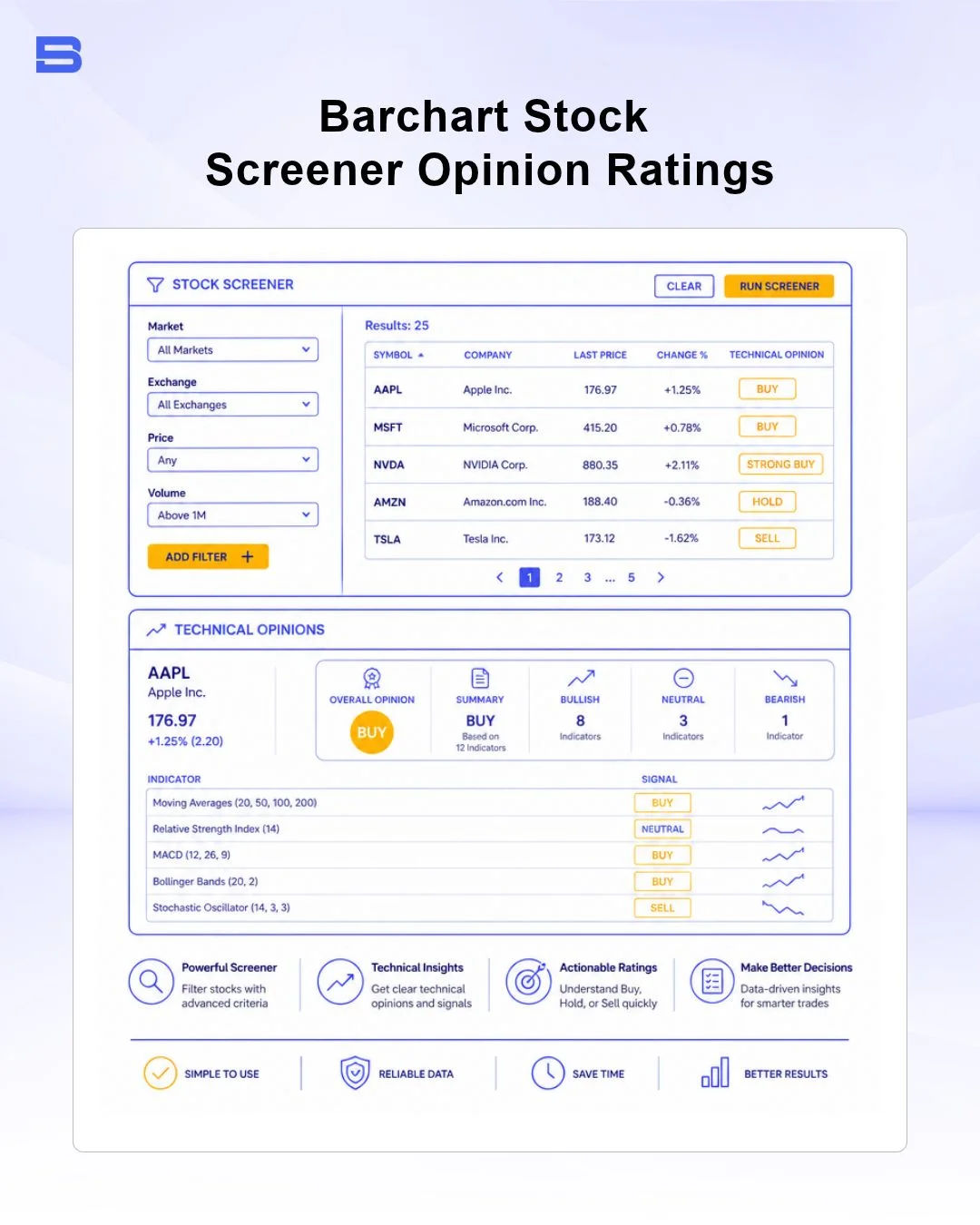
A prominent feature on the platform is the Barchart Opinion score. This automated tool evaluates a combination of 13 popular technical indicators—including short-term moving averages, the Relative Strength Index (RSI), and MACD crossovers—to generate a consolidated sentiment rating ranging from 100% Sell to 100% Buy.
Technical ratings like Barchart Opinions or institutional tools like Trading Central aggregate historical price trends into statistical signals, but they do not predict future performance. A stock carrying an "80% Buy" opinion reflects past momentum; sudden news events or broader market shifts can still lead to immediate downside price moves and capital loss.
To further gauge institutional money flows, traders rely on Barchart's Unusual Options Activity scanner. This tool flags options contracts experiencing order volumes significantly higher than their average open interest, pointing toward potential directional sentiment among institutional market participants.
Barchart vs. TradingView: Which Platform Suits You?
Choosing between research environments depends on whether your strategy prioritizes data screening or advanced charting. While the platform excels at raw data filtering and quantitative lists, platforms like TradingView emphasize charting features and interactive script development.
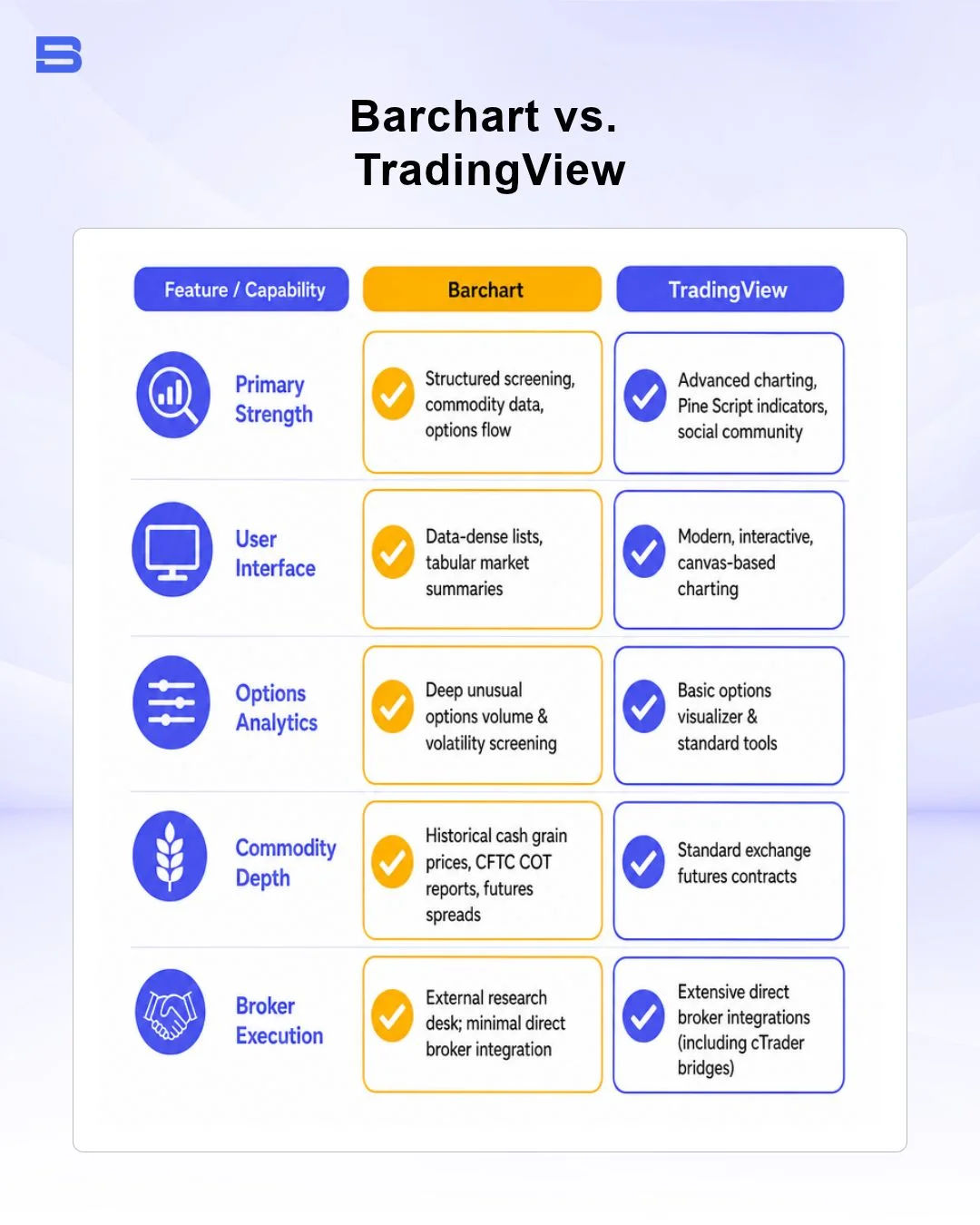
If your trading strategy requires scanning thousands of equities for specific technical setups or tracking unusual options volume, it provides an effective workspace. Conversely, if your primary workflow involves drawing technical patterns or coding custom strategy backtests, TradingView offers superior chart flexibility.
Comparing Barchart to Other Screening Tools (Finviz & StockCharts)
When building a market research desk, retail traders frequently compare Barchart against specialized screening alternatives such as Finviz and StockCharts, or desktop software platforms like Thinkorswim.
- Barchart vs. Finviz: Finviz is widely recognized for its visual stock heatmaps and quick performance screens (per Finviz's official feature set). However, Barchart offers broader multi-asset depth—specifically regarding futures, options flow, and commodity cash prices—whereas Finviz focuses primarily on US equities and ETFs.
- Barchart vs. StockCharts: StockCharts is tailored toward technical analysts who prefer classic chart overlay techniques (such as Point & Figure charts or SharpCharts). Barchart offers a more data-centric experience focused on tabular screening, custom filters, and market sentiment metrics.
Evaluating these tools side-by-side helps clarify their specific strengths:
- Use Finviz for rapid visual screening of daily equity movers and visual market heatmaps.
- Use StockCharts for detailed, traditional technical chart overlay analysis.
- Use Barchart for comprehensive multi-asset research combining equity screening, commodity data, and options volume metrics.
Pros and Cons of Using Barchart
Assessing the structural benefits and operational drawbacks of the platform helps determine if it fits your analytical needs.
Pros
- Extensive Asset Coverage: Single access point for equities, options, futures, commodities, and forex data.
- Advanced Options Flow Tracking: Identifies unusual options activity, implied volatility skew, and volume spikes.
- Customizable Screeners: Enables multi-variable filtering across fundamental, technical, and volume metrics.
- Free Access Tier: Provides access to basic charts, market lists, and delayed data feeds without requiring an immediate paid subscription.
Cons
- Data Delays on Free Accounts: Basic free accounts rely on delayed market data feeds (typically 15 minutes for equities and futures).
- Dense User Interface: The sheer volume of tables, text links, and lists can present a steep learning curve for absolute beginners.
- Charting Limitations: Interactive charting capabilities are less fluid compared to specialized charting platforms like TradingView.
The Bottom Line
The platform stands out as a versatile data and screening hub for traders seeking structured quantitative lists across stocks, commodities, and options. By aggregating complex market feeds into automated tools like Barchart Opinions and Unusual Options scanners, the platform simplifies daily research.
- Proprietary Trading Explained: What It Is and Its Key Benefits
- TradingView: Features, Broker Integration, and Strategies
- cTrader: How It Works and How It Compares
- What Is a VPS for Trading and Do You Need One?
- Thinkorswim Trading: Features, Tools, and Availability
- Trading Platform Malaysia: What to Look For
- Bursa Anywhere: A Guide to Managing Shares in Malaysia
- What Is Forex Factory and How Do Traders Use It?
- Delta App: Multi-Asset Portfolio Tracker for Crypto & Stocks
- What Is Trading Central and How to Use It?
- What Is Simply Wall St and How to Use It
- What Is Seeking Alpha and How to Use It
- What Is MarketWatch and How to Use It
- What Is Barchart and How to Use It
- Google Finance Explained: How to Track Stocks and Markets
- What Is Finviz and How to Use It for Stock Screening
- What Is Yahoo Finance and How to Use It
- What Is TradingEconomics and How to Use It
- StockCharts Review 2026: Features, Pricing, and Performance
- What Is ZuluTrade and How Does Copy Trading Work on It?
- What Is Investing.com and How to Use It?
- What Is Myfxbook and How Do Traders Use It?
- What Is CoinGecko? A Complete Guide to Crypto Data Tracking
- What Is CoinMarketCap and How to Use It
- What Is CoinStats and How to Use It for Portfolio Tracking
- What Is Sharesight and How to Use It for Portfolio Tracking
- What Is Personal Capital and How to Use It
- What Is a Low Spread Broker? How It Affects Your Trading
- What Is an Introducing Broker (IB) in Forex?
- What Is Social Trading? How Copy Trading Platforms Work
- What Is a PAMM Account? How Managed Forex Accounts Work
- What Is a Margin Account and How Does Margin Trading Work?
- What Are Trading Signals and How Do They Work?
- What Is an Expert Advisor (EA) in Forex Trading?
Disclaimer: The content on this page is intended for educational and informational purposes only. It does not constitute financial, investment, tax, or legal advice, and should not be interpreted as a recommendation to buy, sell, or hold any financial instrument or asset. Trading and investing involve significant risk, including the possible loss of your entire capital. Products such as forex, CFDs, and cryptocurrencies carry additional risks due to leverage, high volatility, and limited regulatory protection in some jurisdictions. Past performance of any financial instrument does not guarantee future results. Any market views, forecasts, or opinions expressed are those of the author at the time of writing and may not reflect current market conditions. Platform features, fees, and regulatory status are subject to change — always verify information directly with the relevant provider or regulator before making any financial decision. BrokerSpecs may receive compensation from third parties featured on this site. Always conduct your own due diligence and consider seeking advice from a licensed financial professional before investing. Portions of this article were prepared with the assistance of AI tools and reviewed by our editorial team before publication.