


Related Tags
Choosing a trading platform Malaysia traders can rely on may come with unexpected challenges. You might find a feature-rich mobile app that does not support direct Ringgit (MYR) deposits, or sign up with an international broker only to experience slower order execution on regional markets. Finding the right trading software means balancing regulatory protection, available assets, execution speed, platform features, and overall transaction costs.
The right trading platform Malaysia traders can trust depends on how you plan to trade. Whether you are building a dividend portfolio on Bursa Malaysia or executing intraday strategies in global markets, understanding platform licensing, fee structures, and order routing is essential for managing trading costs and protecting your capital.
Regulatory Oversight: SC Malaysia, Bank Negara, and Offshore Safety
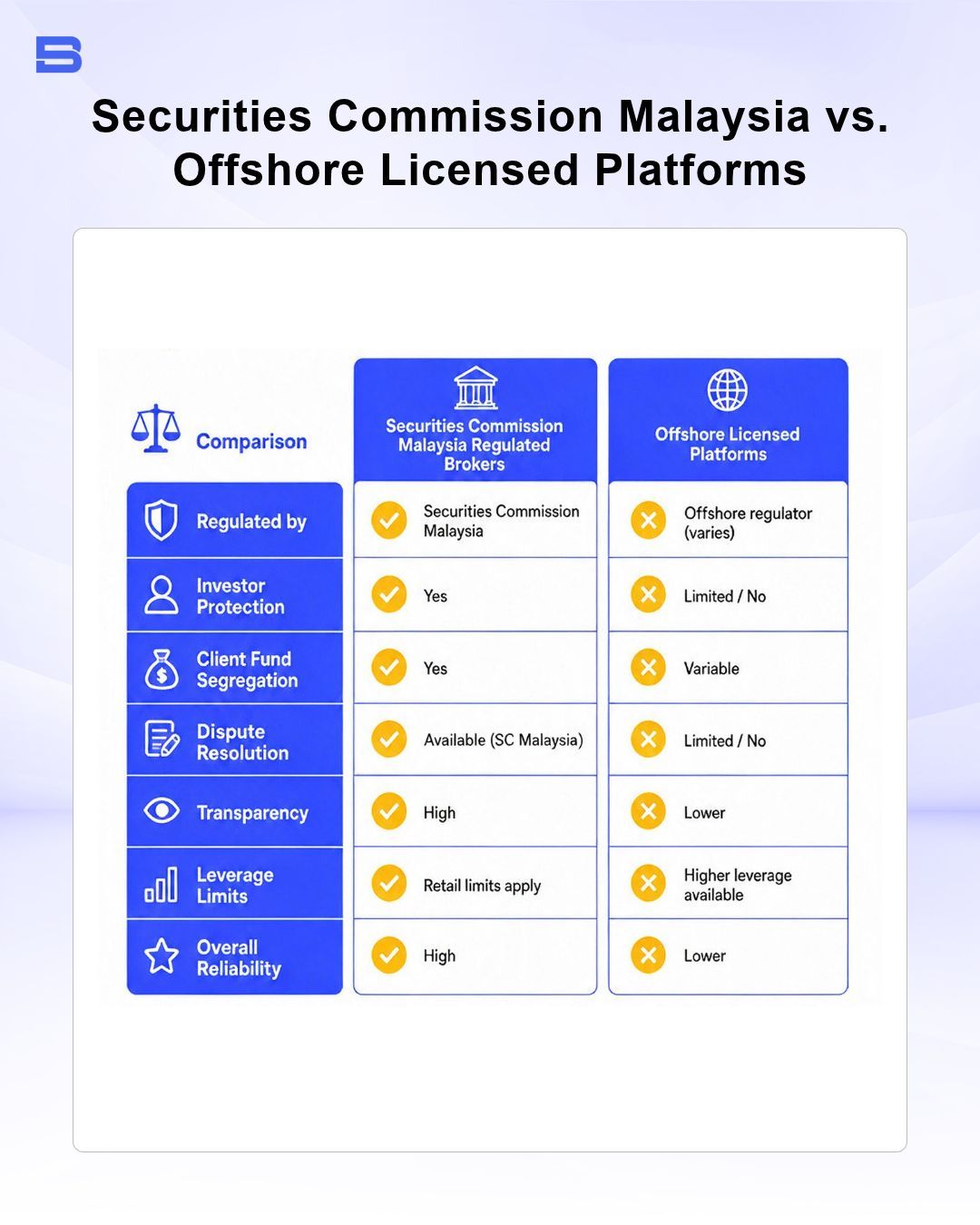
Regulatory protection forms the foundation of any broker selection process. In Malaysia, local capital market activities fall under the authority of the Securities Commission Malaysia (SC), while foreign exchange administration rules fall under Bank Negara Malaysia (BNM).
Brokers holding a Capital Markets Services Licence (CMSL) from the SC offer the highest tier of local legal protection. Local entities must adhere to strict capital adequacy ratios, provide client account segregation in local financial institutions, and give investors access to local dispute resolution mechanisms like the Securities Industry Dispute Resolution Center (SIDREC).
Many Malaysian investors also trade through international multi-asset brokers whose groups are regulated by Tier-1 authorities such as the Monetary Authority of Singapore (MAS) or the Australian Securities and Investments Commission (ASIC). Keep in mind that a broker group's Tier-1 license does not automatically cover you: Malaysian residents are often onboarded through a separate entity in a different jurisdiction, so check the entity named in your client agreement. Because these platforms operate outside SC Malaysia's direct legal mandate, you also won't have access to local dispute channels like SIDREC, and it's worth checking the SC's Investor Alert List before opening an account.
Verifying Regulatory Credentials and Segregated Client Funds
Before depositing funds, always verify a broker's regulatory status through official public registers rather than relying on homepage badges. You can cross-check a firm's legal entity directly through the SC Public Register of Licensed Persons or equivalent Tier-1 database entries.
Key Features of the Best Online Trading Platforms in Malaysia
When you compare features on any trading platform Malaysia traders can rely on, focus on what happens after you tap "buy." Order stability, execution infrastructure, platform uptime, and overall trading costs can all affect the trading experience. Reliable performance during periods of high market volatility can help reduce execution issues, while clear and responsive charts support more efficient technical analysis.
Spreads, Commissions, and MYR Currency Conversion Costs
Trading costs in Malaysia typically include raw execution spreads, per-lot or per-share commissions, and MYR currency conversion markups. For Bursa Malaysia trades, you'll also pay regulatory charges such as clearing fees and stamp duty, and CFD positions held overnight may incur swap charges, so always check a broker's full fee schedule before you trade. Brokers advertising zero-commission trading frequently make their money by widening the bid-ask spread or charging conversion markups when you deposit in Ringgit to trade USD-denominated assets.
Conversion costs can quietly erode your portfolio performance over time. Consider a scenario where you deposit RM10,000 to trade US equities:
- Broker A (Spread-Markup Model): Charges zero explicit commission but levies a 1.2% currency conversion spread when exchanging MYR to USD, instantly costing you RM120 upon entry.
- Broker B (Raw Commission Model): Charges an explicit flat commission of USD 2.00 (approx. RM8.80, assuming an illustrative rate of USD 1 = RM4.40) per trade and uses a near-mid-market FX rate with a fixed 0.2% markup (RM20 on RM10,000), bringing total entry cost to roughly RM28.80.
In this scenario, Broker B saves you over RM91 on a single funding cycle despite not advertising "zero commission."
Shariah-Compliant Filtering Tools and Swap-Free Features
According to the Securities Commission Malaysia's updated list of Shariah-compliant securities (May 2026), the large majority of counters on Bursa Malaysia are classified as Shariah-compliant, which is why many trading apps serving Malaysian investors build Islamic screening tools directly into their platforms.
For multi-asset and CFD traders, swap-free functionality eliminates interest-based rollover charges on overnight positions to maintain alignment with Islamic financial principles. To review how overnight financing fees are structured on Islamic accounts, see our breakdown of the Islamic forex account.
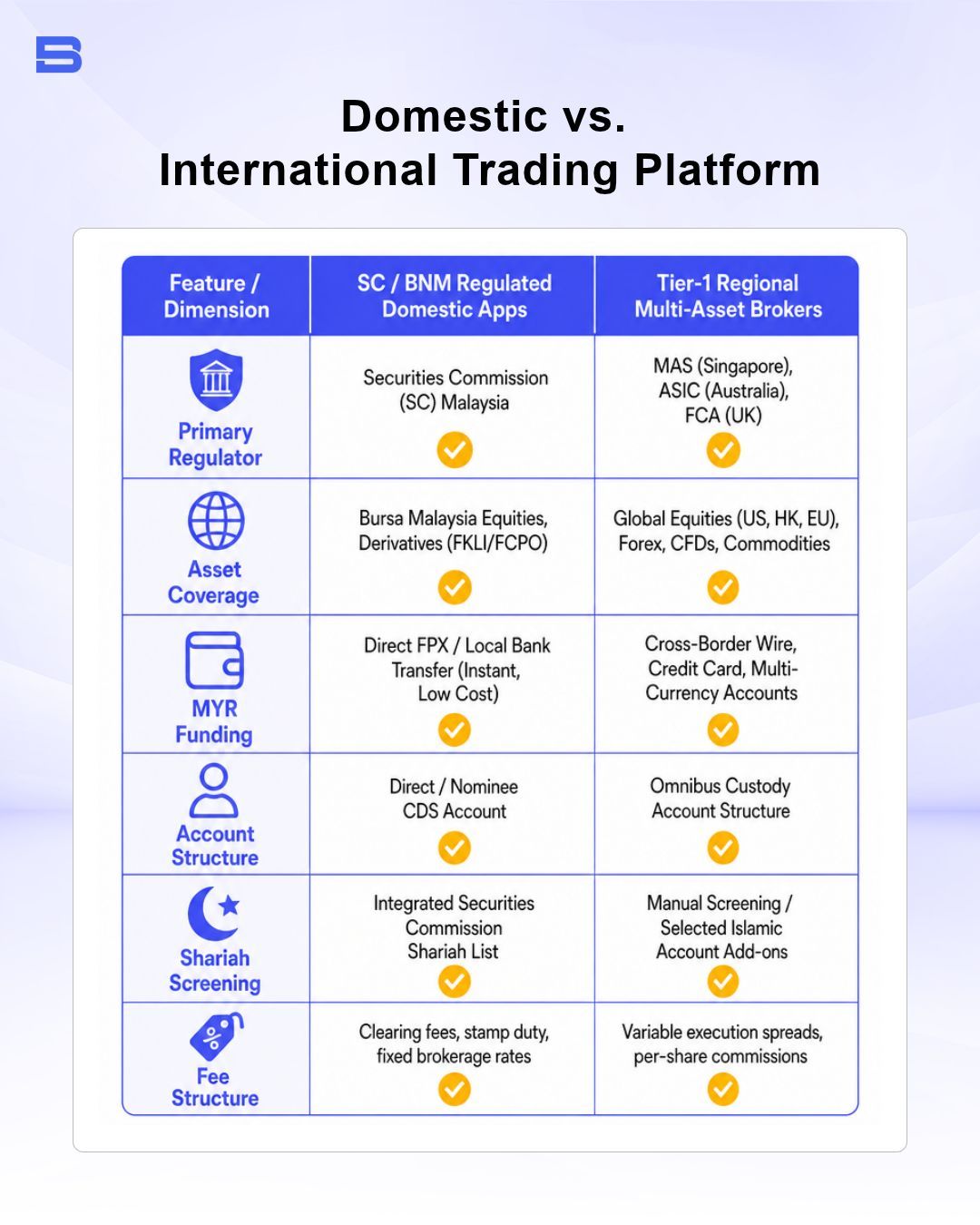
Domestic vs. International Trading Platform Comparison
Domestic platforms licensed by SC Malaysia offer local legal protection and direct Bursa Malaysia access, while international platforms typically provide broader global market coverage but fall outside SC Malaysia's oversight. The comparison below summarizes the key differences.
Evaluating Mobile Stock Trading Apps in Malaysia
Mobile responsiveness is critical for active investors. A dependable stock trading app in Malaysia should support two-factor authentication (2FA), instant push notifications for filled orders, custom alert triggers, and responsive charting frameworks.
Accessing Local vs Global Stock Exchanges
When trading local equities, your platform connection depends on your Central Depository System (CDS) account type. Direct CDS accounts hold shares in your own name, so you receive dividends directly from the listed company and can attend and vote at shareholder meetings. Nominee CDS accounts hold shares under your broker's nominee company, which simplifies administration, but dividends and voting are handled through the nominee, and brokerage rates vary by broker.
To track your portfolio across local clearing institutions, you can cross-reference holdings via local tools like Bursa Anywhere alongside your broker's app interface. For a detailed guide on setting up a local share account, review our walk-through on opening a CDS account in Malaysia.
When accessing international exchanges like the NASDAQ, NYSE, or HKEX, Malaysian apps route orders through global custodian networks. Ensure your mobile platform provides real-time market data quotes rather than delayed feeds, as 15-minute price delays lead to poor order fills during volatile market openings.
Platform Architecture: Execution Models and Charting Tools
Advanced traders usually require dedicated platform architectures rather than standard web browsers.
Advanced Charting and Third-Party Execution Integrations
Many intermediate traders choose platforms that integrate directly with third-party technical analysis tools. Platforms that support custom indicator scripts and webhooks (automated alerts that trigger an action on another system) let you analyze markets on charting tools like TradingView while sending orders to your brokerage account through an application programming interface (API).
Direct Market Access and ECN Platform Architecture
For faster order processing, Electronic Communication Network (ECN) and Direct Market Access (DMA) setups bypass internal dealing desks and route your trade directly to liquidity providers. Advanced platforms like cTrader display Level 2 market depth, a live view of pending buy and sell orders at each price level, so you can see where liquidity sits before you trade.
Serious day traders often host their automated strategy scripts on a virtual private server (VPS), a remote computer that runs around the clock, to prevent execution disconnects during local internet drops. They also cross-reference economic calendar releases via external tools like Forex Factory alongside advanced desktop suites like thinkorswim to manage market volatility around macroeconomic announcements.
How to Choose the Right Trading Platform in Malaysia
Choosing a trading platform Malaysia investors can depend on requires balancing regulatory compliance, total execution costs, and platform architecture. Prioritize platforms with verifiable oversight from SC Malaysia or Tier-1 international regulators, calculate currency conversion costs carefully when funding accounts in Ringgit, and match your platform's execution features to your trading frequency.
- Proprietary Trading Explained: What It Is and Its Key Benefits
- TradingView: Features, Broker Integration, and Strategies
- cTrader: How It Works and How It Compares
- What Is a VPS for Trading and Do You Need One?
- Thinkorswim Trading: Features, Tools, and Availability
- Trading Platform Malaysia: What to Look For
- Bursa Anywhere: A Guide to Managing Shares in Malaysia
- What Is Forex Factory and How Do Traders Use It?
- Delta App: Multi-Asset Portfolio Tracker for Crypto & Stocks
- What Is Trading Central and How to Use It?
- What Is Simply Wall St and How to Use It
- What Is Seeking Alpha and How to Use It
- What Is MarketWatch and How to Use It
- What Is Barchart and How to Use It
- Google Finance Explained: How to Track Stocks and Markets
- What Is Finviz and How to Use It for Stock Screening
- What Is Yahoo Finance and How to Use It
- What Is TradingEconomics and How to Use It
- StockCharts Review 2026: Features, Pricing, and Performance
- What Is ZuluTrade and How Does Copy Trading Work on It?
- What Is Investing.com and How to Use It?
- What Is Myfxbook and How Do Traders Use It?
- What Is CoinGecko? A Complete Guide to Crypto Data Tracking
- What Is CoinMarketCap and How to Use It
- What Is CoinStats and How to Use It for Portfolio Tracking
- What Is Sharesight and How to Use It for Portfolio Tracking
- What Is Personal Capital and How to Use It
- What Is a Low Spread Broker? How It Affects Your Trading
- What Is an Introducing Broker (IB) in Forex?
- What Is Social Trading? How Copy Trading Platforms Work
- What Is a PAMM Account? How Managed Forex Accounts Work
- What Is a Margin Account and How Does Margin Trading Work?
- What Are Trading Signals and How Do They Work?
- What Is an Expert Advisor (EA) in Forex Trading?
Disclaimer: The content on this page is intended for educational and informational purposes only. It does not constitute financial, investment, tax, or legal advice, and should not be interpreted as a recommendation to buy, sell, or hold any financial instrument or asset. Trading and investing involve significant risk, including the possible loss of your entire capital. Products such as forex, CFDs, and cryptocurrencies carry additional risks due to leverage, high volatility, and limited regulatory protection in some jurisdictions. Past performance of any financial instrument does not guarantee future results. Any market views, forecasts, or opinions expressed are those of the author at the time of writing and may not reflect current market conditions. Platform features, fees, and regulatory status are subject to change — always verify information directly with the relevant provider or regulator before making any financial decision. BrokerSpecs may receive compensation from third parties featured on this site. Always conduct your own due diligence and consider seeking advice from a licensed financial professional before investing. Portions of this article were prepared with the assistance of AI tools and reviewed by our editorial team before publication.