



Related Tags
Managing your money across multiple bank accounts, individual brokerages, employer 401(k) plans, and real estate holdings often feels like solving a puzzle with missing pieces. Opening half a dozen mobile apps or updating a manual spreadsheet every month creates friction, leaving you with a fragmented view of your actual financial position.
Managing compound growth and portfolio fees doesn’t have to feel like a part-time job. Personal Capital offers an automated, high-level view of your net worth, while the Delta app provides another option for tracking your investments and portfolio performance.
What Is Personal Capital (Now Empower)?
Personal Capital is an automated wealth aggregation and portfolio analysis platform designed to consolidate your entire financial life into a single dashboard. Following its acquisition by financial giant Empower Retirement, the software service rebranded as the Empower Personal Dashboard.
Despite the brand name change, the core dashboard functionality remains focused on tracking net worth, analyzing asset allocation, and uncovering hidden investment fees across connected accounts.
Unlike daily budgeting applications that focus on tracking granular household expenses, Personal Capital is primarily an investor's platform. It aggregates live data from bank accounts, credit cards, mortgages, taxable brokerages, and retirement accounts to calculate your real-time total net worth.
By centralizing these holdings, the platform gives you a clear view of your overall capital distribution without requiring manual entry after every trade or transaction.
Real-Time Net Worth Tracking
The core engine of Personal Capital relies on secure account aggregation. When you link your financial institutions, the dashboard automatically syncs balances, loan balances, and investment position updates.
For assets that don't support direct digital application programming interface (API) links, such as private real estate, collectibles, or unlisted holdings, you can add custom manual entries. By combining live electronic links with manual asset tracking, you get a continuous calculation of your true net worth—your total assets minus your liabilities—refreshed in real time.
Key Dashboard Features for Investors
While net worth tracking provides a high-level snapshot, Personal Capital’s core value lies in its portfolio analytics. The platform looks past simple cash balances to examine the underlying composition of your funds and equity holdings.
Investment Fee Analyzer and Portfolio Checkup
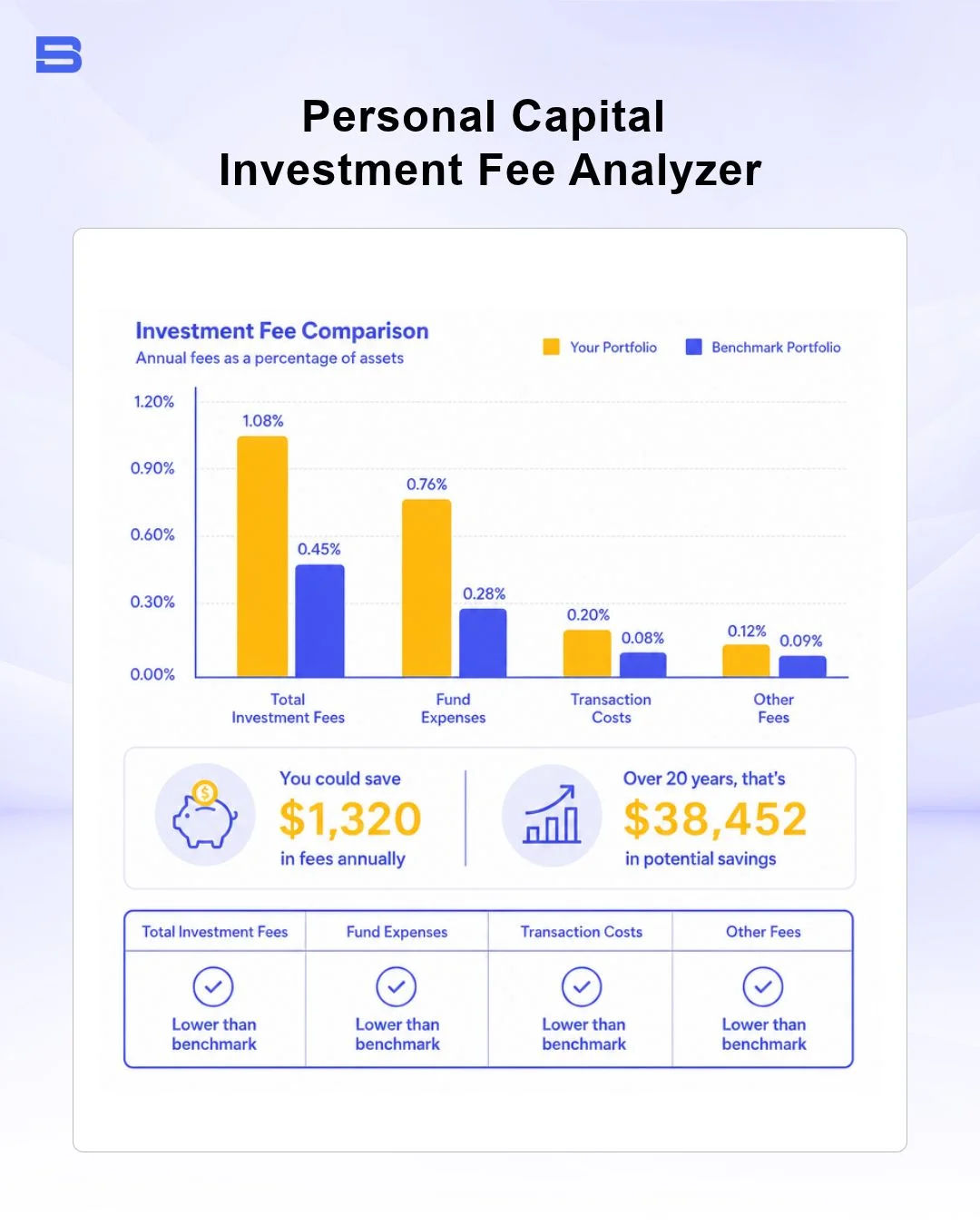
Hidden expense ratios and management fees quietly erode long-term portfolio growth over time. Personal Capital’s Investment Fee Analyzer scans your mutual funds, exchange-traded funds (ETFs), and retirement plans to pinpoint exactly what you pay in underlying fees.
For example, if you hold $100,000 in a retirement portfolio charging a combined expense ratio of 1.25% versus a low-cost index portfolio charging 0.15%, that seemingly minor 1.10% difference costs you $1,100 annually in fee drag alone.
Over a 20-year horizon, assuming a 7% average annual return, that fee difference compounds into tens of thousands of dollars in lost wealth. The Fee Analyzer calculates this cumulative drag visually, highlighting where fund replacements could improve long-term yield.
Retirement Planner and Monte Carlo Simulations
The built-in Retirement Planner goes beyond basic calculators by applying Monte Carlo statistical simulations. It models thousands of potential market scenarios—including bull runs, prolonged bear markets, and inflationary spikes—to determine the probability that your savings will last through retirement.
You can model major life events, such as purchasing a second property, funding higher education, or adjusting your future withdrawal rate, to see how individual decisions alter your financial trajectory.
Cash Flow and Budgeting Limitations
It is important to recognize what Personal Capital is not built for. While it includes a basic cash flow section that categorizes incoming income and outgoing credit card charges, it lacks zero-based budgeting tools.
If you need strict envelope budgeting or daily transaction-level cash management, dedicated budgeting apps are far better suited for that purpose. It excels at macro wealth tracking rather than detailed micro expense planning.
Is Personal Capital Free? How the Business Model Works
The core Empower Personal Dashboard—including net worth aggregation, the Fee Analyzer, investment checkups, and the Retirement Planner—is completely free to use. There are no subscription tiers or monthly software fees for using the aggregation software.
Advisory Services and Wealth Management AUM Fees
Personal Capital monetization operates through an opt-in wealth management advisory service. Once an investor syncs more than $100,000 in investable assets to the platform, Personal Capital’s fiduciary advisory team will offer personalized financial planning services.
If you choose to hire them to manage your money, Personal Capital charges an Assets Under Management (AUM) fee based on a tiered structure:
- $100,000 to $1,000,000: 0.89% annual AUM fee
- $1,000,001 to $3,000,000: 0.79% annual AUM fee
- $3,000,001 to $5,000,000: 0.69% annual AUM fee
- $5,000,001 to $10,000,000: 0.59% annual AUM fee
- Above $10,000,000: 0.49% annual AUM fee
This wealth management service includes custom portfolio construction, rebalancing, tax-loss harvesting, and dedicated fiduciary advice. Regulated investment advisory services in the United States operate under fiduciary standards overseen by the US Securities and Exchange Commission (SEC).
However, using the managed advisory service is completely optional; you are free to use the software dashboard indefinitely without ever enrolling in paid asset management.
Data Security and Aggregation Trade-Offs
Linking bank accounts and brokerage credentials requires robust digital safety standards. Personal Capital uses AES-256-bit encryption, multi-factor authentication (MFA), and read-only data access. Read-only access means that even if someone gained access to your login credentials, they cannot move funds out of your accounts or execute trades through the dashboard.
Financial aggregators operating under international security protocols align with global standards maintained by regulatory authorities. In the United States, it operates under the oversight of the US Securities and Exchange Commission (SEC). Global aggregators also align with standards like those maintained by the Financial Conduct Authority (FCA) in the UK.
The trade-off for accessing free software is sales outreach. Because the platform uses aggregate asset data to identify potential wealth management clients, users with portfolios exceeding $100,000 will likely receive phone calls or emails from Personal Capital advisors offering portfolio consultations. You can decline these calls, but sales outreach is a built-in part of the free model.
Personal Capital vs Sharesight and Other Alternatives
Choosing the right portfolio software depends on whether you prioritize tax reporting, real-time aggregate syncing, active market charting, or crypto tracking.
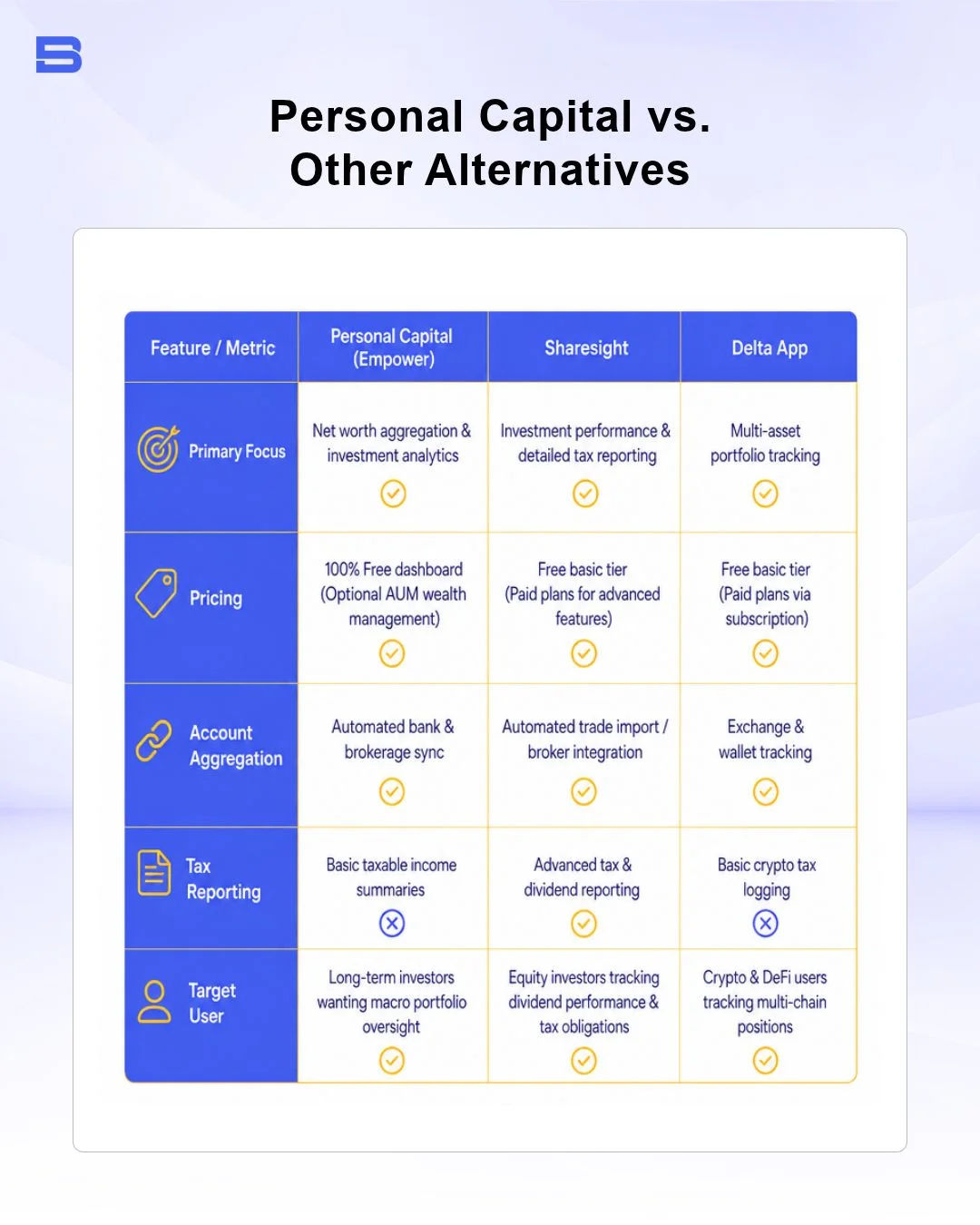
Traders seeking real-time technical analysis and active chart execution typically rely on platforms like TradingView or cTrader. Regional stock investors in Malaysia, meanwhile, track localized direct holdings using tools like Bursa Anywhere.
Final Thoughts
Personal Capital remains one of the most powerful free tools for investors who want to aggregate their net worth and evaluate underlying portfolio fees. While its budgeting tools are basic and high-net-worth users should expect optional wealth management sales calls, the platform's Fee Analyzer and Monte Carlo retirement models deliver exceptional long-term utility.
If your main financial priority is organizing macro wealth and optimizing portfolio efficiency, it offers an automated, clear solution.
- Proprietary Trading Explained: What It Is and Its Key Benefits
- TradingView: Features, Broker Integration, and Strategies
- cTrader: How It Works and How It Compares
- What Is a VPS for Trading and Do You Need One?
- Thinkorswim Trading: Features, Tools, and Availability
- Trading Platform Malaysia: What to Look For
- Bursa Anywhere: A Guide to Managing Shares in Malaysia
- What Is Forex Factory and How Do Traders Use It?
- Delta App: Multi-Asset Portfolio Tracker for Crypto & Stocks
- What Is Trading Central and How to Use It?
- What Is Simply Wall St and How to Use It
- What Is Seeking Alpha and How to Use It
- What Is MarketWatch and How to Use It
- What Is Barchart and How to Use It
- Google Finance Explained: How to Track Stocks and Markets
- What Is Finviz and How to Use It for Stock Screening
- What Is Yahoo Finance and How to Use It
- What Is TradingEconomics and How to Use It
- StockCharts Review 2026: Features, Pricing, and Performance
- What Is ZuluTrade and How Does Copy Trading Work on It?
- What Is Investing.com and How to Use It?
- What Is Myfxbook and How Do Traders Use It?
- What Is CoinGecko? A Complete Guide to Crypto Data Tracking
- What Is CoinMarketCap and How to Use It
- What Is CoinStats and How to Use It for Portfolio Tracking
- What Is Sharesight and How to Use It for Portfolio Tracking
- What Is Personal Capital and How to Use It
- What Is a Low Spread Broker? How It Affects Your Trading
- What Is an Introducing Broker (IB) in Forex?
- What Is Social Trading? How Copy Trading Platforms Work
- What Is a PAMM Account? How Managed Forex Accounts Work
- What Is a Margin Account and How Does Margin Trading Work?
- What Are Trading Signals and How Do They Work?
- What Is an Expert Advisor (EA) in Forex Trading?
Disclaimer: The content on this page is intended for educational and informational purposes only. It does not constitute financial, investment, tax, or legal advice, and should not be interpreted as a recommendation to buy, sell, or hold any financial instrument or asset. Trading and investing involve significant risk, including the possible loss of your entire capital. Products such as forex, CFDs, and cryptocurrencies carry additional risks due to leverage, high volatility, and limited regulatory protection in some jurisdictions. Past performance of any financial instrument does not guarantee future results. Any market views, forecasts, or opinions expressed are those of the author at the time of writing and may not reflect current market conditions. Platform features, fees, and regulatory status are subject to change — always verify information directly with the relevant provider or regulator before making any financial decision. BrokerSpecs may receive compensation from third parties featured on this site. Always conduct your own due diligence and consider seeking advice from a licensed financial professional before investing. Portions of this article were prepared with the assistance of AI tools and reviewed by our editorial team before publication.