


Related Tags
Opening your brokerage app to analyze a potential stock purchase can quickly turn overwhelming. You are immediately confronted with dense financial statements, conflicting analyst ratings, and endless news feeds. Sorting through this data noise to find actionable investment insights often feels like a full-time job.
Seeking Alpha aims to solve this information overload by combining crowd-sourced research with automated quantitative scoring models. Whether you are evaluating US equities or looking for alternative stock screening methods, understanding how this platform structures its data helps you make more deliberate research decisions.
What Is Seeking Alpha and How Does It Work?
Seeking Alpha is a content and research platform designed primarily for retail stock investors and traders. Rather than operating purely as a traditional financial news outlet, it functions as a research hub driven by a hybrid model: independent contributor analysis paired with automated algorithmic grading systems.
The platform aggregates news, Securities and Exchange Commission (SEC) filings, conference call transcripts, and opinion articles across thousands of publicly traded companies. By combining human qualitative perspectives with computer-driven quantitative models, it attempts to give investors a multi-layered view of a stock's potential risk and reward profile.
Crowd-Sourced Investment Analysis vs. Internal Research
Unlike traditional Wall Street research firms that rely entirely on in-house equity analysts, Seeking Alpha crowd-sources its article content. Thousands of independent contributors—ranging from experienced fund managers and financial advisors to dedicated retail investors—submit detailed bull and bear investment theses.
Every article undergoes an internal editorial vetting process before publication to ensure quality and compliance standards. However, because contributor opinions represent individual perspectives, you must evaluate author track records and disclosure statements carefully. Relying blindly on a single author's thesis without cross-referencing fundamental data introduces significant analytical risk.
How the Seeking Alpha Quant Rating System Works
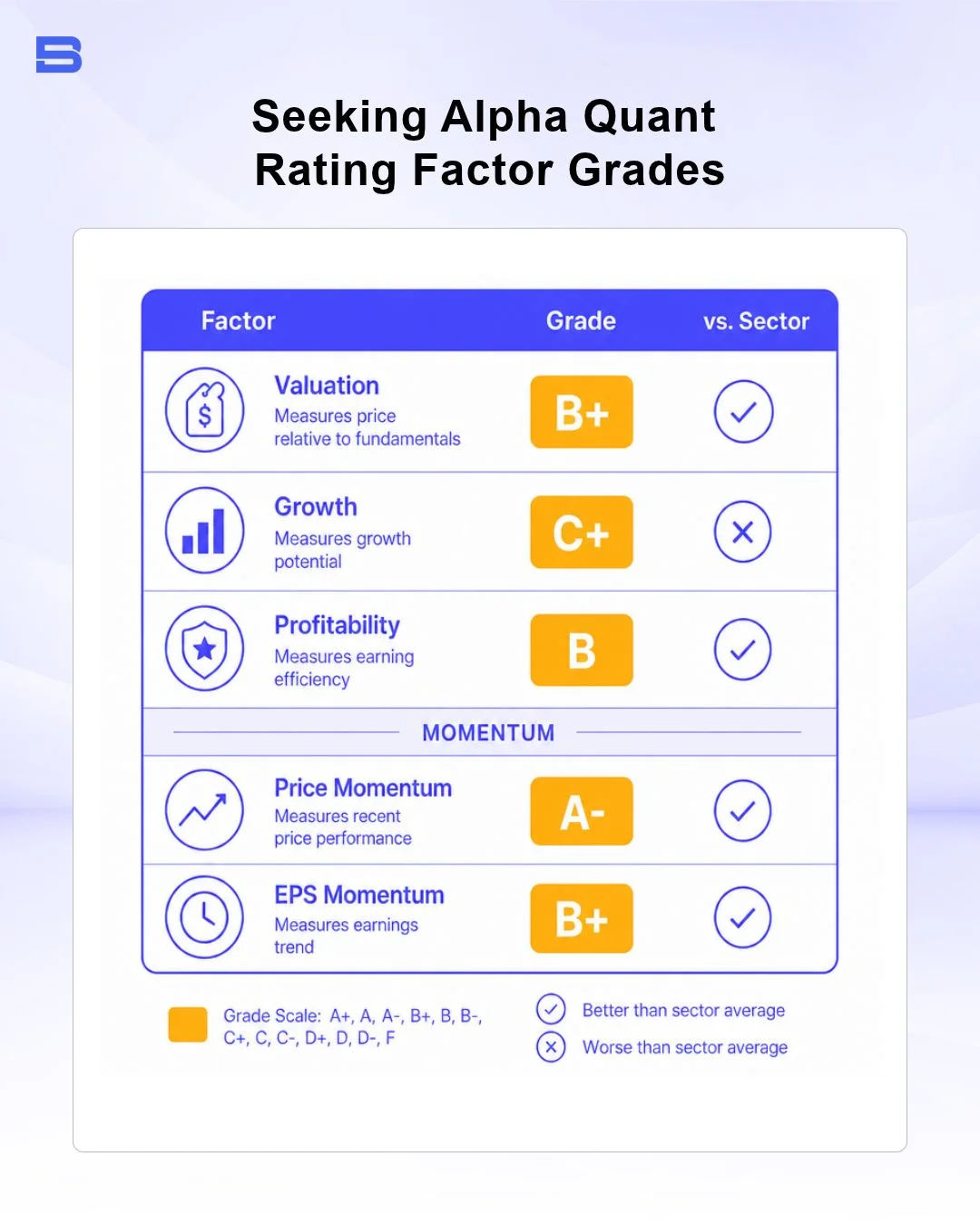
To complement human contributor opinions, the platform uses a proprietary algorithmic framework known as the Seeking Alpha Quant Rating system. This model objectively grades stocks by comparing specific financial metrics against the broader sector average.
The Quant Rating engine evaluates companies across five primary investment factors:
- Valuation: Assesses metrics such as Price-to-Earnings (P/E), Price-to-Sales (P/S), and Enterprise Value to EBITDA (EV/EBITDA).
- Growth: Measures year-over-year revenue expansion, forward EPS growth estimates, and cash flow trajectory.
- Profitability: Gauges gross profit margins, Return on Equity (ROE), and Return on Invested Capital (ROIC).
- Momentum: Evaluates price performance over trailing 3-month, 6-month, and 12-month periods relative to sector peers.
- EPS Revisions: Tracks upward or downward earnings estimate adjustments submitted by Wall Street analysts over recent quarters.
Key Features for Stock Research
Navigating international markets requires systematic tools to narrow down thousands of listed equities into a manageable watch list. Seeking Alpha provides several research features designed to speed up fundamental evaluation.
Proprietary Stock Screeners and Factor Grades
The platform's stock screener allows you to filter equities using factor letter grades ranging from A + (strongest) down to F (weakest). Instead of manually reviewing complex financial statements, you can quickly filter for companies showing strong profitability and positive momentum while filtering out overvalued or decelerating businesses.
For instance, you can construct a screen targeting mid-cap US technology stocks with a minimum Quant Rating of "Strong Buy" and a Profitability grade of B + or higher. This instantly eliminates underperforming companies, allowing you to focus your deeper manual research on top-tier candidates.
Earnings Transcripts, Financials, and Portfolio Tracking
Primary source data remains essential for thorough equity valuation. Seeking Alpha provides comprehensive historical financial statements, raw SEC filing links verified via EDGAR disclosures, and quarterly earnings call transcripts.
You can also link your existing portfolio or create custom watch lists to receive instant email or push notification alerts. When a company in your watch list reports quarterly earnings or files an 8 - K disclosure, the platform delivers the news and transcript summaries straight to your dashboard.
Is Seeking Alpha Worth Paying For? Free vs. Premium Breakdown
Understanding the subscription pricing structure helps you decide whether upgrading from the basic tier aligns with your trading portfolio size and research habits.
Seeking Alpha Basic (Free) Tier Limits
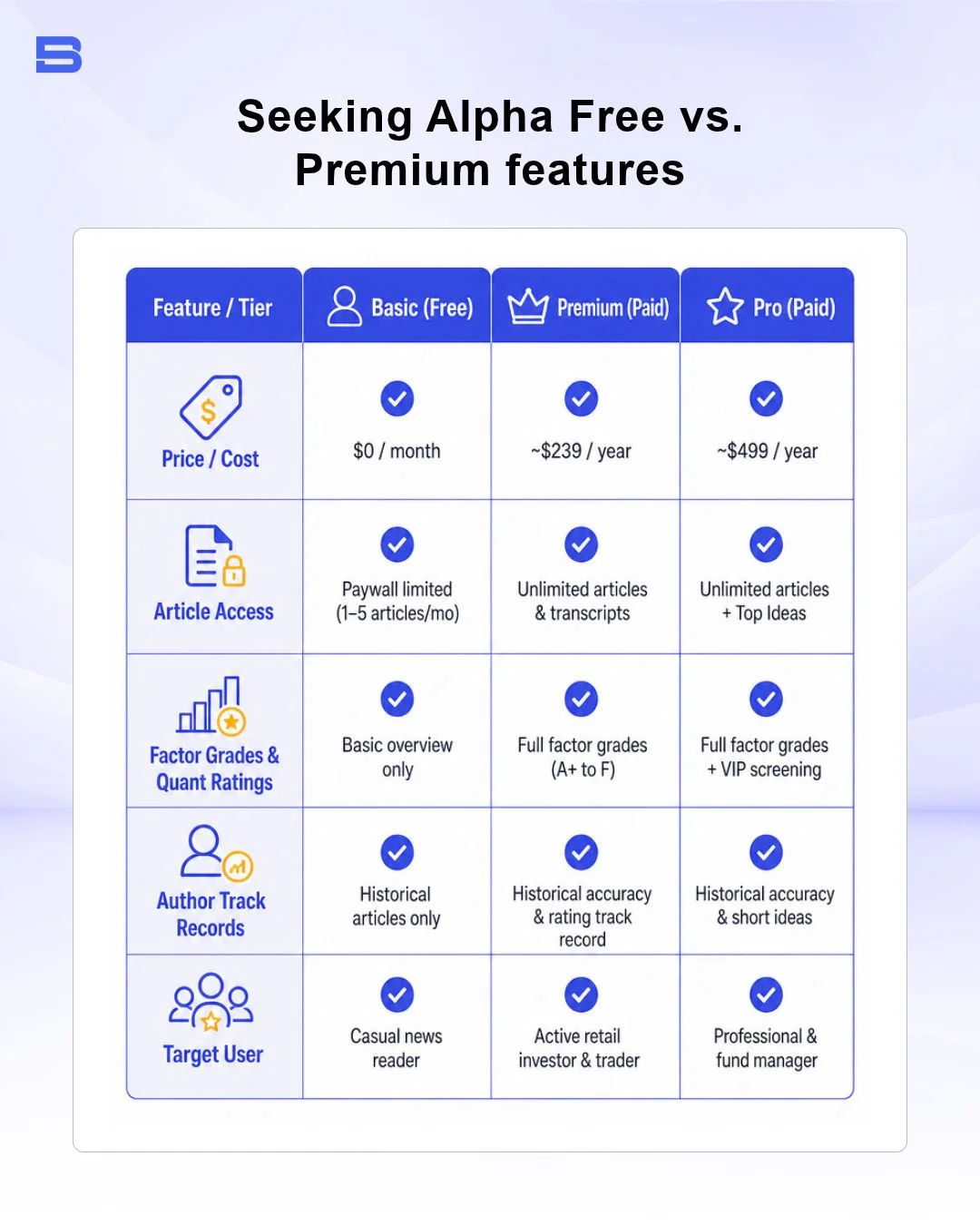
The Basic free tier functions primarily as a light news aggregator and headline preview tool. You can read standard press releases, track real-time stock quotes, and view basic financial charts.
However, free article access is strictly paywalled. Free registered users can typically read only a handful of contributor analysis articles per month before hitting a meter limit. Advanced factor grades, historical quant scores, and full screener customization remain locked behind paid tiers.
Seeking Alpha Premium Features and Cost
Upgrading to Seeking Alpha Premium unlocks unlimited article access, quarterly earnings call transcripts, and full Factor Grades. Premium subscribers can also view historical author accuracy ratings, enabling you to see how past stock recommendations by a specific contributor performed over time.
Seeking Alpha Premium is priced at approximately $239 per year (check Seeking Alpha's official website for current promotions), with introductory discounts frequently available. Premium suits active retail investors managing personal capital who require frequent stock screening and quantitative scoring tools.
Seeking Alpha vs. MarketWatch, Simply Wall St, and Alternatives
Choosing the right stock research platform depends on whether you prioritize raw news feed speed, visual infographics, or quantitative stock ratings.
Seeking Alpha vs. MarketWatch, Simply Wall St, and Financial News Outlets
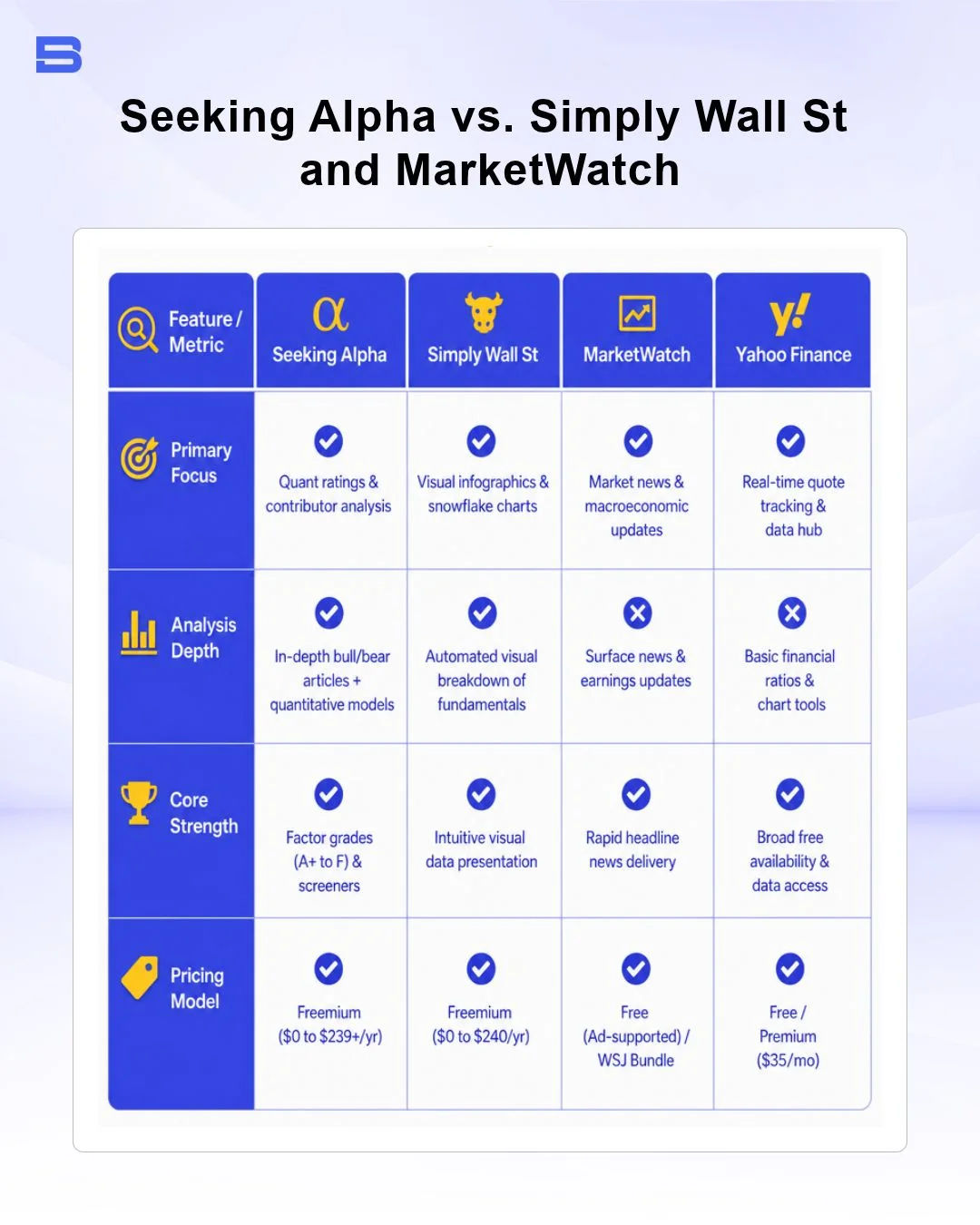
Platforms cater to distinct investor workflows. Mainstream news outlets like MarketWatch focus heavily on rapid macroeconomic reporting and breaking market news. General portals such as Yahoo Finance and Google Finance excel at basic chart tracking and core company data lookup.
Conversely, platforms like Simply Wall St cater to visual learners by converting balance sheet numbers into easy-to-read infographic "snowflake" charts. Seeking Alpha sits between these extremes: it provides deeper written analytical theses than standard news feeds while offering more flexible factor-based quantitative screening than pure visual chart tools.
Risks, Limitations, and How Southeast Asian Investors Should Use It
While quantitative models and contributor insights provide valuable baseline data, relying solely on third-party research platforms carries operational and financial risks. Algorithmic factor grades process historical and reported figures; they cannot predict sudden geopolitical events, management scandals, or regulatory shifts.
International regulatory authorities like the Financial Conduct Authority (FCA) emphasize that investors must conduct independent due diligence rather than treating third-party research as automated execution signals.
For retail investors in Southeast Asia and Malaysia trading US equities via international brokerages, platform subscriptions represent a fixed overhead cost. If you manage a smaller portfolio, high annual subscription fees can erode your net investment yields.
Consider this practical evaluation scenario:
Suppose a retail investor in Malaysia is evaluating a US technology stock showing a "Strong Buy" Quant Rating on Seeking Alpha, supported by an A grade in Growth but a D - grade in Valuation. Rather than buying immediately based on the overall rating, the investor reviews the underlying metrics: forward P/E sits at 45x, well above the sector average of 22x.
By cross-referencing a contributor's bearish thesis on slowing enterprise expenditure, the investor avoids buying at a historical valuation peak, electing instead to set a lower limit order target.
Always treat factor grades as starting points for further verification rather than direct execution orders.
The Bottom Line
Seeking Alpha serves as a robust quantitative and qualitative research platform for investors seeking structured coverage of US equities and exchange-traded funds (ETFs). By combining factor-based screeners with crowd-sourced contributor insights, it helps streamline the stock selection process.
However, third-party ratings should never replace personal risk management and independent research. Always align your platform tools with your overall capital size, portfolio goals, and personal investment strategy.
- Proprietary Trading Explained: What It Is and Its Key Benefits
- TradingView: Features, Broker Integration, and Strategies
- cTrader: How It Works and How It Compares
- What Is a VPS for Trading and Do You Need One?
- Thinkorswim Trading: Features, Tools, and Availability
- Trading Platform Malaysia: What to Look For
- Bursa Anywhere: A Guide to Managing Shares in Malaysia
- What Is Forex Factory and How Do Traders Use It?
- Delta App: Multi-Asset Portfolio Tracker for Crypto & Stocks
- What Is Trading Central and How to Use It?
- What Is Simply Wall St and How to Use It
- What Is Seeking Alpha and How to Use It
- What Is MarketWatch and How to Use It
- What Is Barchart and How to Use It
- Google Finance Explained: How to Track Stocks and Markets
- What Is Finviz and How to Use It for Stock Screening
- What Is Yahoo Finance and How to Use It
- What Is TradingEconomics and How to Use It
- StockCharts Review 2026: Features, Pricing, and Performance
- What Is ZuluTrade and How Does Copy Trading Work on It?
- What Is Investing.com and How to Use It?
- What Is Myfxbook and How Do Traders Use It?
- What Is CoinGecko? A Complete Guide to Crypto Data Tracking
- What Is CoinMarketCap and How to Use It
- What Is CoinStats and How to Use It for Portfolio Tracking
- What Is Sharesight and How to Use It for Portfolio Tracking
- What Is Personal Capital and How to Use It
- What Is a Low Spread Broker? How It Affects Your Trading
- What Is an Introducing Broker (IB) in Forex?
- What Is Social Trading? How Copy Trading Platforms Work
- What Is a PAMM Account? How Managed Forex Accounts Work
- What Is a Margin Account and How Does Margin Trading Work?
- What Are Trading Signals and How Do They Work?
- What Is an Expert Advisor (EA) in Forex Trading?
Disclaimer: The content on this page is intended for educational and informational purposes only. It does not constitute financial, investment, tax, or legal advice, and should not be interpreted as a recommendation to buy, sell, or hold any financial instrument or asset. Trading and investing involve significant risk, including the possible loss of your entire capital. Products such as forex, CFDs, and cryptocurrencies carry additional risks due to leverage, high volatility, and limited regulatory protection in some jurisdictions. Past performance of any financial instrument does not guarantee future results. Any market views, forecasts, or opinions expressed are those of the author at the time of writing and may not reflect current market conditions. Platform features, fees, and regulatory status are subject to change — always verify information directly with the relevant provider or regulator before making any financial decision. BrokerSpecs may receive compensation from third parties featured on this site. Always conduct your own due diligence and consider seeking advice from a licensed financial professional before investing. Portions of this article were prepared with the assistance of AI tools and reviewed by our editorial team before publication.