



Related Tags
Imagine wanting to participate in the fast-moving foreign exchange or CFD markets, but you simply do not have the hours required each day to analyze price charts, conduct technical analysis, or monitor economic news releases.
Copy trading offers a direct alternative by allowing you to link your brokerage account to experienced strategy providers. However, automating your trading through an external bridge like ZuluTrade introduces complex operational layers, execution delays, and unique financial risks that require careful management.
It’s an open social copy trading platform that acts as an intermediate software bridge connecting retail investors with independent strategy providers, known on the platform as "Leaders". Founded in 2007 and later acquired by the Finvasia Group, ZuluTrade doesn’t function as a direct broker itself. Instead, it processes trading signals generated by Leaders and automatically replicates those exact trades inside your connected brokerage account.
When a Leader opens or closes a position—such as going long on EUR/USD or short on Crude Oil—it receives the signal via an API connection and instantly sends a mirror command to your trading account. The primary appeal of this structure is automation: you do not need to sit in front of your screen to execute trades manually.
However, automating trades means you automatically mirror both winning trades and severe account drawdowns in real time. If a Leader experiences a losing streak or employs a high-risk trading style, your account will reflect those losses instantly, scaled proportionally to your selected lot size parameters.
Key Risk Management Settings on ZuluTrade
Automating trades without setting firm safety parameters is one of the fastest ways to deplete a trading account. It provides built-in risk management controls designed to protect your capital from unforeseen market volatility or reckless Leader behavior.
The central security feature on the platform is ZuluGuard, an automated account monitoring system that acts as a circuit breaker. ZuluGuard tracks the real-time performance of the Leaders you copy. If a Leader's strategy strays from its historical norm or hits a predetermined maximum drawdown threshold, ZuluGuard automatically steps in to close all open positions mirrored from that Leader and disables future trading signals from them.
In addition to automated safeguards, you must choose how positions are sized relative to your capital. It offers two primary lot allocation modes:
- Proportional Copying: Positions are automatically scaled based on the ratio between your account balance and the Leader's capital. If the Leader has a $50,000 account and trades 1.0 lot, a $5,000 follower account will automatically execute 0.10 lots.
- Fixed Lot Copying: You assign a static position size for every mirrored trade (e.g., exactly 0.01 lots per trade), regardless of the Leader's account equity or trade sizing.
Leverage amplifies your returns when trades go in your favor, but it accelerates capital destruction just as quickly when the market moves against you—a 2% adverse market shift on a 30:1 leveraged position can wipe out a significant portion of your usable margin. To maintain control over your exposure, it is critical to track market-moving catalysts using tools like the Forex Economic Calendar alongside ZuluTrade's equity protection settings.
How to Evaluate and Filter ZuluTrade Leaders
Choosing which Leaders to copy requires looking beyond raw profit percentages. A Leader displaying a 500% annual return may be using dangerous money management techniques that carry an unacceptably high risk of account liquidation.
ZuluTrade uses a proprietary ranking algorithm called ZuluRank to evaluate signal providers. ZuluRank analyzes multiple quantitative factors, including total account age, overall drawdown history, average trade duration, win/loss ratios, and strategy consistency. When screening Leaders, pay close attention to these critical red flags:
- Martingale or Grid Strategies: Avoid Leaders who double down on losing positions or stack open orders without stop-loss protections. While these strategies produce smooth upward equity curves temporarily, a prolonged trend will inevitably result in a margin call.
- Unusually High Drawdown: A Leader with a historical max drawdown exceeding 25% to 30% indicates reckless exposure that could destabilize smaller follower accounts.
- Short Track Record: Only evaluate Leaders with at least 12 months of live trading history. Short-term performance figures are often skewed by favorable market conditions.
Technical Execution and Slippage Considerations
Automating copy trades introduces technical latency that does not exist in manual trading. When a Leader places an order, the signal must travel from their trading terminal to ZuluTrade's central server, and then route through an API to your broker's execution server.
This multi-step transmission process creates latency delays. During high-volatility events, such as major central bank rate announcements, these delays can result in significant slippage—where your trade is executed at a substantially worse price than the Leader received. Over time, accumulated slippage can turn a strategy that is profitable for the Leader into a losing strategy for the copier.
Supported ZuluTrade Brokers and Account Setup
A common point of confusion for beginners is the operational distinction between ZuluTrade and a brokerage firm. It provides only the social bridge and signal routing software; it never holds customer deposits or directly executes trades on financial markets. Your funds remain housed inside your chosen regulated broker, which executes orders, handles clearing, and manages leverage limits under regulatory oversight like the Financial Conduct Authority (FCA).
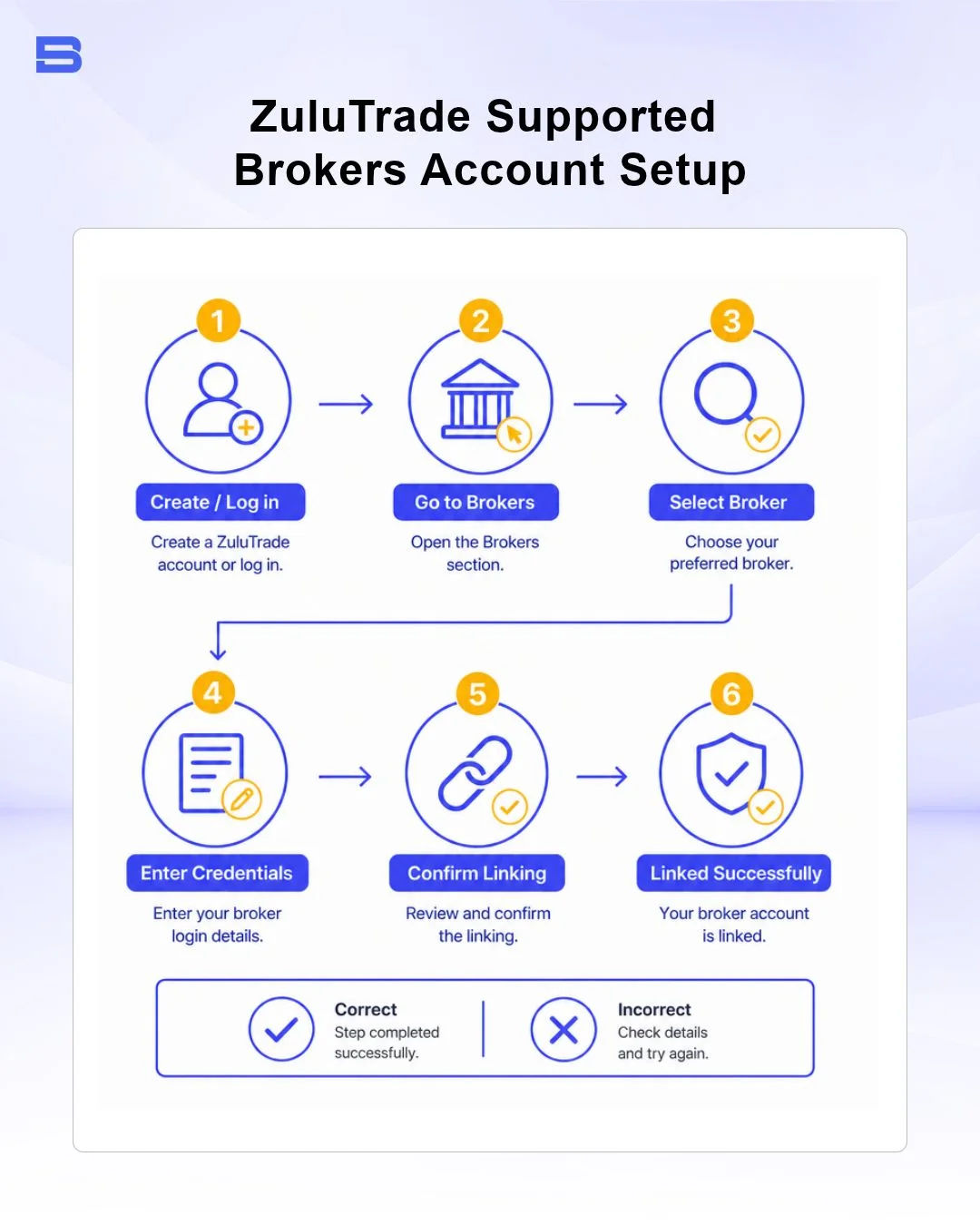
ZuluTrade supports account integration with a variety of international brokers, with primary connections established via MetaTrader 4 (MT4), MetaTrader 5 (MT5), or integrated platform bridges like cTrader. To connect a broker account to ZuluTrade, follow this standard procedure:
- Select a Regulated Broker: Open an account with a broker supported by ZuluTrade, ensuring the entity holds Tier-1 or Tier-2 regulatory licensing.
- Register a ZuluTrade Investor Account: Create an account on the ZuluTrade platform and select "Investor" as your account classification.
- Link Account Credentials: Enter your broker account credentials (broker server name, login ID, and investor password) inside the dashboard bridge settings.
- Configure Allocation & Safety Rules: Set your ZuluGuard drawdown limits, choose lot sizing options, and fund your broker account before enabling live mirroring.
How ZuluTrade Charges Fees and Commission
Understanding the cost structure of social copy trading is necessary to calculate your net potential returns accurately. ZuluTrade's fee model varies based on whether you connect a broker directly integrated with their classic commission model or utilize their subscription-based structure.
- Spread Markups: Under classic integrated broker arrangements, it charges a spread markup (typically between 1.0 and 3.0 pips depending on the asset class) or a round-turn commission per lot copied. This extra cost is added directly to your broker's standard bid-ask spread.
- Performance Fees: When copying top-ranking Leaders, ZuluTrade often utilizes a profit-sharing model (e.g., a 20% performance fee). You pay a percentage of profits generated by the strategy, calculated using a High-Water Mark model so you are never charged twice for the same equity gain.
For example, if you copy a Leader who generates $1,000 in net profit under a 20% performance fee model, $200 is deducted and distributed between ZuluTrade and the strategy provider, leaving you with $800 in net profit before spread markups.
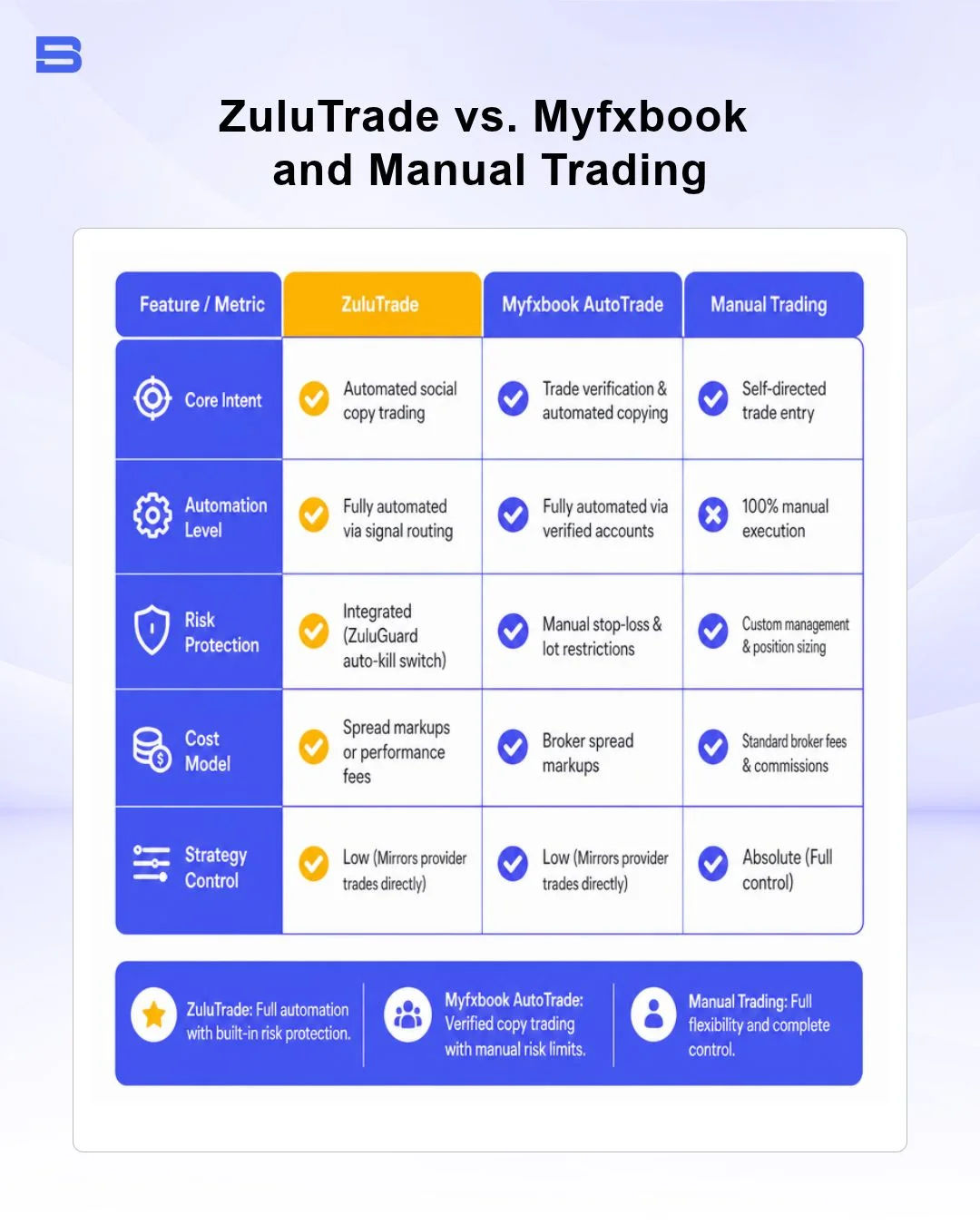
Comparing ZuluTrade vs. Myfxbook and Manual Trading
Choosing the right trading methodology depends on your desired balance between operational control, automation level, and technical complexity. While ZuluTrade offers an end-to-end social ecosystem, analytical platforms like Myfxbook serve traders looking for raw performance verification, and platforms like TradingView cater to manual chart analysis.
Conclusion
ZuluTrade offers a streamlined bridge for traders seeking to automate market participation by mirroring experienced signal providers. However, hands-off trading should never be confused with risk-free investing.
Long-term performance relies heavily on rigorous Leader screening, avoiding high-risk martingale strategies, and configuring strict protection tools like ZuluGuard to preserve your trading capital.
- Proprietary Trading Explained: What It Is and Its Key Benefits
- TradingView: Features, Broker Integration, and Strategies
- cTrader: How It Works and How It Compares
- What Is a VPS for Trading and Do You Need One?
- Thinkorswim Trading: Features, Tools, and Availability
- Trading Platform Malaysia: What to Look For
- Bursa Anywhere: A Guide to Managing Shares in Malaysia
- What Is Forex Factory and How Do Traders Use It?
- Delta App: Multi-Asset Portfolio Tracker for Crypto & Stocks
- What Is Trading Central and How to Use It?
- What Is Simply Wall St and How to Use It
- What Is Seeking Alpha and How to Use It
- What Is MarketWatch and How to Use It
- What Is Barchart and How to Use It
- Google Finance Explained: How to Track Stocks and Markets
- What Is Finviz and How to Use It for Stock Screening
- What Is Yahoo Finance and How to Use It
- What Is TradingEconomics and How to Use It
- StockCharts Review 2026: Features, Pricing, and Performance
- What Is ZuluTrade and How Does Copy Trading Work on It?
- What Is Investing.com and How to Use It?
- What Is Myfxbook and How Do Traders Use It?
- What Is CoinGecko? A Complete Guide to Crypto Data Tracking
- What Is CoinMarketCap and How to Use It
- What Is CoinStats and How to Use It for Portfolio Tracking
- What Is Sharesight and How to Use It for Portfolio Tracking
- What Is Personal Capital and How to Use It
- What Is a Low Spread Broker? How It Affects Your Trading
- What Is an Introducing Broker (IB) in Forex?
- What Is Social Trading? How Copy Trading Platforms Work
- What Is a PAMM Account? How Managed Forex Accounts Work
- What Is a Margin Account and How Does Margin Trading Work?
- What Are Trading Signals and How Do They Work?
- What Is an Expert Advisor (EA) in Forex Trading?
Disclaimer: The content on this page is intended for educational and informational purposes only. It does not constitute financial, investment, tax, or legal advice, and should not be interpreted as a recommendation to buy, sell, or hold any financial instrument or asset. Trading and investing involve significant risk, including the possible loss of your entire capital. Products such as forex, CFDs, and cryptocurrencies carry additional risks due to leverage, high volatility, and limited regulatory protection in some jurisdictions. Past performance of any financial instrument does not guarantee future results. Any market views, forecasts, or opinions expressed are those of the author at the time of writing and may not reflect current market conditions. Platform features, fees, and regulatory status are subject to change — always verify information directly with the relevant provider or regulator before making any financial decision. BrokerSpecs may receive compensation from third parties featured on this site. Always conduct your own due diligence and consider seeking advice from a licensed financial professional before investing. Portions of this article were prepared with the assistance of AI tools and reviewed by our editorial team before publication.