


Related Tags
Imagine opening your trading platform at the market open and seeing a sudden spike in volatility across tech stocks. Before making any impulse moves, you need to know whether the movement stems from a major Federal Reserve announcement, a broader macroeconomic shift, or localized corporate earnings.
This is where financial news hubs step in. MarketWatch serves as a primary portal for retail investors and traders seeking real-time tracking, fundamental data, and market analysis to clarify market dynamics.
What Is MarketWatch and How Does It Work?
MarketWatch is a financial information website that provides stock market data, business news, financial analysis, and economic commentary. Operated as a subsidiary of Dow Jones & Company (a division of News Corp), the platform shares institutional reporting resources with publications like The Wall Street Journal and Barron's.
The core functionality of MarketWatch rests on aggregating market-moving information into an accessible dashboard. The site categorizes data across major global asset classes, including equities, fixed income, commodities, currencies, and cryptocurrencies. Users can track major indices like the S&P 500, Dow Jones Industrial Average, and Nasdaq Composite, while monitoring market movers through built-in screeners.
It’s ideal for swing traders, position investors, and macro researchers who need context behind price action. If you are looking for order-flow mechanics or high-frequency charting, specialized broker terminals remain necessary. However, for understanding why the market is moving, the platform acts as a comprehensive analytical center.
Key Features of MarketWatch for Investors
Understanding Real-Time vs. Delayed Market Data
The website provides financial data across various asset classes, but data speeds depend on the exchange and your subscription level. For major US indices and equities, quotes on the free platform are typically real-time or updated dynamically. However, certain international markets or specialized OTC instruments may carry a standard 15-minute delay due to exchange licensing requirements.
Understanding quote latency is vital for active risk management. Relying on a delayed feed to time precise breakout entries on volatile assets can lead to execution slippage on your execution platform. Always verify whether your data source is live before making trade entries.
Monitoring Premarket and After-Hours Trading
Price-sensitive corporate announcements and earnings releases frequently occur outside standard exchange operating hours. It features dedicated extended-hours tracking, allowing you to observe premarket movement and after-hours liquidity shifts.
Tracking extended-hours volume gives investors early indications of market sentiment before the official opening bell. For example, if a company reports better-than-expected quarterly earnings at 4:15 PM EST, monitoring after-hours trading on the website reveals initial price reaction and volume commitments before order execution begins the following morning.
Practicing Strategies with the MarketWatch Stock Market Game
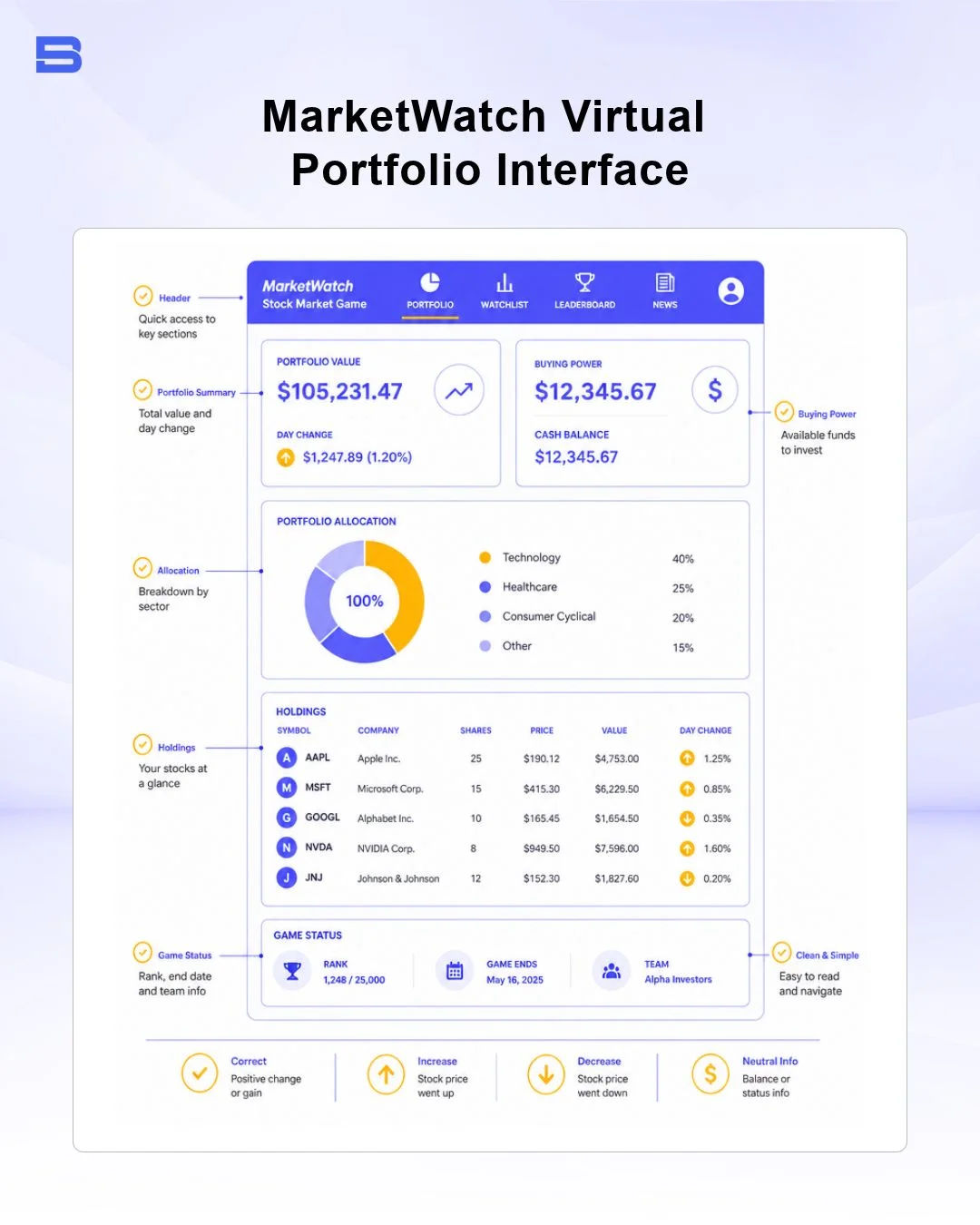
For beginner investors and intermediate traders testing new asset allocation models, risk-free execution practice is essential. The MarketWatch stock market game is a virtual portfolio simulator where users build customized trading games or join public leagues.
The simulator provides virtual capital to trade equities and ETFs in real-time market conditions. Participating in virtual trading helps you test position sizing rules, analyze portfolio drawdown, and understand trade mechanics without risking capital.
Free Features vs. MarketWatch Premium Membership
It operates on a freemium publishing model. The free portal offers market overview quotes, economic calendars, stock screening tools, and standard news reporting.
Upgrading to MarketWatch Premium grants unlimited digital access to paywalled articles across the entire Dow Jones publication network, including institutional analysis from The Wall Street Journal.
Evaluating Data Accuracy: Is MarketWatch Reliable?
Evaluating information sources is a fundamental step in building a disciplined investment approach. Because it operates under Dow Jones editorial oversight, its financial reporting follows strict institutional journalistic standards. Macroeconomic indicator updates—such as Consumer Price Index (CPI) releases or central bank interest rate decisions—are pulled directly from official government feeds.
However, traders must distinguish between financial journalism and execution data. While MarketWatch provides dependable historical statistics, corporate balance sheet metrics, and general quote tracking, portal feeds should not replace primary SEC filings for critical trade decisions.
Consider a scenario where an unexpected breaking news headline reports a major corporate merger. An experienced investor reads the MarketWatch summary for immediate context, but cross-references the official Form 8-K filed with the US Securities and Exchange Commission (SEC) to verify transaction terms, debt obligations, and shareholder approval requirements before making capital adjustments.
MarketWatch vs. Yahoo Finance: Which Tool Suits Your Research Needs?
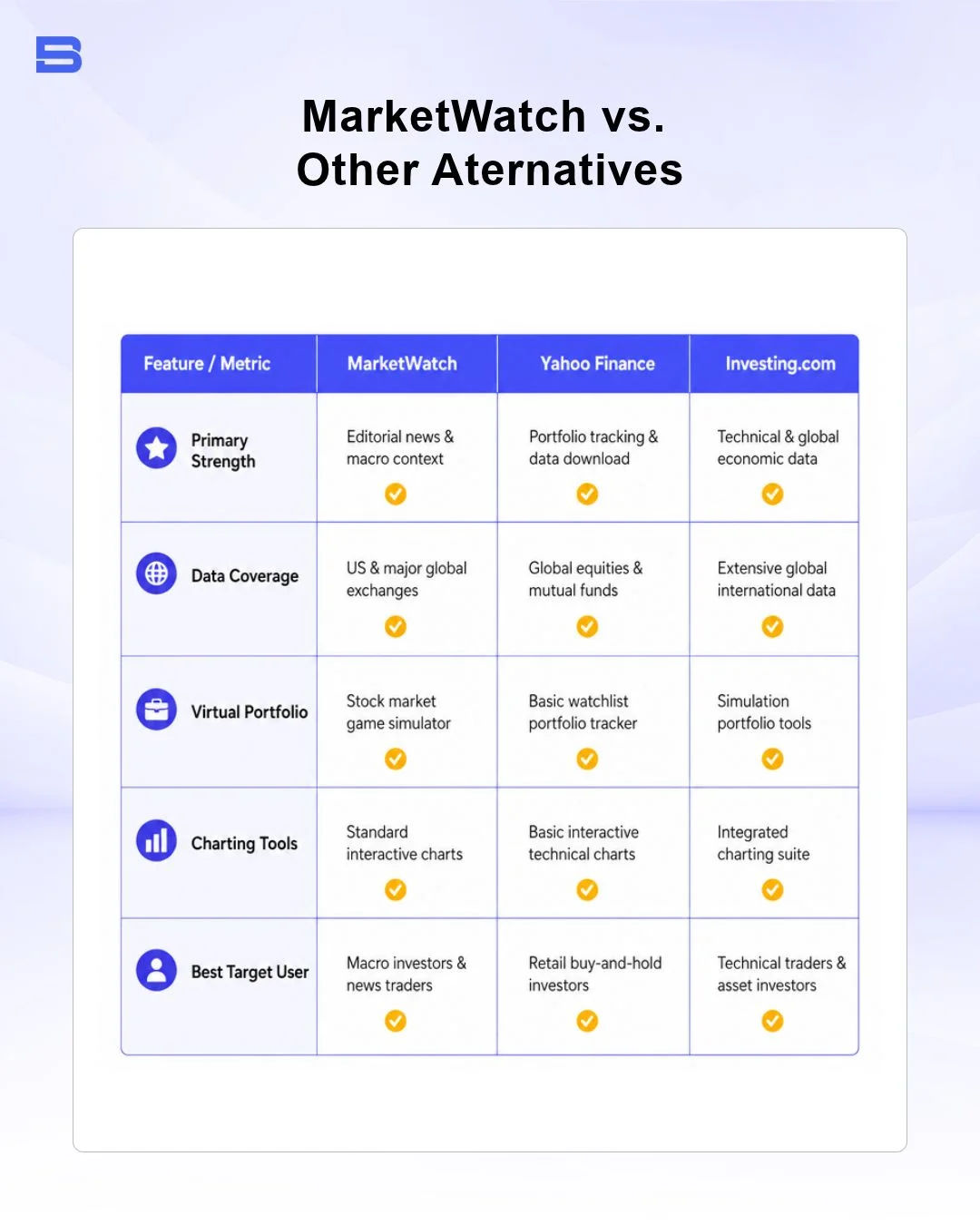
Selecting the right research platform depends on whether you prioritize market commentary or technical screening. Below is a direct breakdown comparing MarketWatch against alternative financial research platforms:
The platform excels at breaking down complex market shifts through investigative reporting and market pulse summaries. Yahoo Finance offers slightly broader automated portfolio linking for personal balance sheet tracking, while Investing.com's platform advertises more granular global technical indicators across multiple asset classes, making it useful for traders focused on granular technical screening.
Comparing Popular Alternatives: MarketWatch, Yahoo Finance, and Investing.com
Rather than relying on a single platform, intermediate traders often assemble a multi-tool research stack tailored to their specific analytical needs:
- MarketWatch & Yahoo Finance: Use for macroeconomic headlines, sector news, and quick corporate earnings overviews.
- Google Finance: Best utilized for minimal, lightweight portfolio monitoring directly within search screens or spreadsheets Google Finance.
- Dedicated Analysis Apps: Tools like Seeking Alpha provide crowd-sourced equity research, while Simply Wall St visualizes balance sheet fundamentals.
- Economic Data Tracking: Platforms such as TradingEconomics deliver deep macroeconomic series data.
By using each tool for its primary strength, you build a balanced view of market movements without suffering from single-source reporting bias.
How to Integrate MarketWatch into Your Daily Trading Workflow
To maximize utility while maintaining strict risk management practices, integrate MarketWatch into a structured multi-step daily workflow:
- Premarket Context Scanning: 30 to 60 minutes before market open, check MarketWatch premarket movers, global index futures, and the daily economic calendar. Identify scheduled macroeconomic releases (e.g., jobs reports or central bank statements) that could generate systemic volatility.
- Context Verification: When a stock on your watchlist sees a sudden volume surge, use MarketWatch news feeds to identify the primary catalyst—such as an earnings release, analyst upgrade, or regulatory inquiry.
- Execution on Regulated Terminals: Never place market orders directly through information portals. Transition to your regulated broker terminal—duly licensed by regulatory authorities like the Financial Conduct Authority (FCA) or local equivalent—to verify live order book liquidity, calculate position sizing, set stop-loss parameters, and execute trades.
Leveraging higher leverage or trading volatile derivatives requires precise risk parameters. A news portal like MarketWatch provides essential analytical context, but managing downside risk remains the trader's individual responsibility.
Conclusion
MarketWatch remains one of the most reliable news portals for tracking market-moving financial news, macroeconomic trends, and asset price overviews. By adding its market tracking and virtual trading simulator to your pre-market routine, you gain valuable context for daily price action.
Always pair third-party market research with independent verification and strict risk management rules on a fully regulated execution platform.
- Proprietary Trading Explained: What It Is and Its Key Benefits
- TradingView: Features, Broker Integration, and Strategies
- cTrader: How It Works and How It Compares
- What Is a VPS for Trading and Do You Need One?
- Thinkorswim Trading: Features, Tools, and Availability
- Trading Platform Malaysia: What to Look For
- Bursa Anywhere: A Guide to Managing Shares in Malaysia
- What Is Forex Factory and How Do Traders Use It?
- Delta App: Multi-Asset Portfolio Tracker for Crypto & Stocks
- What Is Trading Central and How to Use It?
- What Is Simply Wall St and How to Use It
- What Is Seeking Alpha and How to Use It
- What Is MarketWatch and How to Use It
- What Is Barchart and How to Use It
- Google Finance Explained: How to Track Stocks and Markets
- What Is Finviz and How to Use It for Stock Screening
- What Is Yahoo Finance and How to Use It
- What Is TradingEconomics and How to Use It
- StockCharts Review 2026: Features, Pricing, and Performance
- What Is ZuluTrade and How Does Copy Trading Work on It?
- What Is Investing.com and How to Use It?
- What Is Myfxbook and How Do Traders Use It?
- What Is CoinGecko? A Complete Guide to Crypto Data Tracking
- What Is CoinMarketCap and How to Use It
- What Is CoinStats and How to Use It for Portfolio Tracking
- What Is Sharesight and How to Use It for Portfolio Tracking
- What Is Personal Capital and How to Use It
- What Is a Low Spread Broker? How It Affects Your Trading
- What Is an Introducing Broker (IB) in Forex?
- What Is Social Trading? How Copy Trading Platforms Work
- What Is a PAMM Account? How Managed Forex Accounts Work
- What Is a Margin Account and How Does Margin Trading Work?
- What Are Trading Signals and How Do They Work?
- What Is an Expert Advisor (EA) in Forex Trading?
Disclaimer: The content on this page is intended for educational and informational purposes only. It does not constitute financial, investment, tax, or legal advice, and should not be interpreted as a recommendation to buy, sell, or hold any financial instrument or asset. Trading and investing involve significant risk, including the possible loss of your entire capital. Products such as forex, CFDs, and cryptocurrencies carry additional risks due to leverage, high volatility, and limited regulatory protection in some jurisdictions. Past performance of any financial instrument does not guarantee future results. Any market views, forecasts, or opinions expressed are those of the author at the time of writing and may not reflect current market conditions. Platform features, fees, and regulatory status are subject to change — always verify information directly with the relevant provider or regulator before making any financial decision. BrokerSpecs may receive compensation from third parties featured on this site. Always conduct your own due diligence and consider seeking advice from a licensed financial professional before investing. Portions of this article were prepared with the assistance of AI tools and reviewed by our editorial team before publication.