


Related Tags
You are tracking a promising altcoin across three different exchanges, but each platform displays a wildly different price, order book depth, and trading volume. One exchange claims millions in daily volume, yet your trade takes minutes to execute due to thin liquidity. How do you separate genuine market activity from inflated figures without spending hours auditing order books yourself?
Crypto market data aggregators serve as a neutral lens in a fragmented, 24/7 financial ecosystem. By consolidating real-time price feeds, volume data, and contract details from hundreds of centralized and decentralized platforms, these platforms give traders a clear overview of actual market liquidity. Among these tools, it stands out as an independent analytics aggregator built to help retail investors verify data and make safer trading decisions.
What Is CoinGecko and How to Use It
It is an independent cryptocurrency data aggregation platform that tracks digital asset prices, trading volume, market capitalization, and community growth metrics across the Web3 ecosystem. Founded in 2014 by TM Lee and Bobby Ong, the platform provides retail investors, institutional traders, and market researchers with neutral analytics free from direct exchange ownership.
Unlike single trading venues that only show their internal order books, it indexes data from hundreds of centralized exchanges (CEXs) and decentralized exchanges (DEXs). To understand how the platform processes this information, consider its core operational metrics:
- Market Capitalization: Calculated by multiplying a token's circulating supply by its current volume-weighted average price across active markets.
- Volume-Weighted Average Price (VWAP): Aggregates price data across multiple exchanges, weighting each platform's contribution by its reported trading volume to prevent a single low-liquidity exchange from skewing the global price.
- Developer and Community Tracking: Tracks GitHub commits, code repository updates, Telegram group growth, and social sentiment to help investors evaluate project activity beyond price action.
According to institutional frameworks from the CFA Institute, verifying data across independent sources is essential when assessing volatile, fragmented markets. For intermediate traders, it acts as a primary research terminal—allowing you to verify token contract addresses, monitor supply emissions, and assess liquidity before entering a trade.
Key Features: Navigating CoinGecko's Analytics Tools
Navigating CoinGecko effectively requires understanding its proprietary filtering mechanisms. While basic market cap rankings offer a quick snapshot, advanced tools allow traders to look past superficial surface numbers.
How CoinGecko Calculates Trust Score
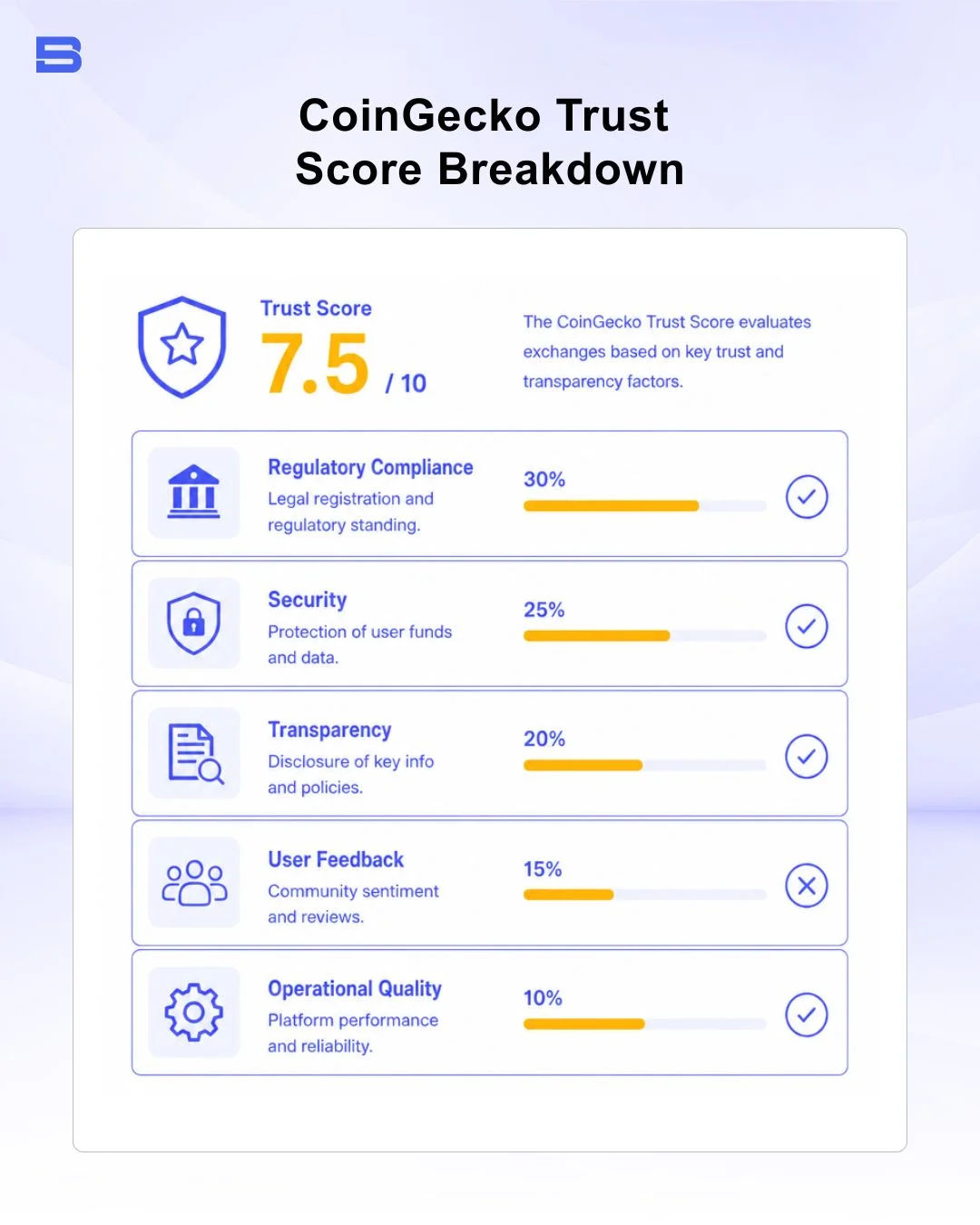
Reported trading volume on crypto exchanges can easily be manipulated through wash trading—a practice where automated bots trade with themselves to create fake volume and attract unsuspecting retail traders. To combat this, CoinGecko developed its proprietary Trust Score algorithm.
Instead of ranking trading venues purely by raw reported volume, Trust Score evaluates exchanges on a scale from 1 to 10 based on a multi-factor methodology:
- Liquidity and Order Book Depth: Measures the actual capital required to move a trading pair's price by 2% (the "+2% and -2% Depth" metric).
- Trading Scale and Spread: Evaluates bid-ask spreads across major pairs to detect artificial volume spikes.
- API Technical Coverage: Assesses the consistency and transparency of the exchange's data feeds.
- Cybersecurity and Proof of Reserves: Factors in cold storage transparency, historical security breaches, and verifiable reserve balances.
Regulatory bodies such as the Monetary Authority of Singapore (MAS) consistently emphasize that market integrity and transparent disclosures are critical for investor safety in digital assets. Filtering exchange rankings by Trust Score helps ensure you route trades through venues with genuine order book depth rather than artificial liquidity.
Tracking DEXs and On-Chain Liquidity via GeckoTerminal
Centralized exchanges represent only part of the crypto market. As decentralized finance (DeFi) has expanded, trading activity has shifted heavily toward automated market makers (AMMs) like Uniswap, Raydium, and PancakeSwap. Because new tokens often launch on decentralized pools without a formal listing process, tracking them requires specialized tools.
It addresses on-chain markets through GeckoTerminal, its dedicated decentralized exchange tracker:
- Real-Time Pool Analytics: Tracks individual liquidity pool balances, reserve ratios, and token pair transactions directly from the blockchain.
- Contract Audits and Safety Warnings: Highlights potential rug-pull risk parameters, such as unrenounced contract ownership, minting functions, or high buy/sell taxes.
- Pool Liquidity Depth: Shows the exact amount of paired collateral (e.g., ETH/USDT) backing a token pool, letting traders estimate potential price impact before executing on-chain swaps.
Practical Guide: How to Use CoinGecko for Bitcoin Trading
To see how it supports active market analysis, let's look at a practical scenario involving a trader planning an entry into a $50,000 how to trade Bitcoin position.
Suppose Bitcoin is trading near a key resistance level. Relying on a single exchange's price chart might give you an incomplete picture, as local order book imbalances can cause temporary price spikes. Here is how you can use CoinGecko to plan your execution step-by-step:
- Check Global Volume-Weighted Average Price: Navigate to the Bitcoin asset page on CoinGecko to confirm the global average price ($50,000) and compare it against your local exchange's order book.
- Evaluate Exchange Depth: Scroll to the "Markets" tab and filter exchanges by Trust Score. Look at the +2% Depth column across top venues. If Exchange A requires $12 million in buy orders to move the price up by 2%, while Exchange B requires only $1.5 million, executing a large market order on Exchange B carries significantly higher slippage risk.
- Verify Circulating vs. Total Supply: Check the circulating supply (e.g., ~19.7 million BTC) relative to the maximum supply limit (21 million BTC). While Bitcoin has a predictable emission schedule, applying this step to altcoins prevents you from buying into assets facing imminent token unlocks that could dilute price.
- Analyze Derivatives Volume: Examine the perpetual futures tab on CoinGecko to compare spot volume with derivatives volume. High derivatives volume paired with stagnant spot volume often signals leveraged speculation (as documented in perpetual futures analytics). This imbalance increases the risk of sudden liquidation cascades.
Executing a trade based on multi-exchange order book depth and verified supply parameters helps minimize slippage and protects your capital from temporary market dislocations.
How to Track Your Portfolio on CoinGecko
Beyond market research, managing risk across multiple wallet addresses and exchange accounts requires centralizing your holdings. It provides a built-in, free portfolio tracking feature accessible via web browser or mobile app.
Setting up a portfolio only takes a few minutes:
- Create a Free Account: Sign up using an email address to sync your portfolio across devices.
- Add Assets Manually or via Watchlist: Click "Add New Asset," search for your held tokens, and enter the quantity and buy price. Manually inputting purchase costs allows the platform to track your total profit/loss (PNL) over time.
- Set Custom Price Alerts: Configure push notifications for specific target prices or rapid percentage drops to stay informed without monitoring charts constantly.
Alternative Portfolio Trackers
While it offers straightforward manual tracking, intermediate traders with complex multi-chain portfolios often evaluate dedicated tracking applications.
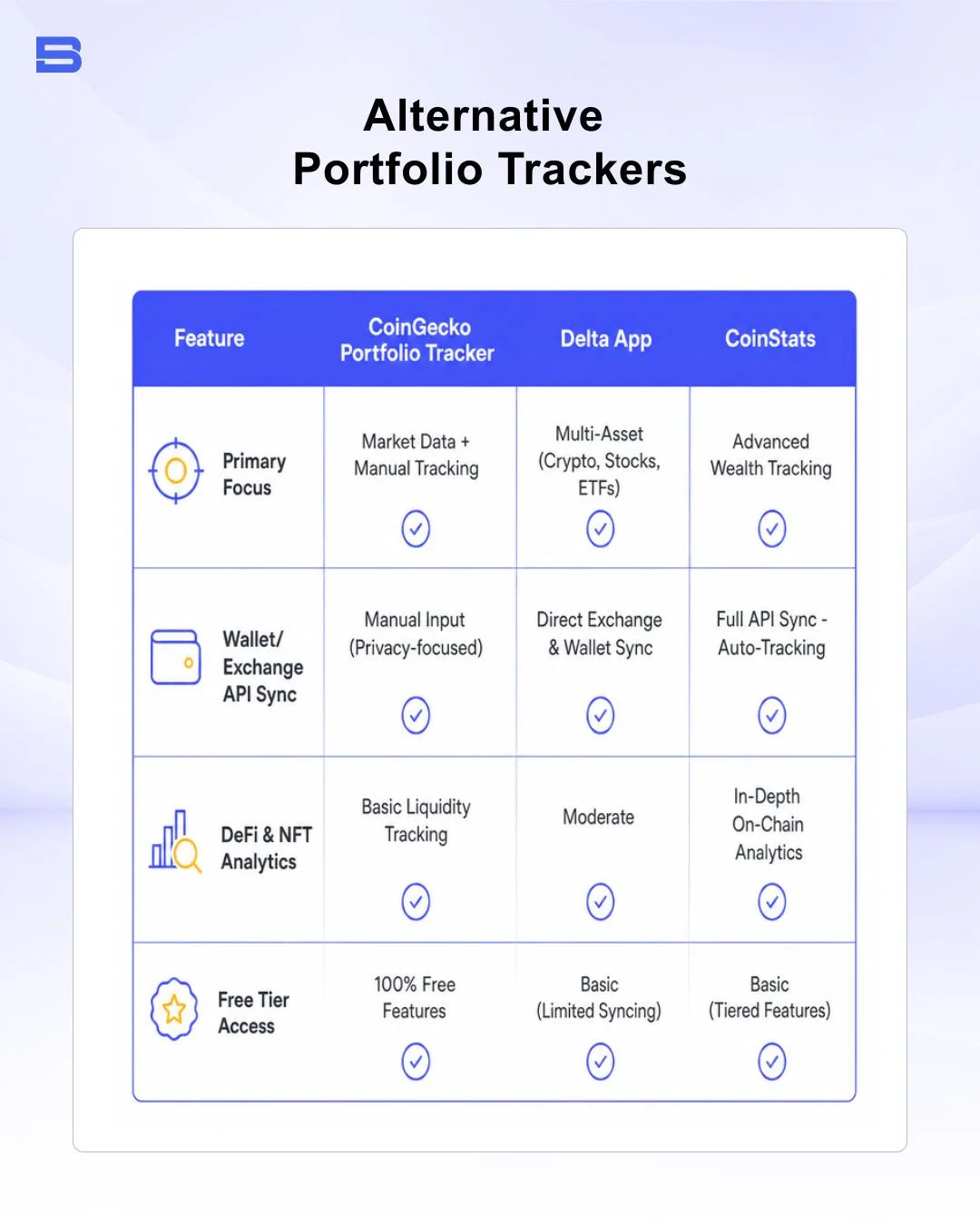
Traders prioritizing complete privacy often prefer CoinGecko because manual entry requires no exchange API keys or wallet address linking. However, traders managing complex multi-chain DeFi portfolios may prefer specialized auto-sync trackers like CoinStats or Delta App.
CoinGecko vs CoinMarketCap: Key Differences for Traders
When evaluating crypto market aggregators, traders frequently compare CoinGecko with CoinMarketCap. While both platforms aggregate global price and volume data, key structural differences impact how data is presented.
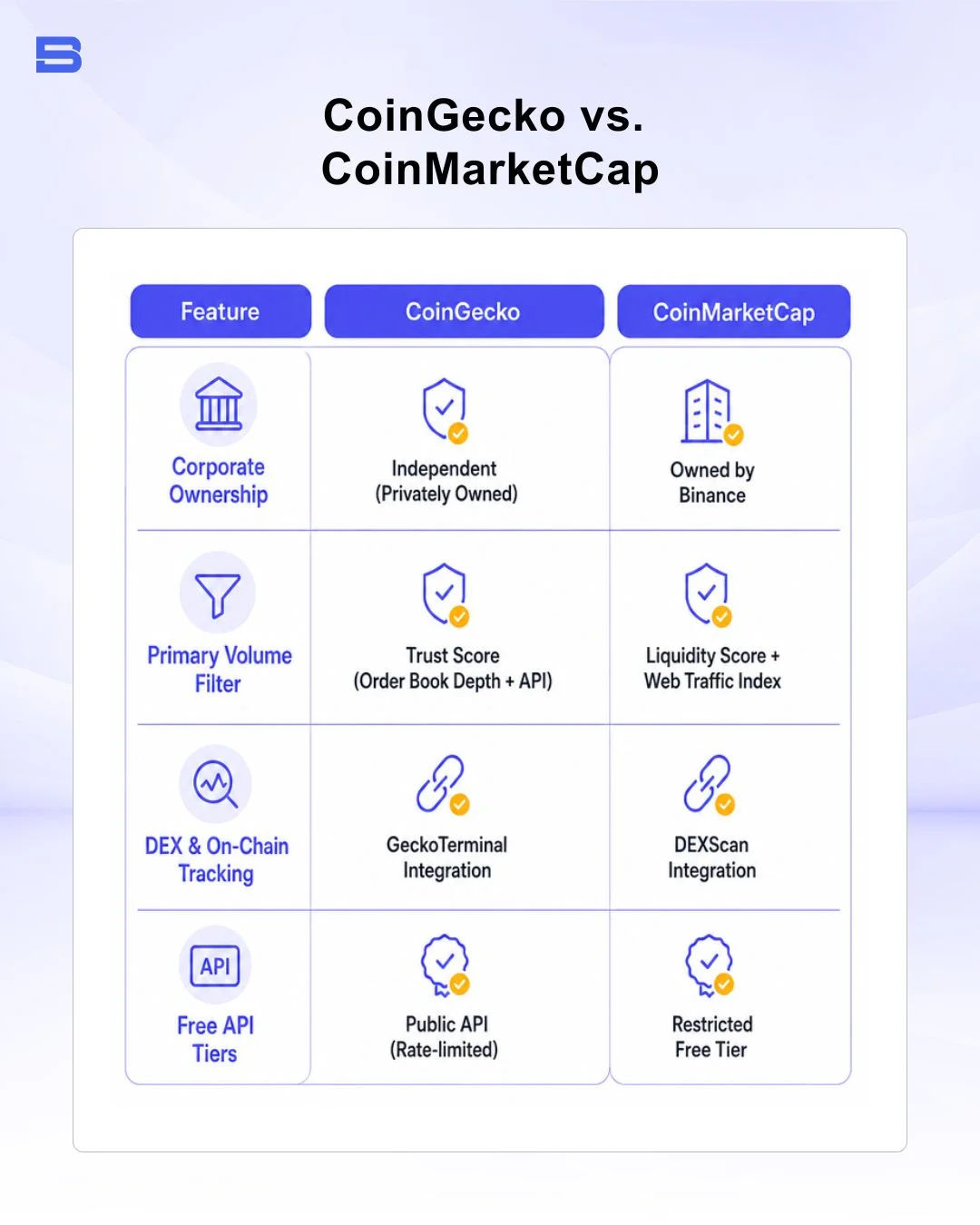
The primary distinction between the two aggregators lies in corporate ownership and methodology transparency:
- Ownership and Independence: CoinMarketCap was acquired by Binance (one of the world's largest crypto exchanges) in 2020. While CoinMarketCap maintains that it operates independently, some market participants scrutinize potential exchange bias. It remains privately owned and independent of exchange operators.
- Exchange Ranking Algorithms: CoinMarketCap uses a combination of web traffic factors and liquidity scores to rank exchanges. CoinGecko's Trust Score relies heavily on order book depth, spread metrics, and technical API verification to filter wash trading.
- Developer API Rate Limits: For developers and quantitative traders building automated tools, it offers a transparent public API with structured pricing tiers, whereas CoinMarketCap restricts free API usage to smaller data sets.
For intermediate traders seeking neutral liquidity data, CoinGecko's independent status and order-book-focused scoring provide a balanced framework for cross-exchange verification.
Final Thoughts
Accurate market data is your first line of defense in cryptocurrency trading. Using an independent aggregator like CoinGecko allows you to verify reported volume, evaluate order book depth, and analyze supply metrics before committing capital.
However, remember that aggregated data is a research tool, not a substitute for sound risk management. Always implement strict trade limits, manage leverage carefully, and independently verify contract details when trading digital assets.
- Proprietary Trading Explained: What It Is and Its Key Benefits
- TradingView: Features, Broker Integration, and Strategies
- cTrader: How It Works and How It Compares
- What Is a VPS for Trading and Do You Need One?
- Thinkorswim Trading: Features, Tools, and Availability
- Trading Platform Malaysia: What to Look For
- Bursa Anywhere: A Guide to Managing Shares in Malaysia
- What Is Forex Factory and How Do Traders Use It?
- Delta App: Multi-Asset Portfolio Tracker for Crypto & Stocks
- What Is Trading Central and How to Use It?
- What Is Simply Wall St and How to Use It
- What Is Seeking Alpha and How to Use It
- What Is MarketWatch and How to Use It
- What Is Barchart and How to Use It
- Google Finance Explained: How to Track Stocks and Markets
- What Is Finviz and How to Use It for Stock Screening
- What Is Yahoo Finance and How to Use It
- What Is TradingEconomics and How to Use It
- StockCharts Review 2026: Features, Pricing, and Performance
- What Is ZuluTrade and How Does Copy Trading Work on It?
- What Is Investing.com and How to Use It?
- What Is Myfxbook and How Do Traders Use It?
- What Is CoinGecko? A Complete Guide to Crypto Data Tracking
- What Is CoinMarketCap and How to Use It
- What Is CoinStats and How to Use It for Portfolio Tracking
- What Is Sharesight and How to Use It for Portfolio Tracking
- What Is Personal Capital and How to Use It
- What Is a Low Spread Broker? How It Affects Your Trading
- What Is an Introducing Broker (IB) in Forex?
- What Is Social Trading? How Copy Trading Platforms Work
- What Is a PAMM Account? How Managed Forex Accounts Work
- What Is a Margin Account and How Does Margin Trading Work?
- What Are Trading Signals and How Do They Work?
- What Is an Expert Advisor (EA) in Forex Trading?
Disclaimer: The content on this page is intended for educational and informational purposes only. It does not constitute financial, investment, tax, or legal advice, and should not be interpreted as a recommendation to buy, sell, or hold any financial instrument or asset. Trading and investing involve significant risk, including the possible loss of your entire capital. Products such as forex, CFDs, and cryptocurrencies carry additional risks due to leverage, high volatility, and limited regulatory protection in some jurisdictions. Past performance of any financial instrument does not guarantee future results. Any market views, forecasts, or opinions expressed are those of the author at the time of writing and may not reflect current market conditions. Platform features, fees, and regulatory status are subject to change — always verify information directly with the relevant provider or regulator before making any financial decision. BrokerSpecs may receive compensation from third parties featured on this site. Always conduct your own due diligence and consider seeking advice from a licensed financial professional before investing. Portions of this article were prepared with the assistance of AI tools and reviewed by our editorial team before publication.