


Related Tags
Entering the cryptocurrency market for the first time can feel like walking into a crowded financial trading floor without a map. With thousands of digital assets trading simultaneously across hundreds of exchanges, tracking accurate prices and market trends is essential. That is where CoinMarketCap comes in as a primary data aggregator for retail crypto traders and investors.
CoinMarketCap is a web-based price tracking platform that aggregates real-time market data—including prices, trading volume, circulating supply, and total market capitalization—from global crypto exchanges. Instead of logging into multiple platforms to check an asset's valuation, you can use it to gain a unified view of the market. Understanding how to navigate this dashboard safely allows you to monitor price movements, evaluate liquidity, and track your personal portfolio with clarity.
What Is CoinMarketCap and How Does It Work?
It operates as a financial information platform that continuously fetches trade execution data from cryptocurrency exchanges worldwide. It collects data points like order book liquidity, trading pair volume, and current execution prices through Application Programming Interfaces (APIs). The platform processes this raw data through standard weighting formulas to report a single representative benchmark price for each listed asset.
For retail investors, the main dashboard provides an immediate health check of the overall crypto market. Key macro indicators include total market capitalization, 24-hour global volume, and Bitcoin dominance (BTC.D), which measures Bitcoin's share of the total crypto market cap. The homepage ranks assets sequentially by their market capitalization, giving you a structured overview from top-tier institutional coins down to smaller altcoins.
While the platform is an essential tracking tool, relying solely on aggregated price feeds carries specific operational pros and cons:
- Pros: Access to free real-time data across tens of thousands of crypto assets, built-in tracking tools like portfolio monitoring, and detailed exchange pair listings.
- Cons: Potential display lag during extreme volatility, exposure to self-reported supply data from project teams, and reporting biases tied to exchange ownership structures.
If you are evaluating trading platforms or data trackers, using trusted tools helps protect your trading workflow. You can also explore our detailed guide on selecting a trading platform in Malaysia to understand how desktop charting platforms compare with web-based price aggregators.
How CoinMarketCap Calculates Market Cap and Circulating Supply
Market capitalization serves as the primary metric for ranking digital assets on CoinMarketCap. The basic mathematical formula used is straightforward:
Market Capitalization = Current Price x Circulating Supply
To evaluate an asset accurately, you must distinguish between the three supply figures reported on the platform:
- Circulating Supply: The total number of coins or tokens currently unlocked, publicly available, and circulating in the market.
- Total Supply: The total number of tokens currently created, minus any tokens that have been permanently destroyed (burned).
- Max Supply: The absolute limit of tokens that will ever be minted or issued under the project's core protocol code.
Evaluating circulating supply against max supply is critical for long-term risk assessment. If an asset has a low circulating supply relative to its max supply, upcoming token unlocks can dilute existing holdings and trigger downward price pressure. Additionally, verify whether a token’s supply displays a "Verified" badge on CoinMarketCap, as unverified supply figures rely on self-reported data from the project team rather than verified on-chain audits.
Key Features and Tracking Tools on CoinMarketCap
Beyond viewing basic price charts, active traders rely on CoinMarketCap's suite of analytical features to evaluate liquidity, track DEX transactions, and set market triggers.
- Exchange Liquidity & Confidence Scores: To prevent wash-trading from inflating trading volume, it assigns a Liquidity Score to specific exchange pairs based on order book depth, bid-ask spread stability, and user traffic volume.
- DEX Tracker (DexScan): Decentralized exchange (DEX) listings allow you to track real-time liquidity pools, token swaps, and smart contract safety metrics across decentralized protocols like Uniswap or PancakeSwap.
- Watchlists & Price Alerts: You can customize dedicated watchlists to group assets by specific themes (such as Layer-1s, DeFi, or AI tokens) and set mobile push notifications for sudden price breaks or percentage swings.
Using the CoinMarketCap Portfolio Tracker
Tracking performance across multiple wallet addresses and exchange accounts can become complex. It offers a free built-in portfolio tracker that lets you centralize your holdings in one location.
You can construct a portfolio using manual transaction entries or by connecting read-only wallet API keys. Once set up, the dashboard calculates your real-time profit and loss (P&L), total portfolio allocation percentages, and historical return curves. Tracking unrealized gains versus realized profits helps you stick to your profit-taking targets without making emotional decisions during market spikes.
How to Track Bitcoin Price & Market Movements
When analyzing market trends, tracking individual price movements is only half the picture. Because Bitcoin acts as the market's primary liquidity anchor, monitoring its broader market indicators gives you valuable context before entering altcoin positions.
If you are exploring how to trade Bitcoin, it provides key metrics like Bitcoin Dominance (BTC.D), 24-hour exchange inflow/outflow metrics, and real-time market depth. A rising Bitcoin dominance combined with increasing prices often indicates capital flowing primarily into major assets, whereas falling dominance during a stable market phase can signal capital rotating into higher-risk altcoins.
Comparing Crypto Trackers: CoinMarketCap vs. CoinGecko
CoinMarketCap and CoinGecko are the two dominant price aggregators in the industry. While both platforms provide similar primary functions, subtle differences in token coverage, data methodologies, and corporate structures exist.
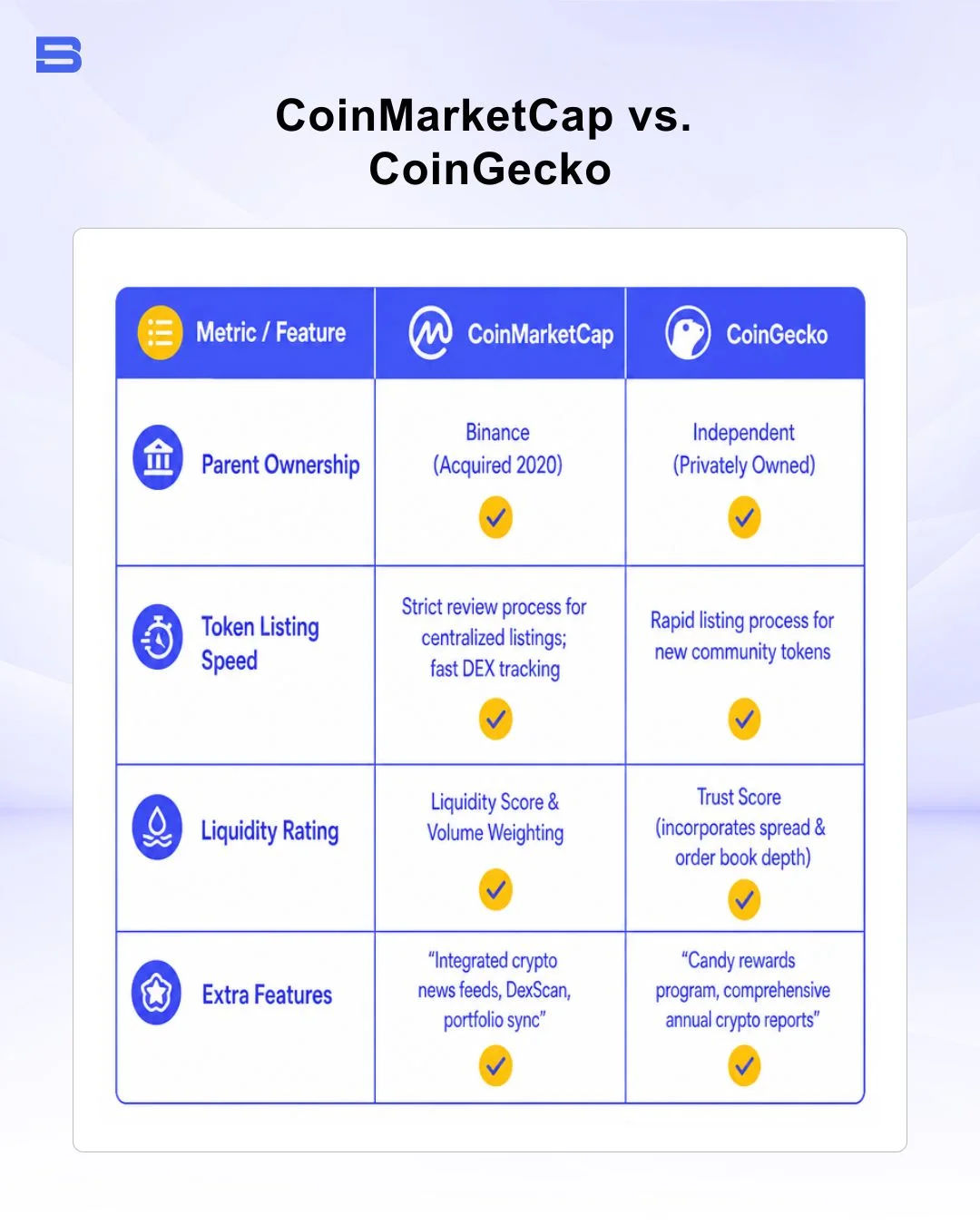
While it offers seamless UI navigation and deep integration with historical price feeds, some market participants cross-reference data with CoinGecko to compare self-reported supply verification and Trust Scores across smaller altcoins. Using multiple independent data sources minimizes the risk of acting on single-feed pricing delays.
Integrating CoinMarketCap Data with External Charting Tools
While CoinMarketCap excels at aggregated price reporting and quick overview analytics, it is not designed to replace dedicated technical analysis software. Most active day traders use it as a macro monitoring dashboard while executing chart analysis on standalone platforms.
For detailed technical analysis, market participants combine aggregated pricing feeds with advanced charting suites like TradingView. External charting software allows you to overlay multi-timeframe indicators, draw trendlines, and analyze volume profiles. You can also export CoinMarketCap's public API feeds directly into custom spreadsheets or external portfolio management applications to track personal performance metrics automatically.
Data Accuracy, Liquidity Risks, and How to Spot Fake Volumes
No price aggregator is immune to bad source data. Because aggregator platforms ingest pricing inputs directly from hundreds of external exchanges, artificial volume and manipulation on smaller platforms can skew reported averages if not filtered out correctly.
To evaluate market data safely, keep these three verification practices in mind:
- Cross-Check Exchange Liquidity: High reported trading volume with a low Liquidity Score is a red flag. Unregulated or secondary exchanges sometimes use wash-trading algorithms—buying and selling to themselves—to fake volume metrics and attract retail traders.
- Verify DEX Smart Contracts: When researching newly launched tokens on decentralized exchanges, always cross-reference the token's contract address directly on block explorers (like Etherscan or BscScan). Scam tokens often clone legitimate tickers to pull liquidity from unsuspecting traders.
- Acknowledge Potential Conflicts of Interest: Following Binance’s acquisition of CoinMarketCap in 2020, questions arose regarding potential reporting bias toward parent-exchange volume rankings. While the platform uses public algorithms, major international regulatory bodies, including the US Securities and Exchange Commission (SEC), frequently advise retail investors to verify financial information against multiple independent exchanges. Additionally, regulatory authorities like the Securities Commission Malaysia (SC) maintain alert lists of unauthorized platforms to protect local investors from market manipulation and fraudulent entities.
Final Thoughts
It remains an essential reference dashboard for retail crypto participants seeking a high-level view of valuation, market volume, and asset supply dynamics. By learning how market cap is calculated and identifying verified supply indicators, you can navigate the crypto markets with greater clarity.
However, always remember that an aggregator's primary function is informational tracking rather than trade execution. Always verify liquidity depth, contract addresses, and order book spreads on your primary exchange before placing real-capital orders.
- Proprietary Trading Explained: What It Is and Its Key Benefits
- TradingView: Features, Broker Integration, and Strategies
- cTrader: How It Works and How It Compares
- What Is a VPS for Trading and Do You Need One?
- Thinkorswim Trading: Features, Tools, and Availability
- Trading Platform Malaysia: What to Look For
- Bursa Anywhere: A Guide to Managing Shares in Malaysia
- What Is Forex Factory and How Do Traders Use It?
- Delta App: Multi-Asset Portfolio Tracker for Crypto & Stocks
- What Is Trading Central and How to Use It?
- What Is Simply Wall St and How to Use It
- What Is Seeking Alpha and How to Use It
- What Is MarketWatch and How to Use It
- What Is Barchart and How to Use It
- Google Finance Explained: How to Track Stocks and Markets
- What Is Finviz and How to Use It for Stock Screening
- What Is Yahoo Finance and How to Use It
- What Is TradingEconomics and How to Use It
- StockCharts Review 2026: Features, Pricing, and Performance
- What Is ZuluTrade and How Does Copy Trading Work on It?
- What Is Investing.com and How to Use It?
- What Is Myfxbook and How Do Traders Use It?
- What Is CoinGecko? A Complete Guide to Crypto Data Tracking
- What Is CoinMarketCap and How to Use It
- What Is CoinStats and How to Use It for Portfolio Tracking
- What Is Sharesight and How to Use It for Portfolio Tracking
- What Is Personal Capital and How to Use It
- What Is a Low Spread Broker? How It Affects Your Trading
- What Is an Introducing Broker (IB) in Forex?
- What Is Social Trading? How Copy Trading Platforms Work
- What Is a PAMM Account? How Managed Forex Accounts Work
- What Is a Margin Account and How Does Margin Trading Work?
- What Are Trading Signals and How Do They Work?
- What Is an Expert Advisor (EA) in Forex Trading?
Disclaimer: The content on this page is intended for educational and informational purposes only. It does not constitute financial, investment, tax, or legal advice, and should not be interpreted as a recommendation to buy, sell, or hold any financial instrument or asset. Trading and investing involve significant risk, including the possible loss of your entire capital. Products such as forex, CFDs, and cryptocurrencies carry additional risks due to leverage, high volatility, and limited regulatory protection in some jurisdictions. Past performance of any financial instrument does not guarantee future results. Any market views, forecasts, or opinions expressed are those of the author at the time of writing and may not reflect current market conditions. Platform features, fees, and regulatory status are subject to change — always verify information directly with the relevant provider or regulator before making any financial decision. BrokerSpecs may receive compensation from third parties featured on this site. Always conduct your own due diligence and consider seeking advice from a licensed financial professional before investing. Portions of this article were prepared with the assistance of AI tools and reviewed by our editorial team before publication.