



Related Tags
Entering a trade for the first time can be thrilling, but seeing your position instantly start in the negative can be confusing. That initial drop isn't a platform glitch or bad market timing—it represents the bid-ask spread, which is the immediate cost of entering the market.
For active traders and scalpers, these tiny price differences accumulate rapidly over dozens of trades. This constant fee drag is why many traders seek out a low spread broker to minimize friction on their capital. However, ultra-low spread brokers often come with hidden trade-offs, alternative fee structures, or specific execution models that every trader must evaluate.
What Is a Low Spread Broker in Malaysia?
A low spread broker is a brokerage firm that offers narrow gaps between the buy (ask) and sell (bid) prices of financial instruments, minimizing entry costs for traders. Spreads are quoted in pips for forex pairs or points for indices and commodities.
In forex trading, major pairs like EUR/USD or USD/JPY typically carry the tightest spreads due to high liquidity. A standard account might offer a EUR/USD spread of 1.2 pips, whereas a specialized low spread broker account might quote the same pair at 0.1 or 0.0 pips.
When evaluating a low spread broker in Malaysia, traders usually encounter two main account categories, each handling transaction costs differently.
Raw Spread vs Standard Accounts
A low spread broker offering raw spread accounts passes wholesale market pricing directly from liquidity providers to traders with little or no markup. During peak market hours, spreads can drop as low as 0.0 pips, while the broker typically charges a fixed commission of $3.00 to $3.50 per lot per side, or $6.00 to $7.00 per round turn.
Standard accounts, by contrast, charge no explicit commission per trade. Instead, the broker adds a markup directly to the raw market spread. A raw spread of 0.1 pips might be marked up to 1.2 pips on a standard account. While this keeps fee structures simpler for beginners, it can prove more expensive for high-volume strategies.
Fixed vs Variable Spreads
Fixed spreads remain constant regardless of underlying market conditions, providing price predictability during quiet markets or news releases. However, brokers offering fixed pricing must build a larger buffer into the spread to cover their own volatility risk.
Variable (or floating) spreads reflect real-time market conditions. They contract when market liquidity is high—such as during the London and New York session overlap—and widen significantly during off-peak hours or major economic updates. Most competitive low spread brokers utilize variable pricing models to deliver the tightest possible quotes.
ECN Brokers vs Market Makers: How Execution Affects Spreads
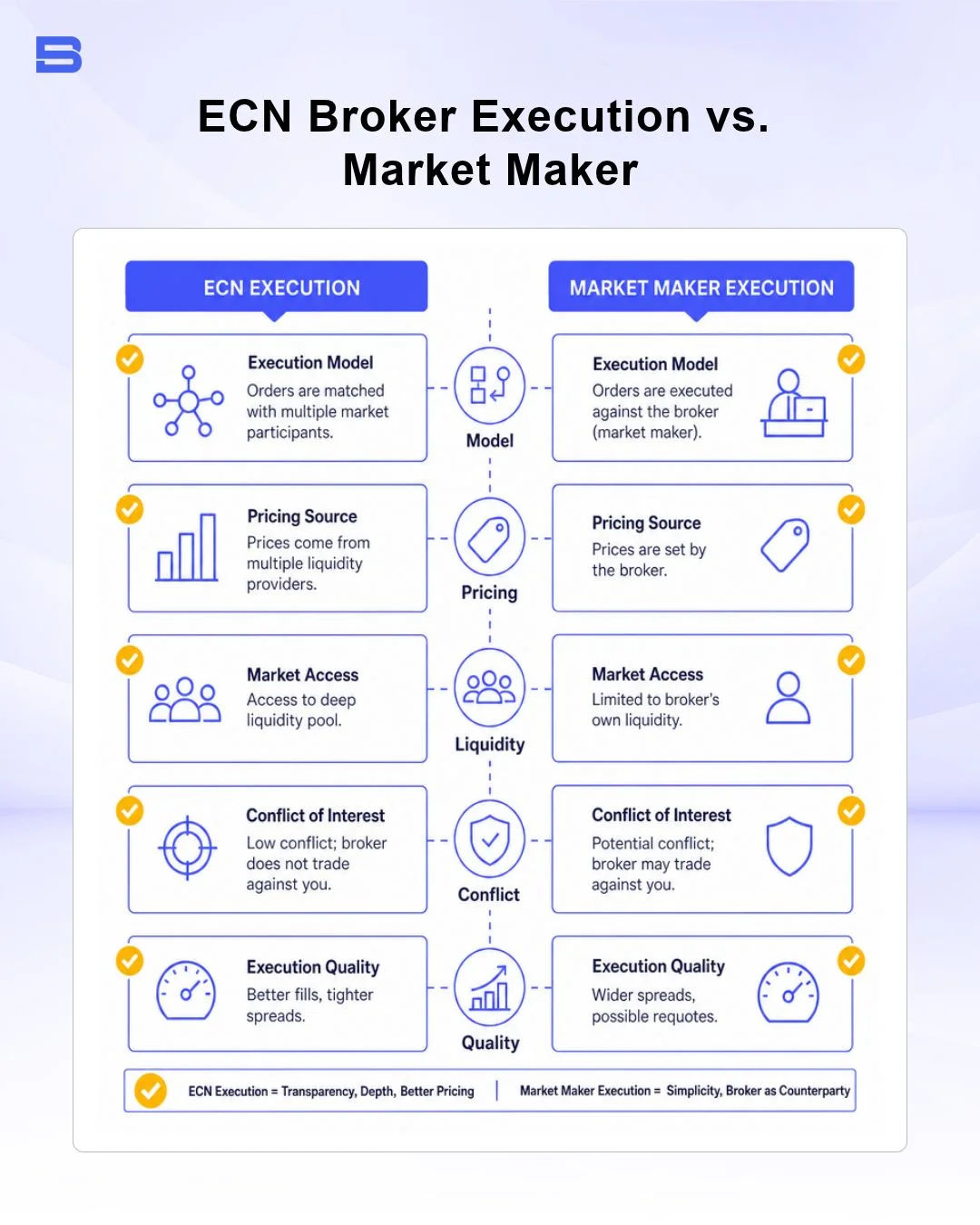
The model a broker uses to execute your orders directly dictates how spreads are priced and whether conflicts of interest exist.
An Electronic Communication Network (ECN) broker operates as a non-dealing desk (NDD) intermediary, routing client orders directly to an electronic communications network composed of banks, hedge funds, and institutional market participants. Because the ECN broker does not take the opposing side of your trade, their sole incentive is matching orders quickly and charging a transparent commission.
Market Makers (Dealing Desk brokers), on the other hand, create an internal market for their clients. They set their own bid and ask prices and frequently take the opposite side of client trades. Market Makers typically absorb volatility risk by offering wider, padded standard spreads without separate commissions.
Liquidity Providers and Execution Quality
A low spread broker depends heavily on the depth and quality of its liquidity provider forex network. Tier-1 banks and leading financial institutions stream competing bid and ask quotes into the broker’s pricing engine, helping maintain tighter spreads and competitive execution.
A broker connected to multiple Tier-1 liquidity providers can aggregate these quotes, automatically displaying the tightest bid and ask combination to the trader. Without deep liquidity, even an advertised "low spread broker" account can experience frequent pricing gaps or order rejections.
Commission vs Spread Pricing Models
Choosing between commission-based and spread-only pricing depends on your trading frequency and position holding times.
- Commission-Based Pricing: Best suited for day traders, scalpers, and automated Expert Advisors (EAs) that rely on precise entry levels and tight price targets.
- Spread-Only Pricing: Often preferred by swing traders or long-term investors who trade infrequently and prioritize simple accounting over fractional-pip accuracy.
Calculating the True Cost of Trading (Hidden Trading Fees)
Focusing solely on advertised spreads is a common mistake. An account advertising "0.0 pips" is rarely cost-free, and evaluating real trading expenses requires looking at the total cost equation.
Total Cost = Spread Cost + Commission + Slippage + Swap/Overnight Fees
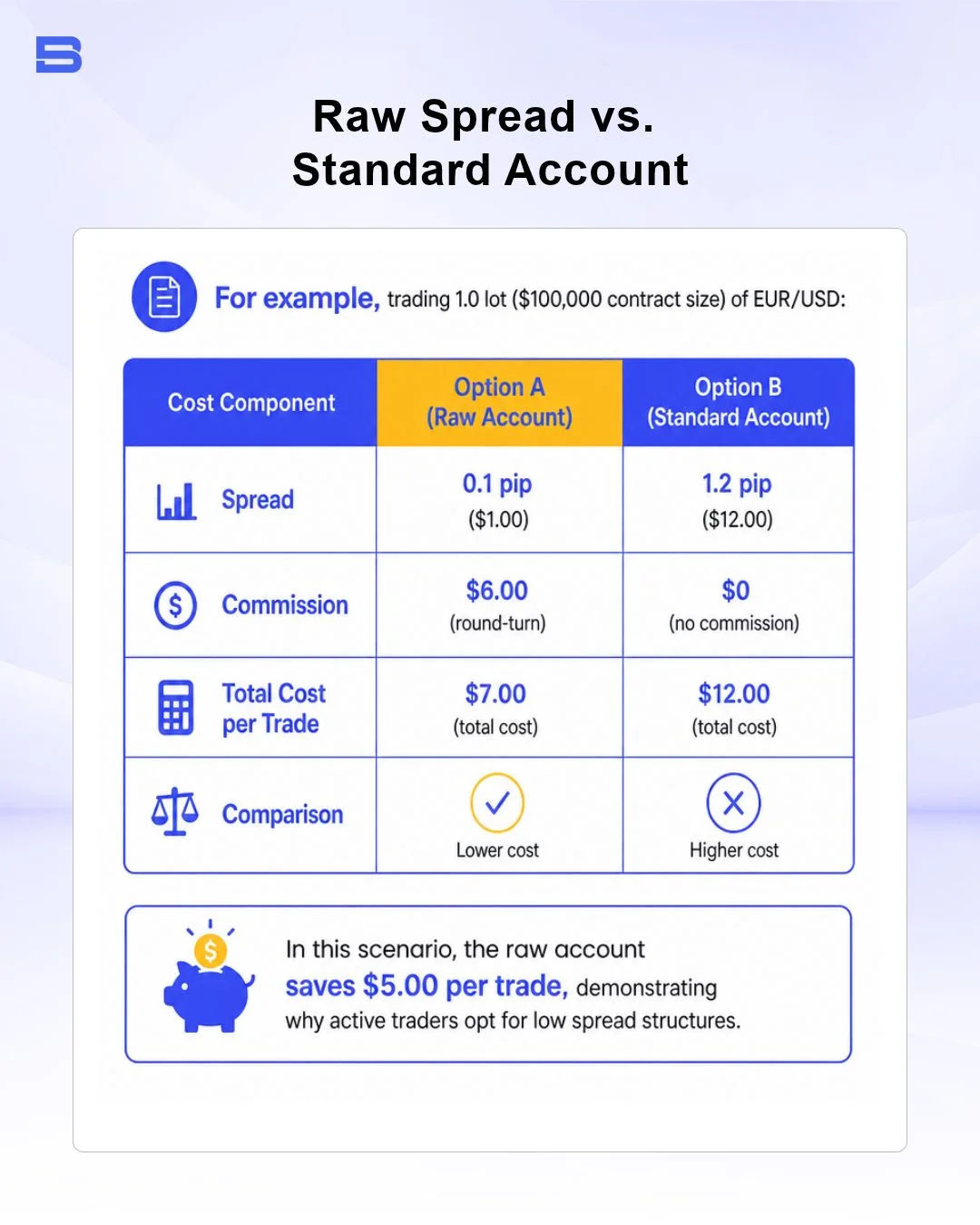
For example, trading 1.0 lot (standard $100,000 contract size) of EUR/USD:
- Option A (Raw Account): 0.1 pip spread (typical $1.00 cost) + $6.00 round-turn commission = $7.00 total cost.
- Option B (Standard Account): 1.2 pip spread ($12.00) + $0 commission = $12.00 total cost.
In this scenario, the raw account saves $5.00 per trade, demonstrating why active traders opt for low spread broker structures.
Slippage and Market Liquidity Impact
Order execution speed plays a critical role in realizing advertised spreads. Slippage in forex occurs when an order fills at a price different from the requested rate due to market movement during order transmission.
During high-impact economic news releases or market openings, liquidity providers temporarily withdraw order depth, causing spreads to naturally expand. If execution latency is slow, a trade submitted at a 0.2 pip spread might fill 1.5 pips higher. Slippage can quietly erase the cost savings of a low spread broker account, making execution speed just as vital as advertised pricing.
Additionally, swing traders holding positions overnight must account for swap rates (rollover fees). A broker with tight intra-day spreads might charge higher overnight financing rates, offsetting initial fee savings if trades are held across sessions.
Regulatory Oversight and Security Standards
A competitive pricing model offers no benefit if your invested capital lacks regulatory protection. Choosing a regulated broker in Malaysia or an internationally licensed firm ensures that operational integrity and client fund segregation protocols are enforced.
Top-tier regulatory bodies enforce strict capital adequacy rules and mandate segregated accounts, keeping trader deposits separate from corporate operational funds.
- Local Frameworks: Investors trading foreign exchange or financial derivatives should verify regulatory guidelines issued by the Securities Commission Malaysia (SC) and review the Bank Negara Malaysia (BNM) official lists to ensure compliance with domestic exchange controls.
- Tier-1 International Regulators: Overseas entities regulated by the UK Financial Conduct Authority (FCA) or Australian Securities and Investments Commission (ASIC) adhere to strict execution transparency standards and client money protection rules.
Leverage amplifies your returns when you're right, but it accelerates capital destruction just as quickly when the market moves against you. A 2.5% move against a 30:1 position can wipe out a large share of your margin and trigger a margin call, forcing automatic liquidation of your positions at unfavorable prices. This means you can lose far more than your initial margin deposit if the position moves sharply against you.
Conclusion
Finding the right broker requires looking beyond advertised “0.0 pip” spreads. Comparing total trading costs, including commissions, execution speed, slippage, and overnight swaps, helps identify the lowest spread forex broker based on actual trading expenses.
Choosing a low spread broker Malaysia traders can rely on involves balancing competitive trading costs, strong regulatory oversight, and reliable execution to protect your capital and minimize fees that directly impact your trading strategy.
- Proprietary Trading Explained: What It Is and Its Key Benefits
- TradingView: Features, Broker Integration, and Strategies
- cTrader: How It Works and How It Compares
- What Is a VPS for Trading and Do You Need One?
- Thinkorswim Trading: Features, Tools, and Availability
- Trading Platform Malaysia: What to Look For
- Bursa Anywhere: A Guide to Managing Shares in Malaysia
- What Is Forex Factory and How Do Traders Use It?
- Delta App: Multi-Asset Portfolio Tracker for Crypto & Stocks
- What Is Trading Central and How to Use It?
- What Is Simply Wall St and How to Use It
- What Is Seeking Alpha and How to Use It
- What Is MarketWatch and How to Use It
- What Is Barchart and How to Use It
- Google Finance Explained: How to Track Stocks and Markets
- What Is Finviz and How to Use It for Stock Screening
- What Is Yahoo Finance and How to Use It
- What Is TradingEconomics and How to Use It
- StockCharts Review 2026: Features, Pricing, and Performance
- What Is ZuluTrade and How Does Copy Trading Work on It?
- What Is Investing.com and How to Use It?
- What Is Myfxbook and How Do Traders Use It?
- What Is CoinGecko? A Complete Guide to Crypto Data Tracking
- What Is CoinMarketCap and How to Use It
- What Is CoinStats and How to Use It for Portfolio Tracking
- What Is Sharesight and How to Use It for Portfolio Tracking
- What Is Personal Capital and How to Use It
- What Is a Low Spread Broker? How It Affects Your Trading
- What Is an Introducing Broker (IB) in Forex?
- What Is Social Trading? How Copy Trading Platforms Work
- What Is a PAMM Account? How Managed Forex Accounts Work
- What Is a Margin Account and How Does Margin Trading Work?
- What Are Trading Signals and How Do They Work?
- What Is an Expert Advisor (EA) in Forex Trading?
Disclaimer: The content on this page is intended for educational and informational purposes only. It does not constitute financial, investment, tax, or legal advice, and should not be interpreted as a recommendation to buy, sell, or hold any financial instrument or asset. Trading and investing involve significant risk, including the possible loss of your entire capital. Products such as forex, CFDs, and cryptocurrencies carry additional risks due to leverage, high volatility, and limited regulatory protection in some jurisdictions. Past performance of any financial instrument does not guarantee future results. Any market views, forecasts, or opinions expressed are those of the author at the time of writing and may not reflect current market conditions. Platform features, fees, and regulatory status are subject to change — always verify information directly with the relevant provider or regulator before making any financial decision. BrokerSpecs may receive compensation from third parties featured on this site. Always conduct your own due diligence and consider seeking advice from a licensed financial professional before investing. Portions of this article were prepared with the assistance of AI tools and reviewed by our editorial team before publication.