


Related Tags
Entering the forex market can feel overwhelming if you lack the time to analyze charts, execute trades, and manage positions around the clock. Many traders want market exposure but prefer to leverage the expertise of experienced professionals.
This is where managed account structures like PAMM accounts come into play, offering a pooled investment system that automates trade allocation.
What Is a PAMM Account and How Does It Work?
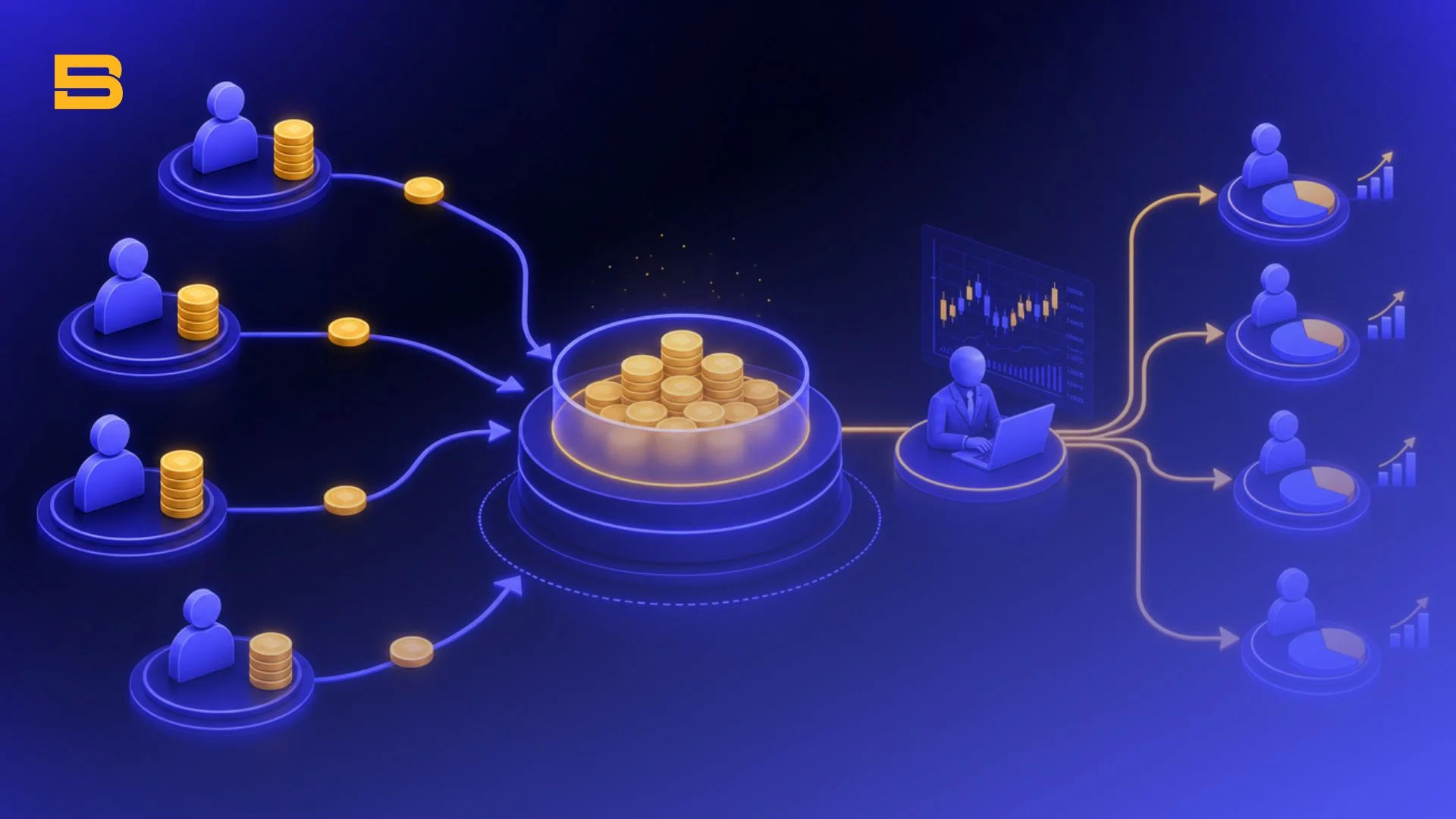
A PAMM account—which stands for Percentage Allocation Management Module—is a technical solution offered by forex brokerages that enables investors to pool their capital together under a single master trader, known as the Money Manager.
Instead of executing individual trades on every investor's account separately, the Money Manager places trades through a centralized Master Account. The broker's PAMM software automatically calculates the percentage of total capital contributed by each investor and divides trades, profits, and losses proportionally across all participating accounts in real time.
Importantly, investors retain ownership of their individual accounts. The Money Manager only receives trading authority over the pooled equity; they cannot withdraw investor funds directly or transfer capital outside the platform.
How PAMM Equity Allocation Works (Worked Example)
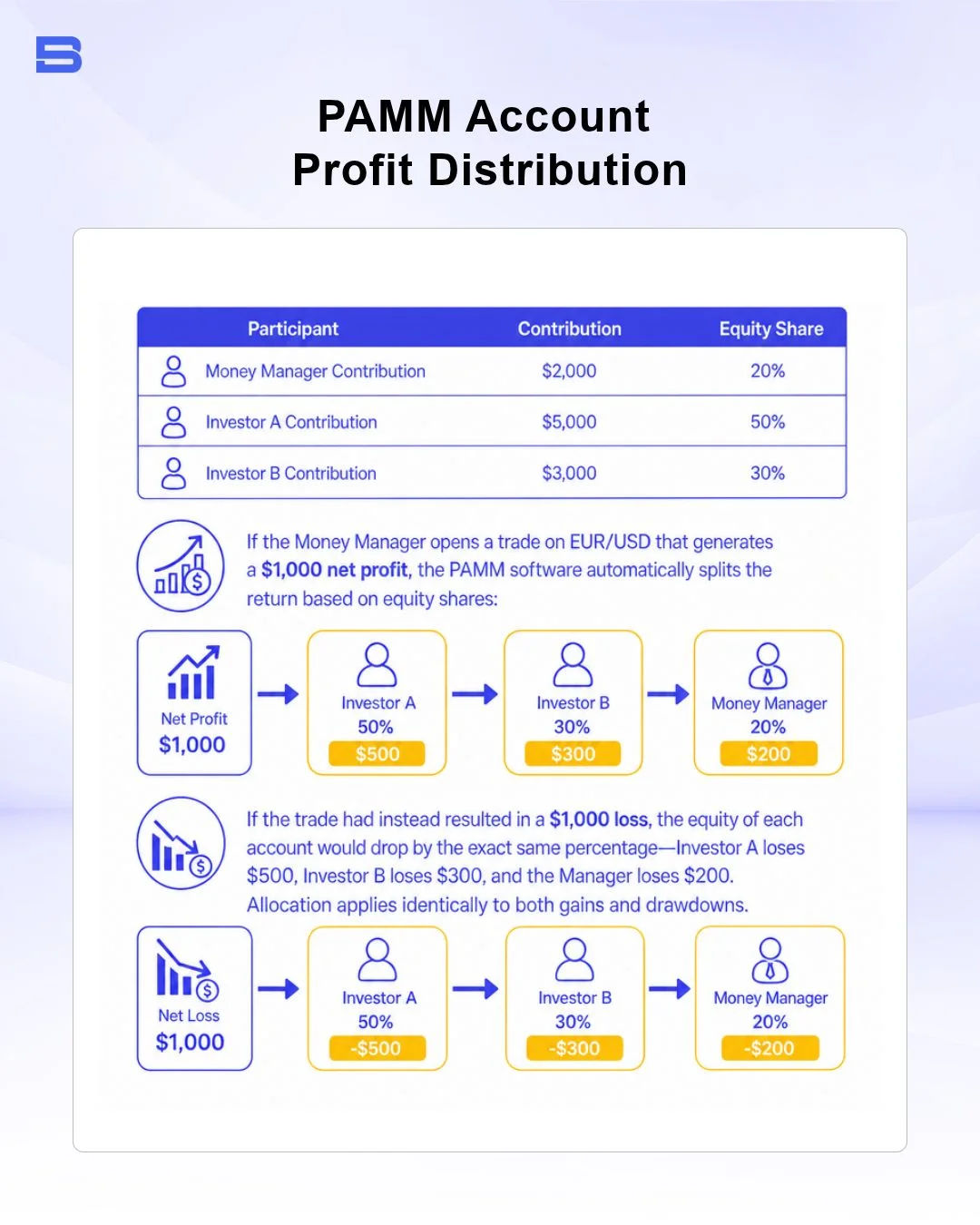
To understand how PAMM account allocation functions, consider a pooled account with $10,000 in total equity:
- Money Manager Contribution: $2,000 (20% share)
- Investor A Contribution: $5,000 (50% share)
- Investor B Contribution: $3,000 (30% share)
If the Money Manager opens a trade on EUR/USD that generates a $1,000 net profit, the PAMM software automatically splits the return based on equity shares:
- Investor A receives 50% of the gain ($500)
- Investor B receives 30% of the gain ($300)
- Money Manager receives 20% of the gain ($200)
If the trade had instead resulted in a $1,000 loss, the equity of each account would drop by the exact same percentage—Investor A loses $500, Investor B loses $300, and the Manager loses $200. Allocation applies identically to both gains and drawdowns.
PAMM vs MAM vs Copy Trading: Key Differences
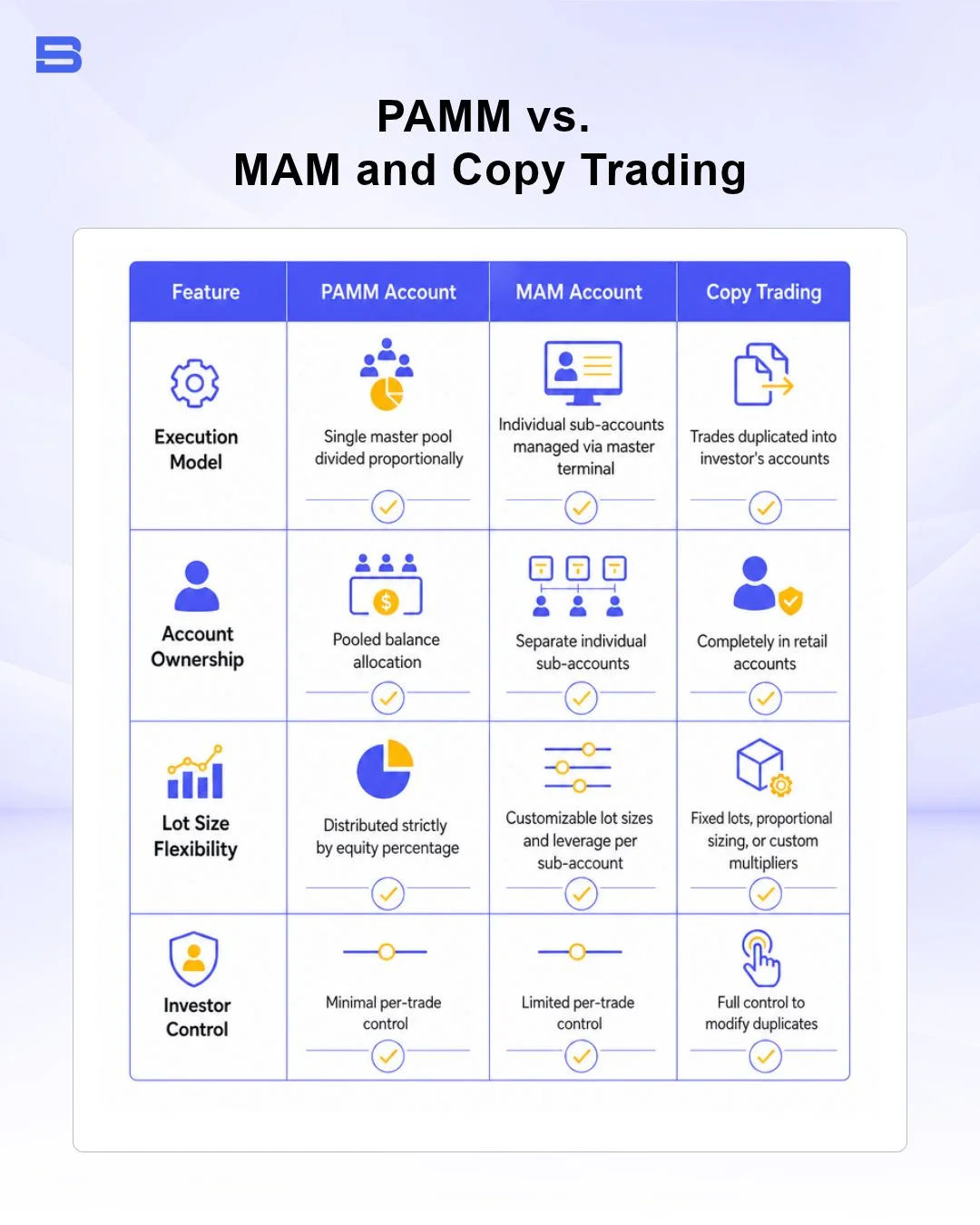
While PAMM accounts, MAM (Multi-Account Manager), and Copy Trading all allow hands-off participation in the market, their underlying architecture and execution mechanisms differ significantly.
Fee Structures and the High-Water Mark Principle
Money Managers are typically compensated through performance fees, taking an agreed-upon percentage (e.g., 20%) of the net profits generated for investors. To protect investors from paying duplicate fees on recovered losses, reputable PAMM brokers enforce the High-Water Mark principle.
Under a High-Water Mark rule, a manager only earns performance fees when the account equity reaches a new peak value. For example, if an investor's balance grows from $5,000 to $6,000, the manager earns a performance fee on the $1,000 gain.
However, if the balance subsequently drops to $5,200 during a market drawdown, the manager will not receive any performance fees on future gains until the account equity surpasses the previous $6,000 peak.
Key Risks and Limitations of PAMM Accounts
While PAMM accounts simplify exposure to forex markets, they carry distinct structural and trading risks that every participant must evaluate:
- Manager Drawdown Risk: Past performance does not guarantee future results. Even experienced managers experience extended periods of loss or account drawdowns that directly impact your capital.
- Lack of Trade Control: Once capital is allocated to a PAMM account pool, investors cannot close individual open positions or alter risk settings on specific trades.
- Execution and Slippage Risks: In volatile market conditions, larger master orders can experience execution slippage, affecting entry and exit prices across the pool.
- Leverage Risks: Money Managers operating on a margin account structure often utilize leverage. Leverage amplifies potential gains when trades are successful, but it accelerates capital losses just as quickly when the market moves against a position.
Factors When Evaluating PAMM Account Brokers
Choosing a reliable PAMM brokerage requires thorough due diligence to protect your capital from fraudulent operations or unfair execution terms. Consider these critical evaluation factors:
- Regulatory Supervision: Ensure the brokerage operates under reputable Tier 1 or Tier 2 authorities, such as the Financial Conduct Authority (FCA), the Australian Securities and Investments Commission (ASIC), or the Securities Commission Malaysia (SC). Regulatory oversight ensures segregated client accounts and standard operational transparency.
- Verified Manager Track Records: Look for brokers providing independently audited performance histories (such as Myfxbook integration) rather than unverified self-reported gains.
- Flexible Rollover and Withdrawal Terms: Check how frequently investors can enter or exit a PAMM account without incurring penal withdrawal fees or triggering forced trade closures.
- Manager Equity Skin in the Game: Evaluate how much capital the Money Manager contributes to the pool. Managers with significant personal funds at stake are naturally aligned with managing drawdown risk conservatively.
Related Managed Account Structures
PAMM accounts represent one segment within broader forex account types offered by modern brokerages. Depending on your investment objectives, you may encounter related managed models, such as accounts introduced through an introducing broker network or specialized corporate portfolio management funds.
- Proprietary Trading Explained: What It Is and Its Key Benefits
- TradingView: Features, Broker Integration, and Strategies
- cTrader: How It Works and How It Compares
- What Is a VPS for Trading and Do You Need One?
- Thinkorswim Trading: Features, Tools, and Availability
- Trading Platform Malaysia: What to Look For
- Bursa Anywhere: A Guide to Managing Shares in Malaysia
- What Is Forex Factory and How Do Traders Use It?
- Delta App: Multi-Asset Portfolio Tracker for Crypto & Stocks
- What Is Trading Central and How to Use It?
- What Is Simply Wall St and How to Use It
- What Is Seeking Alpha and How to Use It
- What Is MarketWatch and How to Use It
- What Is Barchart and How to Use It
- Google Finance Explained: How to Track Stocks and Markets
- What Is Finviz and How to Use It for Stock Screening
- What Is Yahoo Finance and How to Use It
- What Is TradingEconomics and How to Use It
- StockCharts Review 2026: Features, Pricing, and Performance
- What Is ZuluTrade and How Does Copy Trading Work on It?
- What Is Investing.com and How to Use It?
- What Is Myfxbook and How Do Traders Use It?
- What Is CoinGecko? A Complete Guide to Crypto Data Tracking
- What Is CoinMarketCap and How to Use It
- What Is CoinStats and How to Use It for Portfolio Tracking
- What Is Sharesight and How to Use It for Portfolio Tracking
- What Is Personal Capital and How to Use It
- What Is a Low Spread Broker? How It Affects Your Trading
- What Is an Introducing Broker (IB) in Forex?
- What Is Social Trading? How Copy Trading Platforms Work
- What Is a PAMM Account? How Managed Forex Accounts Work
- What Is a Margin Account and How Does Margin Trading Work?
- What Are Trading Signals and How Do They Work?
- What Is an Expert Advisor (EA) in Forex Trading?
Disclaimer: The content on this page is intended for educational and informational purposes only. It does not constitute financial, investment, tax, or legal advice, and should not be interpreted as a recommendation to buy, sell, or hold any financial instrument or asset. Trading and investing involve significant risk, including the possible loss of your entire capital. Products such as forex, CFDs, and cryptocurrencies carry additional risks due to leverage, high volatility, and limited regulatory protection in some jurisdictions. Past performance of any financial instrument does not guarantee future results. Any market views, forecasts, or opinions expressed are those of the author at the time of writing and may not reflect current market conditions. Platform features, fees, and regulatory status are subject to change — always verify information directly with the relevant provider or regulator before making any financial decision. BrokerSpecs may receive compensation from third parties featured on this site. Always conduct your own due diligence and consider seeking advice from a licensed financial professional before investing. Portions of this article were prepared with the assistance of AI tools and reviewed by our editorial team before publication.