


- What Is Trading and How Does Trading Work?
- Trading Fundamentals: A Guide for Beginners
- Trading vs. Investing: What Are the Key Differences?
- Trading Terms and Terminologies Every Beginner Should Know
- Common Trading Mistakes Beginners Make and How to Avoid
- Understanding Risk and Reward in Trading: A Complete Guide
- Guide to the Different Types of Financial Markets
- Investment Basics: Definition, Strategies, and How to Invest
- Benefits of Investing: Financial Growth and Security
- What Is Swing Trading? A Practical Guide For Beginners
- What Is Spot Trading? A Guide for Beginners
- What Are Futures in Trading? A Guide for Beginners
- Understanding Bull Markets: Growth & Strategy
- How to Read a Candlestick Chart: A Guide for Beginners
- Is Trading Gambling? The Truth About Risk
- Pip in Forex: How It Works & How to Calculate It
- What Is the Bid-Ask Spread in Trading? A Guide for Beginners
- What Is a Margin Call? A Guide for Beginners
- Market Volatility Explained: What It Is and How to Trade It
- Drawdown in Trading: Meaning, Math, and Risk
- Understanding Slippage in Trading: Causes and Control
- Forex Lot Size Explained: Standard, Mini & Micro
- Trailing Stop vs Stop Loss: Essential Risk Strategy
- How Asset Allocation Works: Strategies Explained
- Understanding Market Trading Hours & Sessions
- Market Makers Explained: A Trader's Guide
- Portfolio Diversification: A Strategy Guide
- Capital Gains Explained: How Investment Taxes Work
- Stock Market Circuit Breakers: How Trading Halts Work
- What Is an IPO? How Initial Public Offerings Work
- What Is a Secondary Market? A Complete Guide
- What Is a Stock Exchange? Functions and Overview Explained
- Understanding Ticker Symbols: A Market Guide
- How Clearing Houses Work in Financial Markets
- Stock Market After Labor Day: Trends and What To Expect

You click "Buy" on EUR/USD (Euro and US Dollar) at 1.0850, expecting to enter the trade precisely at that number. But when the confirmation flashes on your screen a split second later, your entry price shows 1.0853. You just lost three pips before the trade even gets underway.
This gap between the price you expect and the price you actually get is called slippage in trading. It is one of the most common surprises for developing traders, yet it is a natural feature of open financial markets rather than a broker malfunction. Understanding how slippage works—and how to control it—is essential to protecting your trading edge.
What Causes Slippage in Trading?
Slippage occurs in the fractional second between the moment you submit an order and the moment your broker’s order-matching engine executes it. If the market moves during that brief window, your execution price changes.
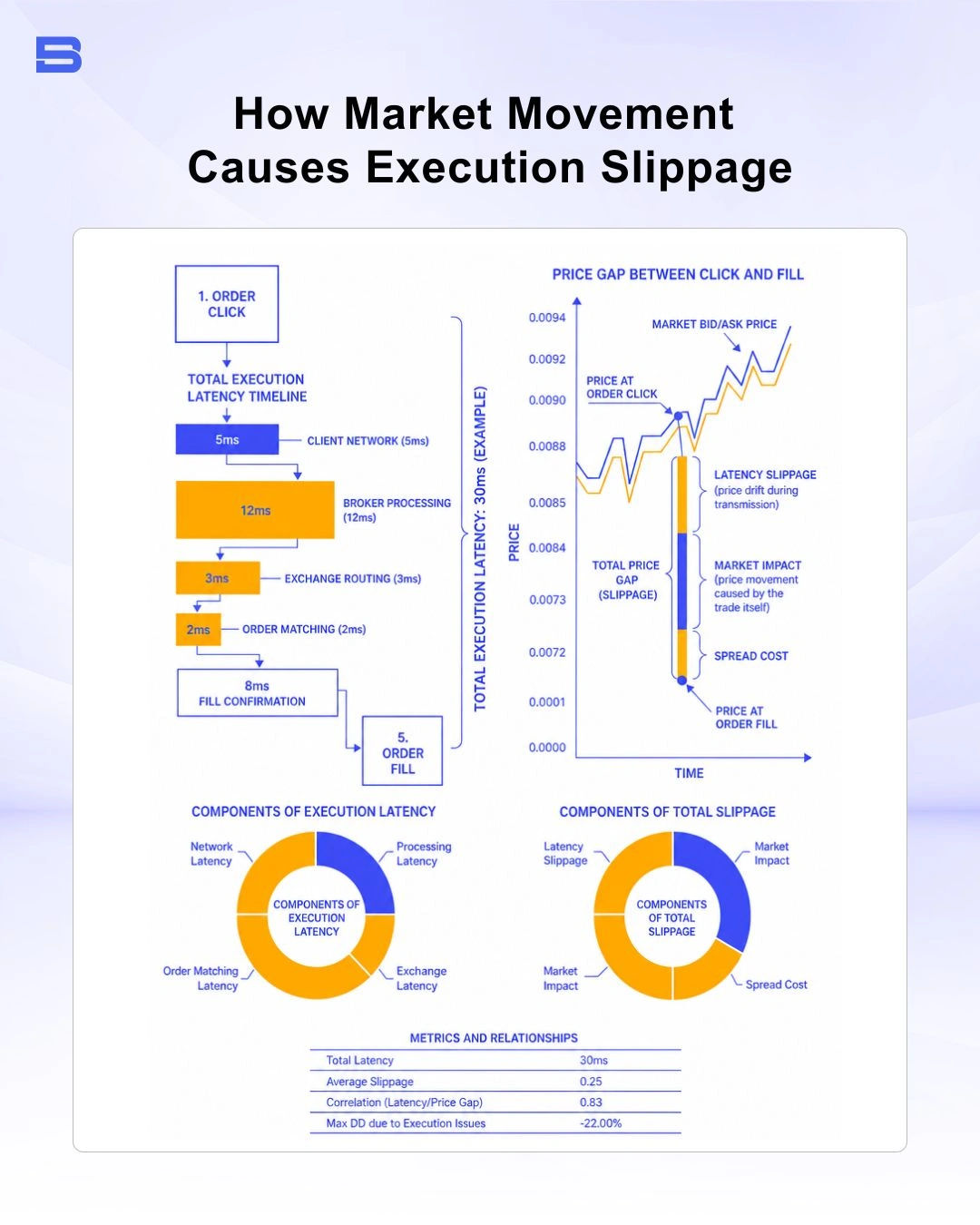
Three main factors drive execution gaps in live trading:
- Market Volatility: High-impact economic news, unexpected earnings reports, or geopolitical events cause rapid price jumps. During these moments, available prices move faster than order routing systems can process orders.
- Liquidity Gaps: Financial markets rely on order books built from bid-ask spread quotes, the gap between the buy/bid and sell/ask prices on offer. If you place a large market order in an asset with low order depth, your broker fills your order across multiple price tiers, worsening your average price.
- Execution Latency: The physical distance between your computer server, your broker's server, and the liquidity provider's engine introduces time delay. Even a 50-millisecond delay can result in price changes during volatile conditions.
Positive vs. Negative Slippage: Is It Always Bad?
Traders often treat slippage as a hidden tax, but execution gaps can move in either direction depending on market momentum.
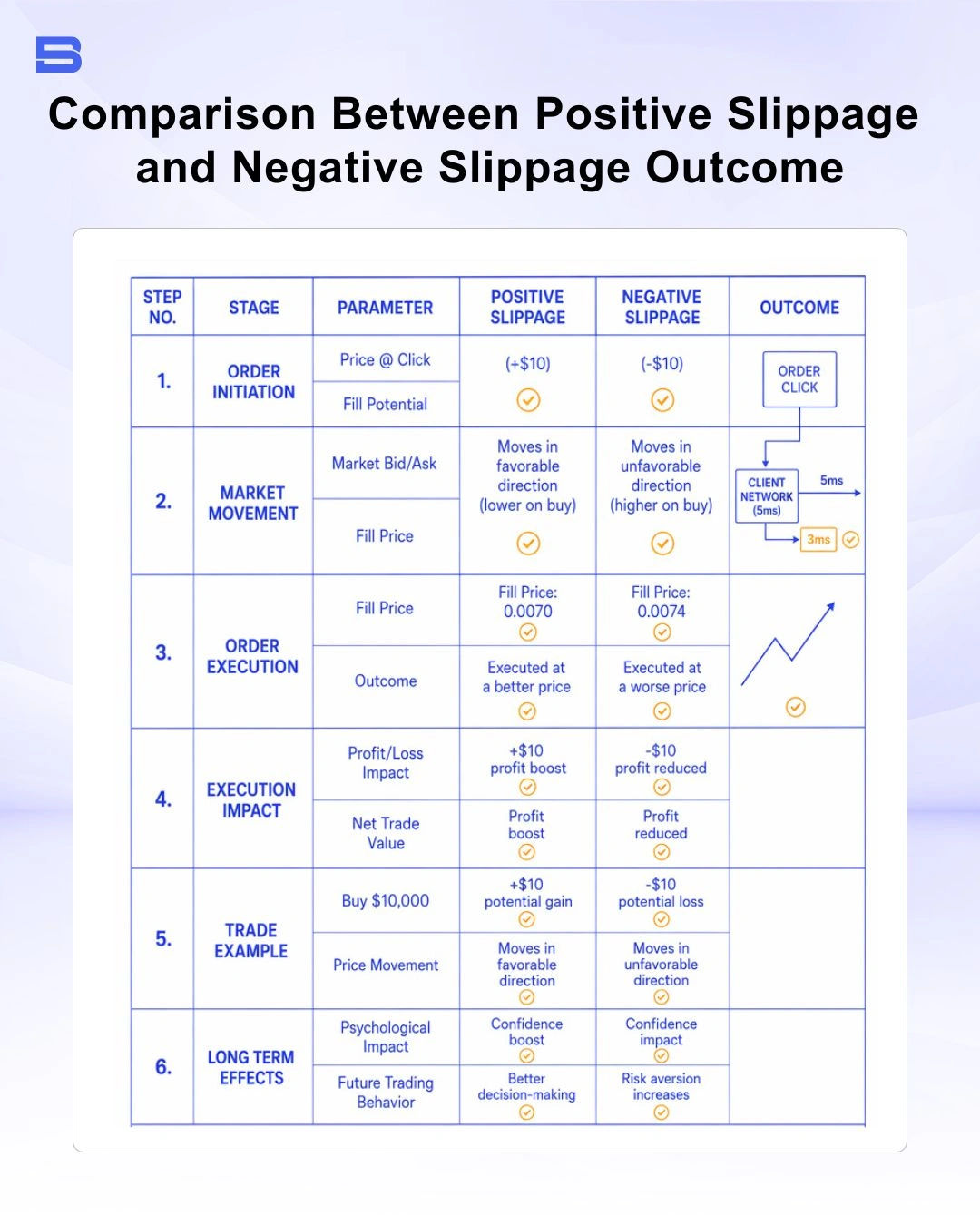
Negative Slippage
Negative slippage happens when your order fills at a worse price than anticipated. For a buy order, this means purchasing at a higher price; for a sell order, it means selling at a lower price. This directly increases your transaction cost or reduces your initial profit potential.
Positive Slippage
Positive slippage occurs when market prices shift in your favor while your order is processing. For example, if you place a market buy order at 1.0850, but sudden selling pressure pushes the price down to 1.0848 right before execution, your fill occurs at 1.0848. You receive a better price than requested, saving money at the point of entry.
Key Takeaway: Slippage is a structural reality of trading on live order books. While negative slippage costs you money, positive slippage works in your favor over time if your broker uses a true non-dealing desk (NDD) execution model — one where your orders route directly to liquidity providers rather than passing through an internal dealing desk.
Market Orders vs. Limit Orders: The Slippage Battle
Your choice of order type determines whether your position is exposed to price movement during execution.
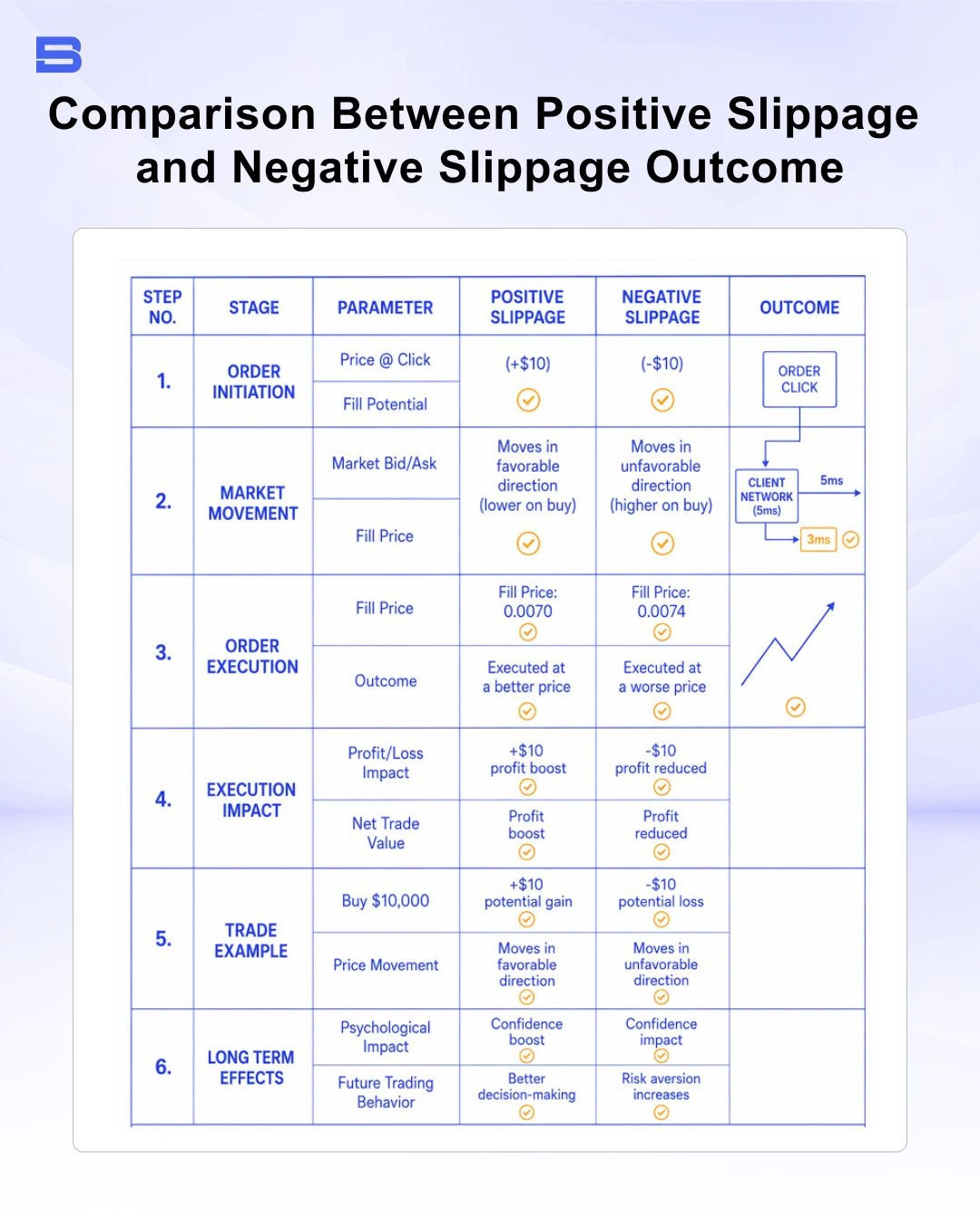
Your choice of order type determines whether your position is exposed to price movement
Market Order
- Price Control: None — fills at whatever price is currently available
- Execution Certainty: Guaranteed — fills immediately
- How It Works: You instruct the broker to fill your order right away, at the best available price in the order book.
Limit Order
- Price Control: Guaranteed — never fills worse than your set price
- Execution Certainty: Not guaranteed — may remain unfilled
- How It Works: Your order only fills at your specified price or better; if the market leaps past that price, it stays open.
Worked Example: Slippage Cost Calculation
Let's look at how negative slippage impacts execution cost on a standard position during a volatile news event:
- Order Setup: You place a market buy order for one Standard Lot (100,000 units) of EUR/USD at 1.0850 right after a central bank rate announcement.
- Market Shock: Extreme volatility causes the bid-ask quote to jump four pips in 30 milliseconds.
- Execution Result: Your market order fills at 1.0854 instead of 1.0850.
- Cost Calculation:
Slippage Gap = 1.0854 - 1.0850 = 0.0004 (four pips)
Financial Impact = four pips x $10 per pip (the standard value for a Standard Lot on a USD-quoted pair like EUR/USD; your actual pip value will differ based on your account currency, lot size, and currency pair) = $40
What this means for you: Before your trade even develops, you start with an uncalculated $40 expense due to negative execution drift. On a small account, repeated execution losses of this size can significantly erode your statistical edge over time.
Practical Ways to Minimize Slippage in Your Trades
While you cannot eliminate market movement, you can apply practical execution rules to control your exposure to price gaps:
- Trade During Peak Market Liquidity: Asset markets experience the lowest slippage when trading volume is highest. For forex, this occurs during the London-New York session overlap. For equities, stick to the opening and closing hours of main exchanges.
- Use Limit and Stop-Limit Orders: Replace market orders with limit orders whenever timing allows. Limit orders ensure you never pay more than your designated price ceiling.
- Set Maximum Slippage Tolerances: Modern trading platforms like MetaTrader allow you to define a maximum price deviation. If the market moves beyond your chosen pip (the smallest standard price increment in a currency pair, typically 0.0001) tolerance during order transmission, the platform cancels the order automatically rather than filling at an unfavorable rate.
- Avoid Trading High-Impact Economic Releases: Major updates like U.S. Non-Farm Payrolls (NFP) or inflation reports create order book imbalance and extreme volatility. Waiting a few minutes after news announcements allows market liquidity to normalize before you enter trading economic news releases.
The Bottom Line
Slippage is an inevitable variable when trading financial markets. It is not inherently a broker trick or a platform error, but a reflection of real-time supply, demand, and execution speed. By choosing the appropriate order types, trading during peak market hours, and controlling slippage tolerance settings, you can protect your account capital from uncalculated execution drag.
Disclaimer: The content on this page is intended for educational and informational purposes only. It does not constitute financial, investment, tax, or legal advice, and should not be interpreted as a recommendation to buy, sell, or hold any financial instrument or asset. Trading and investing involve significant risk, including the possible loss of your entire capital. Products such as forex, CFDs, and cryptocurrencies carry additional risks due to leverage, high volatility, and limited regulatory protection in some jurisdictions. Past performance of any financial instrument does not guarantee future results. Any market views, forecasts, or opinions expressed are those of the author at the time of writing and may not reflect current market conditions. Platform features, fees, and regulatory status are subject to change — always verify information directly with the relevant provider or regulator before making any financial decision. BrokerSpecs may receive compensation from third parties featured on this site. Always conduct your own due diligence and consider seeking advice from a licensed financial professional before investing.