


- How to Start Trading: A Step-by-Step Guide for Beginners
- Demo Trading Accounts: Safe Practice for Beginners
- Understanding How Much Capital You Need to Start Trading
- How to Set Realistic Trading Goals as a New Trader
- How to Open a Trading Account in Malaysia (Step-by-Step)
- How to Start Trading in Malaysia: A Guide for Beginners
- How to Create a Trading Plan Before You Start Trading
- What Is a Trading Account? Everything You Need to Know
- How to Learn Trading: Step-by-Step Beginner Roadmap
- What Is Stop Loss in Trading and How Does It Work?
- Why Every Trader Needs a Trading Journal
- Islamic Forex Account Explained: How Swap-Free Trading Works
- Funded Trading Account: Rules, Splits & Risks
- Master Money Management: Practical Capital Protection Rules
- Overtrading Explained: Common Causes, Signs, and How to Stop
- How Risk-Reward Ratio Works: A Guide to Trading Risk
- How to Open a Brokerage Account as a Beginner
- What Is a Cent Account Forex and How Does It Work?
- What Is an ECN Account and How Does It Work?
- What Is Cashback Forex and How Does It Work?
- Fixed Deposit vs Unit Trust: Key Differences for Investors
- Welcome Bonus Forex: What It Is and What to Watch For
- Forex Deposit Bonus: How It Works
- What Is Forex Rebate and How Does It Work?
- What Is Forex Free Credit and How Does It Work?
- Trading Webinars: Are They Worth Attending?
- Trading for Beginners PDF: What to Look For in a Good Guide
- Trading 101: How to Start Trading Safely and Effectively

Entering a trade for the first time can be thrilling, but seeing an immediate deduction on your account balance before the market even moves can be perplexing. Imagine executing a buy order on Euro and US Dollar (EUR/USD), expecting zero spread, only to notice a $7 commission fee subtracted instantly. Your trade starts in negative territory before price action even takes off.
This is the standard experience on an ECN account. While Electronic Communication Network (ECN) trading offers direct market execution and raw spreads, its cost structure and operational mechanics differ fundamentally from standard retail trading accounts. Understanding whether this model fits your trading volume, capital size, and strategy is essential before opening a live account.
What Is an ECN Account and How Does It Work?
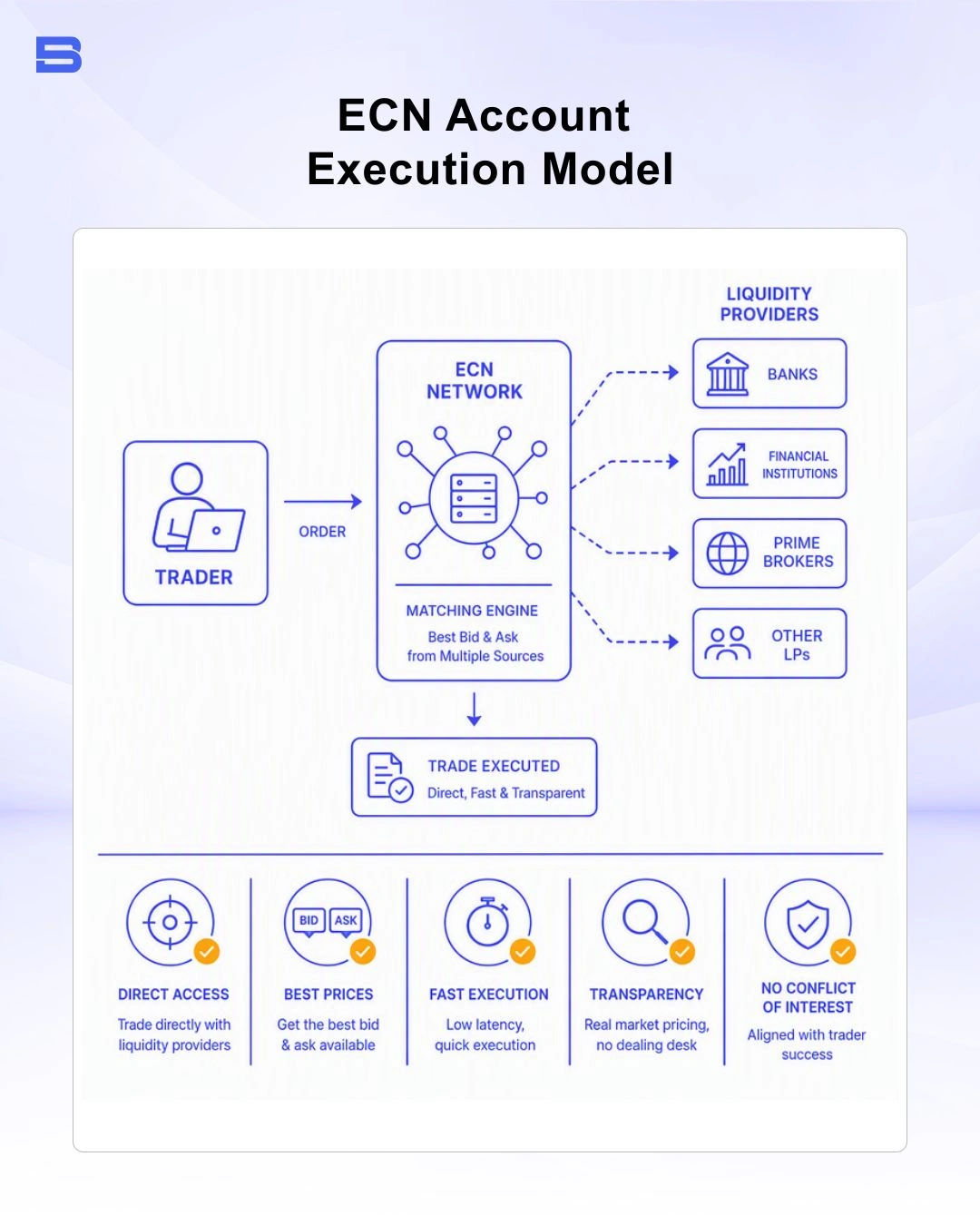
An ECN account is a trading execution model that connects individual traders directly to a network of market participants—including commercial banks, institutional liquidity providers, prime brokers, and other retail traders. Unlike market maker models where a broker may take the opposing side of your order, an ECN broker operates using direct order processing.
To understand the broader setup of brokerage infrastructure, exploring what is a trading account provides essential context on how client equity is routed to international liquidity pools.
Because an ECN broker functions as a technology bridge rather than a counterparty, execution occurs with no dealing desk (NDD) intervention. Orders are automatically matched against the best available bid and ask prices across the global liquidity pool. This pricing model relies on Depth of Market (DOM) transparency.
Through a DOM order book, traders can view real-time market liquidity at varying price levels, seeing exactly where institutional buy and sell orders sit. Major financial regulators, such as the Financial Conduct Authority (FCA), require strict order execution transparency from institutional liquidity providers to prevent price manipulation and unfair order routing.
ECN vs. Standard vs. Cent Accounts: Key Differences
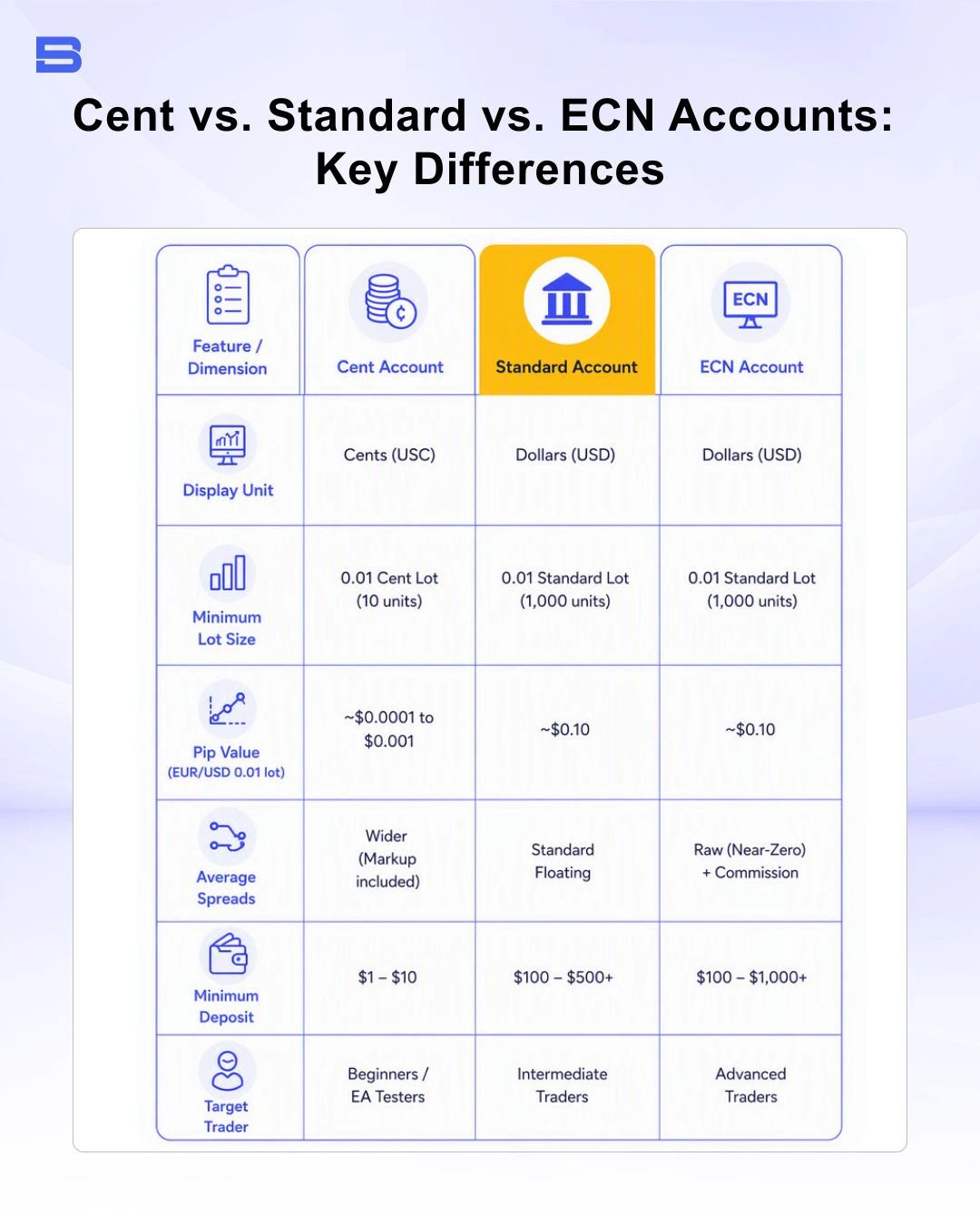
When selecting an account structure, traders usually choose between three primary pricing execution tiers: ECN accounts, Standard accounts, and Cent accounts. Understanding the difference between ECN and Standard account mechanics helps clarify which tier aligns with your capital structure.
- ECN Accounts: Feature raw spreads sourced straight from liquidity providers (frequently starting at 0.0 pips on EUR/USD) plus a fixed round-turn commission charged per traded lot. Execution is NDD-based.
- Standard Accounts: Feature spread-only pricing with zero commission. The broker marks up the raw spread (typically starting around 1.0 to 1.5 pips on EUR/USD) to generate revenue.
- Cent Accounts: Measure account balances in cents rather than standard currency units (e.g., $10 appears as 1,000 cents). Pricing relies on marked-up spreads, which makes the cent account forex model well suited for testing strategies with minimal risk.
The Real Cost Breakdown: Raw Spreads vs. Commissions
In trading, transaction costs consist of two components: the spread in trading (the difference between the buy/bid price and sell/ask price) and explicit fixed broker commissions.
Standard accounts combine all trading expenses into a single spread markup. ECN accounts separate these two elements, offering raw spreads directly from interbank liquidity providers while charging a standalone ECN commission per lot traded.
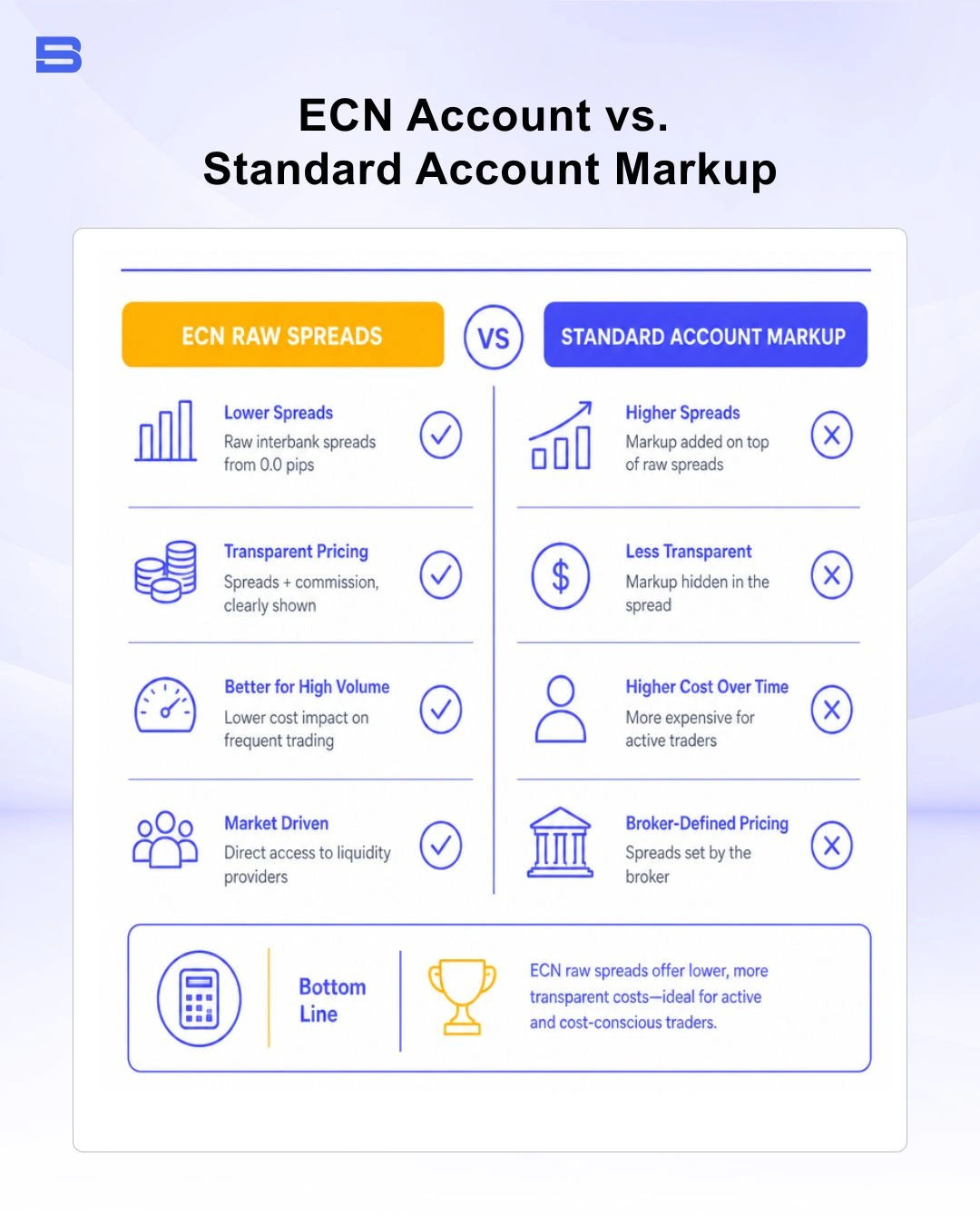
To determine which model offers lower trading costs, consider this comparative example executing a 1.0 standard lot ($100,000 unit contract) trade on EUR/USD (where one pip equals $10):
Standard Account Scenario:
- Spread: 1.2 pips ($12.00)
- Commission: $0.00
- Total Cost per Lot = $12.00
ECN Account Scenario:
- Raw Spread: 0.1 pips ($1.00)
- ECN Commission: $6.00 round-turn
- Total Cost per Lot = $7.00
In this scenario, trading 1.0 lot on an ECN account saves $5.00 per trade. However, transaction math shifts significantly when trading fractional positions (such as 0.01 micro-lots). Some brokers apply a fixed minimum commission per ticket order, which can make micro-lot trading more expensive per lot on ECN pricing tiers compared to Standard accounts.
The Hidden Risks: Variable Spreads and Slippage
While ECN accounts offer tight average spreads during normal market conditions, they are subject to variable spread behavior during volatile periods.
During high-impact macroeconomic announcements—such as US Non-Farm Payrolls or central bank rate decisions—liquidity providers may withdraw active bid/ask quotes from the network. Consequently, variable spread news events can cause raw spreads to temporarily widen from 0.0 pips to 10 pips or more in milliseconds.
Furthermore, because orders are matched directly against live market quotes without dealer intervention, traders face slippage risks. Slippage occurs when an order fills at a different price than requested due to rapid market movement.
Traders should remember that stop-loss orders are executed as market orders once triggered; during severe market gaps, execution price cannot be guaranteed at your exact stop level.
Should Beginners Use an ECN Account?
For beginners starting with small accounts ($50 to $200), an ECN account is not always the most effective choice. High initial minimum deposit thresholds, variable spreads during news volatility, and fixed ticket commissions can rapidly erode small balances. Regulatory bodies in several jurisdictions generally advise that beginner retail traders carefully evaluate total trading friction and execution models relative to their starting capital before opening a live account.
An ECN account is generally suitable if you:
- Trade high volume or use scalping strategies where 0.1-pip entry differences matter.
- Run automated Expert Advisors (EAs) that require precise pricing and fast execution speeds.
- Hold a larger account size ($1,000+) capable of managing variable spread fluctuations comfortably.
For beginners with limited capital, starting on a Standard or Cent account allows you to manage risk without paying fixed lot commissions while learning order placement mechanics.
Final Thoughts
Selecting an account type depends on matching execution mechanics to your trading strategy, volume, and risk model. While ECN accounts deliver order transparency and lower total transaction costs for high-volume traders, beginners should balance raw spreads against commission fees and market volatility before committing capital.
If you are ready to set up your trading workspace, review the steps for how to open a trading account in Malaysia to evaluate licensed platforms, funding rules, and verification requirements safely.
Disclaimer: The content on this page is intended for educational and informational purposes only. It does not constitute financial, investment, tax, or legal advice, and should not be interpreted as a recommendation to buy, sell, or hold any financial instrument or asset. Trading and investing involve significant risk, including the possible loss of your entire capital. Products such as forex, CFDs, and cryptocurrencies carry additional risks due to leverage, high volatility, and limited regulatory protection in some jurisdictions. Past performance of any financial instrument does not guarantee future results. Any market views, forecasts, or opinions expressed are those of the author at the time of writing and may not reflect current market conditions. Platform features, fees, and regulatory status are subject to change — always verify information directly with the relevant provider or regulator before making any financial decision. BrokerSpecs may receive compensation from third parties featured on this site. Always conduct your own due diligence and consider seeking advice from a licensed financial professional before investing.