


- How to Start Trading: A Step-by-Step Guide for Beginners
- Demo Trading Accounts: Safe Practice for Beginners
- Understanding How Much Capital You Need to Start Trading
- How to Set Realistic Trading Goals as a New Trader
- How to Open a Trading Account in Malaysia (Step-by-Step)
- How to Start Trading in Malaysia: A Guide for Beginners
- How to Create a Trading Plan Before You Start Trading
- What Is a Trading Account? Everything You Need to Know
- How to Learn Trading: Step-by-Step Beginner Roadmap
- What Is Stop Loss in Trading and How Does It Work?
- Why Every Trader Needs a Trading Journal
- Islamic Forex Account Explained: How Swap-Free Trading Works
- Funded Trading Account: Rules, Splits & Risks
- Master Money Management: Practical Capital Protection Rules
- Overtrading Explained: Common Causes, Signs, and How to Stop
- How Risk-Reward Ratio Works: A Guide to Trading Risk
- How to Open a Brokerage Account as a Beginner
- What Is a Cent Account Forex and How Does It Work?
- What Is an ECN Account and How Does It Work?
- What Is Cashback Forex and How Does It Work?
- Fixed Deposit vs Unit Trust: Key Differences for Investors
- Welcome Bonus Forex: What It Is and What to Watch For
- Forex Deposit Bonus: How It Works
- What Is Forex Rebate and How Does It Work?
- What Is Forex Free Credit and How Does It Work?
- Trading Webinars: Are They Worth Attending?
- Trading for Beginners PDF: What to Look For in a Good Guide
- Trading 101: How to Start Trading Safely and Effectively

You have spent weeks tracking Malaysian public companies, reading annual reports, and watching stock prices fluctuate on Bursa Malaysia. You are ready to purchase your very first shares in a company like Maybank or Public Bank.
However, when you click "Buy" on your trading app, you hit an unexpected roadblock: the platform asks for your 15-digit Central Depository System (CDS) account number.
In Malaysia, you cannot directly own or trade shares listed on Bursa Malaysia without a CDS account. It serves as your electronic vault, ensuring every share you buy is securely registered and tracked in your name or on your behalf. Understanding how to choose and set up a CDS account in Malaysia correctly is the foundational step toward building your stock portfolio.
Step 1: Direct CDS Account vs. Nominee CDS Account
Before submitting an application, you must make a fundamental decision: whether to open a Direct CDS account or a Nominee CDS account. This choice dictates how your investments are registered, how corporate actions are handled, and how your dividends reach you.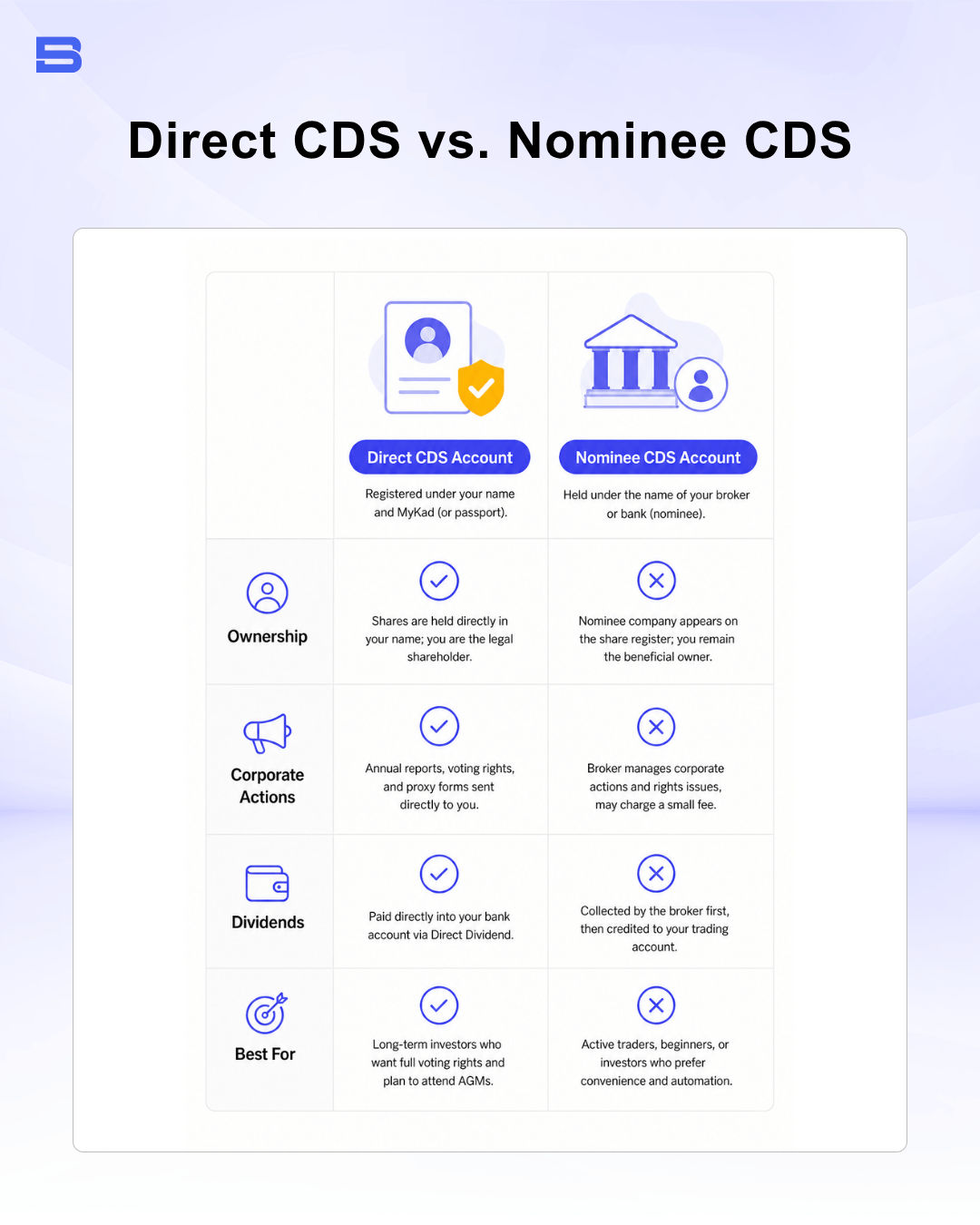
Direct CDS Account
A Direct CDS account is registered under your official name and MyKad (or passport) with Bursa Malaysia Depository Sdn Bhd.
- Ownership: Shares are held directly in your name, making you a legally recognized shareholder of the company.
- Corporate Actions: Annual reports, voting rights, and proxy forms are sent directly to your home address or email.
- Dividends: Dividend payouts are credited directly into your bank account via Direct Dividend without passing through a third party.
- Best For: Investors who want full voting rights, plan to attend Annual General Meetings (AGMs), or intend to hold blue-chip dividend stocks long-term.
Nominee CDS Account
A Nominee CDS account is held under the name of an Authorised Nominee (typically the brokerage firm or bank, acting through its status as an Authorized Depository Agent), which holds the shares on your behalf.
- Ownership: The nominee company appears on the official share register, though you remain the beneficial owner of the economic rights.
- Corporate Actions: The broker manages corporate actions, rights issues, and corporate restructures for you, often charging a small processing fee per event.
- Dividends: Dividends are collected by the nominee broker first and then distributed into your trading account balance.
- Best For: Active traders, beginners seeking convenience, or investors who want automated tax documentation handling through platforms offering online stock trading.
If you value direct shareholder rights and lower recurring corporate action fees, a Direct account is optimal. If you prefer seamless online management and trading flexibility across multiple markets, a Nominee account often suits daily operations better.
Step 2: Key Requirements & Setup Costs
Opening a stock depository account in Malaysia is accessible and inexpensive. However, preparing your identity documents beforehand speeds up verification significantly.
Document Checklist
To satisfy Bank Negara Malaysia (BNM) anti-money laundering regulations and Bursa Malaysia rules, prepare clear digital copies of:
- Malaysian Citizens: Front and back copy of your MyKad (IC).
- Foreign Residents: Valid passport with at least six months of validity remaining.
- Proof of Income: Recent payslip, EA Form, or e-Filing tax acknowledgment receipt.
- Bank Details: Recent bank statement showing your full name and account number for direct dividend linking.
Fee Structure Breakdown
Understanding the upfront cost ensures you are not caught off guard by hidden charges when opening a CDS account in Malaysia:
- Bursa Malaysia Registration Fee: Bursa Malaysia's standard CDS account opening fee is RM10 fixed, a mandatory one-time fee set out in Bursa Malaysia Depository Sdn Bhd's official Fees and Charges Structure for the CDS.
- Brokerage Setup Fee: Most brokers absorb or charge the exact RM10 fee directly.
- Annual Maintenance Fee: Bursa Malaysia does not charge an annual holding fee for maintaining an inactive CDS account.
Worked Scenario: Initial Cost Breakdown
Let's analyze what it actually costs a beginner in Malaysia to make a first investment of RM1,000 into a Bursa Malaysia listed stock priced at RM2.00 per share (minimum lot size in Malaysia is 1 lot = 100 shares).
- Share Purchase: 500 shares (5 lots) × RM2.00 = RM1,000.00
- CDS Account Opening Fee: RM10.00 (one-time fee)
- Brokerage Commission: Minimum brokerage fee varies by platform, e.g., RM8 minimum or 0.05%.
- Clearing Fee: 0.03% of transaction value = 0.03% × RM1,000 = RM0.30
- Stamp Duty: RM1.50 per RM1,000 transaction value (per the Stamp Act 1949, First Schedule Item 31) = RM1.50, with any amount above RM1,000 per contract note remitted under the government's stamp duty remission order (in effect through 31 December 2026).
Total Cost = RM1,000.00+RM10.00+RM8.00+RM0.30+RM1.50 = RM1,019.80
This calculation demonstrates that initial capital friction is minimal, allowing you to deploy capital efficiently without heavy upfront administrative overhead.
Step 3: Choosing the Right Broker for Your CDS Account
Because every CDS account must be opened through an Authorized Depository Agent (ADA), your experience depends heavily on the broker or investment bank you select. When evaluating the best cds account malaysia, balance commission rates against platform reliability:
1. Digital-Native Brokers (e.g., Moomoo MY, Rakuten Trade)
Account Type: Primarily Nominee CDS accounts.
Advantages: Completely digital onboarding, competitive minimum brokerage fees, fast execution, and integrated analytical tools.
Drawbacks: Limited direct participation in AGMs unless requesting nominee authorization.
2. Traditional Bank-Backed Brokers (e.g., Maybank Investment Bank, Public Investment Bank, CGS International)
Account Type: Direct CDS accounts and Nominee CDS accounts available.
Advantages: Direct ownership, seamless integration with existing online banking accounts, and dedicated remisiers (licensed dealer representatives).
Drawbacks: Higher minimum brokerage fees per transaction compared to fintech brokers.
Selecting the right provider depends on whether you value low trading costs or the security of a traditional banking ecosystem with direct share ownership.
Step 4: Step-by-Step Account Opening Process
Opening your account is straightforward and can be completed entirely online in under 15 minutes through modern digital broker applications or Bursa Malaysia's official Bursa Anywhere app.
- Select Your Broker: Download the official trading application or visit the investment bank's online portal.
- Complete Electronic Know Your Customer Verification (e-KYC): Snap a clear photograph of your MyKad (front and back) and complete a facial recognition scan via your mobile device.
- Fill In Personal & Employment Details: Supply standard information regarding your tax residency, employment status, and annual income bracket.
- Link Your Bank Account: Enter your savings or current account number for seamless funds transfers and dividend credit setup.
- Pay the Opening Fee: The standard CDS account opening fee of RM10 can be paid via the Financial Process Exchange (FPX), an online bank transfer system.
- Await Verification: Verification generally takes one to three business days. Once approved, Bursa Malaysia sends an SMS or email notification containing your official CDS account number.
Opening a CDS Account
Opening a CDS account in Malaysia is quick, affordable, and the essential first step before you can legally own shares on Bursa Malaysia.
Whether you select a Direct CDS account to exercise full shareholder rights or a Nominee CDS account for trading convenience, establishing this account is straightforward and affordable. By matching your investment goals with the right brokerage platform, you lay a solid, secure foundation for long-term financial growth on Bursa Malaysia.
Disclaimer: The content on this page is intended for educational and informational purposes only. It does not constitute financial, investment, tax, or legal advice, and should not be interpreted as a recommendation to buy, sell, or hold any financial instrument or asset. Trading and investing involve significant risk, including the possible loss of your entire capital. Products such as forex, CFDs, and cryptocurrencies carry additional risks due to leverage, high volatility, and limited regulatory protection in some jurisdictions. Past performance of any financial instrument does not guarantee future results. Any market views, forecasts, or opinions expressed are those of the author at the time of writing and may not reflect current market conditions. Platform features, fees, and regulatory status are subject to change — always verify information directly with the relevant provider or regulator before making any financial decision. BrokerSpecs may receive compensation from third parties featured on this site. Always conduct your own due diligence and consider seeking advice from a licensed financial professional before investing.