


- How to Start Trading: A Step-by-Step Guide for Beginners
- Demo Trading Accounts: Safe Practice for Beginners
- Understanding How Much Capital You Need to Start Trading
- How to Set Realistic Trading Goals as a New Trader
- How to Open a Trading Account in Malaysia (Step-by-Step)
- How to Start Trading in Malaysia: A Guide for Beginners
- How to Create a Trading Plan Before You Start Trading
- What Is a Trading Account? Everything You Need to Know
- How to Learn Trading: Step-by-Step Beginner Roadmap
- What Is Stop Loss in Trading and How Does It Work?
- Why Every Trader Needs a Trading Journal
- Islamic Forex Account Explained: How Swap-Free Trading Works
- Funded Trading Account: Rules, Splits & Risks
- Master Money Management: Practical Capital Protection Rules
- Overtrading Explained: Common Causes, Signs, and How to Stop
- How Risk-Reward Ratio Works: A Guide to Trading Risk
- How to Open a Brokerage Account as a Beginner
- What Is a Cent Account Forex and How Does It Work?
- What Is an ECN Account and How Does It Work?
- What Is Cashback Forex and How Does It Work?
- Fixed Deposit vs Unit Trust: Key Differences for Investors
- Welcome Bonus Forex: What It Is and What to Watch For
- Forex Deposit Bonus: How It Works
- What Is Forex Rebate and How Does It Work?
- What Is Forex Free Credit and How Does It Work?
- Trading Webinars: Are They Worth Attending?
- Trading for Beginners PDF: What to Look For in a Good Guide
- Trading 101: How to Start Trading Safely and Effectively
Entering the global financial markets presents a unique challenge for Muslim traders who want to build wealth while remaining fully compliant with Sharia law. Standard forex trading accounts automatically calculate interest charges on trades left open after the daily market close—a practice that directly conflicts with Islamic prohibitions against usury (Riba).
An Islamic forex account provides a swap-free framework that removes these interest-based mechanics, allowing traders to access global market liquidity without compromising their religious obligations.
What Is a Swap-Free Account and How Does It Work?
A swap-free account removes interest payments or charges on your open positions held overnight. If you hold a trade past the daily server close in a standard setup, you'll trigger a currency rollover interest adjustment — swap-free accounts waive these daily interest credits and debits entirely, giving you a transparent, Sharia-compliant way to trade.
To understand why this distinction is crucial, it helps to understand how a standard trading account handles overnight positions.
The Rollover Mechanics: How Swaps Violate Riba
An Islamic forex account is designed to address one of the main concerns Muslim traders face in conventional forex trading: overnight swap charges. In standard forex trading, every position involves buying one currency while selling another. Since central banks set different benchmark interest rates, holding a currency pair overnight creates an interest rate differential known as a swap or rollover.
With a conventional trading account, this interest rate differential may result in either a credit or a debit, depending on the currencies in the trade. Under Islamic finance principles, receiving or paying interest (riba) is prohibited because it represents an unearned financial gain. An Islamic forex account removes overnight interest charges, allowing Muslim traders to participate in the forex market while aligning with Sharia principles regarding riba.
Is Forex Trading Haram or Halal in Islam?
The question of whether currency exchange is permissible in Islam hinges on two core requirements defined by Islamic scholars:
- Immediate Settlement (Taqaabudh): The exchange of currencies must take place in the same sitting ("hand to hand") without artificial delays. Modern spot forex execution satisfies this requirement when transactions settle immediately at the prevailing market rate.
- Prohibition of Interest (Riba): The trading account must be completely free of interest charges, overnight rollover fees, and compound interest structures.
When a spot trading environment is paired with a swap-free account model, trading currencies is widely considered permissible (Halal) by major Islamic scholars and financial bodies, provided the trader avoids excessive speculation (Gharar) and gambling behaviors (Maysir).
Key Principles of Sharia-Compliant Forex Trading
Maintaining a Sharia-compliant trading account requires strict adherence to foundational Islamic principles set by international authorities like the Accounting and Auditing Organization for Islamic Financial Institutions (AAOIFI).
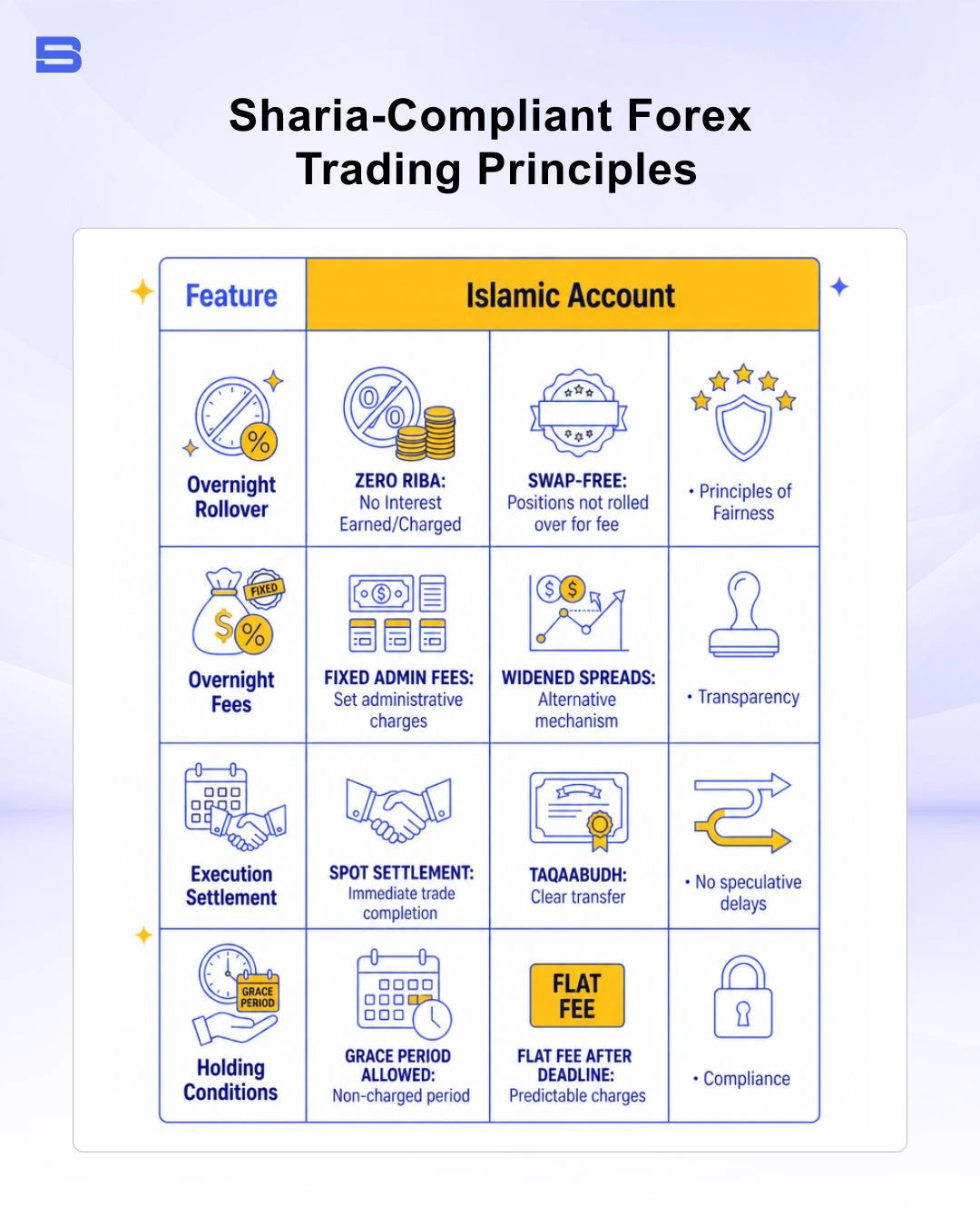
To maintain valid Islamic status, an account must satisfy several core criteria beyond simply waiving swap rates:
- Zero Interest (Riba): No interest can be earned or charged on open positions, margin balances, or overnight holdings.
- Immediate Spot Settlement: Trades must execute instantly at current market bid and ask prices.
- No Unearned Gain or Excessive Risk (Gharar & Maysir): Pricing must remain clear, transparent, and grounded in real-time liquidity rather than speculative tricks.
Fee Structures: How Brokers Offset the Removal of Swaps
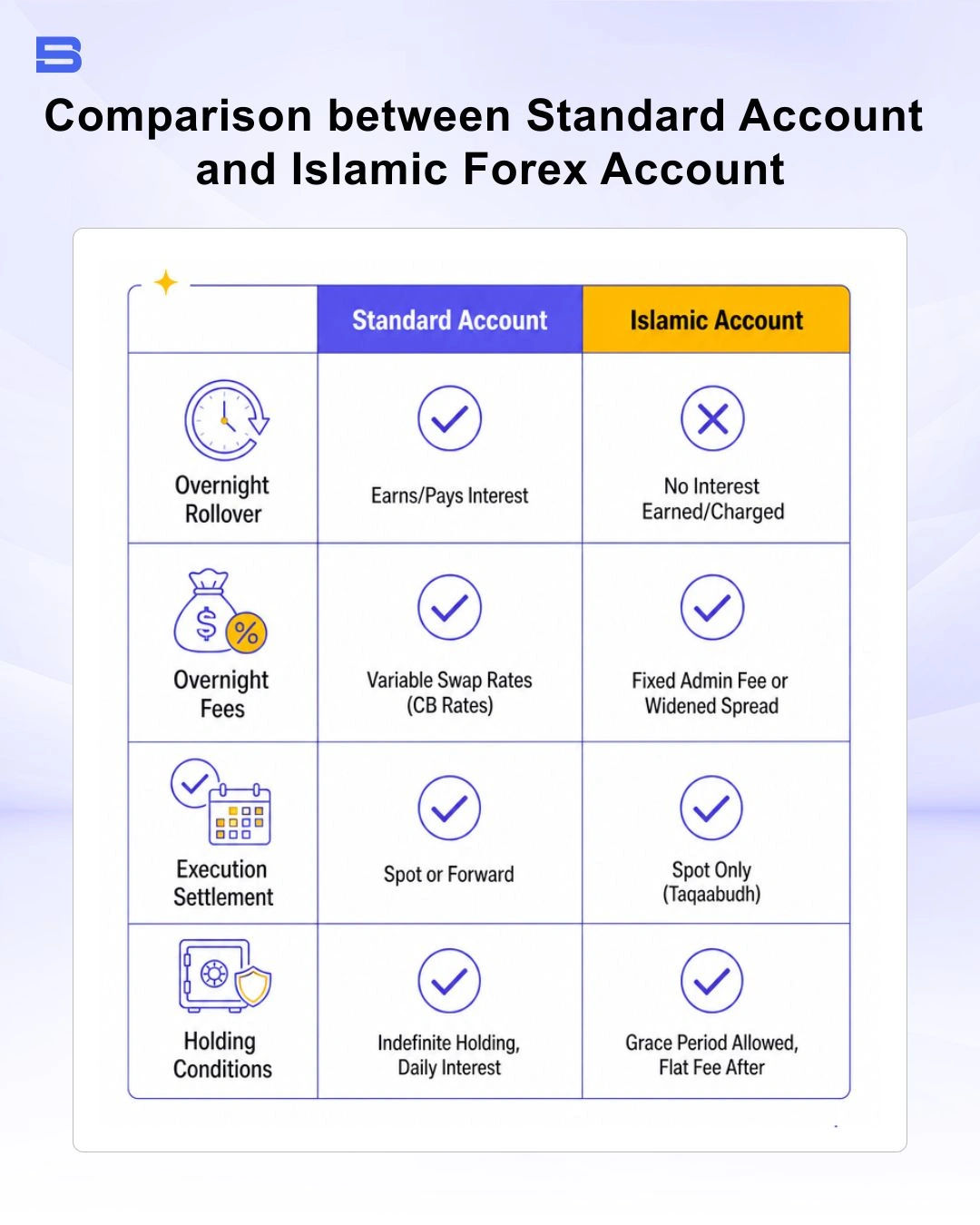
A common question among traders is how brokers manage the economic costs of swap-free trading without charging interest. Waiving rollover fees removes a key revenue and hedging mechanism for the broker, so they offset these operational costs through alternative Sharia-compliant fee structures.
Administration Fees vs. Widened Spreads
Brokers typically replace overnight interest with one of two primary revenue models:
- Administration Grace Periods & Fixed Fees: Brokers offer an interest-free grace period (typically 3 to 14 days). If a trader holds a trade past this window, the broker charges a flat, fixed administration fee per lot per night. This charge covers operational costs rather than fluctuating interest rates.
- Spread Adjustments: The broker widens the bid-ask spread slightly across traded pairs to cover overnight operational risks without levying a separate daily fee.
Example Breakdown: Holding a 1.0 lot Euro and US Dollar (EUR/USD) position overnight for five days:
- Standard Account:
Accrues variable daily interest based on central bank differentials (e.g., -$6.50 on Night 1, +$2.10 on Night 2, -$6.50 on Night 3, etc.).
- Islamic Account:
$0 interest charged for Days 1–3 (Grace Period). A flat $5.00 daily administrative service fee applies on Days 4 and 5.
How to Open and Verify an Islamic Forex Account
Opening a swap-free account is a straightforward process, but verifying Sharia compliance requires diligent research before depositing real capital.
Step-by-Step Account Opening Process
- Broker Due Diligence: Ensure the broker holds a license from a respected Tier-1 regulator—such as the Securities Commission Malaysia (SC) or the United Kingdom Financial Conduct Authority (UK FCA)—and displays a valid Sharia certificate or Fatwa issued by a qualified Islamic board.
- Select Your Account Type: Choose an execution model that fits your capital size, such as a micro-lot cent account for forex for lower initial capital or an execution-focused ECN account for raw market spreads.
- Complete Identity Verification (KYC): Provide proof of identity and address to verify your account under standard regulatory guidelines.
- Activate Swap-Free Status: Request Islamic account status through your client portal. Some brokers toggle this feature automatically upon account selection, while others require a quick manual approval.
If you are a Malaysian trader setting up your local investment infrastructure, you can review our guide on how to open a trading account in Malaysia for full regional details.
Red Flags to Watch For
When evaluating brokers, watch out for these non-compliant practices:
- Hidden Rollover Charges: Brokers renaming swap fees as "overnight storage fees" that still fluctuate based on central bank interest rates.
- Arbitrary Holding Time Limits: Unreasonably short position limits (e.g., forcing positions to close within 48 hours) designed to penalize long-term position traders.
- Unverified Sharia Claims: Platforms claiming "Islamic compliance" without providing documentation or certification from an established Sharia advisory board.
The Bottom Line
Islamic forex accounts make global currency markets accessible to Muslim traders by replacing interest-bearing rollover structures with clear, transparent fee models. By eliminating Riba while maintaining spot execution standards, these accounts bridge modern financial trading with traditional Islamic values. Always review your broker’s fee schedule and verify their Sharia certification before placing your first trade.
Disclaimer: The content on this page is intended for educational and informational purposes only. It does not constitute financial, investment, tax, or legal advice, and should not be interpreted as a recommendation to buy, sell, or hold any financial instrument or asset. Trading and investing involve significant risk, including the possible loss of your entire capital. Products such as forex, CFDs, and cryptocurrencies carry additional risks due to leverage, high volatility, and limited regulatory protection in some jurisdictions. Past performance of any financial instrument does not guarantee future results. Any market views, forecasts, or opinions expressed are those of the author at the time of writing and may not reflect current market conditions. Platform features, fees, and regulatory status are subject to change — always verify information directly with the relevant provider or regulator before making any financial decision. BrokerSpecs may receive compensation from third parties featured on this site. Always conduct your own due diligence and consider seeking advice from a licensed financial professional before investing.