



Related Tags
Entering a trade manually requires constant vigilance—staring at charts, waiting for indicators to align, and executing orders before price action shifts. A split-second delay or an emotional reaction can distort your strategy. This operational friction is precisely why automated execution tools have become central to modern financial markets.
What Is a Trading Bot?
A trading bot is a software program that automatically analyzes market data and executes trades based on predefined algorithmic rules and parameters. Rather than requiring you to manually monitor price movements, a bot continuously scans order books, chart patterns, and technical indicators to place orders on your behalf.
At its core, automated trading strips away emotional bias and human execution delay. Whether you trade forex, crypto, or equities, software programs run continuously to enforce strict risk parameters and strategy guidelines.
Expert Advisors (EAs) vs Standalone Bots
In retail markets, algorithmic execution generally falls into two primary structural categories:
- Expert Advisors (EAs): Programmed specifically for terminal platforms like MetaTrader 4 (MT4) or MetaTrader 5 (MT5) using MetaQuotes Language 4 (MQL4) or MetaQuotes Language 5 (MQL5) code. These run natively inside your trading platform terminal.
- Standalone Bots: External software applications—often written in Python, C++, or Node.js—that communicate directly with exchange servers via an application programming interface.
Regulatory Status: Are Trading Bots Legal?
Using automated software to execute your own trades is generally permitted in major regulated jurisdictions, including those overseen by the US Securities and Exchange Commission (SEC), the Financial Conduct Authority (FCA), the Monetary Authority of Singapore (MAS), and the Securities Commission Malaysia (SC).
Regulators generally treat a bot as a tool for carrying out your own instructions. However, offering bot-based signals, managed accounts, or pooled-fund services may require a license, so check the rules that apply in your country.
However, legal compliance depends on how you use the software. Utilizing algorithms for market manipulation—such as spoofing or layering order books—is strictly prohibited under global securities laws.
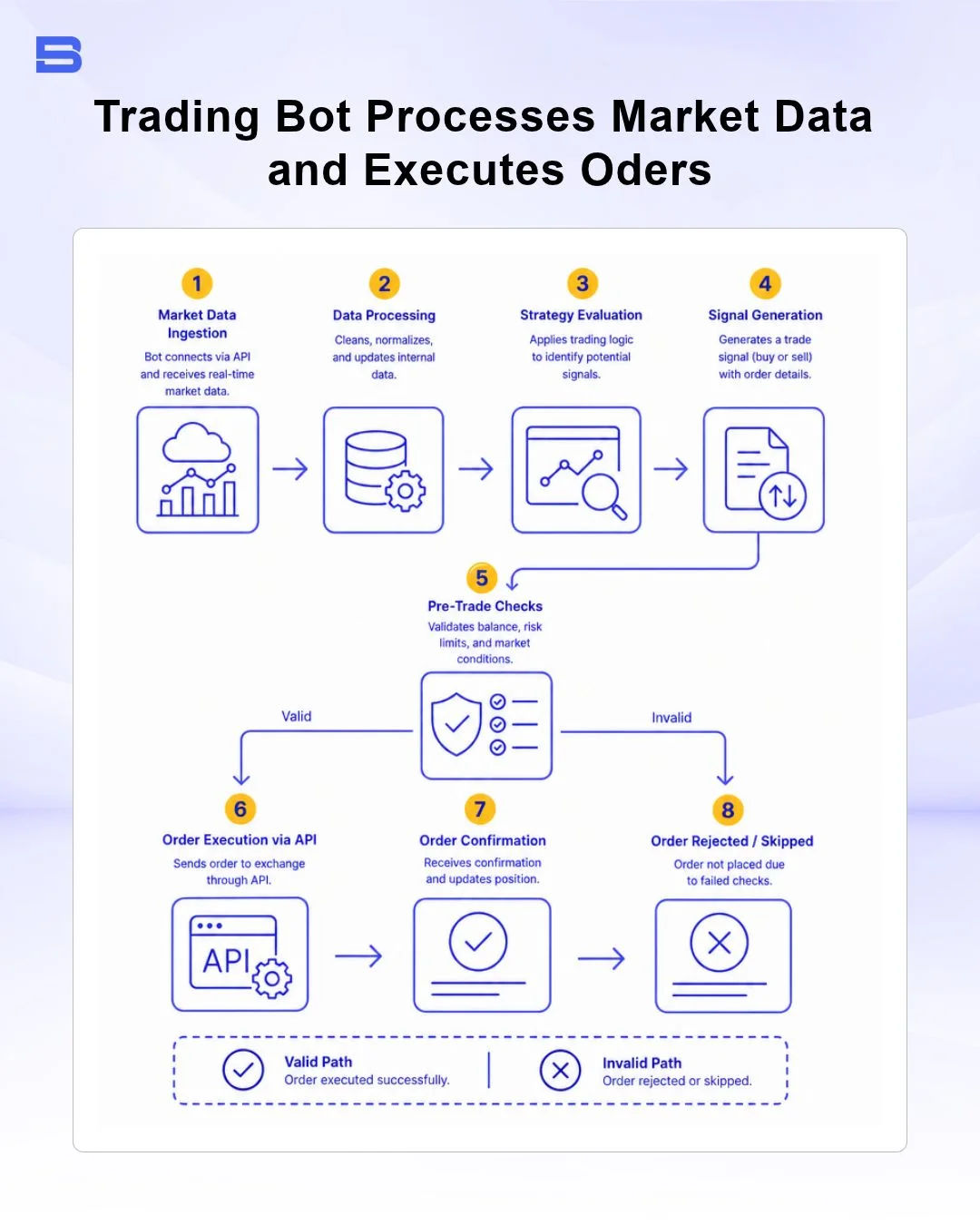
The Mechanics of Bot Trading: How Algorithms Execute Orders
Understanding the mechanics of bot trading requires looking at the continuous data loop between market servers and the algorithm. The software operates in three core phases: data ingestion, signal evaluation, and order routing.
Connecting via Trading API
A trading API (Application Programming Interface) serves as the secure software bridge between your bot and your brokerage or exchange account. The API transfers market data streams to the bot and sends structured execution commands back to the broker's matching engine.
Forex Trading Bot Execution
A forex trading bot focuses on liquid currency pairs, evaluating spread fluctuations and interest rate differentials. Because forex positions are opened on margin, execution speed and spread sensitivity are critical factors.
Crypto Trading Bot Execution
Unlike traditional markets, a crypto trading bot operates 24/7 across fragmented digital asset exchanges. Algorithms monitor order book depth and exchange rate limits to capture continuous volatility, although exchange disconnects, API rate limits, and downtime can still interrupt execution.
AI Forex Trading Bot Considerations
An AI forex trading bot utilizes machine learning models to adapt its decision-making parameters based on incoming market regimes. While traditional bots follow rigid "if-then" rules, AI-driven models evaluate probabilistic outcomes across historical datasets.
Key Types of Auto Trading Bot Strategies
Every auto trading bot is driven by an underlying logic framework designed for specific market conditions.
Grid Trading Bots
Grid algorithms place a ladder of buy and sell orders at incremental price intervals above and below a set base price. This strategy tends to perform better in ranging, sideways markets where prices move within a defined channel. It can lose money if price breaks out and trends in one direction.
Dollar-Cost Averaging (DCA) Bots
A dollar-cost averaging bot builds positions over time by making automated purchases at fixed intervals or percentage pullbacks. This mitigates the risk of bad timing by averaging down the entry price across market dips.
Arbitrage & Trend-Following Bots
Arbitrage algorithms exploit temporary price discrepancies for the same asset across different exchanges. Trend-following bots utilize moving averages and breakout indicators to align trades with strong market momentum.
Worked Scenario: A Grid Bot deployed on a ranging currency pair between 1.1000 and 1.1100 divides the 100-pip range into 10 equal grid intervals of 10 pips each. As the price fluctuates, it buys every 10-pip drop and sells every 10-pip rise, which may produce small incremental gains. If price breaks out of the 1.1000–1.1100 range, the open positions can lose money.
What Is an AI Trading Bot and How Does It Differ?
An AI trading bot replaces static conditional logic with dynamic machine learning algorithms. Traditional rule-based bots struggle when market regimes suddenly shift—such as during unexpected macroeconomic news—because their conditional rules remain rigid.
Machine learning models continuously reassess volatile inputs, sentiment metrics, and historical correlations. However, AI algorithms carry unique risks, including overfitting to historical noise and failing during uncharacteristic market shocks.
Reality Check: Do Trading Bots Actually Guarantee Profits?
A widespread myth in retail finance is that automated software guarantees effortless passive income. In reality, a bot is merely an execution tool—it executes your strategy faster, but it cannot fix a flawed underlying edge.
Automated execution exposes traders to distinct operational risks:
- Slippage and Latency: High network latency can delay order arrival, causing fills at significantly worse prices than programmed.
- Market Regime Shifts: A strategy tuned for trending markets can incur heavy drawdowns if the asset enters a prolonged consolidation phase.
- Over-Optimization: Backtested results often look flawless because the code was inadvertently overfitted to past data, leading to failures in live conditions.
Automation streamlines execution, but it also automates losses if proper risk management is ignored.
How to Use a Trading Bot Safely: Step-by-Step
Following a structured deployment protocol helps protect your capital from technical errors and security compromises.
Step 1: Strategy Selection and Backtesting
Before deploying any code live, run your strategy against multi-year historical price data across varying volatility conditions. Ensure your model accounts for commissions, overnight swaps, and historical spreads.
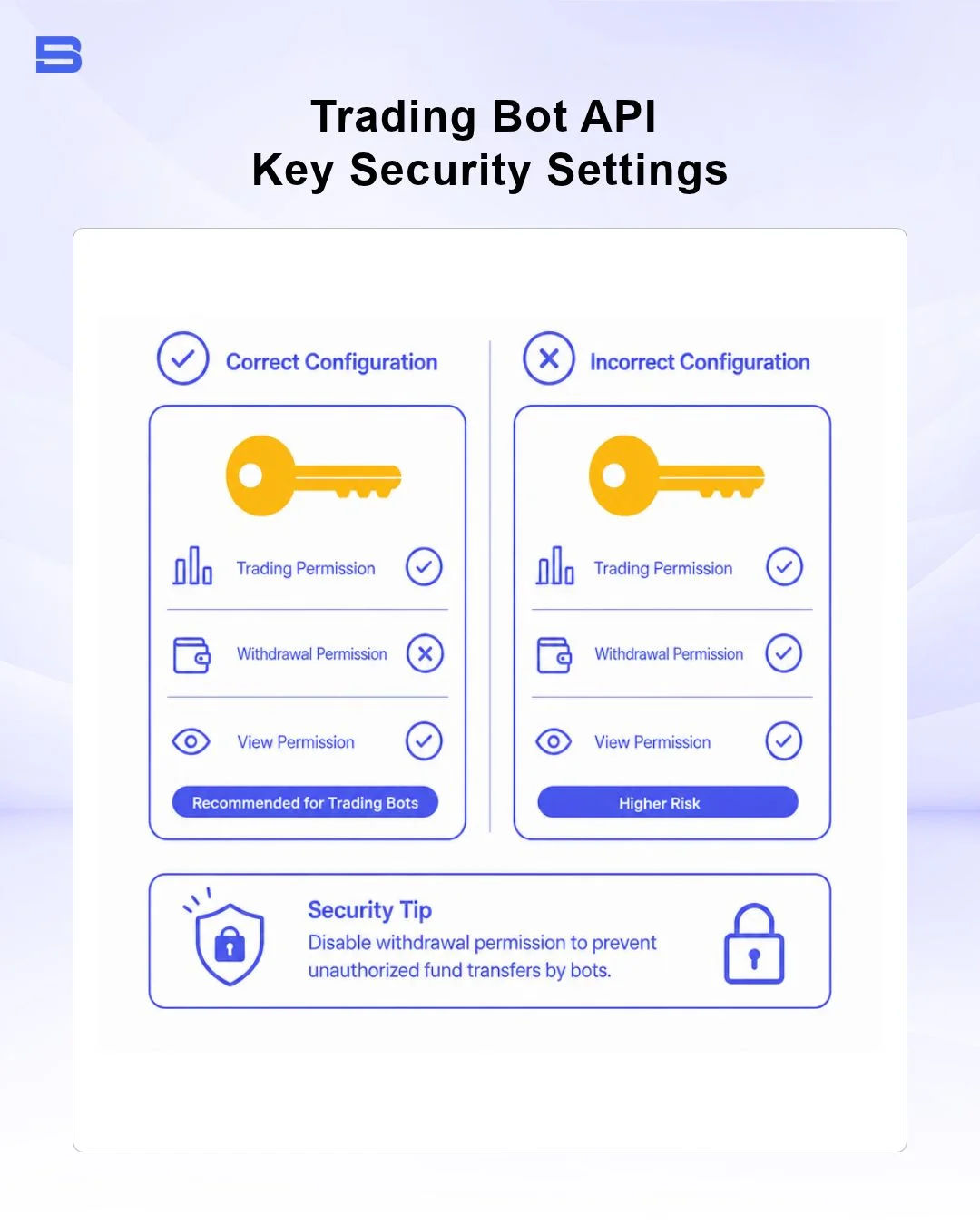
Step 2: Configure Strict API Key Safety
When connecting your bot software to your exchange or broker via API, set API permissions carefully. Enable "Read" and "Trade" permissions, but never enable "Withdrawal" permissions. Disabling withdrawals ensures that even if your API key is compromised, unauthorized funds cannot be removed from your account.
Step 3: Paper Trading in Demo Environments
Run the bot in a simulated market environment (paper trading or demo account) for several weeks. This tests how the software handles real-time execution delays, order modifications, and connection drops without risking actual capital.
Step 4: Live Deployment with Risk Controls
When transitioning to live markets, start with minimal lot sizing. Implement hard stop-loss levels and account-level drawdown caps directly inside the broker server rather than relying solely on the bot's internal code.
What to Remember Before You Automate Your Trades
Automated trading software is an execution engine designed to reduce manual monitoring and emotional decision-making. However, automation is not a substitute for market literacy or strict risk management.
By securing your API keys, backtesting thoroughly across different market regimes, and applying conservative position sizing, you can integrate automated execution safely into your broader investment approach.
- Proprietary Trading Explained: What It Is and Its Key Benefits
- TradingView: Features, Broker Integration, and Strategies
- cTrader: How It Works and How It Compares
- What Is a VPS for Trading and Do You Need One?
- Thinkorswim Trading: Features, Tools, and Availability
- Trading Platform Malaysia: What to Look For
- Bursa Anywhere: A Guide to Managing Shares in Malaysia
- What Is Forex Factory and How Do Traders Use It?
- Delta App: Multi-Asset Portfolio Tracker for Crypto & Stocks
- What Is Trading Central and How to Use It?
- What Is Simply Wall St and How to Use It
- What Is Seeking Alpha and How to Use It
- What Is MarketWatch and How to Use It
- What Is Barchart and How to Use It
- Google Finance Explained: How to Track Stocks and Markets
- What Is Finviz and How to Use It for Stock Screening
- What Is Yahoo Finance and How to Use It
- What Is TradingEconomics and How to Use It
- StockCharts Review 2026: Features, Pricing, and Performance
- What Is ZuluTrade and How Does Copy Trading Work on It?
- What Is Investing.com and How to Use It?
- What Is Myfxbook and How Do Traders Use It?
- What Is CoinGecko? A Complete Guide to Crypto Data Tracking
- What Is CoinMarketCap and How to Use It
- What Is CoinStats and How to Use It for Portfolio Tracking
- What Is Sharesight and How to Use It for Portfolio Tracking
- What Is Personal Capital and How to Use It
- What Is a Low Spread Broker? How It Affects Your Trading
- What Is an Introducing Broker (IB) in Forex?
- What Is Social Trading? How Copy Trading Platforms Work
- What Is a PAMM Account? How Managed Forex Accounts Work
- What Is a Margin Account and How Does Margin Trading Work?
- What Are Trading Signals and How Do They Work?
- What Is an Expert Advisor (EA) in Forex Trading?
Disclaimer: The content on this page is intended for educational and informational purposes only. It does not constitute financial, investment, tax, or legal advice, and should not be interpreted as a recommendation to buy, sell, or hold any financial instrument or asset. Trading and investing involve significant risk, including the possible loss of your entire capital. Products such as forex, CFDs, and cryptocurrencies carry additional risks due to leverage, high volatility, and limited regulatory protection in some jurisdictions. Past performance of any financial instrument does not guarantee future results. Any market views, forecasts, or opinions expressed are those of the author at the time of writing and may not reflect current market conditions. Platform features, fees, and regulatory status are subject to change — always verify information directly with the relevant provider or regulator before making any financial decision. BrokerSpecs may receive compensation from third parties featured on this site. Always conduct your own due diligence and consider seeking advice from a licensed financial professional before investing. Portions of this article were prepared with the assistance of AI tools and reviewed by our editorial team before publication.