


- How to Start Trading: A Step-by-Step Guide for Beginners
- Demo Trading Accounts: Safe Practice for Beginners
- Understanding How Much Capital You Need to Start Trading
- How to Set Realistic Trading Goals as a New Trader
- How to Open a Trading Account in Malaysia (Step-by-Step)
- How to Start Trading in Malaysia: A Guide for Beginners
- How to Create a Trading Plan Before You Start Trading
- What Is a Trading Account? Everything You Need to Know
- How to Learn Trading: Step-by-Step Beginner Roadmap
- What Is Stop Loss in Trading and How Does It Work?
- Why Every Trader Needs a Trading Journal
- Islamic Forex Account Explained: How Swap-Free Trading Works
- Funded Trading Account: Rules, Splits & Risks
- Master Money Management: Practical Capital Protection Rules
- Overtrading Explained: Common Causes, Signs, and How to Stop
- How Risk-Reward Ratio Works: A Guide to Trading Risk
- How to Open a Brokerage Account as a Beginner
- What Is a Cent Account Forex and How Does It Work?
- What Is an ECN Account and How Does It Work?
- What Is Cashback Forex and How Does It Work?
- Fixed Deposit vs Unit Trust: Key Differences for Investors
- Welcome Bonus Forex: What It Is and What to Watch For
- Forex Deposit Bonus: How It Works
- What Is Forex Rebate and How Does It Work?
- What Is Forex Free Credit and How Does It Work?
- Trading Webinars: Are They Worth Attending?
- Trading for Beginners PDF: What to Look For in a Good Guide
- Trading 101: How to Start Trading Safely and Effectively
Entering the market for the first time can feel overwhelming. Watching asset prices swing wildly up and down often leaves new investors paralyzed by a single question: Is today the right day to buy, or will the market crash tomorrow?
This fear of bad timing keeps millions of dollars sitting on the sidelines in cash, eroding against inflation. Trying to time the exact bottom of a market dip is a strategy that fails even experienced professionals.
What Is Dollar Cost Averaging and How Does It Work?
Fortunately, you do not need to predict the future to build long-term wealth. Dollar cost averaging (DCA) is a disciplined, stress-reducing entry strategy that removes guesswork, eliminates emotional timing errors, and helps you steadily grow your portfolio regardless of short-term market noise.
Dollar-cost averaging is an investment strategy where you invest a fixed amount of money at regular intervals, regardless of market price fluctuations.
Instead of deploying a large lump sum of capital all at once, you divide your investment budget into equal, recurring amounts—such as $100 every week, $500 every month, or RM250 (Malaysian Ringgit) every fortnight.
When you invest a fixed cash amount on a set schedule, the underlying math works automatically in your favor:
- When prices are high: Your fixed dollar amount buys fewer units.
- When prices are low: Your fixed dollar amount buys more units.
Over time, this mechanical process lowers your average cost per unit compared to the average market price over the same period. More importantly, it removes emotional bias from your financial decisions. You no longer buy out of fear of missing out (FOMO) at market peaks or hesitate to buy during market pullbacks.
A Practical Dollar Cost Averaging Example
To see the mechanics in action, consider a retail investor allocating $500 per month into a fund over four consecutive months, during a period of market volatility:
- Month 1: Unit price is $10. $500 buys 50 units.
- Month 2: Market drops; unit price falls to $5. $500 buys 100 units.
- Month 3: Market remains low; unit price is $5. $500 buys 100 units.
- Month 4: Market recovers; unit price rises back to $10. $500 buys 50 units.
The Results:
- Total invested: $2,000
- Total units accumulated: 300 units
- Average market price over four months: (10+5+5+10) / 4= $7.50 per unit
- Your average cost per unit: $2,000 / 300 units = $6.67 per unit
Because your fixed $500 bought twice as many units when the price was low ($5), your actual average cost ($6.67) is significantly lower than the average market price ($7.50). When the price recovered to $10 in Month Four, your 300 units were worth $3,000—yielding a $1,000 profit, even though the market simply returned to where it started.
Dollar Cost Averaging vs Lump Sum Investing
When deciding how to allocate capital, investors generally choose between DCA or investing all available funds immediately (Lump-Sum Investing).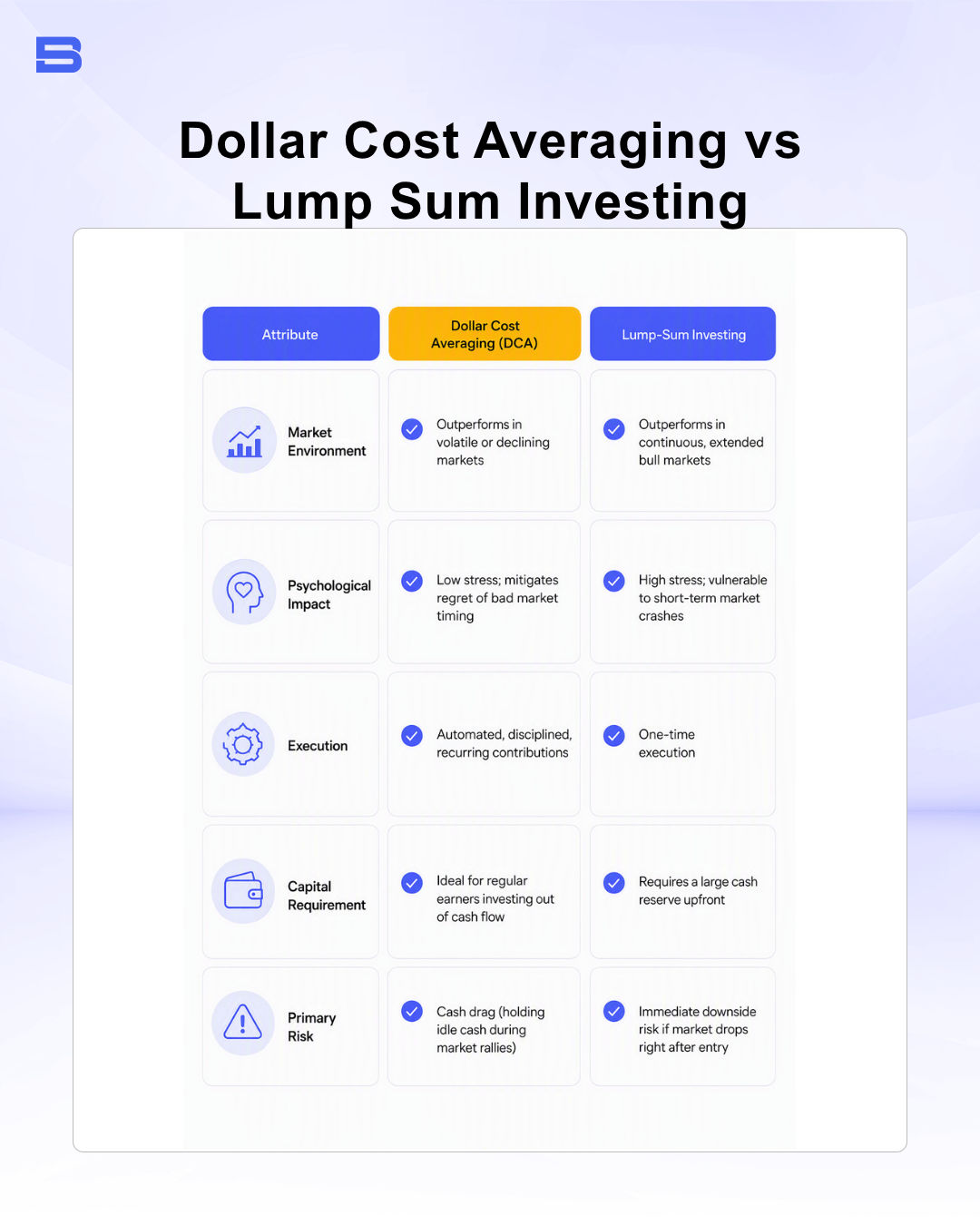 A widely cited long-term study by Vanguard found that lump-sum investing beat DCA in roughly 61.6% to 73.7% of historical periods analyzed, depending on the market studied. This occurs because markets historically trend upward over long periods, meaning cash deployed earlier has more time to compound.
However, statistics offer little comfort if you invest a lump sum right before a 30% market correction. For most retail investors, the psychological protection against catastrophic bad timing outweighs the marginal statistical advantage of lump-sum entry.
Drawbacks and Cash Drag Risks
While DCA provides emotional peace of mind, you must remain aware of its structural trade-offs:
- Cash Drag in Bull Markets: Keeping money in cash while waiting to dollar-cost average means that capital earns minimal returns. In a prolonged market rally, DCA forces you to buy at progressively higher prices, reducing overall gains compared to a lump-sum entry.
- Transaction Fee Overhead: If you invest small amounts manually through a traditional broker that charges flat commission fees (e.g., $10 per trade), frequent buying can accumulate high costs that erode your returns.
How to Automate Your Monthly Contributions
The primary key to a successful DCA strategy is discipline. Setting up automated recurring deposits removes the impulse to skip contributions when headlines turn negative.
- Determine Your Budget: Calculate an amount you can comfortably invest every month without affecting your emergency fund or immediate living expenses.
- Select an Execution Channel: Choose a regulated investment platform that supports automated recurring transfers. Retail investors in Southeast Asia and Malaysia frequently automate DCA via platforms like robo advisors, unit trust auto-debit plans, or local retirement schemes like EPF i-Invest.
- Set the Frequency: Weekly, bi-weekly, or monthly intervals all perform similarly over multi-year horizons. Match the frequency to your salary schedule.
- Automate the Transfer: Establish a standing auto-debit order from your primary bank account to your investment account on the day after payday.
- Review Annually: Avoid checking your portfolio daily. Review your portfolio once or twice a year solely to rebalance your overall asset allocation.
Combining Dollar-Cost Averaging with Micro Investing
If you do not have large sums of capital to start, you can combine DCA with micro investing. Micro-investing apps and digital platforms allow you to start building an investment habit with as little as $10 or RM10. By automating micro-contributions, beginners can build portfolio discipline and compounding habits without needing a substantial upfront bank balance.
How to Assess Your Risk Tolerance Before Choosing DCA
Before implementing a strategy, evaluate how it aligns with your personal financial profile and risk tolerance:
- Conservative Investors: If market volatility causes you severe anxiety, DCA is an ideal mechanism. It prevents you from panic-selling during pullbacks because price drops are re-framed as opportunities to buy units at a discount.
- Aggressive Investors: If you have a high risk tolerance, a long-term horizon, and a large lump sum ready, you may prefer deploying capital more aggressively, accepting short-term drawdown risks for higher expected upside.
- Cash-Flow Earners: If you do not have a lump sum and instead invest out of your monthly salary, DCA is not just a strategic choice—for cash-flow earners without a lump sum, it's often the most practical way to invest consistently.
Avoid Timing the Market With Dollar Cost Averaging
Dollar-cost averaging converts market volatility from an emotional threat into a mathematical advantage. By automating fixed contributions over time, you trade the impossible task of timing the market for the proven power of time in the market. Focus on consistency, keep transaction costs low, and let compounding handle the rest.
Disclaimer: The content on this page is intended for educational and informational purposes only. It does not constitute financial, investment, tax, or legal advice, and should not be interpreted as a recommendation to buy, sell, or hold any financial instrument or asset. Trading and investing involve significant risk, including the possible loss of your entire capital. Products such as forex, CFDs, and cryptocurrencies carry additional risks due to leverage, high volatility, and limited regulatory protection in some jurisdictions. Past performance of any financial instrument does not guarantee future results. Any market views, forecasts, or opinions expressed are those of the author at the time of writing and may not reflect current market conditions. Platform features, fees, and regulatory status are subject to change — always verify information directly with the relevant provider or regulator before making any financial decision. BrokerSpecs may receive compensation from third parties featured on this site. Always conduct your own due diligence and consider seeking advice from a licensed financial professional before investing.