



Related Tags
Imagine sitting in front of four monitors during a sudden interest rate announcement. Charts flash red and green as price quotes update faster than any human eye can track. You attempt to manually click an execution button, but by the time your order registers with the server, the quote has already jumped three pips—resulting in significant execution slippage.
High-volatility environments highlight the core bottleneck of manual trading: latency and physical execution limits. This is precisely where programmatic execution changes the playing field.
What Is an API for Trading and How Does It Work?
A trading API (Application Programming Interface) is a secure set of protocols and data specifications that allows custom software applications to communicate directly with a brokerage’s trading engine. Rather than interacting with a graphical user interface (GUI) like a mobile app or desktop platform, your software transmits structured code instructions directly over the network to send orders, check balances, or retrieve real-time price quotes.
An API for trading acts as a digital bridge between your strategy code and the broker's execution infrastructure. When your custom algorithm identifies a trading signal based on its internal logic, it formats an HTTP (Hypertext Transfer Protocol) or TCP (Transmission Control Protocol) request specifying the symbol, order volume, direction, and order type.
The broker's API endpoint receives this packet, authenticates your API key, validates your available margin, and routes the trade directly to the liquidity pool or order book—returning an immediate JSON (JavaScript Object Notation) or FIX confirmation packet to your script.
Market Data APIs vs. Execution APIs
Not all trading APIs serve the same operational function; brokers and technology providers generally split trading API endpoints into two distinct architectural categories depending on their bandwidth and security requirements.
- Market Data APIs: Read-only data connections designed to stream real-time price quotes, historical candlestick data, order book depth (Level 2 data), or trade tick volume. Because these endpoints cannot alter account balances or place trades, they carry lower access security barriers and are frequently integrated into custom charting dashboards or backtesting engines.
- Execution APIs: Interactive write-enabled connections that process live trading instructions, such as submitting market or limit orders, modifying active stop-loss levels, canceling pending orders, and querying live account equity. Execution endpoints require elevated security protocols, including IP address whitelisting (approving only specific addresses), OAuth tokens (temporary access credentials), and strict rate limiting to prevent system overload.
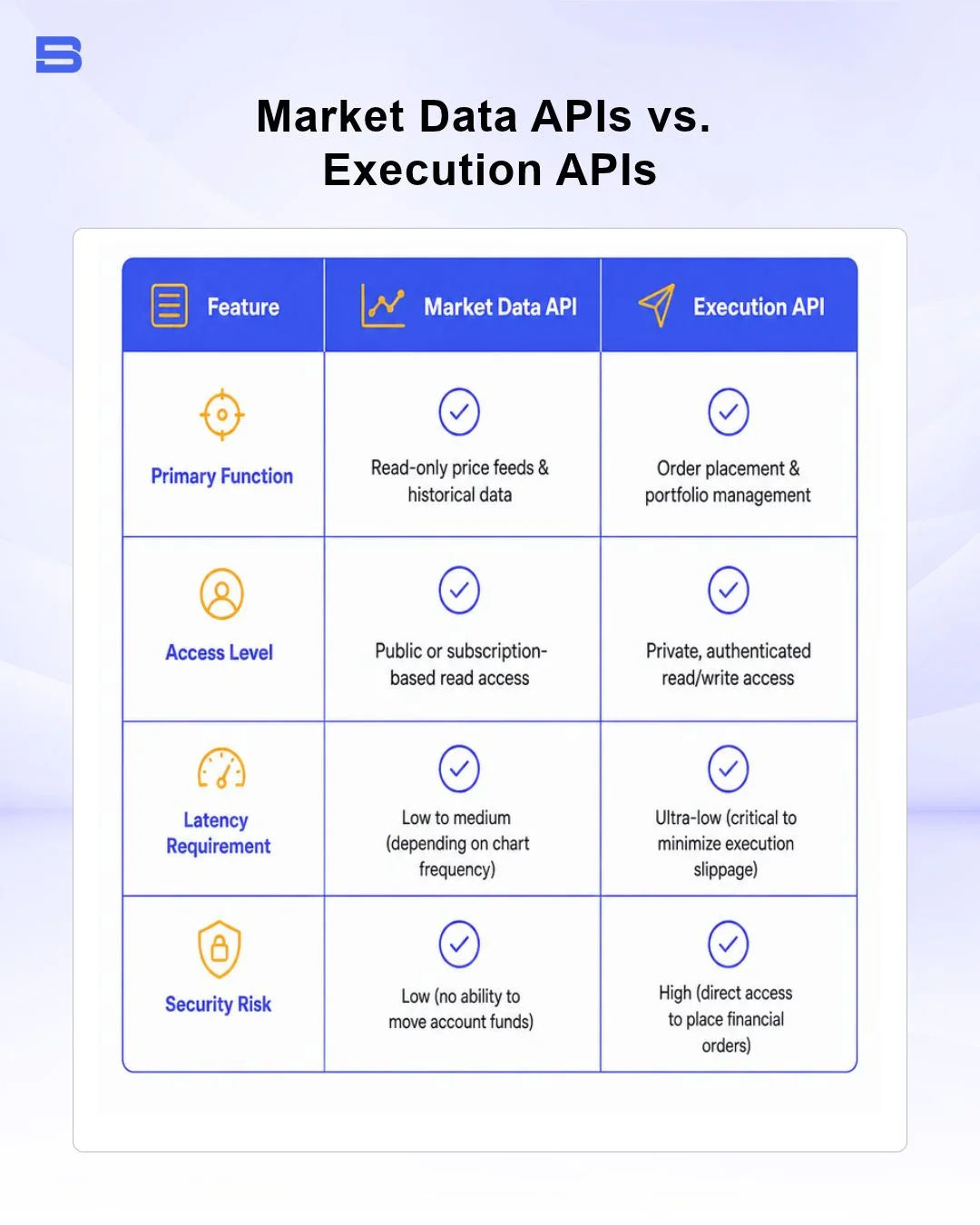
Traders building comprehensive automated systems typically combine both types within a unified framework, relying on market data feeds to trigger internal decision logic and execution endpoints to submit the resulting orders. Algorithmic trading strategies depend heavily on maintaining stable throughput between these two layers.
Open API Trading Protocols: REST, WebSocket, and FIX
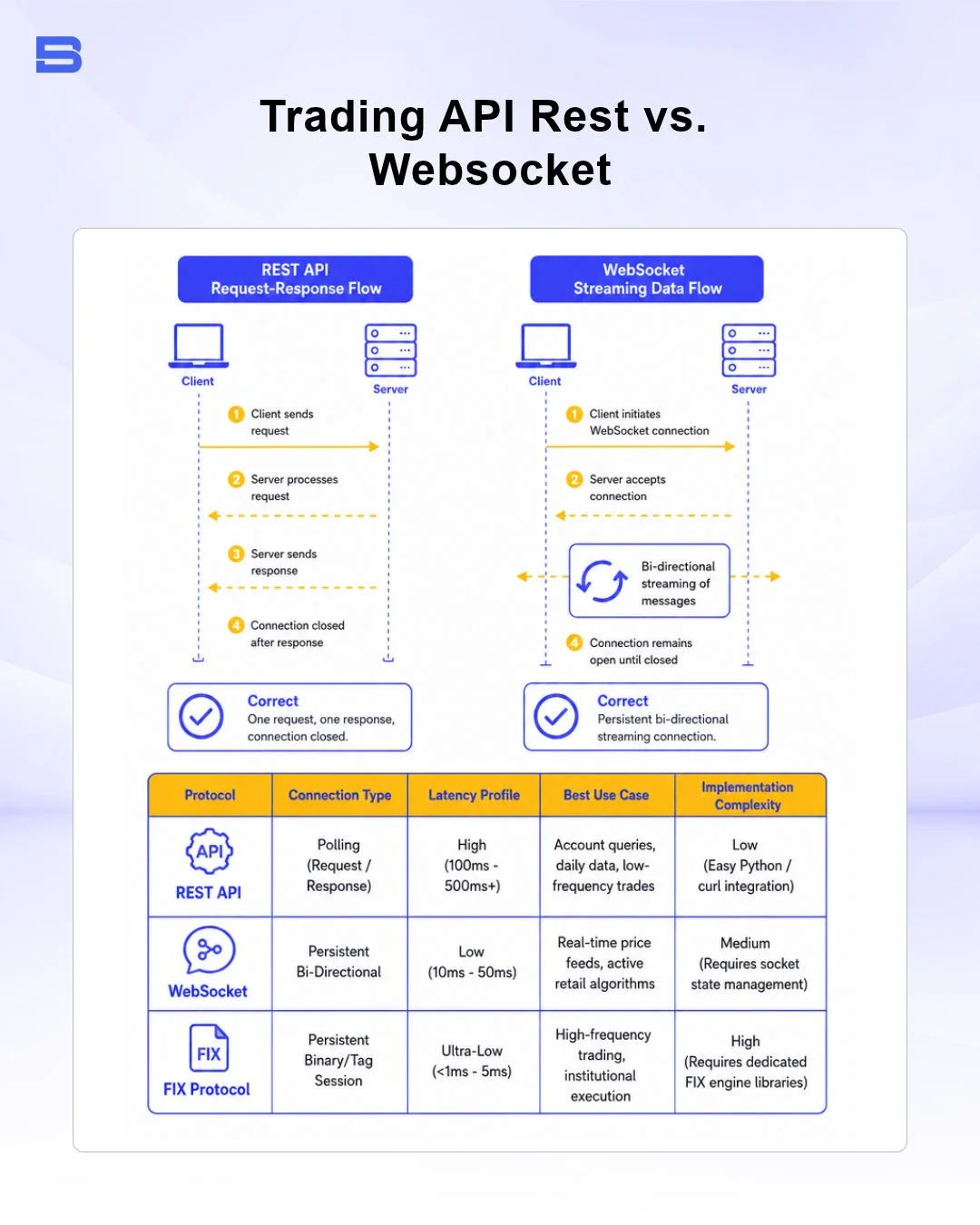
When evaluating open trading API architectures, you will encounter three standard communication protocols. Choosing the right protocol depends on your strategy's execution frequency, data streaming needs, and technical capacity.
- REST (Representational State Transfer) APIs (HTTP/HTTPS): Standard request-response protocols best suited for non-time-critical tasks, such as querying account balances, pulling daily historical price data, or placing low-frequency position trades. The client sends a request (GET or POST), and the server replies. REST APIs are easy to build and test using standard software development kits (SDKs) in Python or JavaScript, but they introduce higher network latency due to the overhead of opening and closing HTTP connections for every request.
- WebSocket APIs: Continuous, bi-directional streaming sockets that establish a single, persistent TCP connection between your application and the broker. Instead of constantly polling a REST endpoint for updated quotes, a WebSocket allows the broker's server to instantly "push" tick-by-tick price data or order status updates to your application the millisecond they occur. WebSocket connections form the backbone of modern retail execution algorithms and real-time charting interfaces.
- FIX Protocol (Financial Information eXchange): The institutional standard for electronic trading. Operating directly over raw TCP connections with minimal protocol overhead, FIX provides ultra-low latency order execution and messaging across global exchanges, institutional prime brokers, and quantitative hedge funds. While FIX is typically among the fastest options for order execution, it requires complex session management, custom tag-value parsing (reading FIX's numbered-field message format), and dedicated infrastructure.
Third-Party Integrations: TradingView API and Webhooks
You do not necessarily need to build a strategy engine from scratch in Python or C++ to utilize programmatic execution. Many modern traders use third-party charting platforms to handle signal generation and route those signals to their broker via webhooks.
For instance, the trading view API and custom webhooks allow you to set up alert conditions directly on Pine Script indicators. When a technical signal triggers on your chart—such as a moving average crossover—TradingView generates an automated JSON payload containing order instructions and sends an HTTP POST request to your broker's execution endpoint or an intermediate bridge script. This allows you to combine intuitive visual charting with fully automated order routing.
Connecting a Trading Bot to an API
Connecting an automated system or trading bot to a broker's trading API requires a clear architectural pipeline. Whether you are running a standalone Python script on a remote server or utilizing platform-native solutions like MetaTrader Expert Advisors (EAs), every programmatic trade follows a fixed five-step sequence:
- Authentication & Handshake: Your application initiates a connection by transmitting your API key and a signature (created by signing the request with your secret key using HMAC-SHA256, a keyed hashing method) to the broker's authentication server to establish a secure session token
- Market Data Ingestion: The bot subscribes to a real-time WebSocket ticker stream or queries a REST endpoint to pull live bid/ask quotes, order book depth, or historical candlestick arrays.
- Strategy Engine Processing: The internal code processes incoming price data against strategy rules (e.g., calculating an RSI value or checking a volatility threshold) to determine whether an entry or exit condition is met.
- Order Execution Request: Upon detecting a signal, the bot builds a structured JSON or FIX message containing the trading parameters (e.g., {"symbol": "EURUSD", "side": "BUY", "type": "LIMIT", "price": 1.0850, "qty": 100000, "stop_loss": 1.0820}) and sends it to the execution endpoint.
- Fill Confirmation & Risk Loop: The broker's engine processes the trade, returns an execution report (filled, partially filled, or rejected), and your software updates its internal state while monitoring open trade equity and stop-loss levels.
Traders operating within platforms like MetaTrader 4 or MetaTrader 5 often use a built-in expert advisor written in MQL4 or MQL5. These scripts run inside the platform terminal, using native API functions to execute trades directly on the broker's underlying server without needing external network sockets.
Hard Risk Controls in Automated API Trading
While programmatic execution can reduce emotion-driven execution mistakes, it introduces distinct software execution risks. An unhandled exception, network disconnection, or infinite loop in your code can submit hundreds of unwanted trades in seconds—potentially liquidating an account before you realize an error has occurred.
In the US, the SEC's Market Access Rule (Rule 15c3-5) requires broker-dealers that provide market access to maintain risk controls. In the UK, the FCA's algorithmic trading requirements expect investment firms that use algorithms to have safeguards such as the ability to cancel unexecuted orders. These rules apply to regulated firms rather than individual retail traders, but they show why built-in safeguards matter in any automated system.
Managing API Latency, Rate Limits, and Slippage
To keep an algorithm operating safely under real-world market conditions, you should build defensive parameters directly into your source code:
- Rate Limits and Throttling: Brokers limit the number of trading API requests your IP address can submit per second (e.g., 10 requests/sec). Exceeding these limits results in HTTP 429 "Too Many Requests" errors or temporary IP bans. Software should implement request queues and exponential backoff retry logic (waiting progressively longer between each retry) to handle rate limits smoothly.
- Network Latency & Server Location: Execution delays between your script sending an order and the broker receiving it can lead to negative slippage. Hosting your strategy code on a low-latency Virtual Private Server (VPS) for trading located in the same data center as your broker's execution matching engine can reduce round-trip network latency to just a few milliseconds, depending on the broker's infrastructure and the provider's data-center location.
- Max Slippage Guards: Always attach an explicit maximum slippage (price deviation) limit to market orders rather than sending them unprotected during volatile news releases. For example, if you send a buy market order when the ask price is 1.0850 and set a maximum slippage tolerance of 1.5 pips, the broker's matching engine can reject the order if the best available ask price rises above 1.0865 before your packet arrives. A limit order offers similar price protection, but it may not fill at all if the market moves away from your price.
API Key Security: Never hardcode your trading API secret keys directly into public repositories or script files. Store keys securely in environment variables or encrypted vault managers. When generating API keys in your broker portal, apply strict permission limits: enable trading privileges, disable withdrawal rights entirely, and restrict access exclusively to your VPS server's fixed IP address.
The Bottom Line
Trading APIs serve as an essential foundation for systematic and quantitative traders, offering direct access to platform execution without manual user interface delays. By selecting the appropriate protocol—whether REST for low-frequency management, WebSockets for streaming data, or FIX for high-speed execution—you can build robust, disciplined trading systems.
However, automated speed must always be paired with stringent risk management safeguards, including strict rate limit handling, maximum slippage controls, and strict API security parameters to safeguard your account capital.
- Proprietary Trading Explained: What It Is and Its Key Benefits
- TradingView: Features, Broker Integration, and Strategies
- cTrader: How It Works and How It Compares
- What Is a VPS for Trading and Do You Need One?
- Thinkorswim Trading: Features, Tools, and Availability
- Trading Platform Malaysia: What to Look For
- Bursa Anywhere: A Guide to Managing Shares in Malaysia
- What Is Forex Factory and How Do Traders Use It?
- Delta App: Multi-Asset Portfolio Tracker for Crypto & Stocks
- What Is Trading Central and How to Use It?
- What Is Simply Wall St and How to Use It
- What Is Seeking Alpha and How to Use It
- What Is MarketWatch and How to Use It
- What Is Barchart and How to Use It
- Google Finance Explained: How to Track Stocks and Markets
- What Is Finviz and How to Use It for Stock Screening
- What Is Yahoo Finance and How to Use It
- What Is TradingEconomics and How to Use It
- StockCharts Review 2026: Features, Pricing, and Performance
- What Is ZuluTrade and How Does Copy Trading Work on It?
- What Is Investing.com and How to Use It?
- What Is Myfxbook and How Do Traders Use It?
- What Is CoinGecko? A Complete Guide to Crypto Data Tracking
- What Is CoinMarketCap and How to Use It
- What Is CoinStats and How to Use It for Portfolio Tracking
- What Is Sharesight and How to Use It for Portfolio Tracking
- What Is Personal Capital and How to Use It
- What Is a Low Spread Broker? How It Affects Your Trading
- What Is an Introducing Broker (IB) in Forex?
- What Is Social Trading? How Copy Trading Platforms Work
- What Is a PAMM Account? How Managed Forex Accounts Work
- What Is a Margin Account and How Does Margin Trading Work?
- What Are Trading Signals and How Do They Work?
- What Is an Expert Advisor (EA) in Forex Trading?
Disclaimer: The content on this page is intended for educational and informational purposes only. It does not constitute financial, investment, tax, or legal advice, and should not be interpreted as a recommendation to buy, sell, or hold any financial instrument or asset. Trading and investing involve significant risk, including the possible loss of your entire capital. Products such as forex, CFDs, and cryptocurrencies carry additional risks due to leverage, high volatility, and limited regulatory protection in some jurisdictions. Past performance of any financial instrument does not guarantee future results. Any market views, forecasts, or opinions expressed are those of the author at the time of writing and may not reflect current market conditions. Platform features, fees, and regulatory status are subject to change — always verify information directly with the relevant provider or regulator before making any financial decision. BrokerSpecs may receive compensation from third parties featured on this site. Always conduct your own due diligence and consider seeking advice from a licensed financial professional before investing. Portions of this article were prepared with the assistance of AI tools and reviewed by our editorial team before publication.