



Related Tags
Picture delivering a completed RM100,000 contract for a major client, only to discover payment terms dictate a 90-day waiting period. While your cash sits locked in unpaid receivables, monthly payroll, inventory costs, and supplier bills arrive on schedule. Invoice financing offers Malaysian businesses a practical working capital solution to unlock cash tied up in unpaid invoices without taking on long-term bank debt.
How Does Invoice Financing Work in Malaysia?
Invoice financing is a short-term borrowing mechanism where a business uses its unpaid customer invoices as collateral to secure immediate working capital from a lender or digital platform. Instead of waiting 30 to 90 days for client settlement, you receive a major portion of the invoice value within days.
The standard transaction flow follows three straightforward steps:
- You issue an invoice to a verified B2B client upon delivering goods or services, then submit the invoice to an invoice financing platform.
- The financing provider evaluates client creditworthiness and advances 70% to 80% of the invoice value directly to your business bank account.
- Once your customer settles the full invoice at maturity, the provider releases the remaining 20% to 30% balance to you, deducting a pre-agreed platform fee.
To understand the numbers, consider an SME submitting a RM100,000 invoice with a 60-day credit term. The platform advances 80% (RM80,000) immediately. Upon customer payment 60 days later, the platform deducts a monthly fee of 1.5% (RM3,000 total across two months) and returns the remaining balance of RM17,000 to the SME.
Invoice Financing vs. Invoice Factoring: Key Differences
While both tools monetize receivables, invoice financing and invoice factoring operate under distinct structures regarding invoice ownership and credit risk.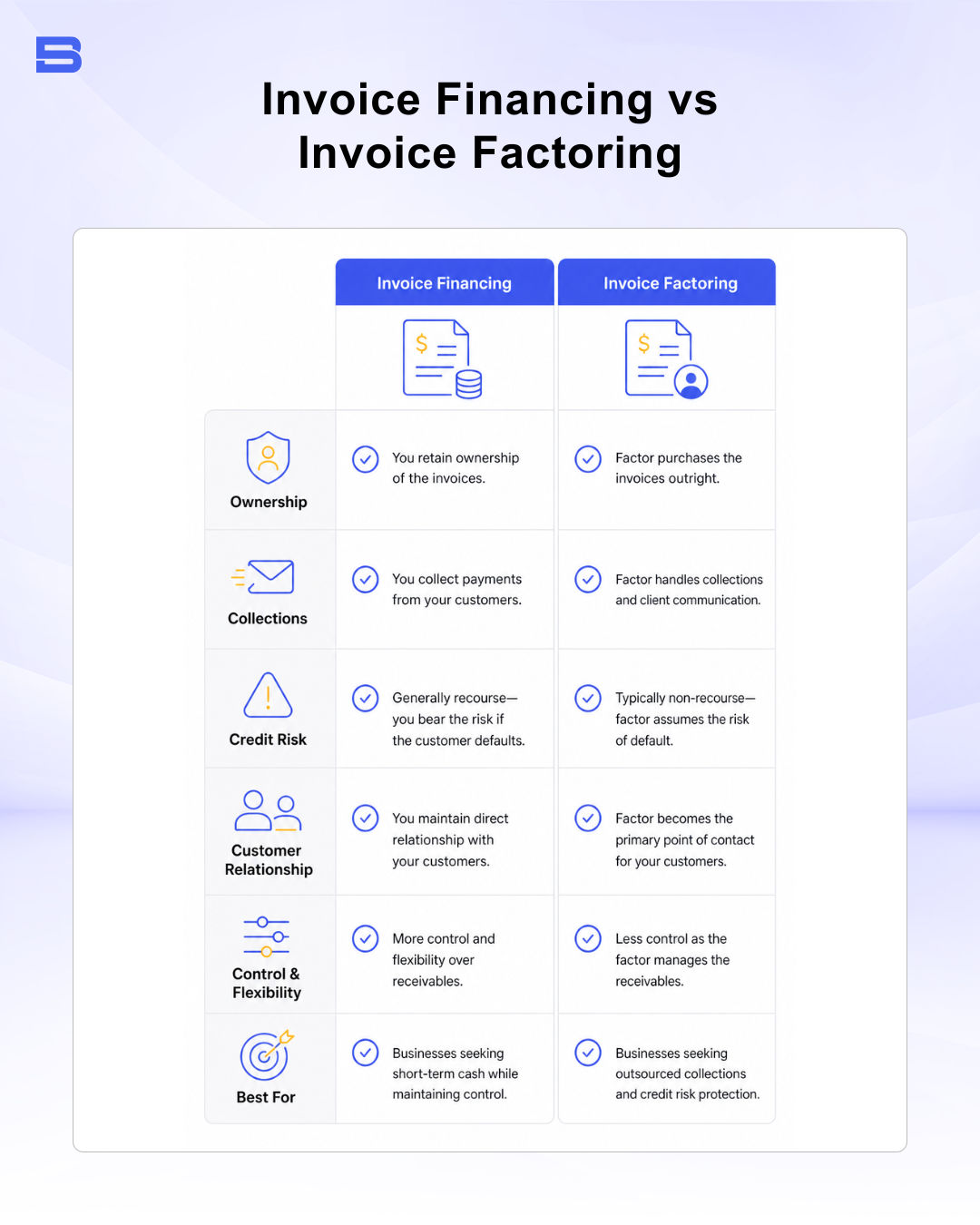
Under invoice financing, your business retains full ownership of the sales ledger and remains responsible for collecting payment from the customer. Most invoice financing in Malaysia operates on a recourse basis, meaning if the customer defaults, your business must repay the advance.
In contrast, invoice factoring involves selling your receivables outright to a factor who assumes collection duties and client communication.
Comparing P2P Lending Malaysia and Direct Invoice Financing
Digital alternative finance has expanded rapidly across Malaysia through peer-to-peer (P2P) lending platforms regulated by the Securities Commission Malaysia (SC). Through P2P lending, retail and institutional investors fund short-term business notes, providing liquidity directly to growing companies.
SC-Regulated P2P Invoice Financing Platforms Malaysia
The Securities Commission Malaysia regulates Recognized Market Operators (RMOs) that host invoice financing investment notes. Leading digital platforms such as CapBay and Funding Societies allow SMEs to upload verified invoices, while these and other SC-registered P2P operators such as B2B FinPAL enable retail investors to purchase fractional shares of these financing notes.
The regulator enforces strict platform operational standards, escrow account segregation, and risk disclosure rules to protect both business issuers and retail investors.
Shariah Compliant Invoice Financing Structures
Islamic invoice financing (Invoice Financing-i) is widely available in Malaysia, adhering to principles established by Shariah advisory councils. Platforms predominantly use Tawarruq (commodity murabahah) or Wakalah (agency) contracts.
Under Wakalah, the investor appoints the platform as an agent to purchase receivables, while Tawarruq utilizes underlying commodity trades to facilitate compliant profit distributions without charging interest (riba).
Key Risks and Returns for SMEs and Investors
Invoice financing provides distinct advantages alongside material risks that require careful evaluation from both business borrowers and investors. For SMEs, the primary upside is immediate working capital flexibility without diluting business equity or pledging property collateral.
However, invoice financing carries short-term borrowing fees that reduce overall profit margins, and late payment surcharges apply if clients delay payment beyond the agreed credit period. If a buyer defaults completely on a recourse note, the borrowing business remains fully liable to repay the advance.
The trade-off is credit default risk if the borrowing SME or buyer fails financially. Unlike bank deposits protected by PIDM (Perbadanan Insurans Deposit Malaysia, Malaysia's deposit insurance corporation), invoice investment notes are uncollateralized or backed solely by corporate guarantees, carrying potential loss of principal.
Alternative Financing Options: P2P Lending Malaysia vs. Equity Crowdfunding Malaysia
When evaluating capital strategy, businesses must distinguish debt-based cash flow tools from equity fundraising.
While invoice financing addresses short-term liquidity, companies seeking expansion capital often compare debt notes against equity crowdfunding, which involves selling equity shares to investors, trading long-term ownership for growth capital without monthly debt service obligations.
Larger mature firms may explore institutional channels like private equity or venture capital, whereas invoice financing remains tailored strictly for working capital needs tied to existing trade receivables.
A Bridge for Cash Flow
Invoice financing provides Malaysian SMEs an effective operational bridge to convert outstanding receivables into immediate cash flow while offering investors access to short-term yield opportunities. Maintaining disciplined credit assessment and managing fees remains crucial to leveraging this financial tool effectively.
- What Can You Trade? A Guide to Forex, Stocks, and More
- CFD Trading for Beginners
- What is CFD Trading and How Does It Work?
- Forex vs. Stocks: Which Market Suits You Best?
- How to Diversify a Portfolio Across Asset Classes
- How Dividend Stocks Work: Yields, Risks, and Strategies
- Silver Trading Explained: A Guide for Retail Investors
- Precious Metals Trading: A Complete Guide for Beginners
- Natural Gas Trading: A Guide to the Market
- Structured Warrants Malaysia: How They Work and Risks
- What Is the KLCI Index and How to Trade It
- Gold Investment in Malaysia: A Complete Guide for Beginners
- What Is Kijang Emas and How to Invest in It
- Value Investing Explained: How to Find Undervalued Stocks
- How to Trade Bitcoin Safely: A Complete Market Guide
- Growth Investing Explained: Strategies, Metrics, and Risks
- What Is Digital Gold Malaysia and How to Invest
- Crypto Trading Strategies for Beginners
- Gold vs Bitcoin: Key Differences, Risks, and Strategies
- Sukuk: A Guide for Beginners to Islamic Bonds
- What Is FCPO (Crude Palm Oil Futures) and How to Trade It
- How to Identify and Invest in Shariah-Compliant Stocks
- Timber Investment: Is It Worth It?
- Gold ETF Malaysia: A Guide for Beginners
- What Are Malaysian Government Securities (MGS)?
- Corporate Bonds Malaysia: A Guide for Beginners
- China A-Shares Trading Guide for Malaysian Investors
- What Is a Silver ETF and How to Invest in It?
- How to Trade XRP: A Practical Guide for Retail Investors
- How to Trade Solana (SOL): A Guide for Beginners
- What Are Gold Futures and How Do They Work?
- Money Market Fund in Malaysia: A Guide for Beginners
- Property Investment Malaysia: Direct Real Estate or M-REITs?
- What Is Binance Coin and How Does It Work?
- Green Sukuk: A Guide for Beginners to Islamic ESG Investing
- What Is Shiba Inu (SHIB) and How to Trade It
- What Is USDT? A Complete Guide to Tether for Beginners
- What Is Dogecoin and How to Trade It Safely for Beginners
- Cardano: A Guide for Beginners to Trade This Cryptocurrency
- Polkadot: A Guide to Trading This Cryptocurrency
- Tron: A Guide for Beginners to Trading This Cryptocurrency
- What Is Litecoin (LTC)? A Guide to Trading Digital Silver
- What Is Chainlink (LINK) and How to Trade It
- How to Trade Pepe Coin: Spot, Leverage, and Risk Management
- Near Protocol: A Guide to Trading This Cryptocurrency
- Trading Polygon Crypto: A Practical Guide for Beginners
- Trade Toncoin: Understanding the TON Ecosystem and Risks
- Cosmos Crypto: Ecosystem Architecture, Tokenomics, and Risks
- Stellar Crypto: A Guide to Trading This Cryptocurrency
- Avalanche Crypto Explained: A Practical Guide for Traders
- What Is Worldcoin? How to Trade WLD and Manage Risk
- Aptos: A Guide for Beginners to Trading This Cryptocurrency
- Sui Crypto Explained: Tokenomics and Trading Guide
- Celestia: A Guide to Trading This Cryptocurrency
- Decentraland: A Guide to Trading This Cryptocurrency
- What Is Arbitrum? How to Trade the Leading Layer 2 Network
- Sei Crypto: A Guide to Trading This Cryptocurrency
- What Is Injective Protocol and How to Trade INJ Safely
Disclaimer: The content on this page is intended for educational and informational purposes only. It does not constitute financial, investment, tax, or legal advice, and should not be interpreted as a recommendation to buy, sell, or hold any financial instrument or asset. Trading and investing involve significant risk, including the possible loss of your entire capital. Products such as forex, CFDs, and cryptocurrencies carry additional risks due to leverage, high volatility, and limited regulatory protection in some jurisdictions. Past performance of any financial instrument does not guarantee future results. Any market views, forecasts, or opinions expressed are those of the author at the time of writing and may not reflect current market conditions. Platform features, fees, and regulatory status are subject to change — always verify information directly with the relevant provider or regulator before making any financial decision. BrokerSpecs may receive compensation from third parties featured on this site. Always conduct your own due diligence and consider seeking advice from a licensed financial professional before investing. Portions of this article were prepared with the assistance of AI tools and reviewed by our editorial team before publication.