



Related Tags
Entering a trade or committing your hard-earned cash to an investment for the first time can be intimidating. While standard fixed deposit accounts offer capital protection, their returns often struggle to keep pace with annual inflation.
On the other end of the spectrum, active stock trading on Bursa Malaysia requires constant market monitoring, technical analysis, and a stomach for sharp price swings.
For many retail investors in Malaysia, unit trust funds offered by Amanah Saham Nasional Berhad (ASNB) serve as a middle ground. Whether you are building an emergency fund or setting aside long-term capital, understanding how ASNB funds work—and how they differ from high-risk trading instruments—is an essential first step.
What Is ASNB Investment and How Does It Work?
Amanah Saham Nasional Berhad (ASNB) is a wholly owned subsidiary of Permodalan Nasional Berhad (PNB). Regulated by the Securities Commission Malaysia (SC), ASNB manages various unit trust schemes designed to encourage savings and capital growth among Malaysians.
When you invest in an ASNB fund, your money is pooled alongside billions of Ringgit from other unitholders. Professional fund managers at PNB then deploy this capital across a diversified portfolio of Malaysian equities, corporate bonds, money market instruments, and international assets.
Instead of picking individual stocks yourself, you purchase units in a collective scheme that pays out income distributions (dividends) based on portfolio performance.
ASNB fund offerings are split into two distinct structural categories: fixed-price funds and variable-price funds.
Fixed-Price ASNB Funds
A fixed-price ASNB investment maintains a constant Net Asset Value (NAV) of RM1.00 per unit, so your capital doesn't fluctuate with daily market swings. When you invest RM1,000, you receive exactly 1,000 units; when you redeem RM1,000, you receive your principal back in full without capital losses.
Because NAV is pegged at RM1.00, your capital value carries zero market price volatility. Income generated by the underlying investments is distributed annually as additional units or cash payouts.
The primary fixed-price funds include:
- Amanah Saham Bumiputera (ASB), ASB 2, and ASB 3 Didik (reserved for Bumiputera investors)
- Amanah Saham Malaysia (ASM), ASM 2 Wawasan, and ASM 3 (open to all Malaysian citizens)
Variable-Price ASNB Funds
A variable-price ASNB investment fluctuates daily with market conditions, giving you the potential for capital appreciation alongside annual dividends.
Unlike fixed-price products, variable-price funds operate like traditional retail unit trusts in Malaysia. Their NAV fluctuates daily according to market conditions, underlying stock valuations, and economic trends.
When equity markets rise, your unit price increases along with it—though if markets decline, you could face a capital loss on redemption.
Key variable-price funds managed by ASNB include:
- ASN Equity Series (higher growth potential with direct equity market volatility exposure)
- ASN Imbang Series (balanced funds combining equities and fixed-income assets)
- ASN Sara Series (conservative funds focusing primarily on fixed income and money market stability)
Understanding ASB Account vs. Other ASNB Funds
Understanding the distinction between an ASB account and a broader ASNB investment helps new investors choose the right fund.
ASB (Amanah Saham Bumiputera) is a specific fixed-price unit trust fund under ASNB. It is restricted exclusively to Malaysian Bumiputera citizens. Due to its historical distribution track record and low administrative costs, it remains one of the primary savings vehicles in the country. According to PNB's official ASB fund terms, individual unitholders can hold up to a maximum structural limit of RM300,000 in fixed-price ASB units.
By contrast, ASNB is the management company that operates multiple funds. If you are a non-Bumiputera investor, you cannot open an ASB account, but you can invest in public fixed-price funds like ASM or any of the variable-price ASN funds.
Non-Bumiputera Investment Quotas (ASM)
For non-Bumiputera investors, an ASNB investment through ASM or ASM 2 Wawasan depends on quota availability. PNB allocates total fund units across demographic groups, and once a quota is fully subscribed, no new units can be issued until existing unitholders redeem theirs.
In recent years, PNB has periodically reviewed individual allotment caps and overall unit allocations for ASM funds to improve public access—check the latest myASNB announcements for current quota details.
To secure units during quota releases or peer redemptions, investors typically utilize the digital myASNB portal or internet banking channels early in the business day when liquidity re-enters the system.
Investing in Unit Trust Malaysia Funds Through ASNB
Before making an ASNB investment, it helps to understand the difference between fixed-price and private retail unit trust funds (such as those offered by commercial banks or independent asset management firms).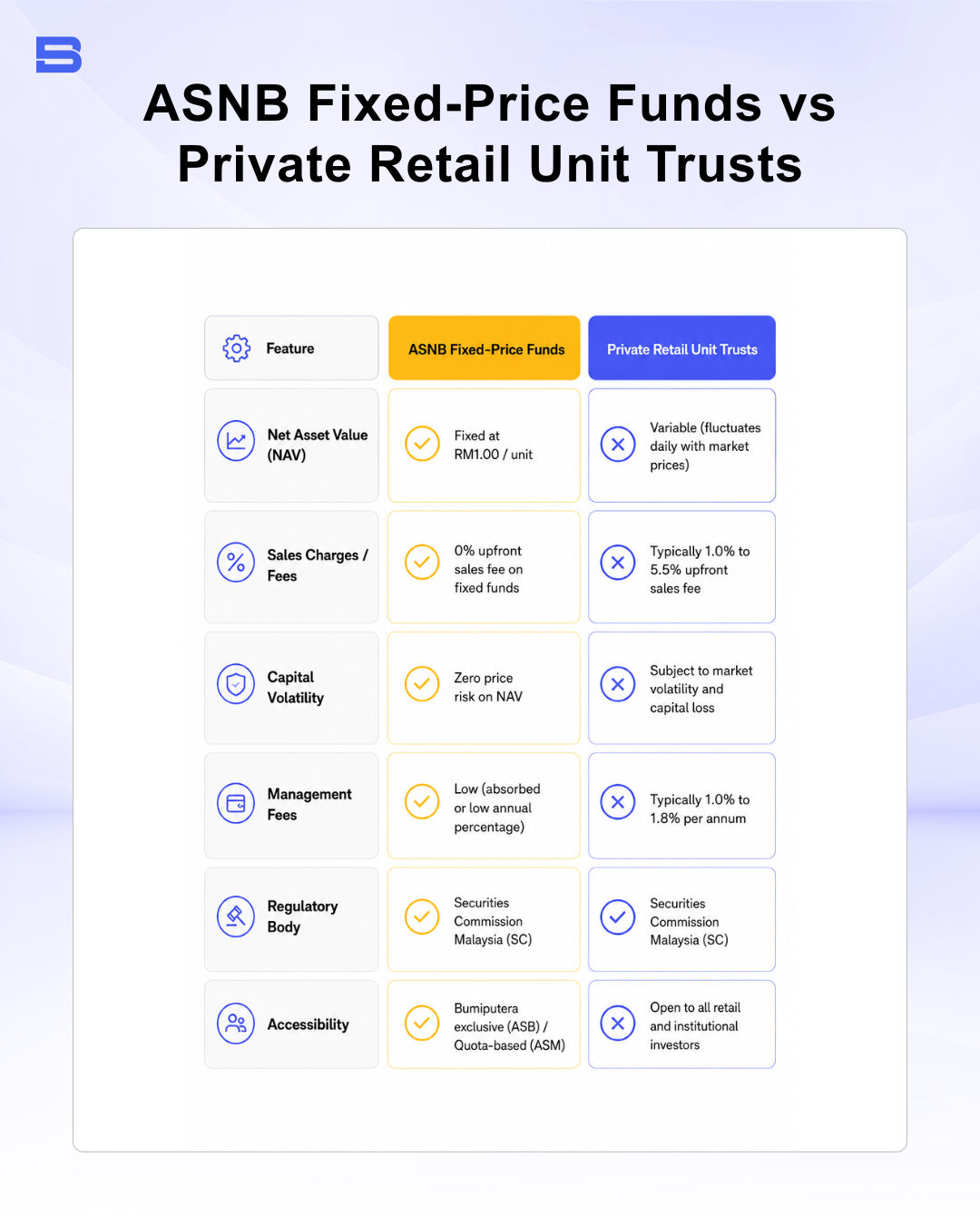
While active unit trust funds managed by private institutions offer specialized exposure to foreign tech equities or niche global sectors, their higher fee structures require superior market performance just to break even after costs. ASNB fixed funds eliminate upfront sales charges entirely, ensuring 100% of your capital begins working immediately.
Historical ASNB Dividend Rates and Yield Expectations
ASNB income distributions are calculated based on the average minimum monthly balance held in your account over the fund's financial year. This calculation method rewards consistent, long-term saving rather than short-term market timing.
To understand how distributions compound, consider a practical scenario:
Worked Example:
- Initial Account Balance: RM10,000 held consistently across the 12-month financial year.
- Announced Annual Distribution: 5.25 cents per unit (5.25%).
- Payout Calculation: RM10,000 x 0.0525 = RM525.
- Reinvestment: On the distribution payout date, RM525 worth of new units (525 units at RM1.00 each) are automatically credited to your principal balance without any manual tax deductions. Your new starting balance for the following financial year becomes RM10,525.
Income distributions from ASNB funds are tax-exempt at the individual unitholder level in Malaysia. Because distributions are automatically reinvested into fixed-price accounts, your balance benefits from compound growth over multi-year horizons. For long-term savers, an ASNB investment can serve as a stable core holding alongside growth assets.
However, annual yield rates vary based on global economic conditions, interest rate environments, and PNB's underlying investment portfolio performance—past yields do not guarantee future distribution levels.
How to Open and Invest in ASNB Online (myASNB)
Setting up an ASNB investment has transitioned from physical agent branches to digital onboarding via the myASNB app. Regulated banking infrastructure monitored by Bank Negara Malaysia (BNM) enables secure electronic fund transfers directly into unit trust accounts.
- Download the myASNB Mobile App: Available on official app stores for Malaysian citizens and permanent residents aged 18 and above.
- Complete Electronic Know Your Customer (e-KYC): Scan your MyKad (front and back) and complete the facial recognition verification step.
- Link Your Online Banking Account: Fund your initial investment via Financial Process Exchange (FPX) direct transfer. Per the official myASNB fund information, the minimum initial investment for most funds starts as low as RM10, and instant online redemptions are capped at RM2,000 per calendar month.
- Set Up Recurring Deposits (Investment Target): Configure automated monthly deductions from your bank account to enforce disciplined, regular savings without relying on manual transfers.
For liquidity needs, unitholders can perform instant online redemptions via the myASNB portal up to RM2,000 per calendar month (subject to operational terms), with funds credited directly to your linked Malaysian bank account. Larger redemptions can be processed online or at physical ASNB branches and agent banks.
Comparing ASNB to Other Savings Options (Tabung Haji, EPF i-Invest)
When structuring a personal portfolio, comparing an ASNB investment against Tabung Haji or EPF i-Invest can help you decide how to structure your savings.
- Lembaga Tabung Haji: Designed specifically for Muslim citizens preparing for the Hajj pilgrimage. It provides Shariah-compliant annual distributions (Hibah) after deducting mandatory Zakat. ASNB fixed funds like ASB and ASM are also declared Shariah-compliant by PNB’s Shariah Advisory Committee and aligned with national regulatory guidelines, giving Muslim investors multiple compliant vehicles.
- EPF i-Invest: Allows Employees Provident Fund (EPF/KWSP) members to invest a portion of their Akaun Persaraan (formerly Account 1) savings above their age-based Basic Savings threshold into approved private unit trust funds or ASNB variable-price funds. While EPF's conventional/Simpanan Shariah accounts offer stable baseline dividends, leveraging EPF i-Invest lets experienced unitholders seek higher risk-adjusted growth without spending out-of-pocket cash.
Fixed-Income Alternatives: Sukuk and MGS
For institutional-grade risk management, PNB allocates a portion of ASNB fund capital into fixed-income instruments such as sukuk (Islamic bonds) and Malaysian Government Securities (MGS).
Holding direct MGS or Sukuk requires specialized accounts, whereas an ASNB investment in fixed-price funds gives retail investors the same stable, government-backed exposure while maintaining daily liquidity at an accessible RM1.00 unit price.
Is ASNB a Good Investment for Long-Term Growth?
Evaluating whether an ASNB investment fits your portfolio depends on your risk tolerance, timeline, and objectives.
For conservative investors, fixed-price funds serve as an effective core holding for capital preservation, building emergency funds, or storing short-to-medium term cash reserves. The zero-volatility NAV eliminates the stress of stock market downturns while providing yields that historically outpace standard bank fixed deposits. A thoughtful ASNB investment approach balances stability today with growth for tomorrow.
However, relying solely on fixed-price unit trusts may limit long-term wealth creation for younger investors with multi-decade horizons. Because capital value remains fixed at RM1.00, your principal does not benefit from capital gains during major bull markets.
A well-balanced ASNB investment strategy often combines fixed-price funds for stability with growth-oriented equities or exchange-traded funds (ETFs) to hedge against long-term inflation.
Balancing Your Portfolio
ASNB investments offer Malaysians a structured, low-cost framework for growing capital without taking on high-risk market exposure. By balancing fixed-price funds for liquidity and capital preservation alongside growth assets, you can establish a resilient financial foundation tailored to your long-term goals.
- What Can You Trade? A Guide to Forex, Stocks, and More
- CFD Trading for Beginners
- What is CFD Trading and How Does It Work?
- Forex vs. Stocks: Which Market Suits You Best?
- How to Diversify a Portfolio Across Asset Classes
- How Dividend Stocks Work: Yields, Risks, and Strategies
- Silver Trading Explained: A Guide for Retail Investors
- Precious Metals Trading: A Complete Guide for Beginners
- Natural Gas Trading: A Guide to the Market
- Structured Warrants Malaysia: How They Work and Risks
- What Is the KLCI Index and How to Trade It
- Gold Investment in Malaysia: A Complete Guide for Beginners
- What Is Kijang Emas and How to Invest in It
- Value Investing Explained: How to Find Undervalued Stocks
- How to Trade Bitcoin Safely: A Complete Market Guide
- Growth Investing Explained: Strategies, Metrics, and Risks
- What Is Digital Gold Malaysia and How to Invest
- Crypto Trading Strategies for Beginners
- Gold vs Bitcoin: Key Differences, Risks, and Strategies
- Sukuk: A Guide for Beginners to Islamic Bonds
- What Is FCPO (Crude Palm Oil Futures) and How to Trade It
- How to Identify and Invest in Shariah-Compliant Stocks
- Timber Investment: Is It Worth It?
- Gold ETF Malaysia: A Guide for Beginners
- What Are Malaysian Government Securities (MGS)?
- Corporate Bonds Malaysia: A Guide for Beginners
- China A-Shares Trading Guide for Malaysian Investors
- What Is a Silver ETF and How to Invest in It?
- How to Trade XRP: A Practical Guide for Retail Investors
- How to Trade Solana (SOL): A Guide for Beginners
- What Are Gold Futures and How Do They Work?
- Money Market Fund in Malaysia: A Guide for Beginners
- Property Investment Malaysia: Direct Real Estate or M-REITs?
- What Is Binance Coin and How Does It Work?
- Green Sukuk: A Guide for Beginners to Islamic ESG Investing
- What Is Shiba Inu (SHIB) and How to Trade It
- What Is USDT? A Complete Guide to Tether for Beginners
- What Is Dogecoin and How to Trade It Safely for Beginners
- Cardano: A Guide for Beginners to Trade This Cryptocurrency
- Polkadot: A Guide to Trading This Cryptocurrency
- Tron: A Guide for Beginners to Trading This Cryptocurrency
- What Is Litecoin (LTC)? A Guide to Trading Digital Silver
- What Is Chainlink (LINK) and How to Trade It
- How to Trade Pepe Coin: Spot, Leverage, and Risk Management
- Near Protocol: A Guide to Trading This Cryptocurrency
- Trading Polygon Crypto: A Practical Guide for Beginners
- Trade Toncoin: Understanding the TON Ecosystem and Risks
- Cosmos Crypto: Ecosystem Architecture, Tokenomics, and Risks
- Stellar Crypto: A Guide to Trading This Cryptocurrency
- Avalanche Crypto Explained: A Practical Guide for Traders
- What Is Worldcoin? How to Trade WLD and Manage Risk
- Aptos: A Guide for Beginners to Trading This Cryptocurrency
- Sui Crypto Explained: Tokenomics and Trading Guide
- Celestia: A Guide to Trading This Cryptocurrency
- Decentraland: A Guide to Trading This Cryptocurrency
- What Is Arbitrum? How to Trade the Leading Layer 2 Network
- Sei Crypto: A Guide to Trading This Cryptocurrency
- What Is Injective Protocol and How to Trade INJ Safely
Disclaimer: The content on this page is intended for educational and informational purposes only. It does not constitute financial, investment, tax, or legal advice, and should not be interpreted as a recommendation to buy, sell, or hold any financial instrument or asset. Trading and investing involve significant risk, including the possible loss of your entire capital. Products such as forex, CFDs, and cryptocurrencies carry additional risks due to leverage, high volatility, and limited regulatory protection in some jurisdictions. Past performance of any financial instrument does not guarantee future results. Any market views, forecasts, or opinions expressed are those of the author at the time of writing and may not reflect current market conditions. Platform features, fees, and regulatory status are subject to change — always verify information directly with the relevant provider or regulator before making any financial decision. BrokerSpecs may receive compensation from third parties featured on this site. Always conduct your own due diligence and consider seeking advice from a licensed financial professional before investing.