


Related Tags
You click "Buy" on EUR/USD (Euro and US Dollar), expecting to see your account start at zero profit. Instead, the moment your trade opens, you are immediately in the red. Nothing went wrong with your connection, and the broker did not execute a faulty order. You have simply paid the cost of entering the market.
That initial negative figure is caused by the bid-ask spread—an implicit, unavoidable trading cost built into almost every financial market. Understanding how this spread works, how to calculate it, and how it impacts your bottom line is essential before opening your next trade.
What Are Bid and Ask Prices?
To understand the spread, you first need to look at the two prices provided on every quote board: the bid price and the ask price. Financial markets do not operate on a single price tag; they operate on a dynamic negotiation between buyers and sellers.
- Bid Price: The highest price a buyer (or market maker) is willing to pay for an asset. This is the price you receive when you decide to sell.
- Ask Price (Offer): The lowest price a seller is willing to accept for an asset. This is the price you pay when you decide to buy.
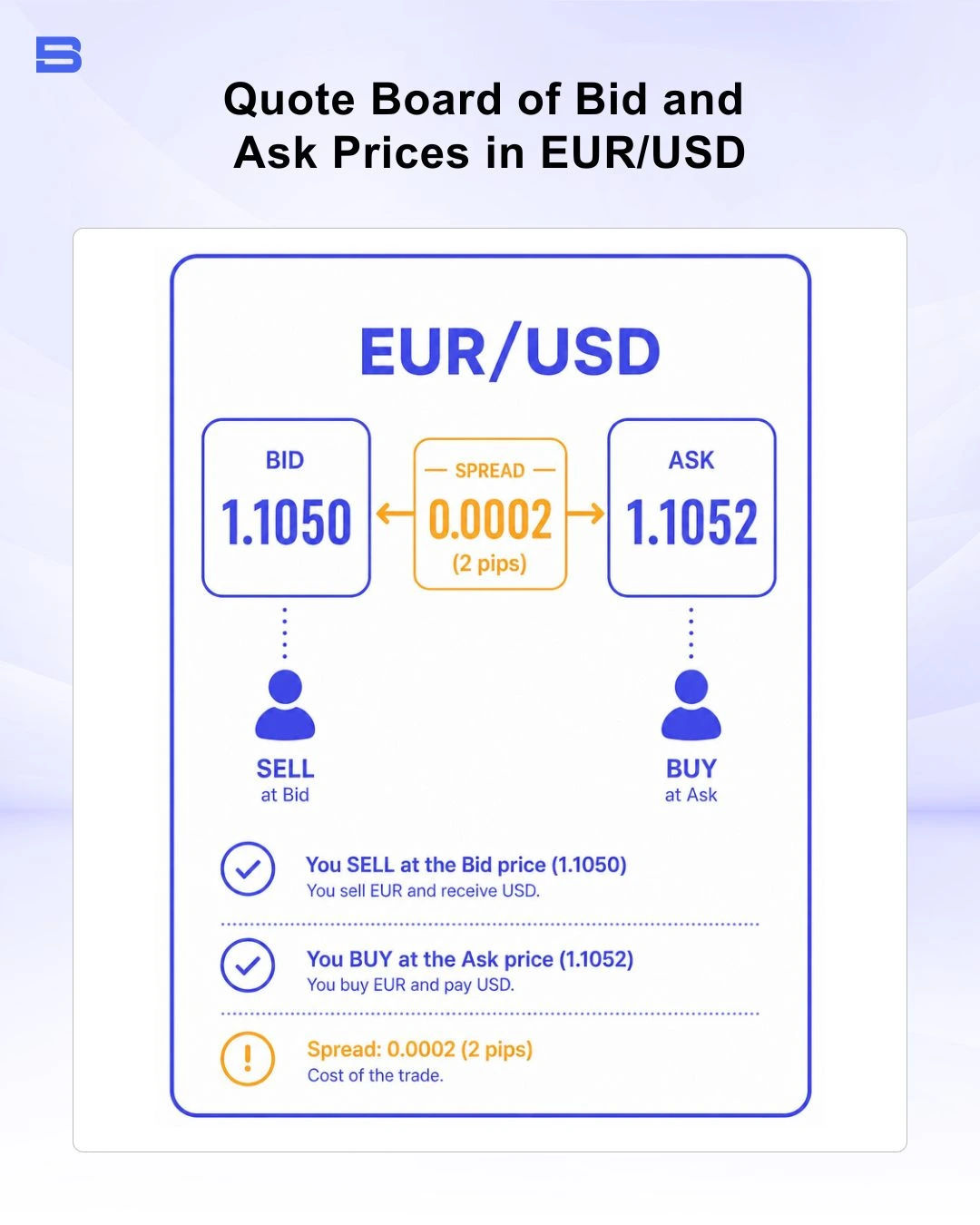
Because buyers naturally want to pay as little as possible and sellers want to receive as much as possible, the ask price is always higher than the bid price. The difference between these two points represents the cost of immediate liquidity—the fee you pay for instant execution.
How to Calculate the Bid-Ask Spread (with Example)
Calculating the bid-ask spread is straightforward. You subtract the bid price from the ask price:
Spread = Ask Price - Bid Price
The calculation applies across asset classes, though it is measured in pips for forex, cents or dollars for stocks, and points for indices.
Forex Example: EUR/USD
Imagine you open your trading platform and see a quote for EUR/USD:
- Ask Price: 1.0852
- Bid Price: 1.0850
Using the formula:
Spread = 1.0852 - 1.0850 = 0.0002 (two pips)
If you open a standard lot position sizing ($100,000 units), where one pip is worth $10, entering this trade costs you $20 upfront (10 x two pips). Your position starts at -$20, meaning the market must move two pips in your favor just for you to break even.
Stock Example: Share Trading
Consider a major technology stock quoted on an exchange:
- Ask Price: $150.10
- Bid Price: $150.00
Spread = $150.10 - $150.00 = $0.10
If you purchase 100 shares at the ask price of $150.10, your total spend is $15,010. If you chose to liquidate those shares instantly, you would sell at the bid price of $150.00, receiving $15,000. That $10 loss represents the bid-ask spread.
Why Does the Bid-Ask Spread Matter to Traders?
The bid-ask spread directly affects your profit potential because every trade starts at a minor loss. Over months or years of active trading, these micro-costs accumulate into a substantial expense.
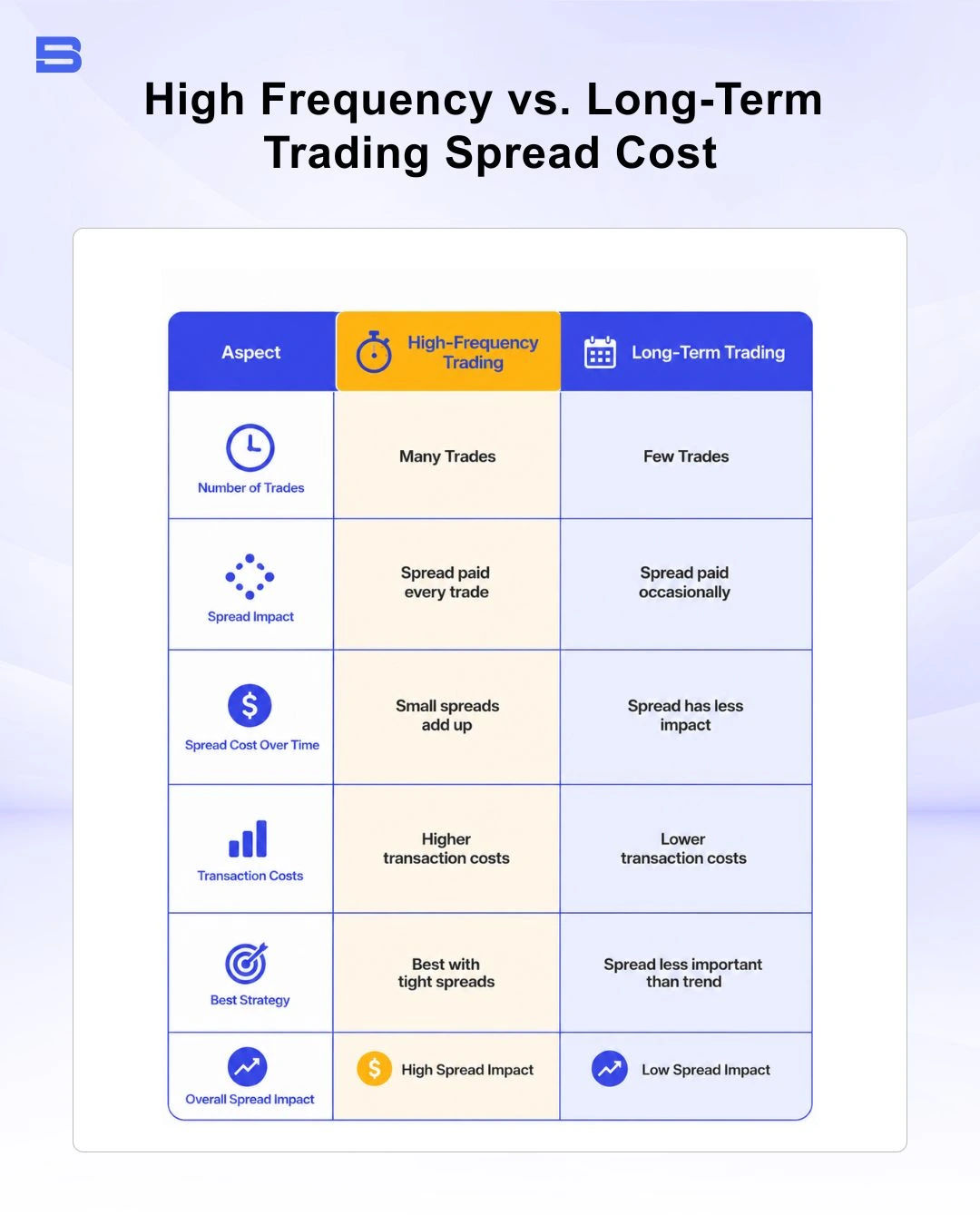
For short-term traders—such as day traders or scalpers- these types of traders prioritize the spread as a primary concern. If your target profit on a trade is five pips, paying a two-pip spread means you are giving up 40% of your total target to transaction costs. For long-term position sizing traders aiming for 200-pip moves, that same two-pip spread is relatively negligible.
If you are evaluating new market opportunities, review our detailed guide on choosing the right trading strategy to see how transaction costs align with different holding periods.
Key Factors That Influence Spread Width
Spreads are not static; they fluctuate based on broader market conditions. Understanding why spreads expand or contract helps you avoid entering trades during unnecessarily expensive conditions.
1. Market Liquidity and Volume
Liquidity refers to how easily an asset can be bought or sold without causing major price movements. Highly liquid assets, like major currency pairs (EUR/USD, USD/JPY), the US Dollar and Japanese Yen, or mega-cap stocks (Apple, Microsoft), feature thousands of active buyers and sellers. This competition drives the bid and ask prices closer together, resulting in tight spreads.
Conversely, exotic currency pairs or small-cap equities have lower trading volumes, leading to wider spreads as liquidity providers demand higher compensation for handling lower-demand assets.
2. Market Volatility
During major economic announcements—such as non-farm payroll reports or central bank rate decisions—prices move rapidly. Liquidity providers face heightened risk during these surges, causing them to widen their quotes to protect against sharp losses.
3. Broker Execution Models
Your choice of broker directly impacts the spreads you receive:
- ECN (Electronic Communication Network) / STP (Straight Through Processing) Brokers: Pass raw spreads directly from market liquidity providers, charging a fixed commission per trade.
- Market Maker Brokers: Often charge zero explicit commissions, but mark up the bid-ask spread to cover their service fee.
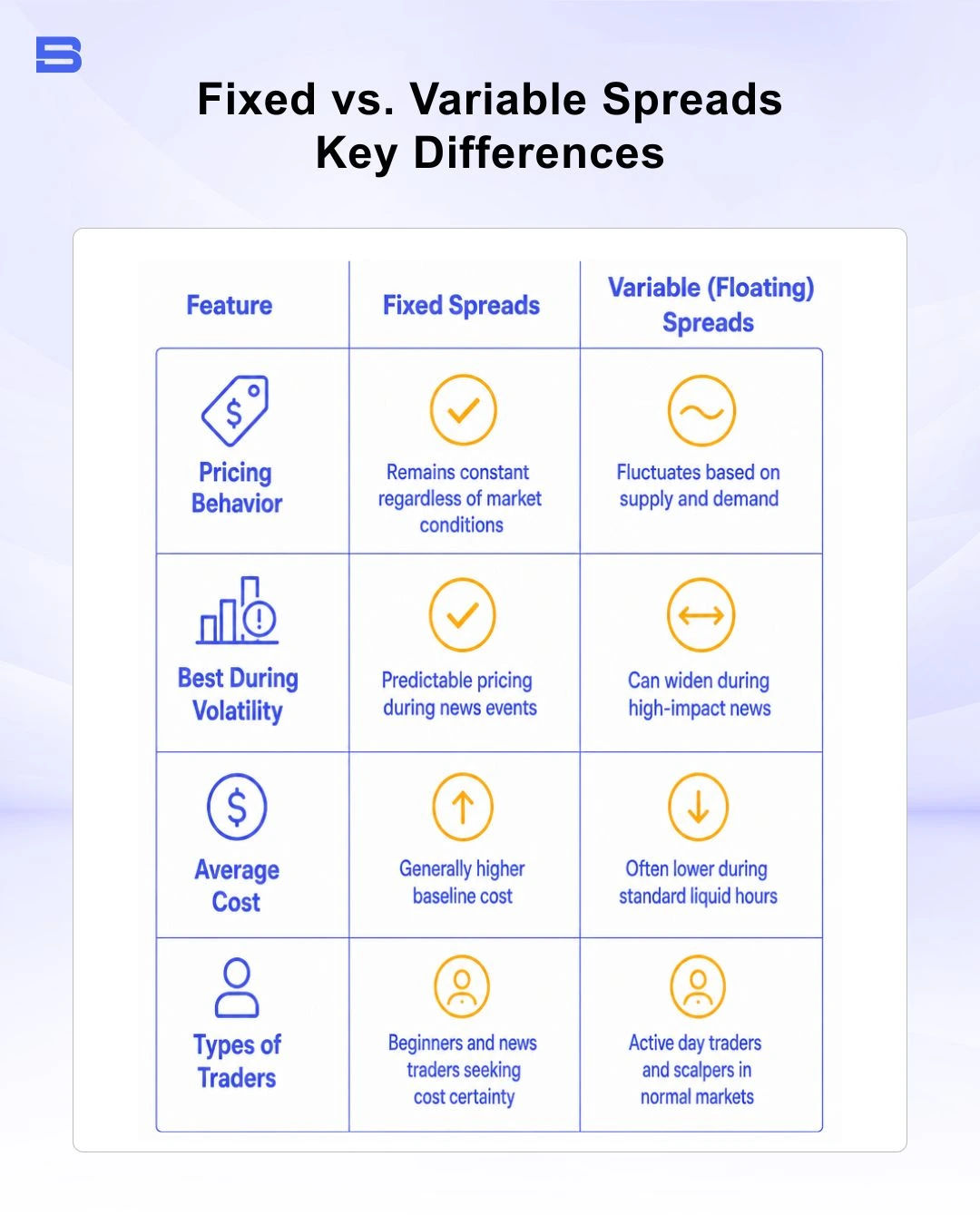
Fixed vs. Variable Spreads: What's the Difference?
When opening a trading account, brokers often offer a choice between fixed and variable spread structures.
Ready to Start Managing Spread Costs
The bid-ask spread is a fundamental reality of financial markets—the small price paid for immediate market execution. While it cannot be avoided, its impact can potentially be reduced. Factors such as trading high-liquidity assets during peak hours, selecting an execution model suited to one's own strategy, and staying mindful of economic calendar releases may help manage spread costs, though the right approach depends on each trader's individual goals, risk tolerance, and experience level. This article does not constitute a recommendation to trade.
- What Is Trading and How Does Trading Work?
- Trading Fundamentals: A Guide for Beginners
- Trading vs. Investing: What Are the Key Differences?
- Trading Terms and Terminologies Every Beginner Should Know
- Common Trading Mistakes Beginners Make and How to Avoid
- Understanding Risk and Reward in Trading: A Complete Guide
- Guide to the Different Types of Financial Markets
- Investment Basics: Definition, Strategies, and How to Invest
- Benefits of Investing: Financial Growth and Security
- What Is Swing Trading? A Practical Guide For Beginners
- What Is Spot Trading? A Guide for Beginners
- What Are Futures in Trading? A Guide for Beginners
- Understanding Bull Markets: Growth & Strategy
- How to Read a Candlestick Chart: A Guide for Beginners
- Is Trading Gambling? The Truth About Risk
- Pip in Forex: How It Works & How to Calculate It
- What Is the Bid-Ask Spread in Trading? A Guide for Beginners
- What Is a Margin Call? A Guide for Beginners
- Market Volatility Explained: What It Is and How to Trade It
- Drawdown in Trading: Meaning, Math, and Risk
- Understanding Slippage in Trading: Causes and Control
- Forex Lot Size Explained: Standard, Mini & Micro
- Trailing Stop vs Stop Loss: Essential Risk Strategy
- How Asset Allocation Works: Strategies Explained
- Understanding Market Trading Hours & Sessions
- Market Makers Explained: A Trader's Guide
- Portfolio Diversification: A Strategy Guide
- Capital Gains Explained: How Investment Taxes Work
- Stock Market Circuit Breakers: How Trading Halts Work
- What Is an IPO? How Initial Public Offerings Work
- What Is a Secondary Market? A Complete Guide
- What Is a Stock Exchange? Functions and Overview Explained
- Understanding Ticker Symbols: A Market Guide
- How Clearing Houses Work in Financial Markets
- Stock Market After Labor Day: Trends and What To Expect
Disclaimer: The content on this page is intended for educational and informational purposes only. It does not constitute financial, investment, tax, or legal advice, and should not be interpreted as a recommendation to buy, sell, or hold any financial instrument or asset. Trading and investing involve significant risk, including the possible loss of your entire capital. Products such as forex, CFDs, and cryptocurrencies carry additional risks due to leverage, high volatility, and limited regulatory protection in some jurisdictions. Past performance of any financial instrument does not guarantee future results. Any market views, forecasts, or opinions expressed are those of the author at the time of writing and may not reflect current market conditions. Platform features, fees, and regulatory status are subject to change — always verify information directly with the relevant provider or regulator before making any financial decision. BrokerSpecs may receive compensation from third parties featured on this site. Always conduct your own due diligence and consider seeking advice from a licensed financial professional before investing. Portions of this article were prepared with the assistance of AI tools and reviewed by our editorial team before publication.