



Related Tags
When you browse everyday investment apps, most funds follow a familiar script: buy a basket of stocks or bonds and hope the market climbs. Behind closed doors, however, private investment partnerships operate under very different rules, using flexible strategies designed to pursue gains whether markets rise, fall, or move sideways.
Those private vehicles are known as hedge funds, and they sit near the complex end of the investing spectrum. Understanding how a hedge fund works, what it charges, and who can legally invest helps you separate Wall Street mystique from financial reality.
What Is a Hedge Fund? Hedge Fund Meaning and Core Structure
A hedge fund is a privately pooled investment partnership that uses flexible, active trading strategies to seek positive returns for qualified investors. Unlike public retail funds, it faces fewer restrictions on the assets it can buy or the trading techniques it can use.
Most hedge funds are organized as limited partnerships with two distinct roles. The fund manager serves as the general partner, making daily portfolio decisions and often investing personal money alongside clients. Outside investors join as limited partners, contributing capital while capping their personal liability at the amount they invest.
Because they operate outside standard retail fund rules, hedge funds belong to the broader world of alternative investments. Their managers can trade stocks, bonds, currencies, commodities, and derivatives across global markets rather than tracking a single public benchmark.
Hedge Fund vs Mutual Fund and Unit Trust: Key Differences
Comparing a hedge fund against a mutual fund, a Malaysian unit trust, or a low-cost index fund shows why each product serves a very different investor profile. The table below outlines how these vehicles compare across access, strategy, fees, and liquidity.
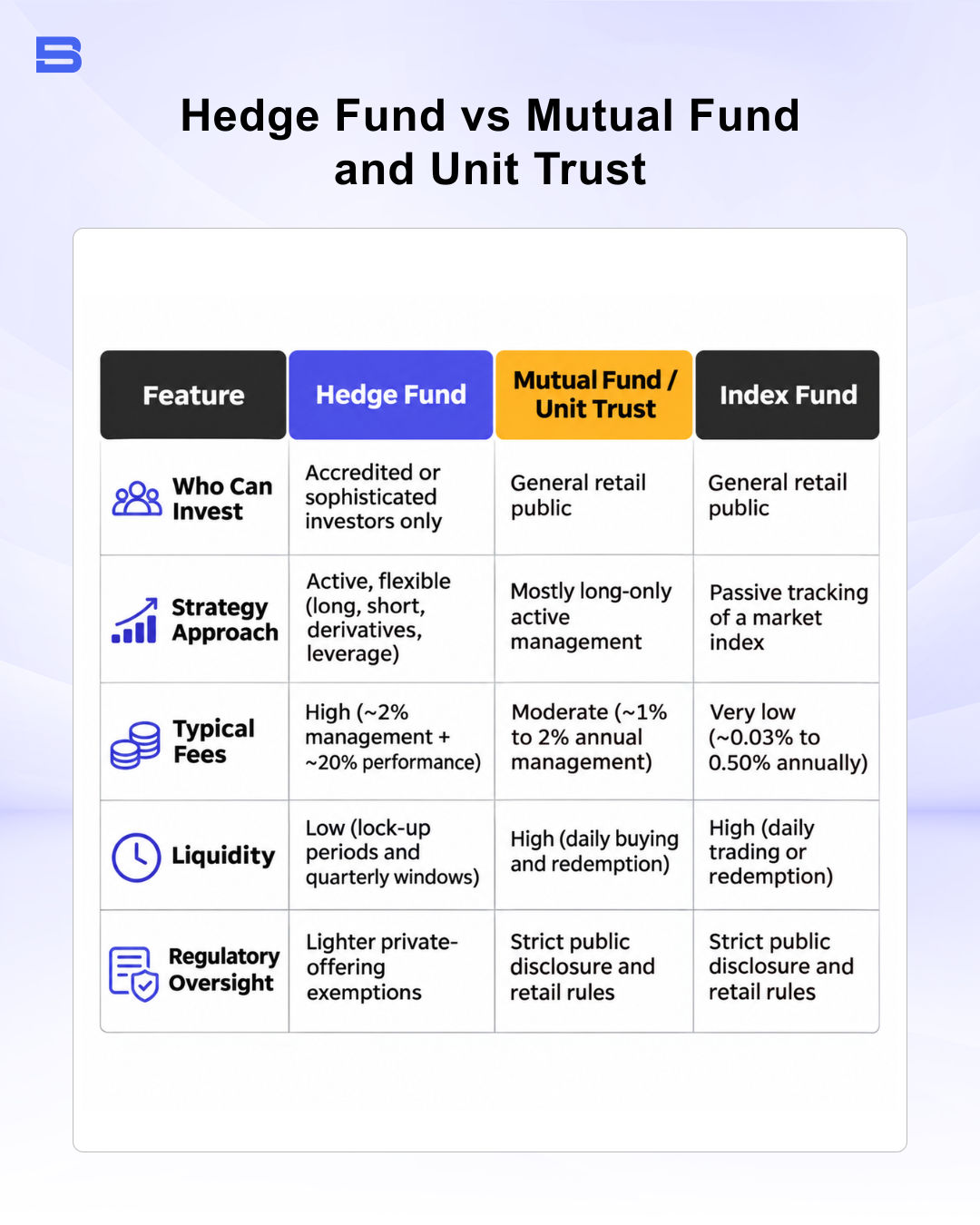
For most everyday savers, unit trusts and index funds provide transparent pricing, daily withdrawals, and strong regulatory safeguards. Hedge funds trade away those protections in exchange for wider strategy freedom and much higher minimum commitments.
How Do Hedge Funds Work? Common Hedge Fund Strategies Explained
The word "hedge" originally referred to offsetting market risk, much like buying insurance against a sudden downturn. Today, most hedge funds aim to maximize risk-adjusted returns across different market cycles rather than simply protecting against losses.
To achieve that goal, managers combine traditional long positions with short selling, derivatives, and borrowed money known as leverage. Using leverage can amplify your returns when a trade goes right, but it magnifies losses just as quickly when prices move against the fund.
Different hedge fund strategies target different market opportunities:
- Long/short equity: Managers buy stocks they expect to rise while short-selling overvalued shares to profit from price gaps in either direction.
- Global macro: Funds place broad trades across currencies, interest rates, commodities, and stock indices based on economic and geopolitical trends.
- Event-driven: Managers seek gains from corporate events such as mergers, restructurings, bankruptcies, or earnings surprises.
- Arbitrage and direct lending: Quantitative teams exploit tiny price mismatches between related securities, while private credit funds lend directly to companies outside traditional banks.
Having broader tools gives managers more ways to navigate volatile markets, yet hedging only reduces specific risks rather than eliminating the chance of losing money.
How Hedge Fund Fees Work: The 2 and 20 Fee Structure Explained
Most hedge funds charge fees under a model known as the "2 and 20" fee structure, though exact terms vary across firms. You typically pay an annual management fee of around 2% of your invested assets plus a 20% performance fee on new profits.
To prevent managers from collecting performance bonuses twice on the same recovery, most funds use a high-water mark. This safeguard ensures the manager only earns a performance fee when your account value rises above its previous highest peak.
Suppose you invest $1,000,000 into a hedge fund charging a 2% annual management fee on starting capital and a 20% performance fee with a high watermark. In Year 1, the fund gains 10% gross ($100,000), deducts $20,000 for the management fee, and takes 20% of the remaining $80,000 gain ($16,000), leaving you with $1,064,000 and a 6.4% net return on investment.
In Year 2, if the fund loses 5% ($53,200) and still charges its 2% management fee ($21,280), your balance falls to $989,520 while the performance fee stays at $0 until the fund climbs back above your $1,064,000 high-water mark. This example shows how ongoing management fees still erode your capital even during a losing year.
Who Can Invest in a Hedge Fund? Rules for Global and Malaysian Investors
Financial regulators restrict hedge fund marketing because complex strategies and lighter reporting rules expose inexperienced savers to steep losses. As a result, most funds remain closed to the general retail public and accept only institutional or high-net-worth investors.
In the United States, the U.S. Securities and Exchange Commission (SEC) limits most private funds to an accredited investor with a net worth above $1 million excluding a primary residence, or annual income exceeding $200,000 individually ($300,000 jointly) for the past two years.
In Malaysia, the Securities Commission Malaysia (SC) restricts wholesale fund and hedge fund offerings in Malaysia to Sophisticated Investors under its CMSA Guidelines. An individual generally qualifies with net personal assets above RM3 million (with primary residence value capped at RM1 million), gross annual income over RM300,000, or a net capital-market investment portfolio exceeding RM1 million.
If you do not meet these thresholds, public unit trusts, ETFs, and regulated equity crowdfunding platforms offer accessible alternatives. Qualified investors exploring private markets in the region often compare hedge funds alongside private equity in Malaysia or early-stage angel investor deals.
Key Risks of Hedge Funds: Leverage, Lock-Up Periods, and Manager Risk
Greater strategy freedom brings serious structural risks that can catch even experienced investors off guard. Before committing capital, you need to weigh four major downsides that rarely affect everyday retail funds.
First, leverage magnifies both gains and losses, meaning a sudden market reversal can trigger forced selling and deep capital drawdowns. Second, most hedge funds enforce an initial lock-up period of one to two years during which you cannot withdraw your cash, followed by quarterly redemption windows or withdrawal gates during market stress.
Third, private funds disclose far less portfolio detail than listed ETFs or unit trusts, leaving you heavily exposed to a single manager's judgment and internal controls. Finally, locking up large sums in a high-fee fund carries a meaningful opportunity cost if simpler, lower-cost investments would have matched or outperformed its net results.
Strategy Freedom Comes at a Price
A hedge fund gives qualified investors access to active, multi-asset strategies that aim to generate returns beyond traditional stock and bond markets. That flexibility comes with high fees, multi-year lock-up periods, lighter regulatory oversight, and a significant risk of capital loss.
- What Is Trading and How Does Trading Work?
- Trading Fundamentals: A Guide for Beginners
- Trading vs. Investing: What Are the Key Differences?
- Trading Terms and Terminologies Every Beginner Should Know
- Common Trading Mistakes Beginners Make and How to Avoid
- Understanding Risk and Reward in Trading: A Complete Guide
- Guide to the Different Types of Financial Markets
- Investment Basics: Definition, Strategies, and How to Invest
- Benefits of Investing: Financial Growth and Security
- What Is Swing Trading? A Practical Guide For Beginners
- What Is Spot Trading? A Guide for Beginners
- What Are Futures in Trading? A Guide for Beginners
- Understanding Bull Markets: Growth & Strategy
- How to Read a Candlestick Chart: A Guide for Beginners
- Is Trading Gambling? The Truth About Risk
- Pip in Forex: How It Works & How to Calculate It
- What Is the Bid-Ask Spread in Trading? A Guide for Beginners
- What Is a Margin Call? A Guide for Beginners
- Market Volatility Explained: What It Is and How to Trade It
- Drawdown in Trading: Meaning, Math, and Risk
- Understanding Slippage in Trading: Causes and Control
- Forex Lot Size Explained: Standard, Mini & Micro
- Trailing Stop vs Stop Loss: Essential Risk Strategy
- How Asset Allocation Works: Strategies Explained
- Understanding Market Trading Hours & Sessions
- Market Makers Explained: A Trader's Guide
- Portfolio Diversification: A Strategy Guide
- Capital Gains Explained: How Investment Taxes Work
- Stock Market Circuit Breakers: How Trading Halts Work
- What Is an IPO? How Initial Public Offerings Work
- What Is a Secondary Market? A Complete Guide
- What Is a Stock Exchange? Functions and Overview Explained
- Understanding Ticker Symbols: A Market Guide
- How Clearing Houses Work in Financial Markets
- Stock Market After Labor Day: Trends and What To Expect
Disclaimer: The content on this page is intended for educational and informational purposes only. It does not constitute financial, investment, tax, or legal advice, and should not be interpreted as a recommendation to buy, sell, or hold any financial instrument or asset. Trading and investing involve significant risk, including the possible loss of your entire capital. Products such as forex, CFDs, and cryptocurrencies carry additional risks due to leverage, high volatility, and limited regulatory protection in some jurisdictions. Past performance of any financial instrument does not guarantee future results. Any market views, forecasts, or opinions expressed are those of the author at the time of writing and may not reflect current market conditions. Platform features, fees, and regulatory status are subject to change — always verify information directly with the relevant provider or regulator before making any financial decision. BrokerSpecs may receive compensation from third parties featured on this site. Always conduct your own due diligence and consider seeking advice from a licensed financial professional before investing. Portions of this article were prepared with the assistance of AI tools and reviewed by our editorial team before publication.