


- What Is Trading and How Does Trading Work?
- Trading Fundamentals: A Guide for Beginners
- Trading vs. Investing: What Are the Key Differences?
- Trading Terms and Terminologies Every Beginner Should Know
- Common Trading Mistakes Beginners Make and How to Avoid
- Understanding Risk and Reward in Trading: A Complete Guide
- Guide to the Different Types of Financial Markets
- Investment Basics: Definition, Strategies, and How to Invest
- Benefits of Investing: Financial Growth and Security
- What Is Swing Trading? A Practical Guide For Beginners
- What Is Spot Trading? A Guide for Beginners
- What Are Futures in Trading? A Guide for Beginners
- Understanding Bull Markets: Growth & Strategy
- How to Read a Candlestick Chart: A Guide for Beginners
- Is Trading Gambling? The Truth About Risk
- Pip in Forex: How It Works & How to Calculate It
- What Is the Bid-Ask Spread in Trading? A Guide for Beginners
- What Is a Margin Call? A Guide for Beginners
- Market Volatility Explained: What It Is and How to Trade It
- Drawdown in Trading: Meaning, Math, and Risk
- Understanding Slippage in Trading: Causes and Control
- Forex Lot Size Explained: Standard, Mini & Micro
- Trailing Stop vs Stop Loss: Essential Risk Strategy
- How Asset Allocation Works: Strategies Explained
- Understanding Market Trading Hours & Sessions
- Market Makers Explained: A Trader's Guide
- Portfolio Diversification: A Strategy Guide
- Capital Gains Explained: How Investment Taxes Work
- Stock Market Circuit Breakers: How Trading Halts Work
- What Is an IPO? How Initial Public Offerings Work
- What Is a Secondary Market? A Complete Guide
- What Is a Stock Exchange? Functions and Overview Explained
- Understanding Ticker Symbols: A Market Guide
- How Clearing Houses Work in Financial Markets
- Stock Market After Labor Day: Trends and What To Expect
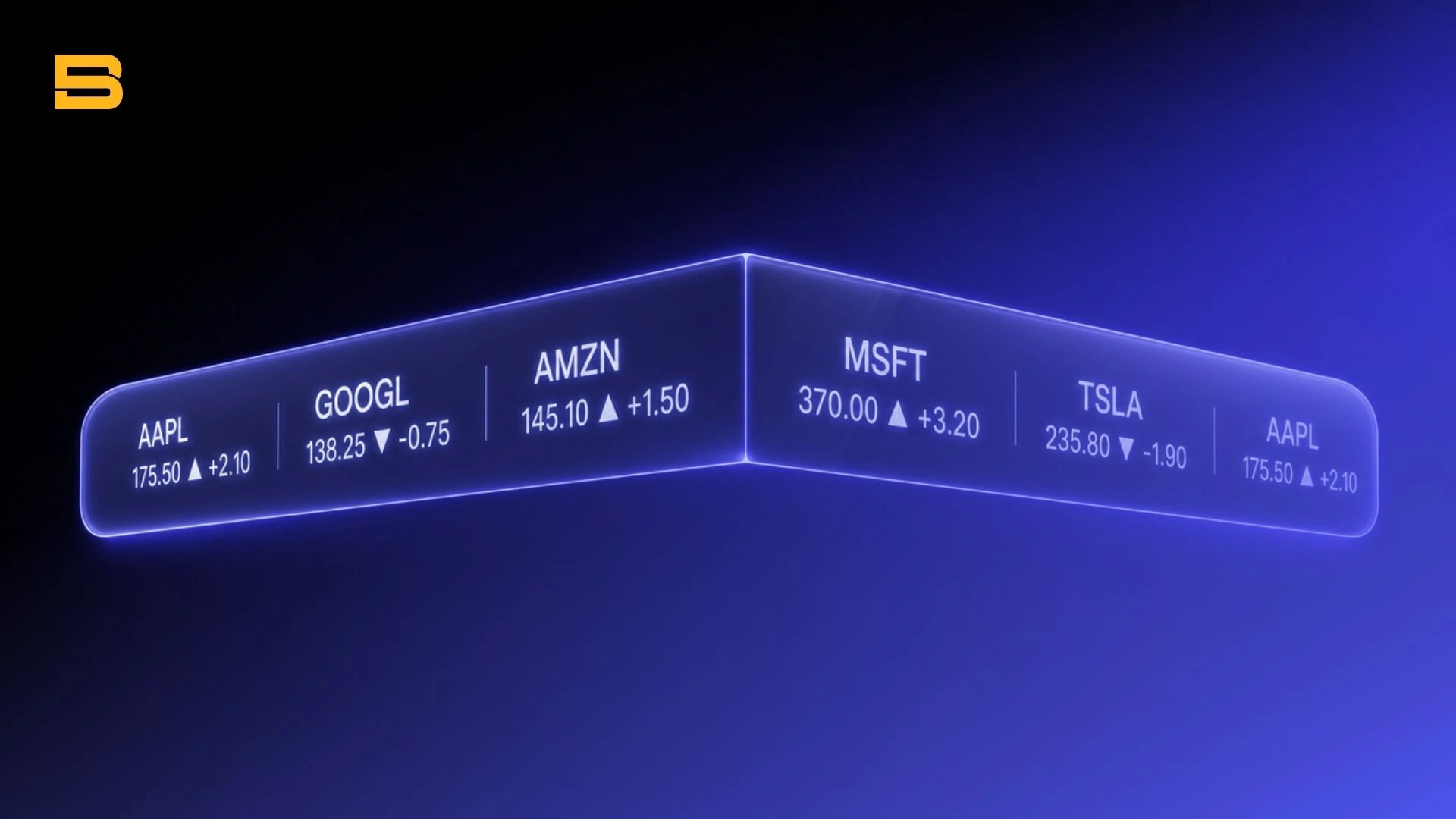
You open your brokerage app, ready to buy shares in the world’s most famous tech company. You type "Apple" into the search bar, but the platform immediately prompts you with a crisp, four-letter code: AAPL. On another screen, you see Microsoft listed simply as MSFT, while Ford sits quietly as a single letter: F.
These short combinations of letters and numbers are known as ticker symbols. They serve as the universal shorthand of global financial markets, ensuring that every trade executes quickly, accurately, and without confusion across millions of daily transactions.
Understanding a ticker symbol makes it easier to learn what is a stock exchange and what is an initial public offering (IPO).
What Is a Ticker Symbol and How Does It Work?
A ticker symbol (also known as a stock symbol or stock ticker) is a unique arrangement of letters, numbers, or both, assigned to a publicly traded security. When a company decides to list its shares on a public stock exchange, it selects a specific symbol to represent its stock in market operations.
The term originates from the 19th-century mechanical ticker tape machines. These early devices printed stock quotes on long strips of paper tape, producing a continuous "ticking" sound as prices updated. Because transmitting full company names across telegraph lines was slow and inefficient, exchanges created short letter codes to speed up data delivery.
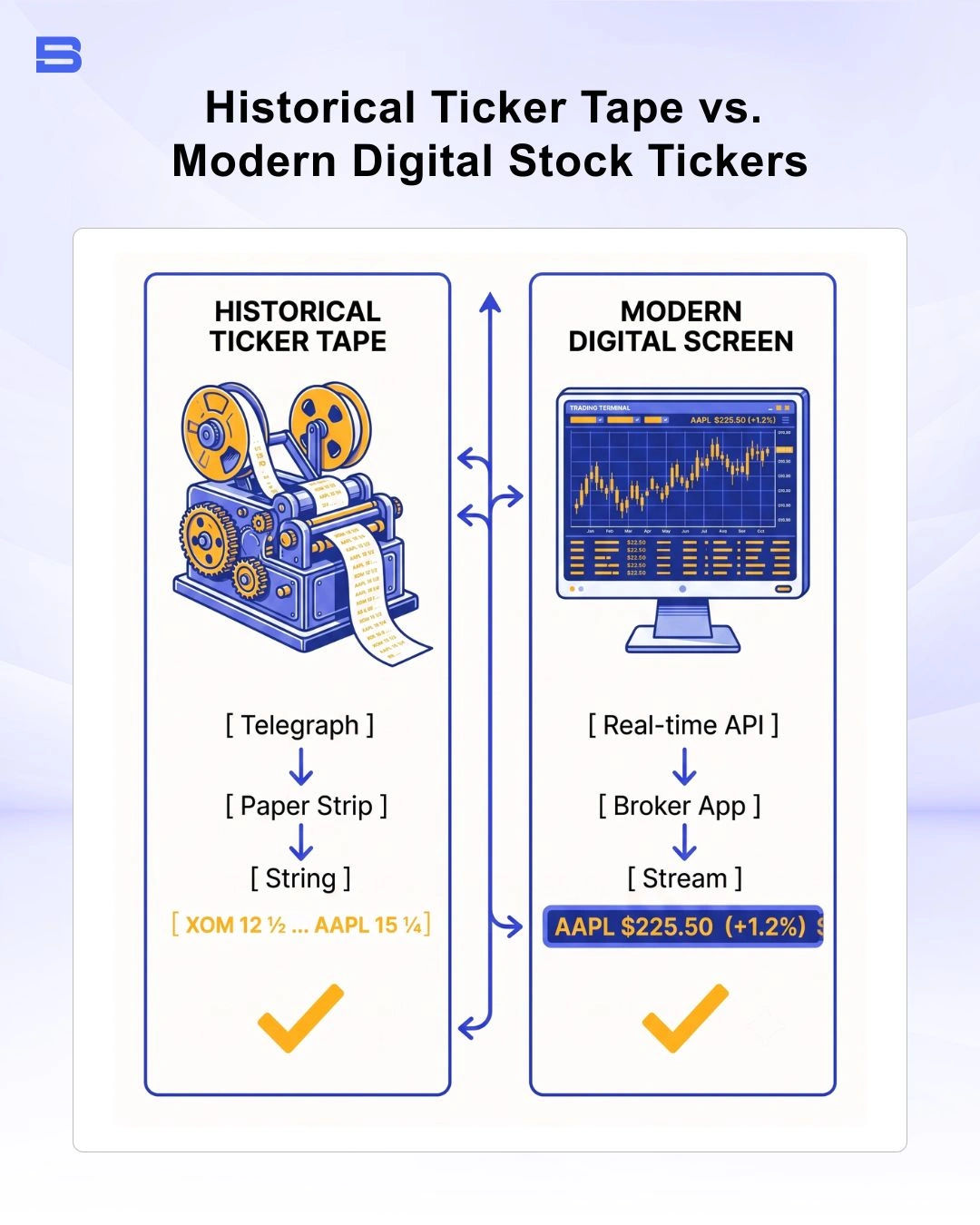
Today, ticker symbols are fully digitized, acting as database keys for market algorithms, brokers, and news outlets. Every time you submit an order through your online trading platform, the software uses the ticker symbol to route your trade to the correct liquidity pool (the pool of matching buy and sell orders) instantly.
Anatomy of a Ticker Symbol: Letters, Suffixes, and Formats
Ticker symbols are structured based on the rules of the stock exchange where the security is primary-listed. Understanding these structural nuances helps you interpret crucial information about a company's share structure directly from its symbol.
Length and Exchange Standards
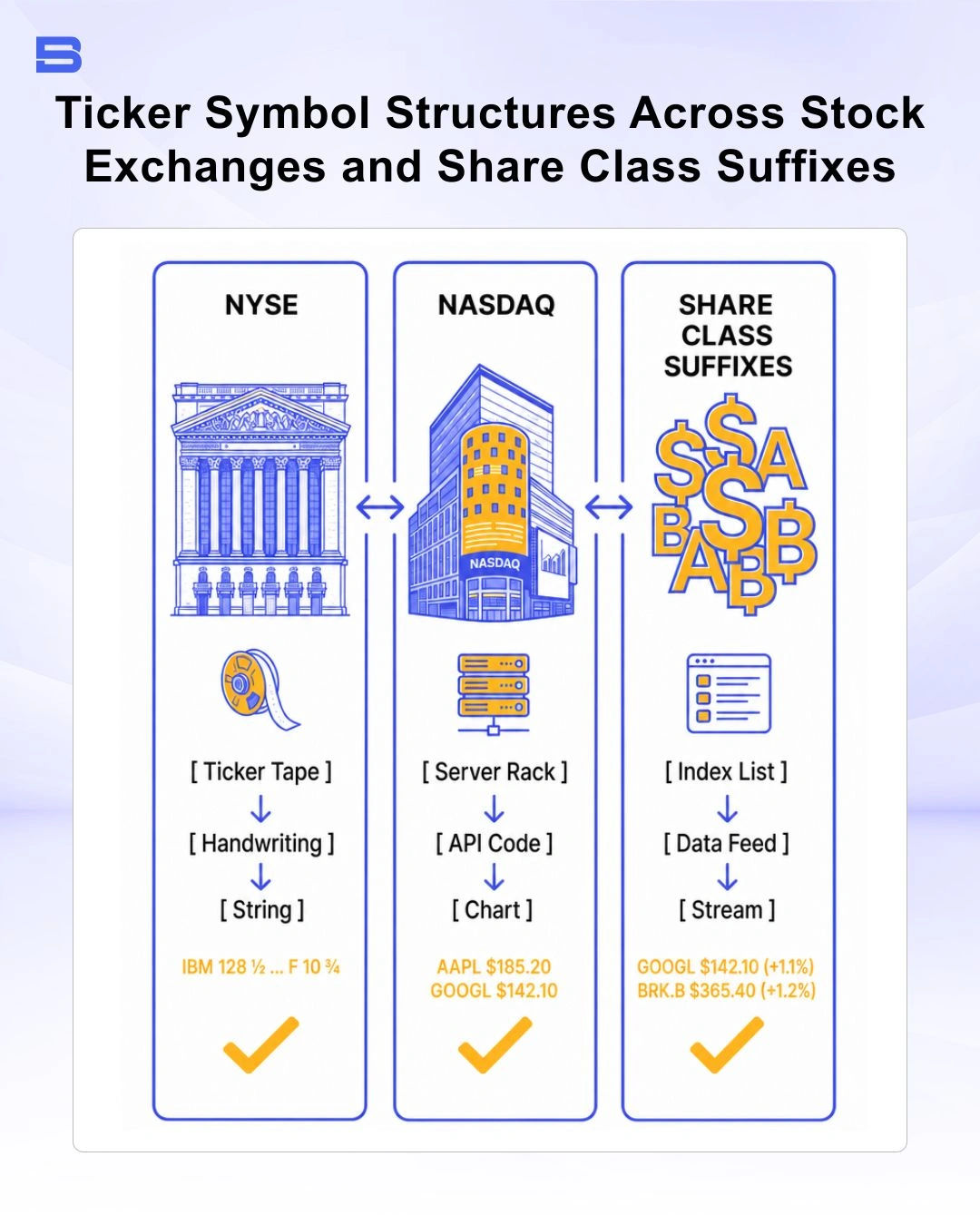
In the United States, ticker symbol length traditionally signaled which exchange listed the stock:
- One to Three Letters: Historically designated companies listed on the New York Stock Exchange (NYSE). Examples include F (Ford Motor Co.), KO (The Coca-Cola Company), and IBM (International Business Machines).
- Four to Five Letters: Traditionally indicated stocks listed on the Nasdaq exchange. Examples include AAPL (Apple Inc.) and MSFT (Microsoft Corporation).
- ETFs: Trade on stock exchanges like individual shares and generally use three-letter or four-letter tickers (e.g., SPY for the SPDR S&P 500 ETF Trust or QQQ for the Invesco QQQ Trust).
While these historical rules have loosened over time—allowing companies to retain original symbols during exchange transfers—letter length remains a helpful general indicator.
Class Shares and Suffixes
Companies sometimes issue multiple classes of common stock with different voting rights or dividend structures. Exchanges distinguish these classes using dots, dashes, or additional letters at the end of the base ticker.
- Berkshire Hathaway: Class A shares trade under BRK.A (or BRK/A), while Class B shares trade under BRK.B (or BRK/B).
- Alphabet Inc. (Google): Class A shares with voting rights trade under GOOGL, whereas Class C shares with no voting rights trade under GOOG.
Tickers across Asset Classes: Stocks, ETFs, Crypto, and Forex
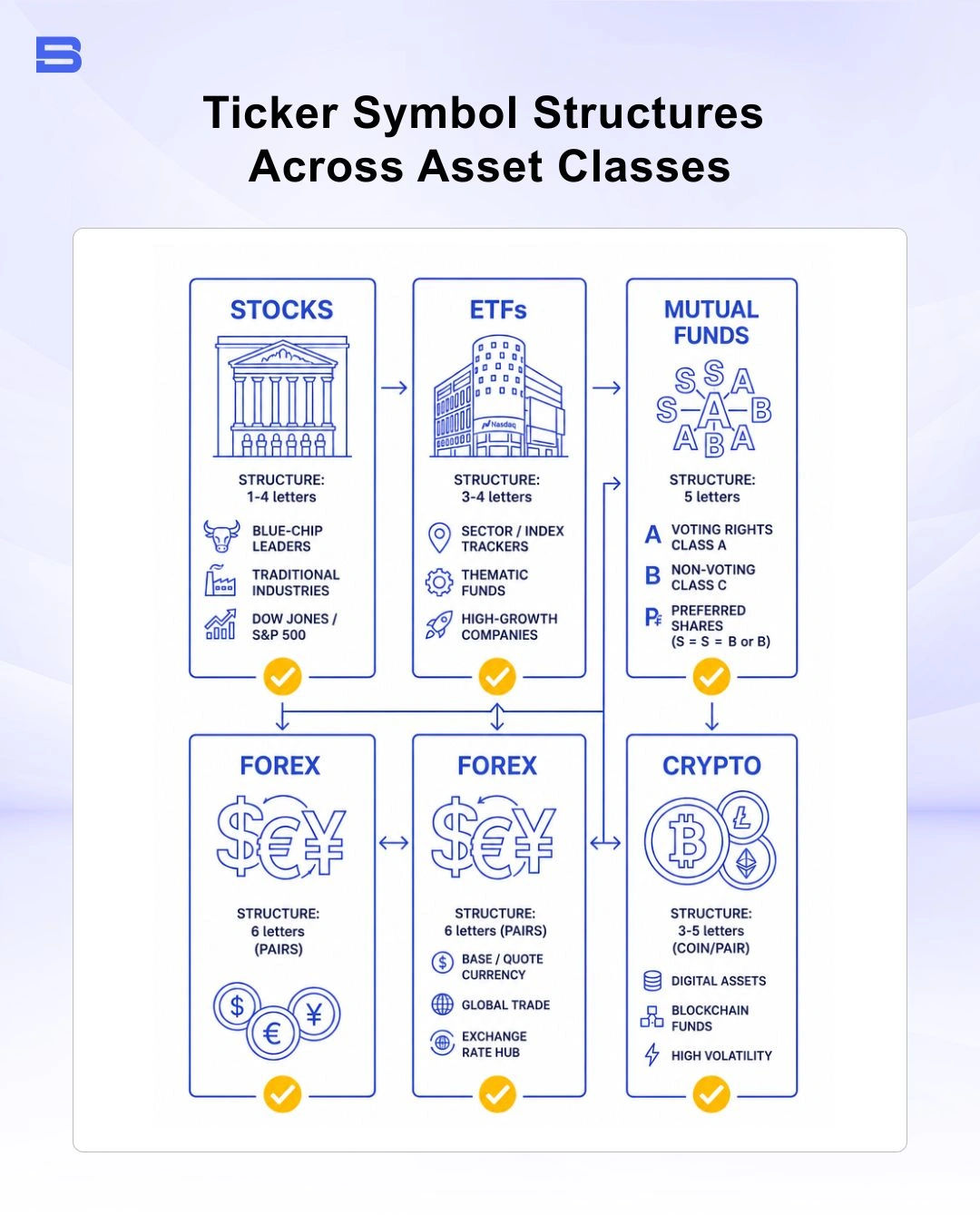
Ticker symbol conventions vary significantly depending on the underlying financial instrument you are trading.
Exchange-Traded Funds (ETFs) and Mutual Funds
- ETFs: Trade on stock exchanges like individual shares and generally use 3-letter or 4-letter tickers (e.g., SPY for the SPDR S&P 500 ETF Trust or QQQ for the Invesco QQQ Trust).
- Mutual Funds: Typically consist of five letters and end with the letter X in the United States. For example, the Vanguard Total Stock Market Index Fund Admiral Shares trades under VTSAX.
Foreign Exchange (Forex) Currency Pairs
Forex markets do not use single company tickers; instead, they quote currency pairs using standardized International Organization for Standardization (ISO) 4217 three-letter country codes.
- EUR/USD: Euro paired against the US Dollar.
- GBP/JPY: British Pound paired against the Japanese Yen.
In each pair, the first three letters represent the base currency, and the second three represent the quote currency.
Cryptocurrencies
Cryptocurrency pairs follow a structure similar to forex, combining the base token symbol with a fiat or stablecoin quote currency.
- BTC/USD: Bitcoin quoted in US Dollars.
- ETH/USDT: Ethereum quoted in Tether stablecoin.
How to Perform a Ticker Symbol Search Efficiently
Conducting a ticker symbol search is straightforward, but care is required to ensure you select the exact security intended.
Step-by-Step Search Process
- Use Your Broker's Search Bar: Type either the full corporate name or the exact symbol.
- Verify the Exchange: Confirm whether the listing is on the NYSE, Nasdaq, London Stock Exchange (LSE), or an over-the-counter (OTC) market.
- Check the Asset Class: Ensure you are selecting the common stock rather than an option contract, preferred share, or debt instrument.
The Cost of Ticker Confusion: A Real Scenario
Failing to double-check ticker symbols can lead to costly mistakes, especially during high-profile market events.
Worked Example: The Zoom Ticker Mix-up
- Setup: In early 2020, as you can refer to the Securities and Exchange Commission (SEC) file, demand surged for the video conferencing company Zoom Video Communications, Inc.
- The Mistake: Thousands of retail investors rushed to buy shares under the ticker symbol ZOOM. However, ZOOM belonged to a tiny, unrelated Chinese telecommunications company named Zoom Technologies. The actual ticker for the popular video conferencing platform was ZM.
- The Result: Shares of Zoom Technologies (ZOOM) temporarily skyrocketed due to mistaken identity. Regulators eventually suspended trading in ZOOM to prevent further market confusion.
Takeaway for You: Always verify the full corporate name, primary exchange, and exact ticker symbol before executing an order. A single wrong letter can mean placing capital into an entirely different asset.
Key Takeaways: Understanding Ticker Symbol
Ticker symbols are much more than simple abbreviations; they are the fundamental coordinates that keep global financial markets organized and efficient. Whether you are searching for established blue-chip stocks like AAPL, tracking currency pairs like EUR/USD, or evaluating index ETFs, knowing how to interpret ticker structures helps you execute trades with confidence.
With a solid understanding of ticker symbols, you'll find it easier to explore what is a stock exchange and what is IPO. Before opening any position, always take a brief moment to confirm the ticker, exchange, and security details to ensure your capital goes precisely where you intend.
Disclaimer: The content on this page is intended for educational and informational purposes only. It does not constitute financial, investment, tax, or legal advice, and should not be interpreted as a recommendation to buy, sell, or hold any financial instrument or asset. Trading and investing involve significant risk, including the possible loss of your entire capital. Products such as forex, CFDs, and cryptocurrencies carry additional risks due to leverage, high volatility, and limited regulatory protection in some jurisdictions. Past performance of any financial instrument does not guarantee future results. Any market views, forecasts, or opinions expressed are those of the author at the time of writing and may not reflect current market conditions. Platform features, fees, and regulatory status are subject to change — always verify information directly with the relevant provider or regulator before making any financial decision. BrokerSpecs may receive compensation from third parties featured on this site. Always conduct your own due diligence and consider seeking advice from a licensed financial professional before investing.