



Related Tags
You are staring at a live chart late at night, watching green and red candles flash across the screen. You feel a sudden surge of excitement, open a position, and watch the price move violently against you. That rapid heartbeat and urge to double down feels eerily familiar—it feels just like sitting at a roulette table in a casino. This leads many beginners to ask a critical question: is trading in the financial markets actually just glorified, legal gambling?
While both activities involve putting capital at risk under conditions of uncertainty, the fundamental mechanics driving their outcomes are vastly different — and understanding whether trading is gambling in your specific case comes down to process, not chance.
High Risk Doesn't Equal Gambling: The Core Difference
The primary distinction between financial trading and gambling lies in the presence of mathematical expectation and control over risk parameters.
In casino gambling, the system operates on fixed, hard-coded odds designed to ensure the house always maintains a positive edge over time. Games like roulette, blackjack, and slot machines have a negative expected value (EV) for the player. No matter how much research or emotion you bring to the table, you cannot alter the underlying mathematical probabilities of the casino's rules. Furthermore, gambling creates purely artificial risk; placing money on red does not acquire an underlying economic asset or fund economic activity.
Trading, on the other hand, operates within open financial markets where probabilities are variable rather than fixed. Market movements are influenced by economic data, corporate earnings, interest rates, and global liquidity. Because market conditions shift, a trader can conduct technical and fundamental analysis to identify conditions where the statistical probability favors a specific direction. By combining market analysis with disciplined risk management, a trader can build a strategy with a positive expected value (+EV) over a large sample size.
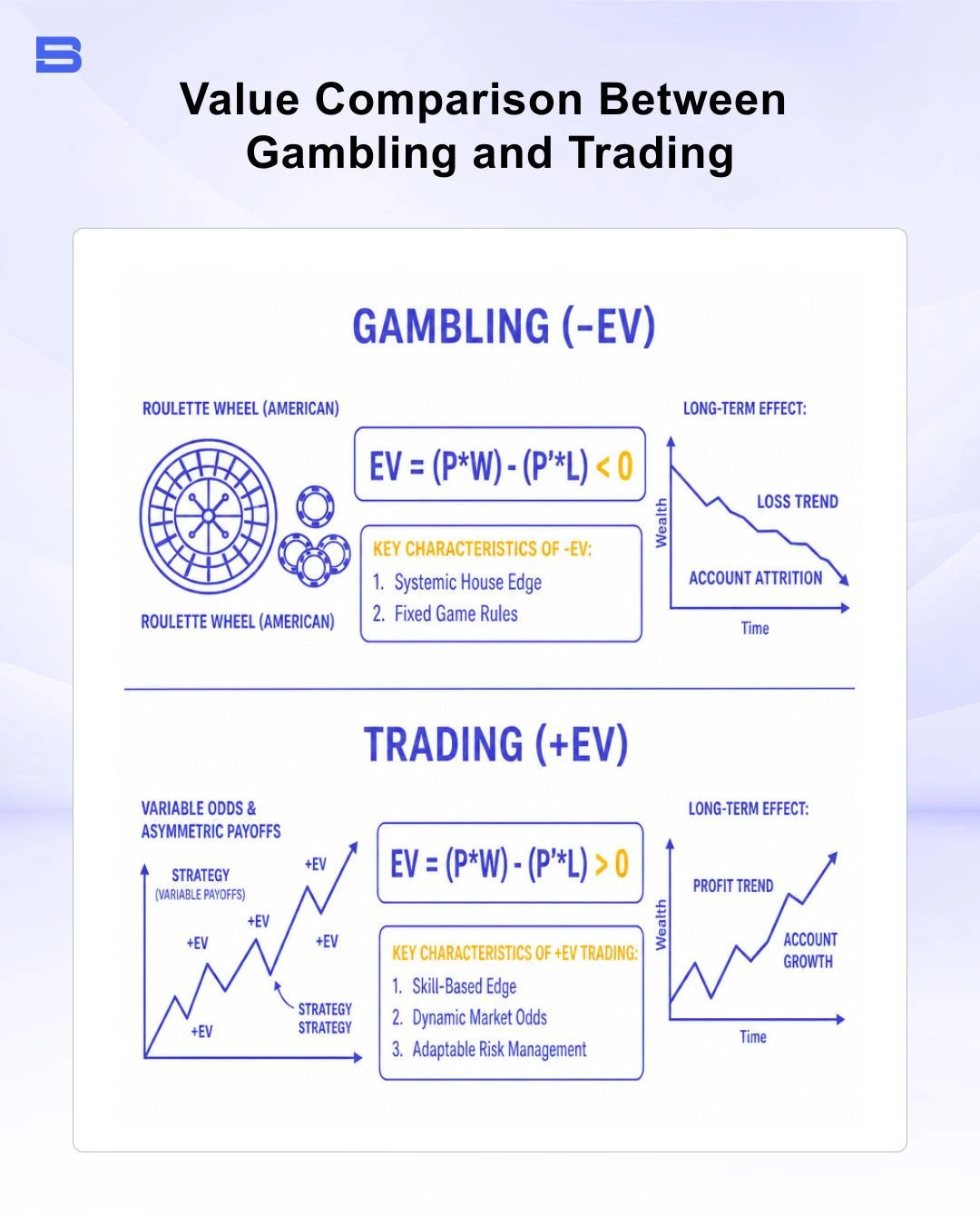
Unlike a casino game where your bet is locked in once the wheel spins, market participants retain active control over their positions. As a trader, you choose when to enter, how much capital to risk, where to cut losses, and when to exit with a profit. You can learn more about managing risk effectively through risk management in trading.
When Trading Actually Becomes Gambling
Trading is not inherently gambling, but your behavior can easily turn it into one. When market participants abandon analysis and act on emotion, they strip away any statistical advantage the market offers.
The behavioral triggers that transform a trader into a gambler include:
- FOMO (Fear of Missing Out): Entering a position late after a rapid price move, buying at the absolute top without a defined strategy.
- Revenge Trading: Immediately opening aggressive, oversized trades after a loss to try to "get money back" from the market.
- Trading Without Stop Losses: Refusing to accept small losses, hoping the market will eventually turn around before wiping out the account.
- Over-Leveraging: Using extreme leverage to trade position sizes far beyond what your account balance can safely support.
When you execute orders based on hunches, tips, or emotional impulses, you are no longer operating as a market strategist. You are placing bets.
Worked Scenario: The Math Behind Impulsive Trading
To understand how impulsive trading mirrors gambling destruction, let us analyze a scenario involving poor risk controls and high leverage.
- The Setup: Trader A opens an account with $1,000. Operating on a spontaneous market hunch without a trade plan or stop-loss, Trader A opens a CFD position on GBP/USD using 100:1 leverage. They commit $500 of their total balance as margin for this single trade.
- The Calculation: With 100:1 leverage, Trader A controls a position size of $50,000 (0.5 lots). At this trade size, every pip (0.0001) movement in GBP/USD is worth approximately $5.
- The Result: The market moves just 100 pips (a modest 1% move) against Trader A's position. A 100-pip adverse move results in a loss of $500 ($5 × 100 pips).
- The Impact: In a matter of minutes, Trader A loses 50% of their total account equity on a single emotional decision. Two consecutive bad calls using this setup wipe out 100% of the account.
This scenario illustrates that trading without predefined limits or statistical reasoning reduces your account to a coin toss with devastating downside.
How to Turn Trading into a Structured Business
To operate as a trader rather than a gambler, you must treat your market activities as a systematic business. Professional traders rely on strict processes to manage probabilities in trading rather than relying on luck.
1. Execute a Backtested Trade Plan
A trade plan defines your exact parameters before you open a chart. It specifies your market entry triggers, stop-loss placement, target profit levels, and position sizing limits. Executing a pre-planned strategy removes real-time emotional decision-making from the process.
2. Follow Capital Preservation Rules
Professional risk management dictates that you should never risk more than 1% to 2% of your total account balance on any single trade position. By limiting individual trade risk, a streak of several consecutive losses will not dismantle your portfolio, allowing your statistical edge to play out over time.
3. Maintain a Trading Journal
Keep a detailed record of every trade executed, including the rationale for entry, risk-to-reward ratio, execution performance, and psychological state. Reviewing historic performance data helps identify bad habits, measure actual win rates, and refine your edge over time.
Conclusion: The Line Between Strategy and Chance
So, is trading gambling? Only if you trade on emotion, ignore risk management, and chase quick profits — otherwise, it is a structured discipline with a real statistical edge.
Financial markets are neither a casino nor a guaranteed path to wealth; they are neutral mechanisms for price discovery and liquidity. Whether you trade forex, equities, crypto, or other asset classes, and regardless of the many types of traders in the market, from scalpers to long-term position traders, your behavior, not your chosen instrument, determines whether you are trading or gambling.
- What Is Trading and How Does Trading Work?
- Trading Fundamentals: A Guide for Beginners
- Trading vs. Investing: What Are the Key Differences?
- Trading Terms and Terminologies Every Beginner Should Know
- Common Trading Mistakes Beginners Make and How to Avoid
- Understanding Risk and Reward in Trading: A Complete Guide
- Guide to the Different Types of Financial Markets
- Investment Basics: Definition, Strategies, and How to Invest
- Benefits of Investing: Financial Growth and Security
- What Is Swing Trading? A Practical Guide For Beginners
- What Is Spot Trading? A Guide for Beginners
- What Are Futures in Trading? A Guide for Beginners
- Understanding Bull Markets: Growth & Strategy
- How to Read a Candlestick Chart: A Guide for Beginners
- Is Trading Gambling? The Truth About Risk
- Pip in Forex: How It Works & How to Calculate It
- What Is the Bid-Ask Spread in Trading? A Guide for Beginners
- What Is a Margin Call? A Guide for Beginners
- Market Volatility Explained: What It Is and How to Trade It
- Drawdown in Trading: Meaning, Math, and Risk
- Understanding Slippage in Trading: Causes and Control
- Forex Lot Size Explained: Standard, Mini & Micro
- Trailing Stop vs Stop Loss: Essential Risk Strategy
- How Asset Allocation Works: Strategies Explained
- Understanding Market Trading Hours & Sessions
- Market Makers Explained: A Trader's Guide
- Portfolio Diversification: A Strategy Guide
- Capital Gains Explained: How Investment Taxes Work
- Stock Market Circuit Breakers: How Trading Halts Work
- What Is an IPO? How Initial Public Offerings Work
- What Is a Secondary Market? A Complete Guide
- What Is a Stock Exchange? Functions and Overview Explained
- Understanding Ticker Symbols: A Market Guide
- How Clearing Houses Work in Financial Markets
- Stock Market After Labor Day: Trends and What To Expect
Disclaimer: The content on this page is intended for educational and informational purposes only. It does not constitute financial, investment, tax, or legal advice, and should not be interpreted as a recommendation to buy, sell, or hold any financial instrument or asset. Trading and investing involve significant risk, including the possible loss of your entire capital. Products such as forex, CFDs, and cryptocurrencies carry additional risks due to leverage, high volatility, and limited regulatory protection in some jurisdictions. Past performance of any financial instrument does not guarantee future results. Any market views, forecasts, or opinions expressed are those of the author at the time of writing and may not reflect current market conditions. Platform features, fees, and regulatory status are subject to change — always verify information directly with the relevant provider or regulator before making any financial decision. BrokerSpecs may receive compensation from third parties featured on this site. Always conduct your own due diligence and consider seeking advice from a licensed financial professional before investing. Portions of this article were prepared with the assistance of AI tools and reviewed by our editorial team before publication.