


- What Is Trading and How Does Trading Work?
- Trading Fundamentals: A Guide for Beginners
- Trading vs. Investing: What Are the Key Differences?
- Trading Terms and Terminologies Every Beginner Should Know
- Common Trading Mistakes Beginners Make and How to Avoid
- Understanding Risk and Reward in Trading: A Complete Guide
- Guide to the Different Types of Financial Markets
- Investment Basics: Definition, Strategies, and How to Invest
- Benefits of Investing: Financial Growth and Security
- What Is Swing Trading? A Practical Guide For Beginners
- What Is Spot Trading? A Guide for Beginners
- What Are Futures in Trading? A Guide for Beginners
- Understanding Bull Markets: Growth & Strategy
- How to Read a Candlestick Chart: A Guide for Beginners
- Is Trading Gambling? The Truth About Risk
- Pip in Forex: How It Works & How to Calculate It
- What Is the Bid-Ask Spread in Trading? A Guide for Beginners
- What Is a Margin Call? A Guide for Beginners
- Market Volatility Explained: What It Is and How to Trade It
- Drawdown in Trading: Meaning, Math, and Risk
- Understanding Slippage in Trading: Causes and Control
- Forex Lot Size Explained: Standard, Mini & Micro
- Trailing Stop vs Stop Loss: Essential Risk Strategy
- How Asset Allocation Works: Strategies Explained
- Understanding Market Trading Hours & Sessions
- Market Makers Explained: A Trader's Guide
- Portfolio Diversification: A Strategy Guide
- Capital Gains Explained: How Investment Taxes Work
- Stock Market Circuit Breakers: How Trading Halts Work
- What Is an IPO? How Initial Public Offerings Work
- What Is a Secondary Market? A Complete Guide
- What Is a Stock Exchange? Functions and Overview Explained
- Understanding Ticker Symbols: A Market Guide
- How Clearing Houses Work in Financial Markets
- Stock Market After Labor Day: Trends and What To Expect

You log into your trading app, tap "Buy" on a company you believe in, and within milliseconds, your trade is confirmed. It feels effortless, almost like buying a digital product online. But beneath that single tap lies a complex global network operating at lightspeed.
A stock exchange is a highly regulated venue—either a physical floor or an electronic network—where buyers and sellers meet to trade shares of publicly listed companies. Without this central marketplace, finding someone who wants to sell the exact number of shares you want to buy at a mutually agreed price would take days or weeks.
The exchange acts as the ultimate facilitator, transforming chaotic private transactions into a streamlined, highly liquid public system. Understanding what is a stock exchange also means knowing the role of a clearing house in settling trades and how ticker symbols identify listed companies.
How Order Matching Works on a Stock Exchange
So, what is a stock exchange? At its core, it operates like a highly specialized digital bazaar. However, instead of haggling over goods in person, participant orders are processed through an automated order book driven by matching algorithms.
When you decide to invest, you do not call the exchange directly. Instead, you send an order through your brokerage platform. The exchange receives thousands of these requests per second and arranges them into two main categories: bids (the maximum price buyers are willing to pay) and asks (the minimum price sellers are willing to accept).
Before diving into order matching, it's worth revisiting what is a stock exchange at a mechanical level — essentially, a matching engine for buyers and sellers. Now that you have a clear answer to what is a stock exchange, you're better equipped to understand the trades happening inside one.
A Real-World Execution Scenario
To see how these mechanics play out in practice, let's walk through a standard trade:
- The Order Setup: Suppose you want to buy 50 shares of Company A. You place a market order through your stockbroker when the prevailing price is $100 per share.
- Routing: Your broker instantly routes your buy order for 50 shares at $100 to the central stock exchange where Company A is listed.
- Matching: The exchange’s digital engine scans its order book and matches your $100 bid with another investor's ask order offering 50 shares of Company A at $100.
- Execution & Settlement: The exchange confirms the match, executes the transaction, and locks in the trade.
In this transaction, the total trade value is $5,000 (50 shares × $100). The exchange takes care of the continuous price discovery—if more buyers rush in to buy Company A than sellers, the exchange’s order book naturally drives the prevailing price upward to balance supply and demand.
Stock Exchange vs. Stock Market: What’s the Difference?
It is easy to use the terms "stock market" and "stock exchange" interchangeably, but they refer to distinctly different aspects of the financial system. Getting a precise answer to what is a stock exchange also means separating it clearly from the broader idea of the stock market.
Think of the stock market as the general concept of buying and selling shares—much like the term "automotive industry." The stock exchange, on the other hand, is the specific facility or platform where that trading actually takes place, similar to an individual dealership or auto factory.
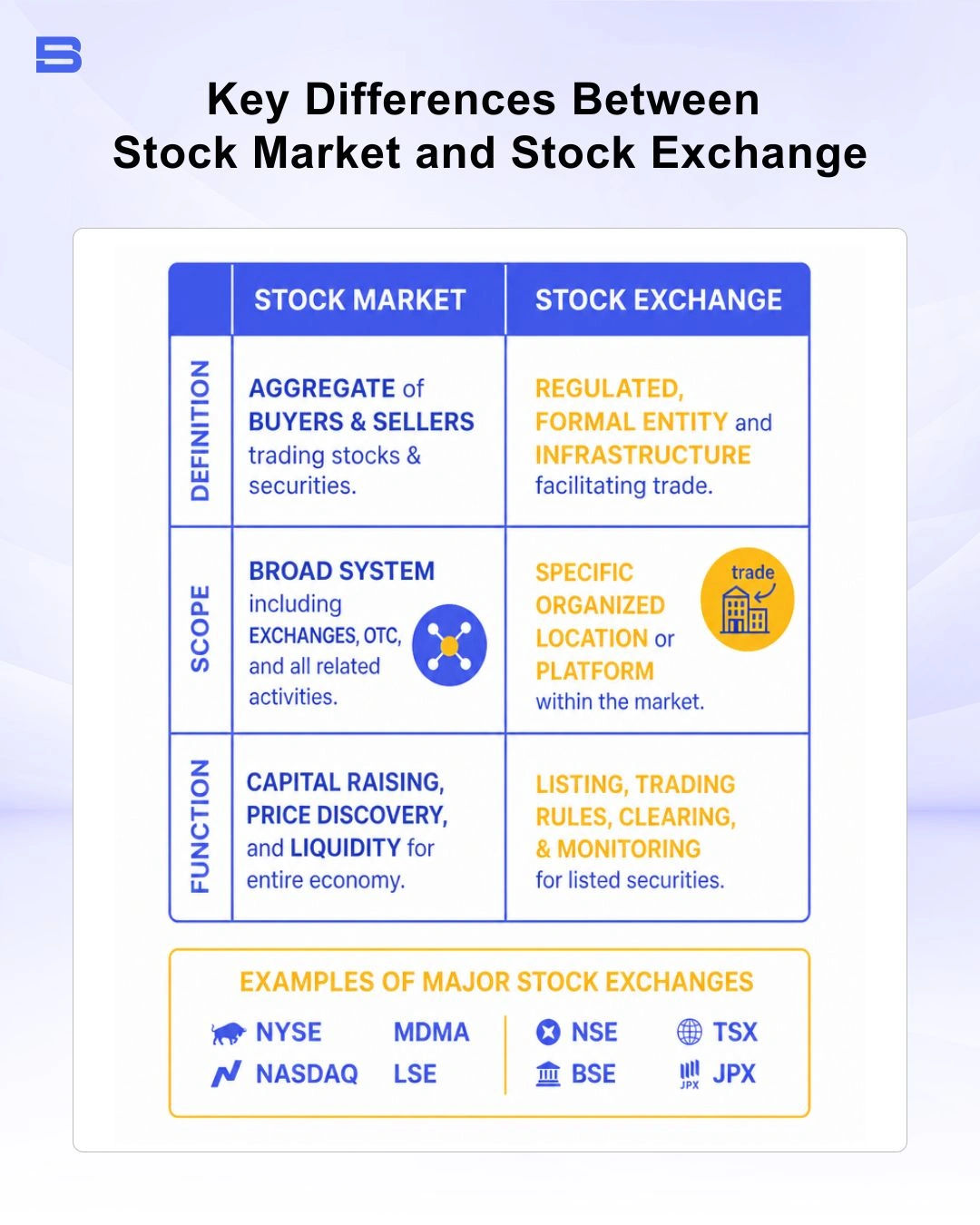
To make the distinction clear, consider how they function side-by-side:
- Scope: The stock market encompasses the entire ecosystem, including all exchanges, regulatory bodies, retail investors, institutional funds, and brokers. A stock exchange is a single infrastructure entity within that market (e.g., the New York Stock Exchange).
- Entity Type: The stock market is an abstract financial sector. A stock exchange is often a corporation—sometimes even publicly traded itself, such as Intercontinental Exchange (ICE), which owns the NYSE.
- Function: The market represents overall sentiment and aggregate trading activity. The exchange provides the exact software, hardware, and regulatory rules required to process individual orders safely.
Understanding this distinction helps you navigate financial news better. When analysts say "the stock market fell today," they are referring to overall index movements across multiple venues. When a company announces it is "listing on an exchange," they mean it has chosen a specific platform to host its public stock.
To sum up what is a stock exchange in practice: it's the regulated infrastructure that turns your tap-to-buy order into a completed trade.
Key Functions of a Stock Exchange
Stock exchanges serve as the engine room of modern capitalism. They do far more than just process daily buy and sell orders; they provide the infrastructure required for global commerce to thrive. Once you understand what is a stock exchange at a basic level, it helps to see the specific functions it performs for the market.
1. Capital Formation for Businesses
Before a company can offer its stock on an exchange, it typically undergoes an Initial Public Offering (IPO) on the primary market. By listing on a public exchange, companies gain access to trillions of dollars in global capital. This capital enables them to build factories, hire engineers, fund research, and scale operations in ways private funding rarely allows.
2. Fair Pricing and Transparency
Transparency is the backbone of investor protection. Exchanges publish real-time bid and ask prices, trading volumes, and historical transaction data. Every participant—whether a retail investor trading from a smartphone or a multi-billion-dollar hedge fund—sees the same price quotes simultaneously.
3. Liquidity and Efficiency
Imagine buying a share of stock and having to hold it forever because you couldn't find a buyer when you needed cash. Exchanges solve this by concentrating millions of traders in one place. This creates high liquidity, meaning you can enter or exit positions in major companies almost instantly without causing massive price fluctuations.
4. Regulatory Oversight and Investor Safety
Exchanges enforce strict listing requirements on public companies. Firms must regularly submit audited financial statements, disclose material news immediately, and adhere to strict corporate governance rules. While this does not eliminate market risk, it reduces the chance of fraud and ensures a level playing field.
Major Stock Exchanges Around the World
Not all exchanges are created equal. Global exchanges differ dramatically in terms of total market capitalization, listed company profiles, and geographic focus. Now that you know what is a stock exchange in principle, here's how that definition plays out across the world's top venues.
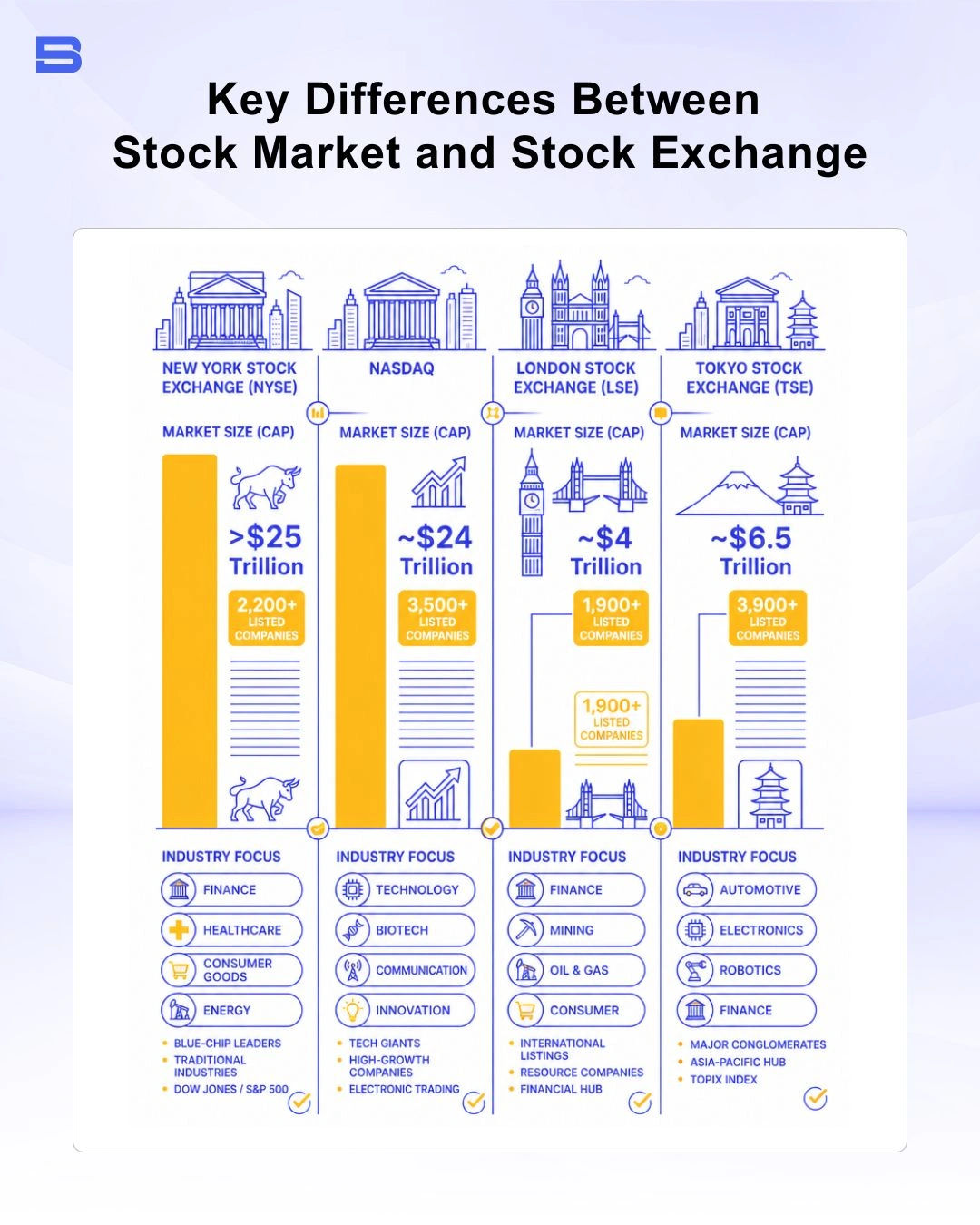
Here is an overview of the world's prominent equity exchanges:
- New York Stock Exchange (NYSE): Located on Wall Street in New York City, it is the world's largest stock exchange by the total market capitalization of its listed companies as of mid-2026. It is famous for hosting traditional corporate giants, industrial leaders, and legacy financial institutions.
- National Association of Securities Dealers Automated Quotations (Nasdaq): Known as the world's first electronic stock exchange, it has a total market capitalization of approximately $24 trillion as of mid-2026, and is heavily weighted toward high-growth tech companies.
- London Stock Exchange (LSE): One of the oldest exchanges in the world, the LSE has a total market capitalization of approximately $4 trillion as of mid-2026 and serves as a major gateway for international companies, particularly in energy, mining, and banking.
- Tokyo Stock Exchange (TSE): Asia's premier exchange venue, the TSE has a total market capitalization of approximately $6.5 trillion as of mid-2026 and hosts major international exporters, automotive pioneers, and industrial conglomerates.
Different exchanges attract different types of companies based on their listing costs, sector reputation, and liquidity profiles. As an investor, your broker handles routing your trades to whichever exchange hosts the stock you wish to buy.
Why Understanding Stock Exchanges Matters for Investors
A stock exchange is much more than a collection of ticking tickers and complex charts—it is the foundational infrastructure that keeps modern financial markets moving. By providing centralized liquidity, strict regulatory standards, and real-time price discovery, exchanges give individual investors the ability to participate alongside institutional giants on fair terms.
As you build your investment journey, knowing how your broker interacts with these central exchanges gives you a clearer picture of how capital moves globally. Before placing your next trade, take time to understand order types, trading hours, and execution methods to make the most of every market opportunity.
Disclaimer: The content on this page is intended for educational and informational purposes only. It does not constitute financial, investment, tax, or legal advice, and should not be interpreted as a recommendation to buy, sell, or hold any financial instrument or asset. Trading and investing involve significant risk, including the possible loss of your entire capital. Products such as forex, CFDs, and cryptocurrencies carry additional risks due to leverage, high volatility, and limited regulatory protection in some jurisdictions. Past performance of any financial instrument does not guarantee future results. Any market views, forecasts, or opinions expressed are those of the author at the time of writing and may not reflect current market conditions. Platform features, fees, and regulatory status are subject to change — always verify information directly with the relevant provider or regulator before making any financial decision. BrokerSpecs may receive compensation from third parties featured on this site. Always conduct your own due diligence and consider seeking advice from a licensed financial professional before investing.