


- What Is Trading and How Does Trading Work?
- Trading Fundamentals: A Guide for Beginners
- Trading vs. Investing: What Are the Key Differences?
- Trading Terms and Terminologies Every Beginner Should Know
- Common Trading Mistakes Beginners Make and How to Avoid
- Understanding Risk and Reward in Trading: A Complete Guide
- Guide to the Different Types of Financial Markets
- Investment Basics: Definition, Strategies, and How to Invest
- Benefits of Investing: Financial Growth and Security
- What Is Swing Trading? A Practical Guide For Beginners
- What Is Spot Trading? A Guide for Beginners
- What Are Futures in Trading? A Guide for Beginners
- Understanding Bull Markets: Growth & Strategy
- How to Read a Candlestick Chart: A Guide for Beginners
- Is Trading Gambling? The Truth About Risk
- Pip in Forex: How It Works & How to Calculate It
- What Is the Bid-Ask Spread in Trading? A Guide for Beginners
- What Is a Margin Call? A Guide for Beginners
- Market Volatility Explained: What It Is and How to Trade It
- Drawdown in Trading: Meaning, Math, and Risk
- Understanding Slippage in Trading: Causes and Control
- Forex Lot Size Explained: Standard, Mini & Micro
- Trailing Stop vs Stop Loss: Essential Risk Strategy
- How Asset Allocation Works: Strategies Explained
- Understanding Market Trading Hours & Sessions
- Market Makers Explained: A Trader's Guide
- Portfolio Diversification: A Strategy Guide
- Capital Gains Explained: How Investment Taxes Work
- Stock Market Circuit Breakers: How Trading Halts Work
- What Is an IPO? How Initial Public Offerings Work
- What Is a Secondary Market? A Complete Guide
- What Is a Stock Exchange? Functions and Overview Explained
- Understanding Ticker Symbols: A Market Guide
- How Clearing Houses Work in Financial Markets
- Stock Market After Labor Day: Trends and What To Expect
Imagine a private tech startup you have followed for years. You watched them develop software, secure venture capital, and build a massive user base. Then, one morning, company executives ring the opening bell on Wall Street. Within seconds, millions of individual traders around the globe can buy and sell ownership stakes in that exact business.
An Initial Public Offering (IPO) is the financial bridge that transforms a privately owned business into a publicly traded company on a stock exchange. Through this process, early founders, venture capitalists, and private equity firms share ownership with everyday retail investors.
What Does IPO Stand For and How Does It Work?
So, what is an IPO in simple terms? An IPO — short for Initial Public Offering — is the moment a private company sells shares to the public for the first time. During an IPO, new shares are sold in the primary market to raise capital for the business before they begin trading between investors in the secondary market. This transition allows the company to access public funding while allowing investors to become shareholders.
Before an IPO occurs, a company is private. Its shares are held exclusively by a tight circle of founders, employees, and venture capital backers. Because private shares do not trade on open exchanges like the New York Stock Exchange (NYSE) or the National Association of Securities Dealers Automated Quotations (Nasdaq), buying or selling them requires complex private deals with strict legal restrictions.
When a company decides to go public, it opens its capital structure to the open market. This transition requires a regulated multi-step journey designed to ensure fair valuation and legal compliance.
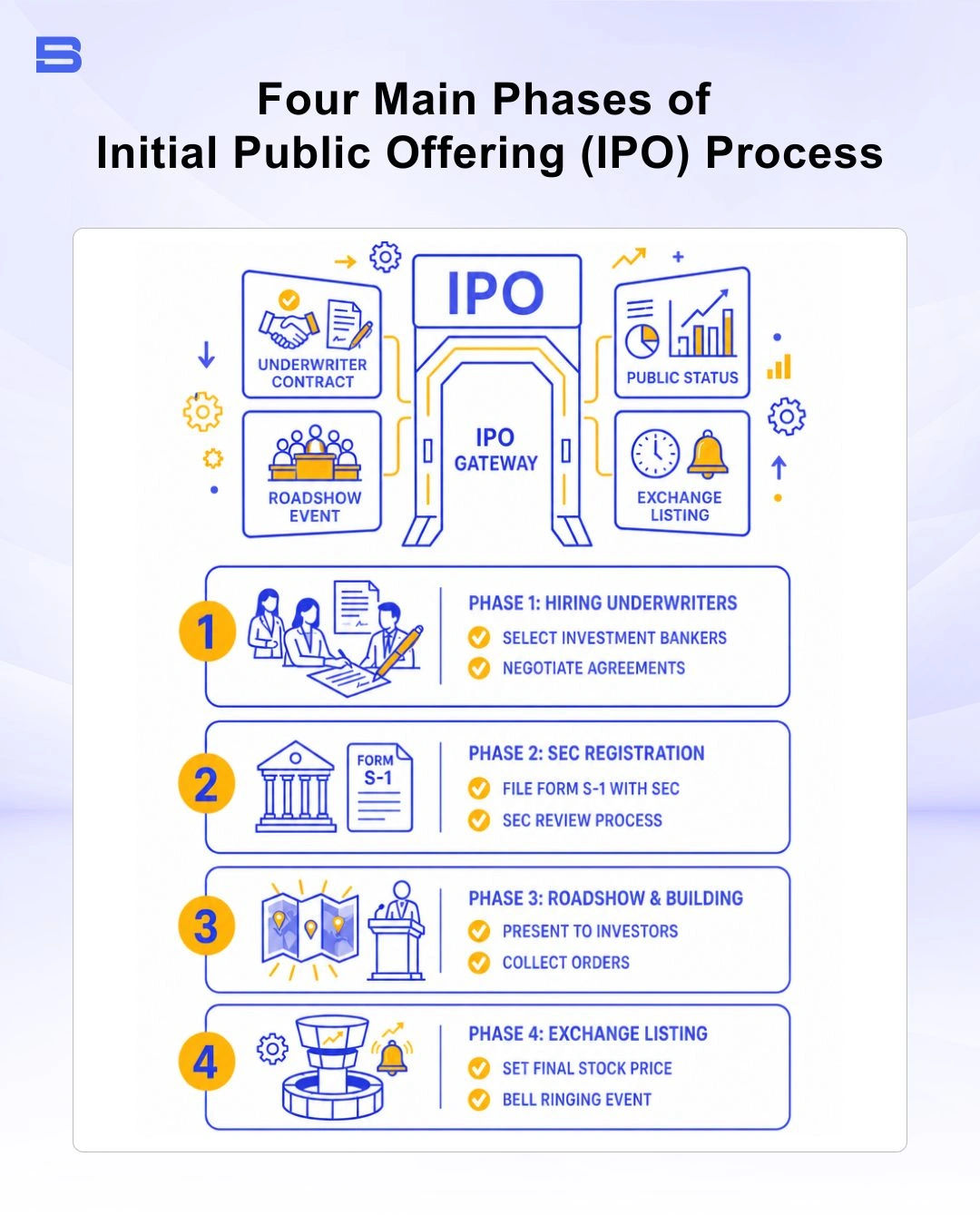
Step 1: Hiring Underwriters and Book Building
The company hires investment banks to act as underwriters. These financial institutions assess the company's financial health, structure the offering, and determine how many shares will be issued. Underwriters conduct a process called "book building" to gather interest from large institutional buyers.
Step 2: Regulatory Registration
To sell shares publicly, the business must submit formal registration documents—such as Form S-1 with the US Securities and Exchange Commission (SEC). This public filing includes audited balance sheets, revenue trends, potential risk factors, and management discussions, as detailed in the SEC's Form S-1 filing requirements.
Step 3: The Roadshow and Final Pricing
Company executives and underwriters travel on a "roadshow" to present the business model to institutional funds, pension groups, and high-net-worth investors. Based on institutional demand, the underwriters set a final IPO offering price the evening before public trading starts.
Step 4: The Secondary Market Launch
On listing morning, shares begin trading under a unique ticker symbol on a public stock exchange. Once open market trading starts, retail traders can buy and sell shares at fluctuating real-time market prices.
Why Do Companies Go Public?
Transitioning from a private company to a public corporation requires immense legal, regulatory, and audit expenses. Businesses endure this rigorous process because going public provides distinct corporate advantages:
- Massive Capital Infusion: Selling millions of new shares generates immediate equity funding to pay off corporate debt, finance research and development, or acquire competitors.
- Liquidity for Early Backers: Venture capitalists, angel investors, and founders who took early financial risks can finally liquidate portions of their holdings on the secondary market.
- Corporate Visibility and Brand Trust: A public listing enhances credibility with major suppliers, institutional lenders, and enterprise customers who value regulatory transparency.
- Employee Stock Incentives: Publicly traded shares give companies a flexible tool to recruit top executive talent through stock option compensation packages.
A Real-World Example: How IPO Trading Works
To understand how an IPO trades on its first day, consider a hypothetical company named CloudTech.
Suppose CloudTech partners with investment bankers to issue 10,000,000 new shares. After conducting their institutional roadshow, underwriters set the official IPO offer price at $20 per share.
Capital Raised = 10,000,000 shares x $20 = $200,000,000
CloudTech successfully raises $200 million (minus underwriting fees) to expand its data center infrastructure.
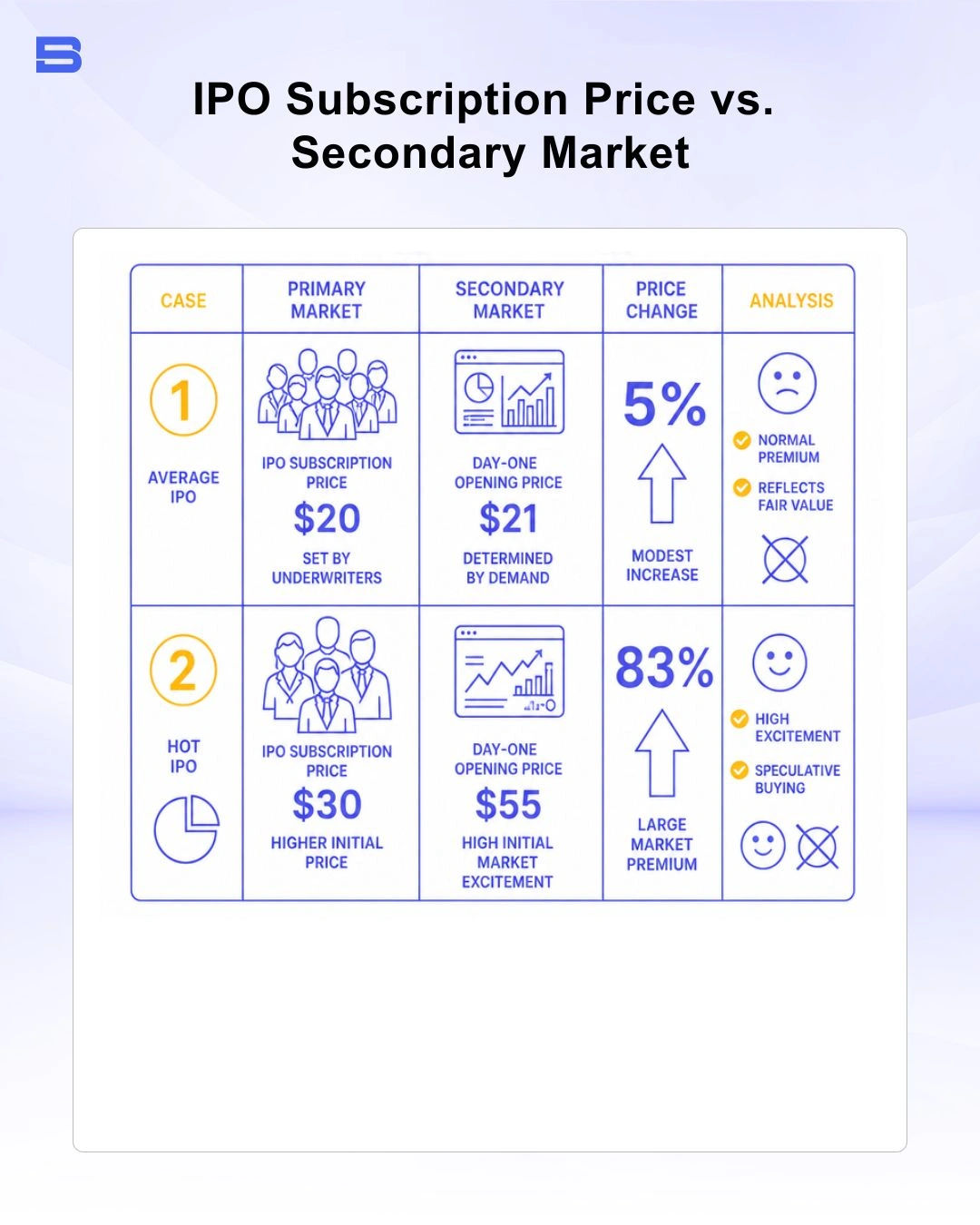
Note: The "Average IPO" and "Hot IPO" figures above are simplified, illustrative examples used for educational purposes and do not represent actual historical IPO performance data for any specific company.
However, setting an IPO offer price does not guarantee where the stock will trade once public order matching begins.
When trading opens on the exchange at 9:30 AM, strong retail and institutional buying pressure causes the first trade to execute at $28 per share—an immediate 40% "pop" over the initial offering price. If you purchase 100 shares at the opening bell price of $28, your initial outlay is $2,800.
If unexpected selling pressure occurs later in the afternoon and the stock settles at $22 by market close, your position is valued at $2,200. This $600 unrealized intraday loss demonstrates why day-one IPO trading requires careful execution and strict risk management and stock market volatility strategies.
Can Beginners Invest in IPOs? (Risks & Opportunities)
What is an IPO? One of the most common questions is whether retail investors can purchase shares at the IPO offering price before public trading starts.
Primary Allocation vs. Secondary Market Trading
Historically, primary pre-IPO allocations at the official offer price were reserved almost exclusively for institutional clients and high-net-worth individuals. While some modern retail brokerages now partner with underwriters to offer limited IPO allocations to everyday investors, eligibility requirements vary by broker.
Some firms require minimum account balances or asset thresholds, while others offer IPO access with no account minimum but impose regulatory and account eligibility requirements.
Most beginner investors participate in IPO trading via the secondary market—buying shares on their trading platform after the stock begins trading on the exchange. Understanding what is IPO and how it gives investors access to shares in the primary market is crucial before you start trading.
Critical Risks Every Investor Should Watch
- Extreme First-Day Volatility: Initial supply-and-demand imbalances often trigger rapid price swings in the first few hours of secondary market trading.
- The Insider Lock-up Period: Early investors, executives, and company insiders are typically contractually restricted from selling their personal shares for 90 to 180 days after the IPO, a standard range set out in the underwriting agreement and consistent with SEC and exchange listing practices.
- Lack of Historical Public Trading Data: Unlike established companies with years of public price charts, brand-new stock listings lack price history, making technical analysis more challenging.
Final Thoughts
Understanding what is an IPO also means knowing why investors and companies alike pay such close attention to first-day trading, since that single event can shape a stock's reputation for months to come.
An Initial Public Offering marks a major milestone in a company's lifecycle, opening doors to vast public capital while giving retail investors access to new growth opportunities. However, the excitement surrounding a high-profile listing can obscure first-day price volatility and underlying valuation risks. By understanding how investment bankers price an offering and recognizing the impact of insider lock-up periods, you can evaluate new stock listings with clarity rather than sentiment.
Disclaimer: The content on this page is intended for educational and informational purposes only. It does not constitute financial, investment, tax, or legal advice, and should not be interpreted as a recommendation to buy, sell, or hold any financial instrument or asset. Trading and investing involve significant risk, including the possible loss of your entire capital. Products such as forex, CFDs, and cryptocurrencies carry additional risks due to leverage, high volatility, and limited regulatory protection in some jurisdictions. Past performance of any financial instrument does not guarantee future results. Any market views, forecasts, or opinions expressed are those of the author at the time of writing and may not reflect current market conditions. Platform features, fees, and regulatory status are subject to change — always verify information directly with the relevant provider or regulator before making any financial decision. BrokerSpecs may receive compensation from third parties featured on this site. Always conduct your own due diligence and consider seeking advice from a licensed financial professional before investing.