



Related Tags
You are watching the price of crude oil climb steadily at the pump, wondering if there is a way to capitalize on these massive global shifts without turning your backyard into a storage depot for oil barrels. Or perhaps you have watched agricultural markets swing wildly and wondered how massive commercial operations manage to stay profitable amidst the chaos.
In the financial markets, professional participants solve these exact problems using a specific type of derivative known as a futures contract. While the concept might sound complex at first glance, understanding what are futures in trading opens the door to understanding how global commerce locks in prices, manages risk, and extracts profit from market movements.
Understanding what are futures in trading — and respecting the leverage built into every contract — is the foundational step toward building longevity in the trading arena.
What Is a Futures Contract?
A futures contract is a legally binding agreement to buy or sell a specific asset at a predetermined price on a specified date in the future. Unlike a traditional stock purchase where you exchange cash for shares instantly, a futures trade postpones the actual exchange of the asset until a later maturity date, while fixing the price today.
To understand this without financial jargon, imagine a farmer growing wheat and a commercial baking company that needs that wheat in six months. The farmer worries that wheat prices will drop by harvest time, ruining their profits. The baking company worries that wheat prices will spike, making their bread production too expensive.
To protect themselves, they enter a contract: the baker agrees to buy 5,000 bushels of wheat from the farmer in six months at exactly $6.00 per bushel. No matter what happens to the market price of wheat over the next half-year, the price is locked.
In modern financial markets, these agreements are highly standardized and traded electronically. You do not need to know a farmer or a baker to participate; you simply trade the contract itself through a broker. The underlying asset can be almost anything: physical commodities like gold and crude oil, agricultural goods like coffee and corn, or financial instruments like stock indices and foreign currencies.
By utilizing these contracts, you gain exposure to the price movements of the asset without ever needing to take physical delivery of it. Most retail traders close out their positions well before the expiration date to avoid any physical delivery obligations, focusing entirely on the price fluctuations of the contract itself.
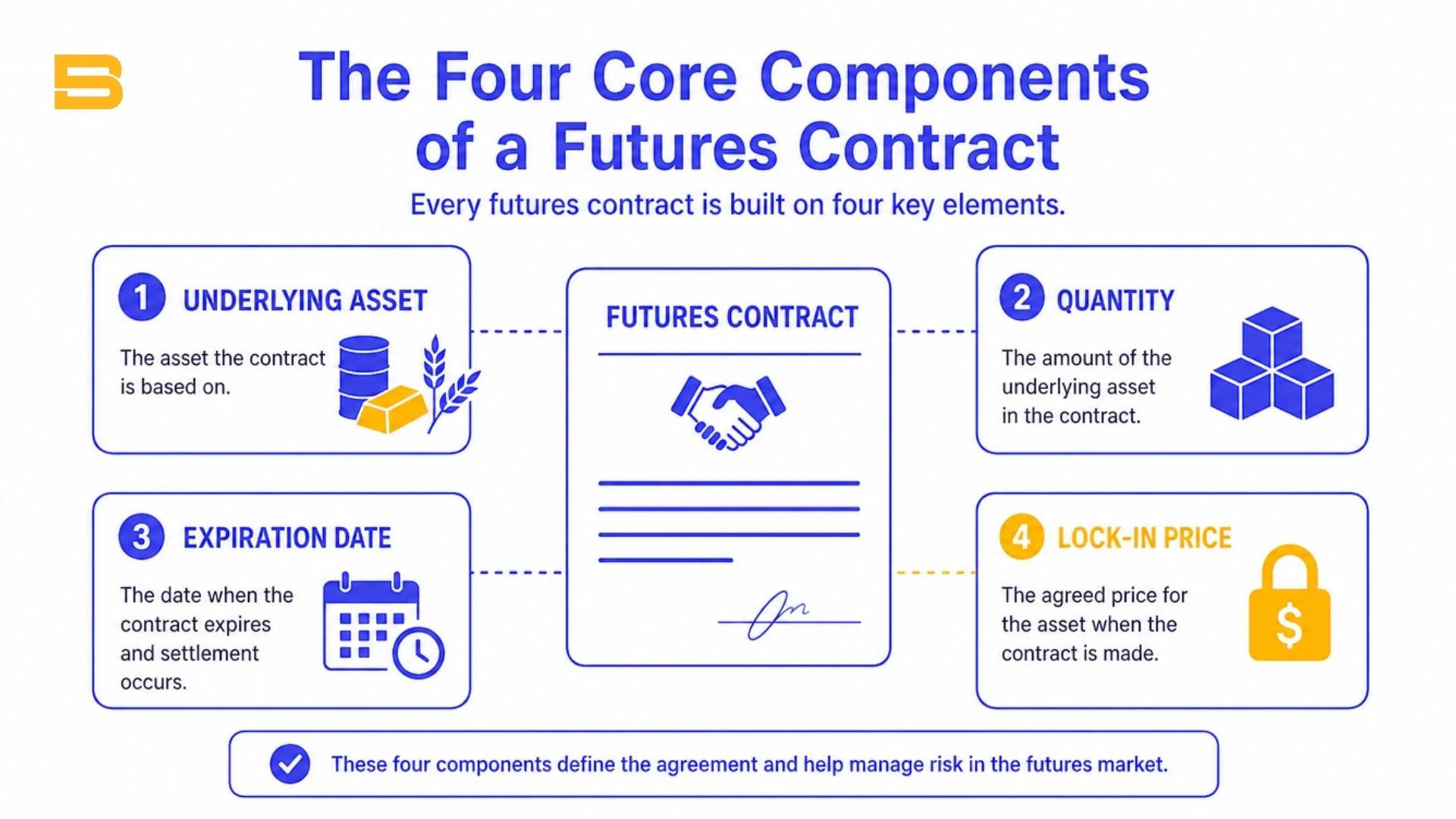
Now that we've defined what a futures contract is, the next question in understanding what are futures in trading is how the market itself functions day to day.
How the Futures Market Operates
The modern futures market functions as a highly structured ecosystem designed to eliminate counterparty risk—the danger that one side of the deal backs out. This reliability is achieved through centralized execution on public exchanges like the Chicago Mercantile Exchange (CME) and the mandatory involvement of a clearinghouse. The clearinghouse acts as the ultimate intermediary, becoming the buyer to every seller and the seller to every buyer, ensuring that both parties fulfill their financial obligations.
Participants in this market generally fall into two distinct camps, each serving a vital role in keeping the system balanced:
- Hedgers: These are the real-world producers and consumers, like the farmer and baker in our earlier example. Their primary goal is to reduce or eliminate the risk of unfavorable price fluctuations in their core business. They use the market for stability, not speculative profit.
- Speculators: These are independent traders, hedge funds, and portfolio managers who have no intention of ever handling physical commodities. They willingly take on the price risk that hedgers want to get rid of, aiming to profit from correctly anticipating which way the market will move.
Without speculators, hedgers would find it incredibly difficult to find someone to take the opposite side of their risk management trades. This continuous interplay between those avoiding risk and those seeking it creates a highly liquid environment where contracts can be bought and sold in fractions of a second. The practical takeaway for you as a retail trader is that you are interacting with a highly liquid, transparent machine where the rules are identical for everyone, and your contract can almost always be exited instantly at the prevailing market price.
Margin in Futures: Understanding the Leverage Engine
One of the most defining characteristics of trading these instruments is the concept of margin in futures. Unlike the equity markets, where margin represents borrowed money that incurs interest charges, margin in the futures arena acts as a good-faith performance bond. It is a slice of capital you must hold in your account to ensure you can cover potential losses.
Because you are not paying for the full value of the underlying asset upfront, futures trading is inherently leveraged. This allows you to control a massive financial position with a relatively small amount of capital. However, this engine requires a strict understanding of two distinct types of margin:
- Initial Margin: The minimum amount of capital required to open a new position. According to exchange-published margin specifications (e.g., CME Group's margin requirements), this is typically a small fraction of the total contract value, often between 3% and 12%, though exact figures vary by contract and broker.
- Maintenance Margin: The absolute lowest amount of capital your account must hold to keep that position open. If your account equity falls below this threshold due to adverse market moves, you face a margin call.
To see exactly how this functions, let us look at a worked example using a standard E-mini S&P 500 index contract.
The Setup: Suppose the S&P 500 index is trading at 5,000 points. A single E-mini contract multiplies the index value by $50, meaning the total contractual value of what you are controlling is $250,000. Instead of requiring $250,000, your broker might only require an initial margin of $12,500 to open the trade. This represents 20:1 leverage.
The Calculation: You believe the market will rise, so you buy one contract. Instead of rising, the S&P 500 drops by 2%, falling from 5,000 to 4,900 points—a loss of 100 points.
The Result: Because each point is worth $50, your total financial loss is 100 points multiplied by $50, which equals $5,000.
The Meaning for You: A modest 2% decline in the underlying index has wiped out exactly 40% of your $12,500 initial margin deposit. If your maintenance margin threshold was set at $11,500, this drop would immediately trigger a margin call, requiring you to deposit cash instantly or have your broker automatically liquidate your position at a steep loss. Leverage amplifies your returns when you are right, but it accelerates capital destruction just as quickly when the market moves against you.
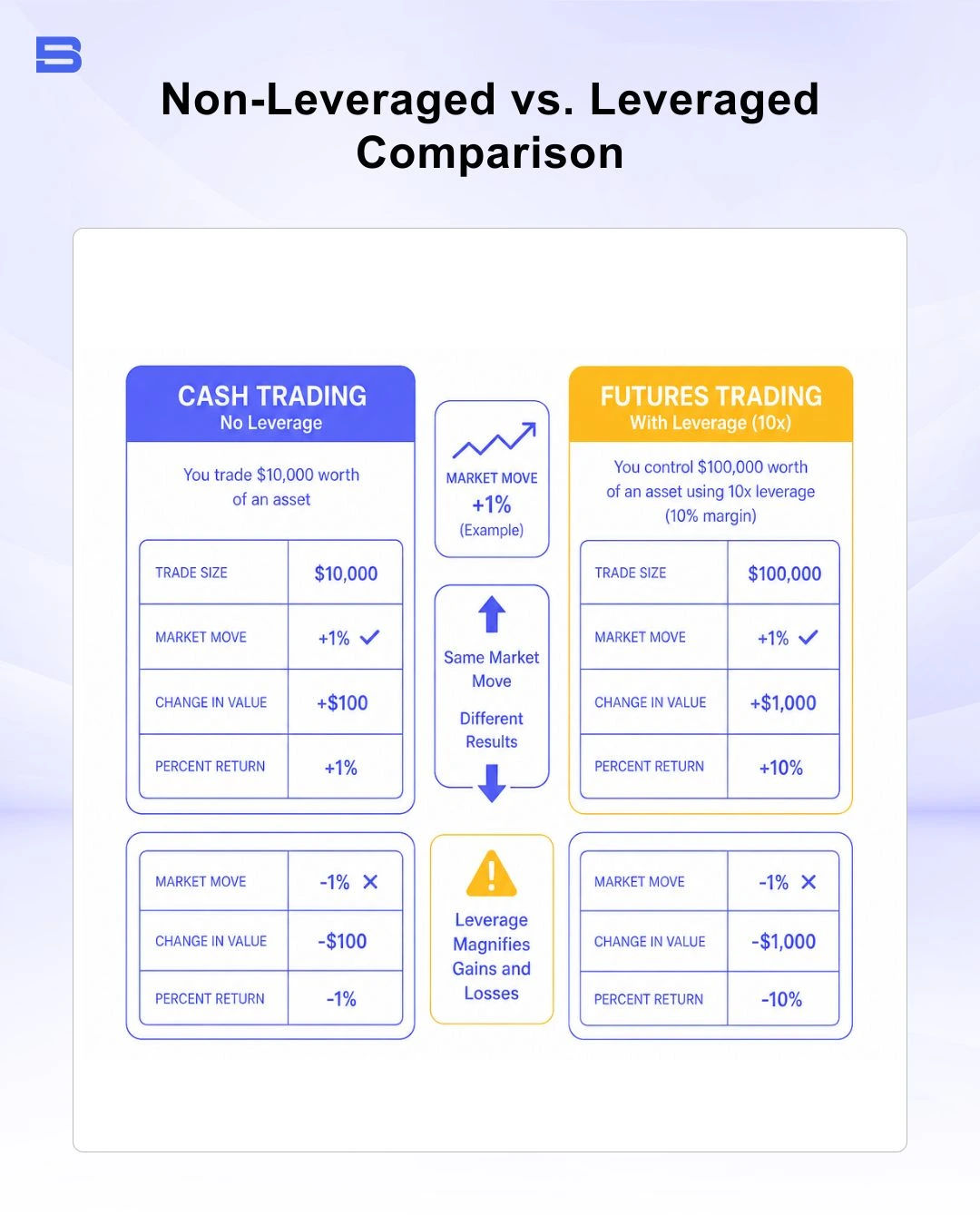
The Core Risks of Trading Futures
While the liquidity and profit potential of these markets draw in thousands of new participants daily, navigating them safely requires a sober assessment of the hazards involved. The environment is fast-moving and carries distinct structural risks that can catch unprepared traders off guard.
The most prominent hazard stems directly from the leverage engine explained above. Because the capital requirements are low, it is deceptively easy to over-leverage your account, taking on position sizes that are far too large for your total account balance. A sharp, unexpected move against an over-leveraged position can wipe out your entire trading account within minutes.
Furthermore, you must be aware of market gaps and overnight risk. While many futures markets trade nearly 24 hours a day during the workweek, they do close briefly, and major geopolitical events or economic announcements can occur while the market is paused. When trading resumes, the price can "gap"—meaning it opens substantially lower or higher than the previous closing price, bypassing your intended stop-loss order entirely and executing your exit at a significantly worse price than anticipated.
Managing these realities requires rigorous application of position sizing rules, a deep understanding of contract specifications, and ensuring that you never risk capital you cannot afford to lose completely.
Summary of the Trading Roadmap
Navigating the futures markets successfully requires shifting your mindset from casual investing to disciplined risk management. These instruments provide remarkable liquidity, transparent pricing, and the ability to profit in both rising and falling markets across global asset classes. However, the exact mechanism that makes them efficient—leverage—presents the steepest learning curve for any newcomer.
Before committing your capital to a live futures position, it is highly advisable to spend time studying the exact specifications of the contracts you intend to trade, calculating your maximum risk per trade, and practicing your execution strategy in a simulated environment. Treating leverage with the respect it commands is the foundational step toward building longevity in the trading arena.
- What Is Trading and How Does Trading Work?
- Trading Fundamentals: A Guide for Beginners
- Trading vs. Investing: What Are the Key Differences?
- Trading Terms and Terminologies Every Beginner Should Know
- Common Trading Mistakes Beginners Make and How to Avoid
- Understanding Risk and Reward in Trading: A Complete Guide
- Guide to the Different Types of Financial Markets
- Investment Basics: Definition, Strategies, and How to Invest
- Benefits of Investing: Financial Growth and Security
- What Is Swing Trading? A Practical Guide For Beginners
- What Is Spot Trading? A Guide for Beginners
- What Are Futures in Trading? A Guide for Beginners
- Understanding Bull Markets: Growth & Strategy
- How to Read a Candlestick Chart: A Guide for Beginners
- Is Trading Gambling? The Truth About Risk
- Pip in Forex: How It Works & How to Calculate It
- What Is the Bid-Ask Spread in Trading? A Guide for Beginners
- What Is a Margin Call? A Guide for Beginners
- Market Volatility Explained: What It Is and How to Trade It
- Drawdown in Trading: Meaning, Math, and Risk
- Understanding Slippage in Trading: Causes and Control
- Forex Lot Size Explained: Standard, Mini & Micro
- Trailing Stop vs Stop Loss: Essential Risk Strategy
- How Asset Allocation Works: Strategies Explained
- Understanding Market Trading Hours & Sessions
- Market Makers Explained: A Trader's Guide
- Portfolio Diversification: A Strategy Guide
- Capital Gains Explained: How Investment Taxes Work
- Stock Market Circuit Breakers: How Trading Halts Work
- What Is an IPO? How Initial Public Offerings Work
- What Is a Secondary Market? A Complete Guide
- What Is a Stock Exchange? Functions and Overview Explained
- Understanding Ticker Symbols: A Market Guide
- How Clearing Houses Work in Financial Markets
- Stock Market After Labor Day: Trends and What To Expect
Disclaimer: The content on this page is intended for educational and informational purposes only. It does not constitute financial, investment, tax, or legal advice, and should not be interpreted as a recommendation to buy, sell, or hold any financial instrument or asset. Trading and investing involve significant risk, including the possible loss of your entire capital. Products such as forex, CFDs, and cryptocurrencies carry additional risks due to leverage, high volatility, and limited regulatory protection in some jurisdictions. Past performance of any financial instrument does not guarantee future results. Any market views, forecasts, or opinions expressed are those of the author at the time of writing and may not reflect current market conditions. Platform features, fees, and regulatory status are subject to change — always verify information directly with the relevant provider or regulator before making any financial decision. BrokerSpecs may receive compensation from third parties featured on this site. Always conduct your own due diligence and consider seeking advice from a licensed financial professional before investing.