


- What Is Trading and How Does Trading Work?
- Trading Fundamentals: A Guide for Beginners
- Trading vs. Investing: What Are the Key Differences?
- Trading Terms and Terminologies Every Beginner Should Know
- Common Trading Mistakes Beginners Make and How to Avoid
- Understanding Risk and Reward in Trading: A Complete Guide
- Guide to the Different Types of Financial Markets
- Investment Basics: Definition, Strategies, and How to Invest
- Benefits of Investing: Financial Growth and Security
- What Is Swing Trading? A Practical Guide For Beginners
- What Is Spot Trading? A Guide for Beginners
- What Are Futures in Trading? A Guide for Beginners
- Understanding Bull Markets: Growth & Strategy
- How to Read a Candlestick Chart: A Guide for Beginners
- Is Trading Gambling? The Truth About Risk
- Pip in Forex: How It Works & How to Calculate It
- What Is the Bid-Ask Spread in Trading? A Guide for Beginners
- What Is a Margin Call? A Guide for Beginners
- Market Volatility Explained: What It Is and How to Trade It
- Drawdown in Trading: Meaning, Math, and Risk
- Understanding Slippage in Trading: Causes and Control
- Forex Lot Size Explained: Standard, Mini & Micro
- Trailing Stop vs Stop Loss: Essential Risk Strategy
- How Asset Allocation Works: Strategies Explained
- Understanding Market Trading Hours & Sessions
- Market Makers Explained: A Trader's Guide
- Portfolio Diversification: A Strategy Guide
- Capital Gains Explained: How Investment Taxes Work
- Stock Market Circuit Breakers: How Trading Halts Work
- What Is an IPO? How Initial Public Offerings Work
- What Is a Secondary Market? A Complete Guide
- What Is a Stock Exchange? Functions and Overview Explained
- Understanding Ticker Symbols: A Market Guide
- How Clearing Houses Work in Financial Markets
- Stock Market After Labor Day: Trends and What To Expect
You've spent weeks researching a high-performing tech stock. Its earnings reports are stellar, industry analysts are bullish, and your initial investment is already turning a profit. It is tempting to throw your entire trading account into that single opportunity to maximize gains.
But market conditions can turn on a dime. A sudden supply chain disruption, regulatory crackdowns, or a macroeconomic shift can send that winning asset into a free fall, pulling your net worth down with it.
Putting all your capital into a single asset leaves your financial future at the mercy of unpredictable market moves. Portfolio diversification is the antidote to this vulnerability. It is not about eliminating risk—it is about managing risk so that one bad trade or sector crash does not destroy your entire account.
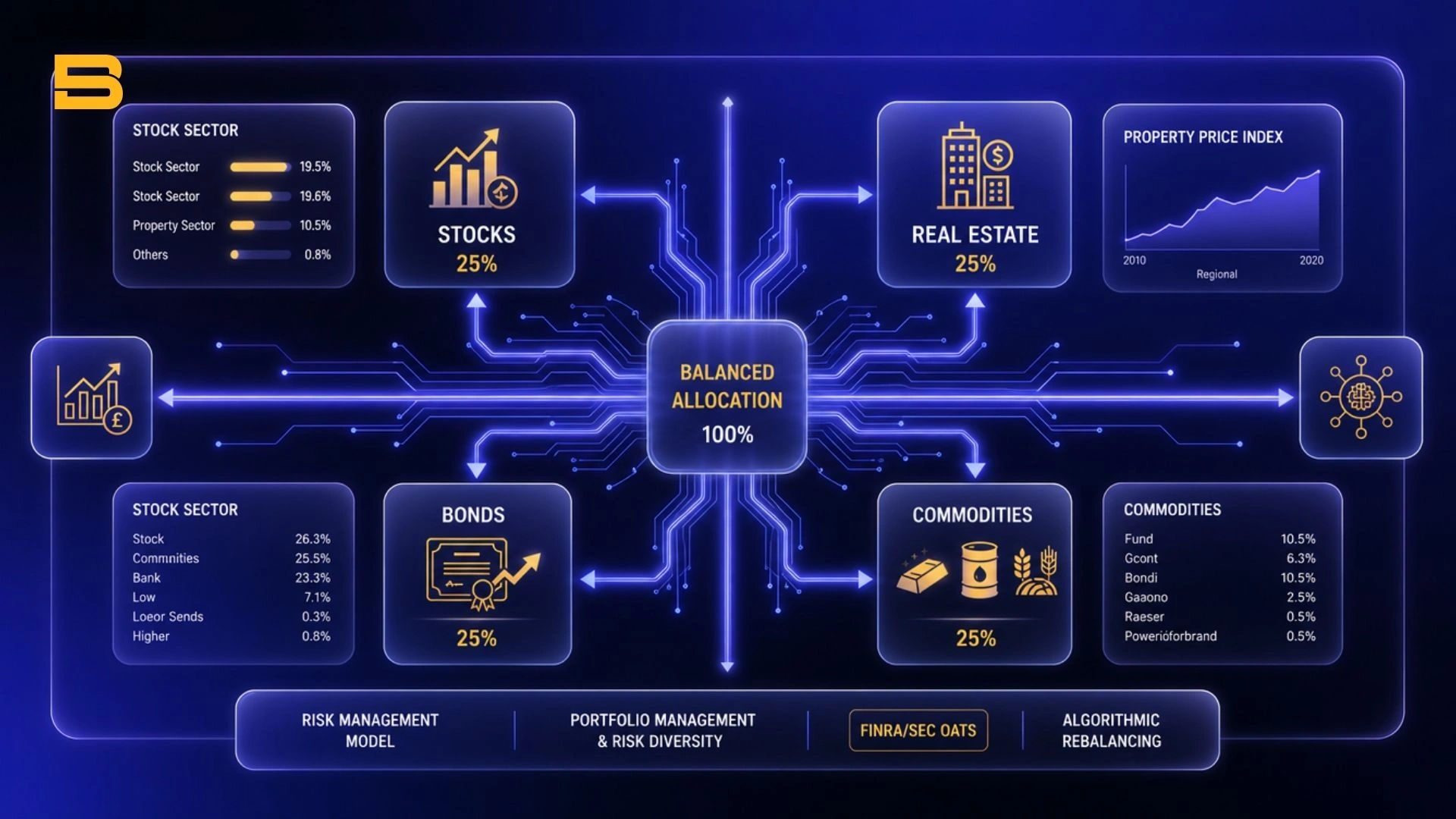
Portfolio diversification spreads your investments across different assets, sectors, and market cap categories to reduce risk and improve long-term portfolio stability.
What Is Portfolio Diversification?
Portfolio diversification is a risk management strategy that mixes different investments within a single portfolio. The primary goal is to combine assets whose market prices do not move in tandem. When some assets fall in value, others may hold steady or even rise, smoothing out your total portfolio returns over time.
To understand why this works, you need to understand correlation. Correlation measures how two financial assets move relative to each other, expressed on a scale from -1.0 to +1.0:
- Positive Correlation (+1.0): Two assets move in the same direction. If you own shares in two competing electric vehicle manufacturers, market forces will likely hit both simultaneously.
- Zero Correlation (0.0): The price movements of the two assets are completely independent of each other.
- Negative Correlation (-1.0): Two assets move in opposite directions. When Asset A rises, Asset B falls, and vice versa.
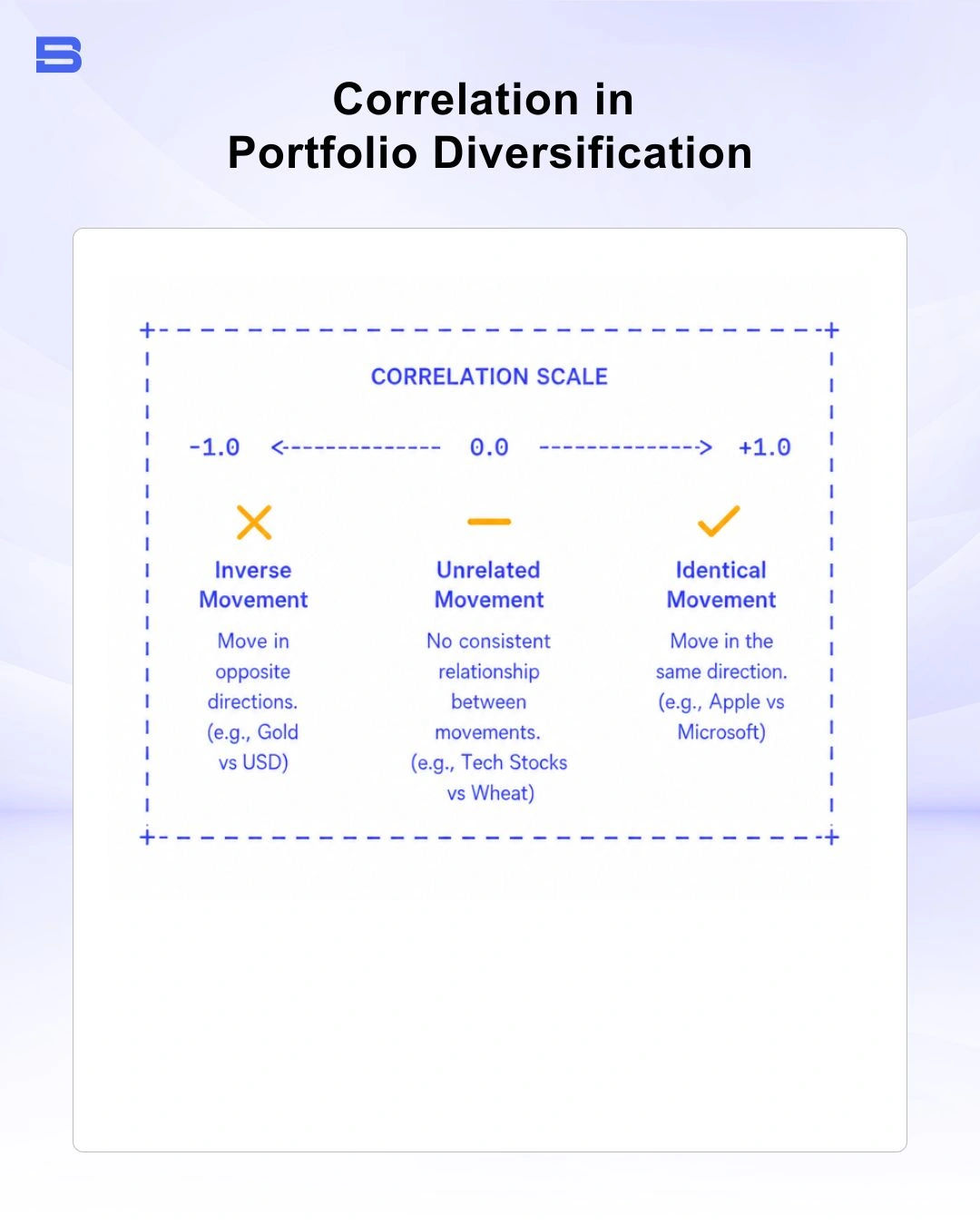
By selecting non-correlated or negatively correlated assets, you create a buffer against volatility. When one area of the market takes a hit, the performance of stable assets compensates, preserving your capital.
Why Is Diversification Important for Traders and Investors?
The core mandate of long-term investing is capital preservation alongside growth. Diversification serves as your primary defense against two main types of investment risk:
- Unsystematic Risk (Specific Risk): Risk that affects a single company, industry, or asset class. Examples include a product recall, poor leadership, or sector-specific regulatory shifts.
- Systematic Risk (Market Risk): Broad macroeconomic risks that impact the entire financial market, such as interest rate changes, inflation spikes, or global recessions.
Diversification effectively eliminates unsystematic risk. If you hold 30 different stocks across eight distinct industries, an accounting scandal at one company will barely dent your total balance.
However, diversification cannot eliminate systematic risk. During severe market panics, broad market forces pull down almost all risk assets together. Understanding this limitation helps you set realistic expectations and manage leverage safely.
How to Diversify a Portfolio: The Key Layers
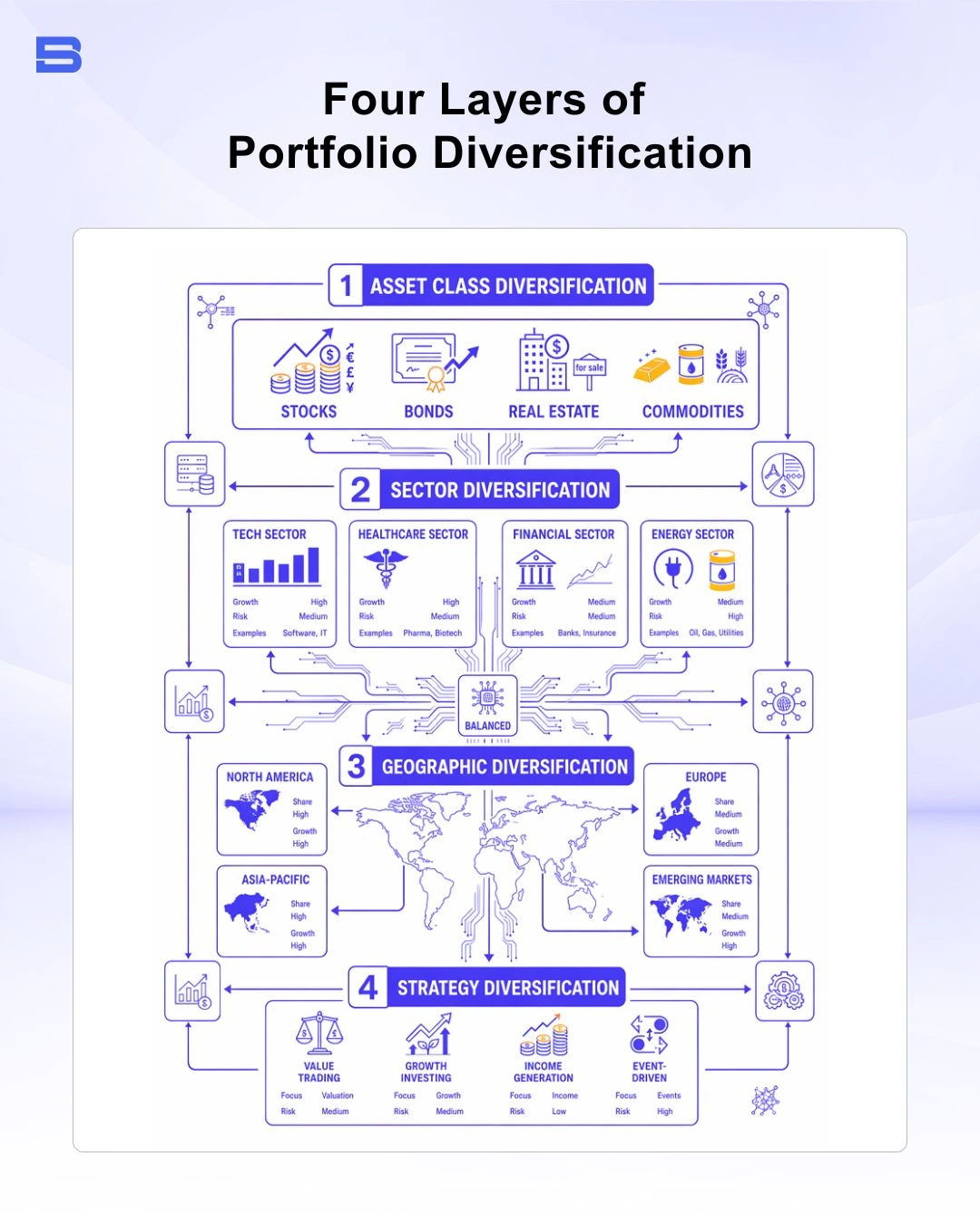
Building a resilient portfolio requires diversification across multiple structural dimensions. Broadly scattering cash across 20 tech stocks is not real diversification—that is simply expanding exposure within a single basket.
Asset Class Diversification
Allocate capital across structurally distinct instruments:
- Equities (Stocks): Higher growth potential, but higher volatility.
- Fixed Income (Bonds): Typically lower yield, but offers capital protection and predictable income.
- Commodities (Gold, Oil): Often act as inflation hedges.
- Cash & Equivalents (Money Market Funds): Provide immediate liquidity and safety during market drawdowns.
2. Sector and Industry Diversification
Within your asset allocation, divide exposure across non-related market sectors. The market divides equities into 11 primary sectors, including Technology, Healthcare, Energy, Financials, and Consumer Staples.
When interest rates rise, fast-growing Tech stocks often struggle due to higher borrowing costs, while Financial stocks like banks can benefit from higher net interest margins.
3. Geographic Diversification
Avoid home-country bias by allocating capital across different global markets:
- Developed Markets (United States, United Kingdom, Japan): Highly liquid, stable regulatory frameworks.
- Emerging Markets (Brazil, India, Southeast Asia): Higher growth rates, accompanied by currency and geopolitical risks.
4. Time and Strategy Diversification
You can also diversify by time horizon and entry point. Implementing Dollar-Cost Averaging (DCA)—investing a fixed amount of capital at regular intervals—prevents you from committing all your capital at a market peak.
Worked Example: Concentrated vs. Diversified Portfolio
To see the real-world impact of diversification, let's look at two hypothetical investors, Sarah and Marcus, each starting with a $100,000 portfolio at the beginning of a market downturn.
Scenario Setup
- Sarah (Concentrated): Allocates 100% of her $100,000 into tech growth stocks.
- Marcus (Diversified): Allocates his $100,000 across a multi-asset model:
-
- 40% US Large-Cap Tech ($40,000)
- 30% Government Bonds ($30,000)
- 15% Healthcare Stocks ($15,000)
- 15% Physical Gold ($15,000)
Market Conditions over 12 Months
- A sudden interest rate spike causes Tech Stocks to plummet by 35%.
- Broad Healthcare Stocks hold steady, rising 2%.
- Bonds yield a modest return of 4%.
- Gold rallies by 12% due to safe-haven demand.
The Math & Calculation
Sarah's Account:
- Tech Holding: $100,000 x (1 - 0.35) = $65,000
- Ending Balance: $65,000
- Total Loss: -$35,000 (-35%)
Marcus's Account:
- Tech Holding: $40,000 x (1 - 0.35) = $26,000
- Bond Holding: $30,000 x (1 + 0.04) = $31,200
- Healthcare Holding: $15,000 x (1 + 0.02) = $15,300
- Gold Holding: $15,000 x (1 + 0.12) = $16,800
- Ending Balance: $26,000 + $31,200 + $15,300 + $16,800 = $89,300
- Total Loss: -$10,700 (-10.7%)
What This Means for You
While Marcus still experienced a loss due to systemic market headwinds, his overall drawdown was capped at 10.7%, compared to Sarah's devastating 35% loss.
To break even, Sarah now needs a massive 53.8% gain on her remaining capital just to get back to $100,000. Marcus only needs a 12% gain to fully recover. Diversification preserved Marcus's principal and drastically reduced his recovery time.
Common Diversification Mistakes to Avoid
While spreading your capital is prudent, misapplying the strategy can diminish your trading performance:
- Over-Diversification ("Diworsification"): Holding 100+ different assets dilutes your returns to the point where even great stock picks fail to move the needle. It also increases transaction fees, management complexity, and spread costs.
- Illiquidity Traps: Spreading funds into illiquid physical assets or niche instruments can prevent you from exiting positions quickly during a market emergency.
- Fake Diversification: Buying four tech ETFs (Exchange-Traded Funds) believing you are diversified, without realizing that all four hold the same top 10 mega-cap companies.
Ready to Diversify Your Portfolio?
Portfolio diversification is not a get-rich-quick mechanism; it is a stay-rich strategy. By structuring your capital across different asset classes, market sectors, and geographies, you remove single-point-of-failure vulnerabilities from your investment path.
If you'd like to apply these ideas, a good starting point is reviewing your existing positions to see where your capital may be concentrated and how your assets correlate with one another. The right diversification approach depends on your own goals, time horizon, and risk tolerance, so consider speaking with a licensed financial professional before making any changes to your portfolio.
Disclaimer: The content on this page is intended for educational and informational purposes only. It does not constitute financial, investment, tax, or legal advice, and should not be interpreted as a recommendation to buy, sell, or hold any financial instrument or asset. Trading and investing involve significant risk, including the possible loss of your entire capital. Products such as forex, CFDs, and cryptocurrencies carry additional risks due to leverage, high volatility, and limited regulatory protection in some jurisdictions. Past performance of any financial instrument does not guarantee future results. Any market views, forecasts, or opinions expressed are those of the author at the time of writing and may not reflect current market conditions. Platform features, fees, and regulatory status are subject to change — always verify information directly with the relevant provider or regulator before making any financial decision. BrokerSpecs may receive compensation from third parties featured on this site. Always conduct your own due diligence and consider seeking advice from a licensed financial professional before investing.