


- What Is Trading and How Does Trading Work?
- Trading Fundamentals: A Guide for Beginners
- Trading vs. Investing: What Are the Key Differences?
- Trading Terms and Terminologies Every Beginner Should Know
- Common Trading Mistakes Beginners Make and How to Avoid
- Understanding Risk and Reward in Trading: A Complete Guide
- Guide to the Different Types of Financial Markets
- Investment Basics: Definition, Strategies, and How to Invest
- Benefits of Investing: Financial Growth and Security
- What Is Swing Trading? A Practical Guide For Beginners
- What Is Spot Trading? A Guide for Beginners
- What Are Futures in Trading? A Guide for Beginners
- Understanding Bull Markets: Growth & Strategy
- How to Read a Candlestick Chart: A Guide for Beginners
- Is Trading Gambling? The Truth About Risk
- Pip in Forex: How It Works & How to Calculate It
- What Is the Bid-Ask Spread in Trading? A Guide for Beginners
- What Is a Margin Call? A Guide for Beginners
- Market Volatility Explained: What It Is and How to Trade It
- Drawdown in Trading: Meaning, Math, and Risk
- Understanding Slippage in Trading: Causes and Control
- Forex Lot Size Explained: Standard, Mini & Micro
- Trailing Stop vs Stop Loss: Essential Risk Strategy
- How Asset Allocation Works: Strategies Explained
- Understanding Market Trading Hours & Sessions
- Market Makers Explained: A Trader's Guide
- Portfolio Diversification: A Strategy Guide
- Capital Gains Explained: How Investment Taxes Work
- Stock Market Circuit Breakers: How Trading Halts Work
- What Is an IPO? How Initial Public Offerings Work
- What Is a Secondary Market? A Complete Guide
- What Is a Stock Exchange? Functions and Overview Explained
- Understanding Ticker Symbols: A Market Guide
- How Clearing Houses Work in Financial Markets
- Stock Market After Labor Day: Trends and What To Expect
Imagine you buy a brand-new car directly from a dealership. The money goes to the manufacturer, and you drive off the lot with the keys. A few years later, you decide to sell that same car to another driver. The manufacturer doesn't get a single penny from that second transaction—it's strictly between you and the buyer.
That second transaction is precisely how the secondary market works in the financial world. It is the vast ecosystem where investors buy and sell financial assets—like stocks, bonds, and options—among themselves, completely separate from the original issuing company.
Understanding the difference between the primary and secondary markets and what a stock exchange does in the trading process can help you make necessary risk management strategies.
What Is the Main Purpose of a Secondary Market?
If secondary markets didn’t exist, investing would be an extremely rigid and risky endeavor. Imagine buying shares in a company and being forced to hold them until the business liquidates or dissolves.
The main purpose of the market is to provide liquidity. Liquidity refers to how quickly and easily you can convert an asset into cash without drastically affecting its price.
Here is why it is vital for modern finance:
- Instant Liquidity: Investors can enter or exit positions whenever the market is open, ensuring they aren't trapped in long-term investments.
- Fair Price Discovery: Continuous buying and selling establish real-time market prices based on supply, demand, and public information.
- Capital Allocation: Efficient secondary markets give investors the confidence to buy new securities in the primary market, knowing they can easily sell them later.
Order Execution Example: How It Works in Practice
To understand how trades execute in real life, let’s look at a practical scenario involving stock exchanges.
Suppose you log into your brokerage platform today and place an order to buy 100 shares of Apple (AAPL) at $200 per share.
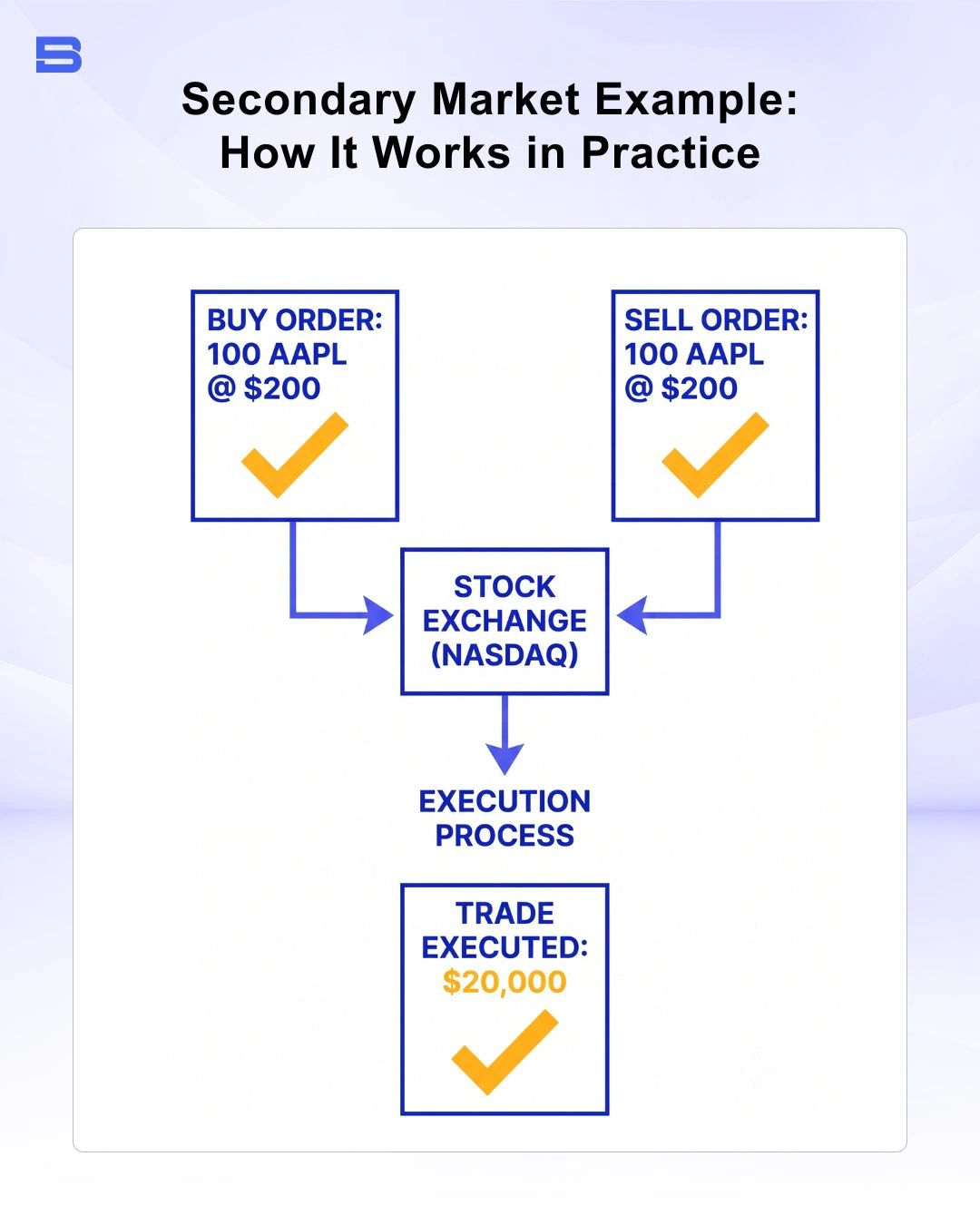
When your order fills, Apple Inc. receives $0 from this $20,000 transaction. Instead, your money goes directly to an anonymous investor who wanted to sell their Apple shares at that exact price. The stock exchange acts as a central digital venue that matches your buy order with another investor's sell order in milliseconds.
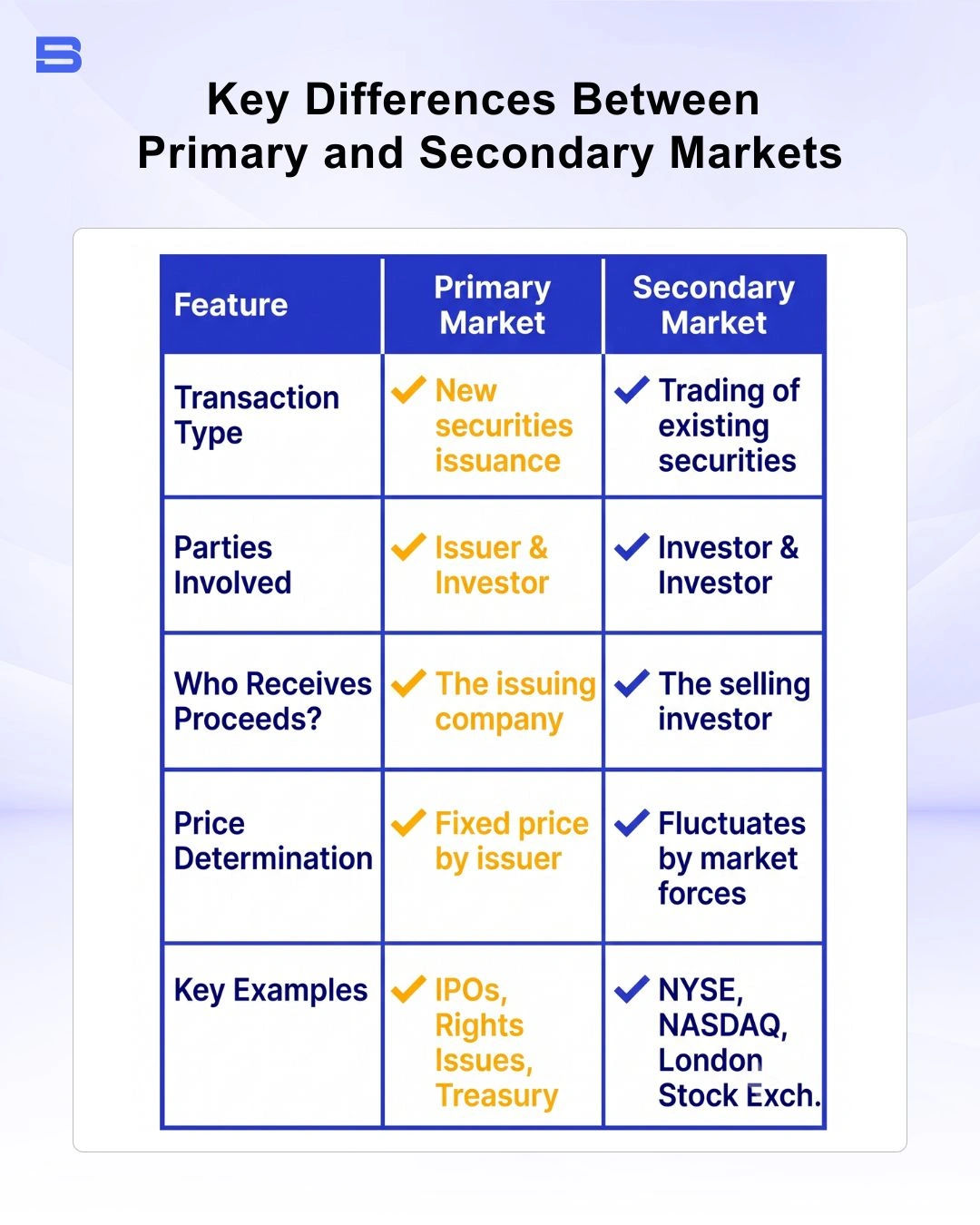
Primary Market vs Secondary Market: Key Differences
Understanding the distinction between primary and secondary markets is essential for every investor. While both are critical components of the global financial system, they serve fundamentally different functions.
Types of Secondary Markets
Secondary markets are generally split into two distinct structures: centralized exchanges and over-the-counter markets.
1. Stock Exchanges (Centralized Markets)
Centralized exchanges are highly regulated platforms where buyers and sellers meet through an automated matching engine. Prominent examples include the New York Stock Exchange (NYSE) and the National Association of Securities Dealers Automated Quotations (Nasdaq). Prices are transparent, and all traders have access to the same order book data simultaneously.
2. Over-the-Counter (OTC) Markets (Decentralized Markets)
In an OTC market, trading occurs directly between two parties without a central exchange. A network of dealers acts as market makers, quoting prices at which they are willing to buy or sell. Bonds, foreign exchange (Forex), and many derivative products trade primarily over-the-counter.
A Real Worked Example: Buying and Selling Shares
Let's walk through a realistic numerical example to see how price discovery and trading costs impact your secondary market returns.
Scenario: You want to buy 50 shares of Company XYZ on a public stock exchange.
Setting the Trade:
- Bid Price (highest price buyers are willing to pay): $100.00
- Ask Price (lowest price sellers are willing to accept): $100.10
- Bid-Ask Spread: $0.10
Executing the Purchase:
- You place a market order to buy 50 shares, which fills at the current Ask Price of $100.10.
- Total Initial Investment = 50 shares x $100.10 = $5,005.00
Selling for a Profit:
- Six months later, strong earnings push the stock higher. The new market quote is:
- Bid: $120.00 | Ask: $120.10
- You place a market order to sell your 50 shares, which fills at the current Bid Price of $120.00.
- Total Proceeds = 50 shares x $120.00 = $6,000.00
Calculating the Result:
Net Gain = $6,000.00 - $5,005.00 = $995.00
This $995 profit came entirely from market price movement in the secondary market, without Company XYZ ever touching the transaction. The same market mechanics can also result in losses if the share price moves against the investor.
Risks to Consider When Trading These Assets
While they provide high flexibility, they also expose investors to specific market risks:
- Market Volatility: Prices can fluctuate rapidly due to economic news, company earnings report announcements, or global events.
- Liquidity Risk: Less-popular stocks and infrequently traded corporate bonds often have lower liquidity, as stated by the Financial Industry Regulatory Authority (FINRA), making it more difficult to execute orders quickly without affecting the market price. As a result, investors may experience wider bid-ask spreads and greater price impact when buying or selling these securities.
- Counterparty and Brokerage Risk: While regulated exchanges minimize counterparty default, market gaps during volatile economic news can still cause significant slippage.
Final Thoughts
The secondary market is the engine of modern retail trading and investing. By enabling seamless liquidity, continuous price discovery, and easy access to thousands of assets, it provides the bridge between long-term corporate funding and everyday investor mobility. Whether you trade blue-chip equities on major stock exchanges or trade OTC financial instruments, you rely on the efficiency of the market every time you click "buy" or "sell."
Disclaimer: The content on this page is intended for educational and informational purposes only. It does not constitute financial, investment, tax, or legal advice, and should not be interpreted as a recommendation to buy, sell, or hold any financial instrument or asset. Trading and investing involve significant risk, including the possible loss of your entire capital. Products such as forex, CFDs, and cryptocurrencies carry additional risks due to leverage, high volatility, and limited regulatory protection in some jurisdictions. Past performance of any financial instrument does not guarantee future results. Any market views, forecasts, or opinions expressed are those of the author at the time of writing and may not reflect current market conditions. Platform features, fees, and regulatory status are subject to change — always verify information directly with the relevant provider or regulator before making any financial decision. BrokerSpecs may receive compensation from third parties featured on this site. Always conduct your own due diligence and consider seeking advice from a licensed financial professional before investing.