


- What Is Trading and How Does Trading Work?
- Trading Fundamentals: A Guide for Beginners
- Trading vs. Investing: What Are the Key Differences?
- Trading Terms and Terminologies Every Beginner Should Know
- Common Trading Mistakes Beginners Make and How to Avoid
- Understanding Risk and Reward in Trading: A Complete Guide
- Guide to the Different Types of Financial Markets
- Investment Basics: Definition, Strategies, and How to Invest
- Benefits of Investing: Financial Growth and Security
- What Is Swing Trading? A Practical Guide For Beginners
- What Is Spot Trading? A Guide for Beginners
- What Are Futures in Trading? A Guide for Beginners
- Understanding Bull Markets: Growth & Strategy
- How to Read a Candlestick Chart: A Guide for Beginners
- Is Trading Gambling? The Truth About Risk
- Pip in Forex: How It Works & How to Calculate It
- What Is the Bid-Ask Spread in Trading? A Guide for Beginners
- What Is a Margin Call? A Guide for Beginners
- Market Volatility Explained: What It Is and How to Trade It
- Drawdown in Trading: Meaning, Math, and Risk
- Understanding Slippage in Trading: Causes and Control
- Forex Lot Size Explained: Standard, Mini & Micro
- Trailing Stop vs Stop Loss: Essential Risk Strategy
- How Asset Allocation Works: Strategies Explained
- Understanding Market Trading Hours & Sessions
- Market Makers Explained: A Trader's Guide
- Portfolio Diversification: A Strategy Guide
- Capital Gains Explained: How Investment Taxes Work
- Stock Market Circuit Breakers: How Trading Halts Work
- What Is an IPO? How Initial Public Offerings Work
- What Is a Secondary Market? A Complete Guide
- What Is a Stock Exchange? Functions and Overview Explained
- Understanding Ticker Symbols: A Market Guide
- How Clearing Houses Work in Financial Markets
- Stock Market After Labor Day: Trends and What To Expect
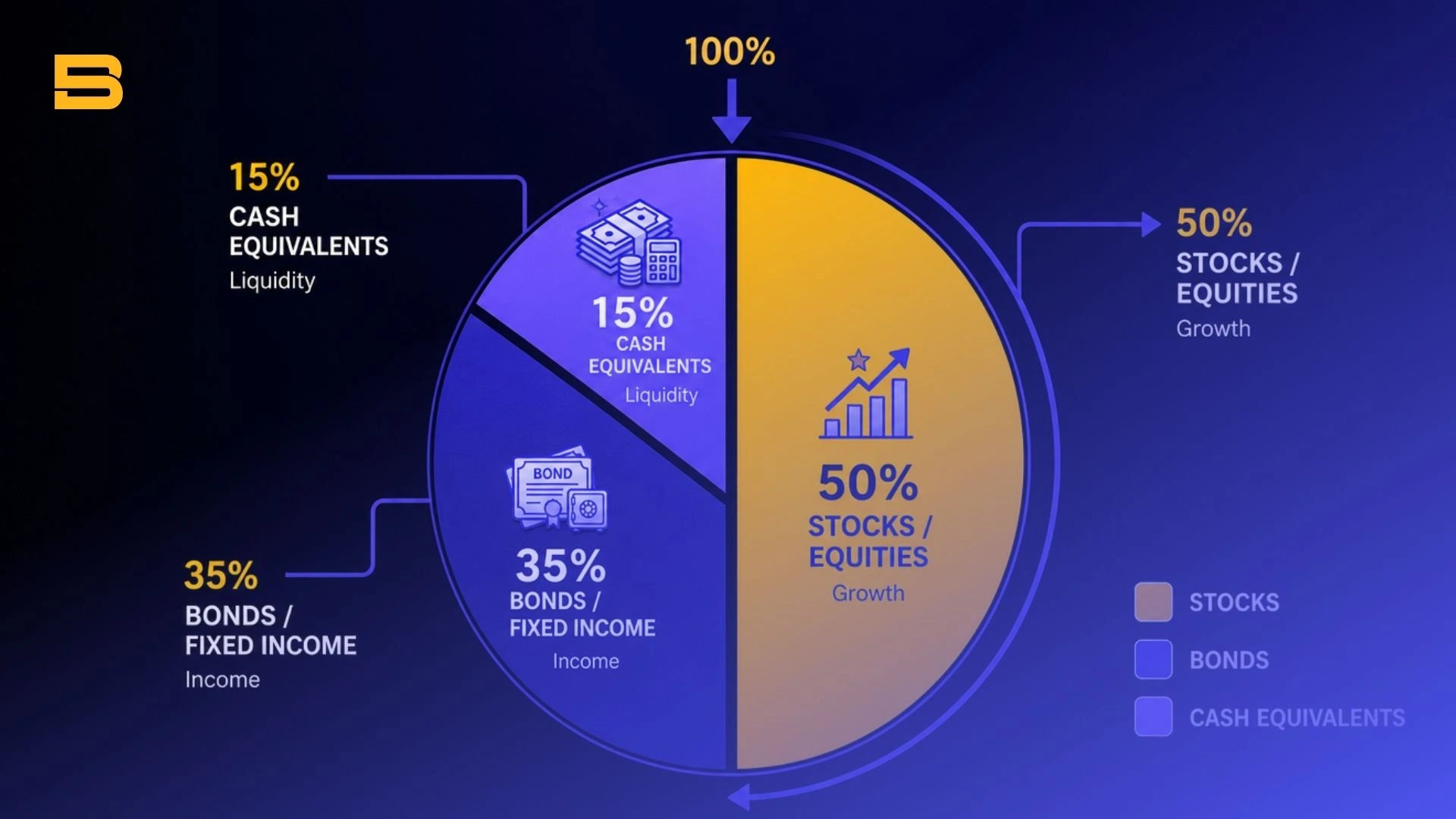
You check your investment account after a volatile week in the markets. Tech stocks have taken a sudden dip, wiping out last month's gains in a matter of days. If your entire portfolio was concentrated in tech equities, that sharp downturn feels like a gut punch. But if you had a mix of assets—perhaps stable government bonds or cash reserves—the impact was likely a mild bump in the road rather than a structural loss.
This balancing act is the core of asset allocation. It is not about picking the single best stock of the year; it is about structuring your wealth so that no single market shift can derail your long-term financial goals.
What Is Asset Allocation?
Asset allocation is the strategy of dividing an investment portfolio among different asset categories—such as equities, fixed income, and cash. The primary goal is to balance risk and reward by adjusting the percentage of each asset class according to your financial goals, risk tolerance, and investment horizon.
Rather than focusing on individual company picks, portfolio diversification focuses on broad market exposure. Markets move in cycles, and different asset classes respond differently to economic conditions. When equities decline during an economic slowdown, fixed-income assets like bonds often hold their value or appreciate as central banks cut interest rates. By combining assets that do not move in tandem, you create a portfolio designed to smooth out long-term returns.
The 3 Main Asset Classes Explained
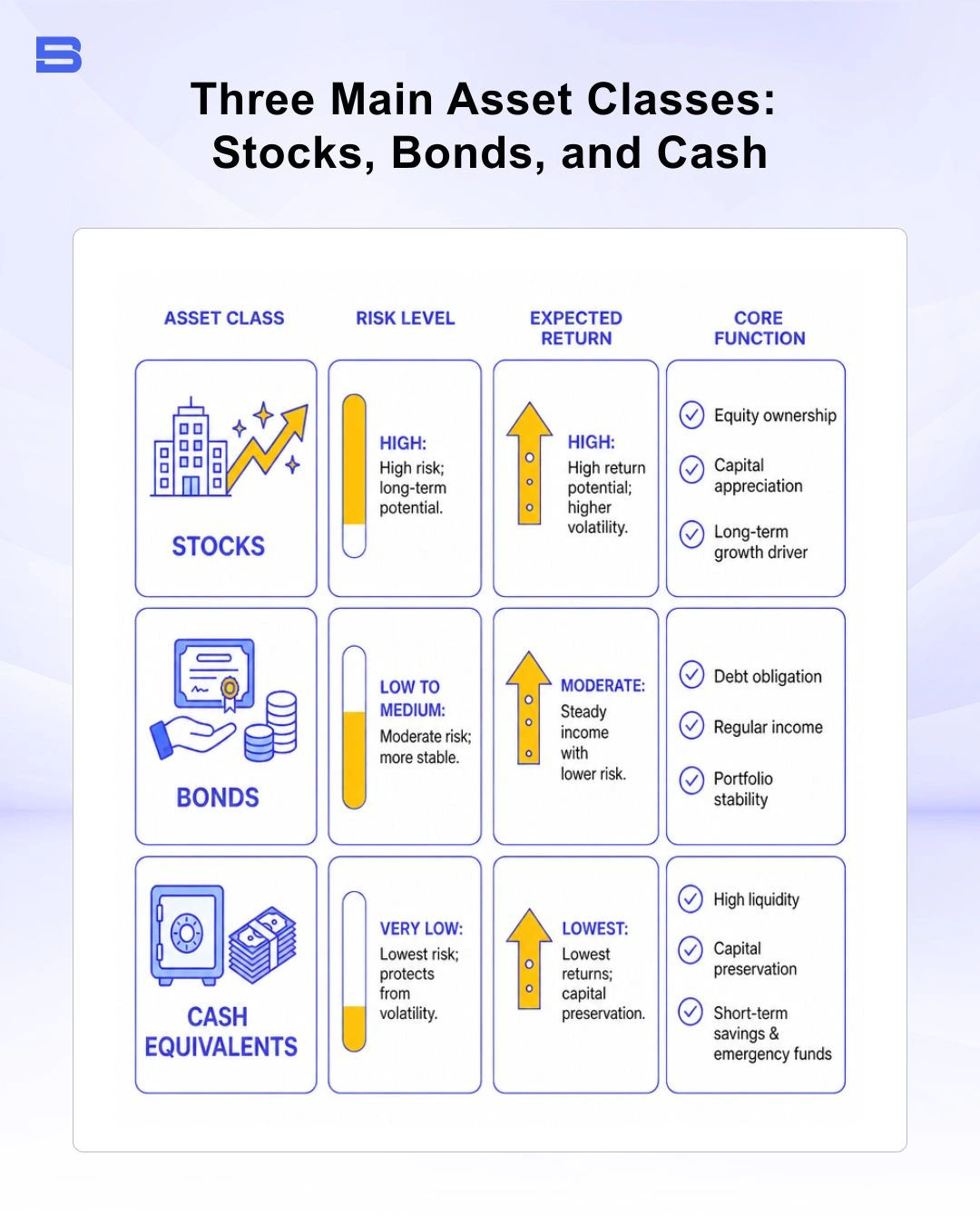
To build a robust portfolio, you need to understand the core building blocks. Every major asset class serves a distinct role in managing risk and generating returns.
1. Equities (Stocks)
Equities offer ownership stakes in publicly traded companies. They represent the primary engine for capital appreciation over the long term. However, stocks carry the highest volatility among traditional asset classes. A market crash can temporarily reduce an equity position's value significantly, making them best suited for long-term horizons.
2. Fixed Income (Bonds)
Fixed income investments, such as corporate or government bonds, pay regular interest and return the principal upon maturity. They typically carry lower volatility than equities and provide steady income. While their long-term capital gains potential is modest, they act as a crucial buffer during stock market sell-offs.
3. Cash and Cash Equivalents
Cash equivalents include money market funds, treasury bills, and short-term certificates of deposit. They offer maximum liquidity and capital preservation with minimal risk of capital loss. The trade-off is low return potential, which often fails to keep pace with inflation over extended periods.
Beyond these primary categories, investors may also allocate capital to alternative assets like real estate, commodities, or gold to diversify their risk exposure further.
Strategic vs. Tactical Asset Allocation
Understanding how to structure your allocations depends on your approach to market opportunities and portfolio management. The two primary frameworks are Strategic Asset Allocation (SAA) and Tactical Asset Allocation (TAA).
Strategic Asset Allocation (SAA)
Strategic Asset Allocation sets a target mix of assets based on your long-term return objectives and risk profile. You maintain these fixed target weights over time, regardless of short-term market noise.
For example, a traditional strategic mix might be 60% equities and 40% bonds. If market moves push equities up to 70%, you rebalance the portfolio back to the original 60/40 ratio. This approach prevents emotion from driving your decision-making.
Tactical Asset Allocation (TAA)
Tactical Asset Allocation allows for short-term deviations from your strategic baseline to take advantage of specific market inefficiencies or economic trends.
If economic indicators signal a temporary downturn in equities, a manager using tactical allocation might temporarily reduce stock exposure from 60% to 50% and shift 10% into defensive assets like short-term treasuries. Once market conditions normalize, the allocation returns to its strategic baseline.
Why Is Asset Allocation Important?
Academic research suggests that asset allocation accounts for the majority of a portfolio's return variability over time—far more than stock selection or market timing.
Here is why establishing a solid asset allocation strategy matters:
- Risk Management: Spreading capital across uncorrelated assets prevents a single underperforming sector from ruining your entire portfolio.
- Emotional Discipline: A predefined target structure removes panic from decision-making during market crashes, encouraging you to buy low and sell high through systematic rebalancing.
- Tailored Alignment: Your asset mix directly reflects your personal time horizon and risk capacity, ensuring your money works toward specific goals like retirement or purchasing property.
Worked Example: Rebalancing a Portfolio in Action
To understand how asset allocation protects your wealth, let's examine a practical worked example showing a portfolio over a two-year market cycle.
The Setup
Suppose you start with a $100,000 investment portfolio set to a classic 60/40 Strategic Asset Allocation:
- Equities (60%): $60,000
- Bonds (40%): $40,000
Year 1: Stock Market Rally
During Year 1, equities experience a bull run and gain 30%, while bonds yield a modest 5%.
- Equities value: $60,000 + 30% = $78,000
- Bonds value: $40,000 + 5% = $42,000
- Total Portfolio Value: $120,000
At the end of Year 1, your asset mix has shifted naturally:
- Equities now represent 65% ($78,000 / $120,000) of your portfolio.
- Bonds now represent 35% ($42,000 / $120,000) of your portfolio.
Your risk exposure is now higher than intended because your stock allocation expanded.
The Rebalancing Calculation
To return to your strategic 60/40 mix on a $120,000 portfolio, you calculate your targets:
- Target Equities (60%): $120,000 × 0.60 = $72,000
- Target Bonds (40%): $120,000 × 0.40 = $48,000
Action Taken: You sell $6,000 of equities ($78,000 - $72,000) and purchase $6,000 worth of bonds ($42,000 + $6,000).
What This Means for You
Rebalancing forced you to harvest profits from an overperforming asset class (selling stocks high) and lock in stability in a lower-risk asset class (buying bonds). If market equities take a downturn in Year 2, your risk is capped at your intended 60% exposure rather than an overextended 65%.
How to Determine Your Personal Asset Mix
There is no single "correct" allocation mix that works for every investor. Your personal structure depends heavily on three variables:
- Time Horizon: The length of time before you need to withdraw the capital. Longer time horizons allow you to allocate more to growth assets like equities, as you have time to recover from cyclical market downturns.
- Risk Tolerance: Your emotional ability to endure short-term portfolio losses without panic-selling.
- Risk Capacity: Your actual financial ability to withstand losses without altering your standard of living or immediate financial plans.
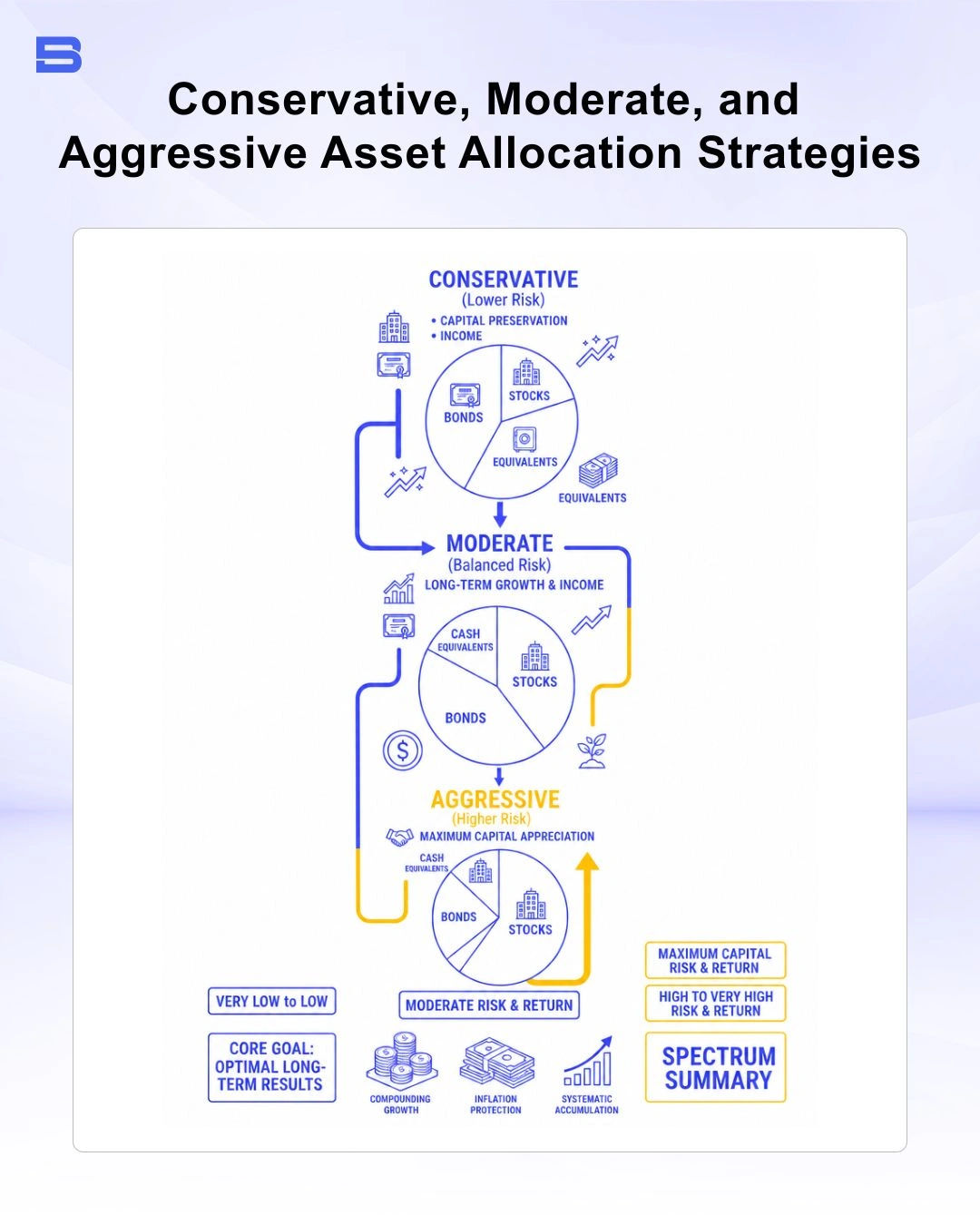
A common general rule of thumb is the "110 Rule" (subtracting your age from 110) to determine your stock percentage. Under the 110 Rule, a 30-year-old might consider 80% stocks (110 − 30 = 80) and 20% fixed income. While rules of thumb offer a quick benchmark, your individual goals should always drive final decisions.
The Bottom Line
Asset allocation is the cornerstone of effective portfolio management. By intentionally diversifying across equities, bonds, and cash, you build a resilient foundation capable of navigating various economic environments. Rather than attempting to predict short-term market movements, a disciplined approach—combining strategic targets with systematic rebalancing—ensures your investments remain aligned with your long-term goals and risk tolerance.
Disclaimer: The content on this page is intended for educational and informational purposes only. It does not constitute financial, investment, tax, or legal advice, and should not be interpreted as a recommendation to buy, sell, or hold any financial instrument or asset. Trading and investing involve significant risk, including the possible loss of your entire capital. Products such as forex, CFDs, and cryptocurrencies carry additional risks due to leverage, high volatility, and limited regulatory protection in some jurisdictions. Past performance of any financial instrument does not guarantee future results. Any market views, forecasts, or opinions expressed are those of the author at the time of writing and may not reflect current market conditions. Platform features, fees, and regulatory status are subject to change — always verify information directly with the relevant provider or regulator before making any financial decision. BrokerSpecs may receive compensation from third parties featured on this site. Always conduct your own due diligence and consider seeking advice from a licensed financial professional before investing.