



Related Tags
You are watching a currency pair on your screen. The numbers flip from 1.0850 to 1.0851. It seems like an insignificant whisper of a change—a tiny fraction of a single cent. Yet, behind that tiny movement, millions of dollars in position value can shift instantly.
Understanding what is a pip and how these fractional shifts translate into actual money is one of the first major hurdles every currency trader faces. In forex, that tiny decimal movement is known as a pip. Whether you are setting a stop-loss, calculating your potential payout, or managing risk, everything in the currency market is measured in pips.
What Is a Pip in Forex?
A pip, which stands for Percentage in Point or Price Interest Point in forex, is the standard unit of measurement and is used in some other asset classes to quantify the change in value between two currencies. It represents the smallest standard price move that a conventional exchange rate can make.
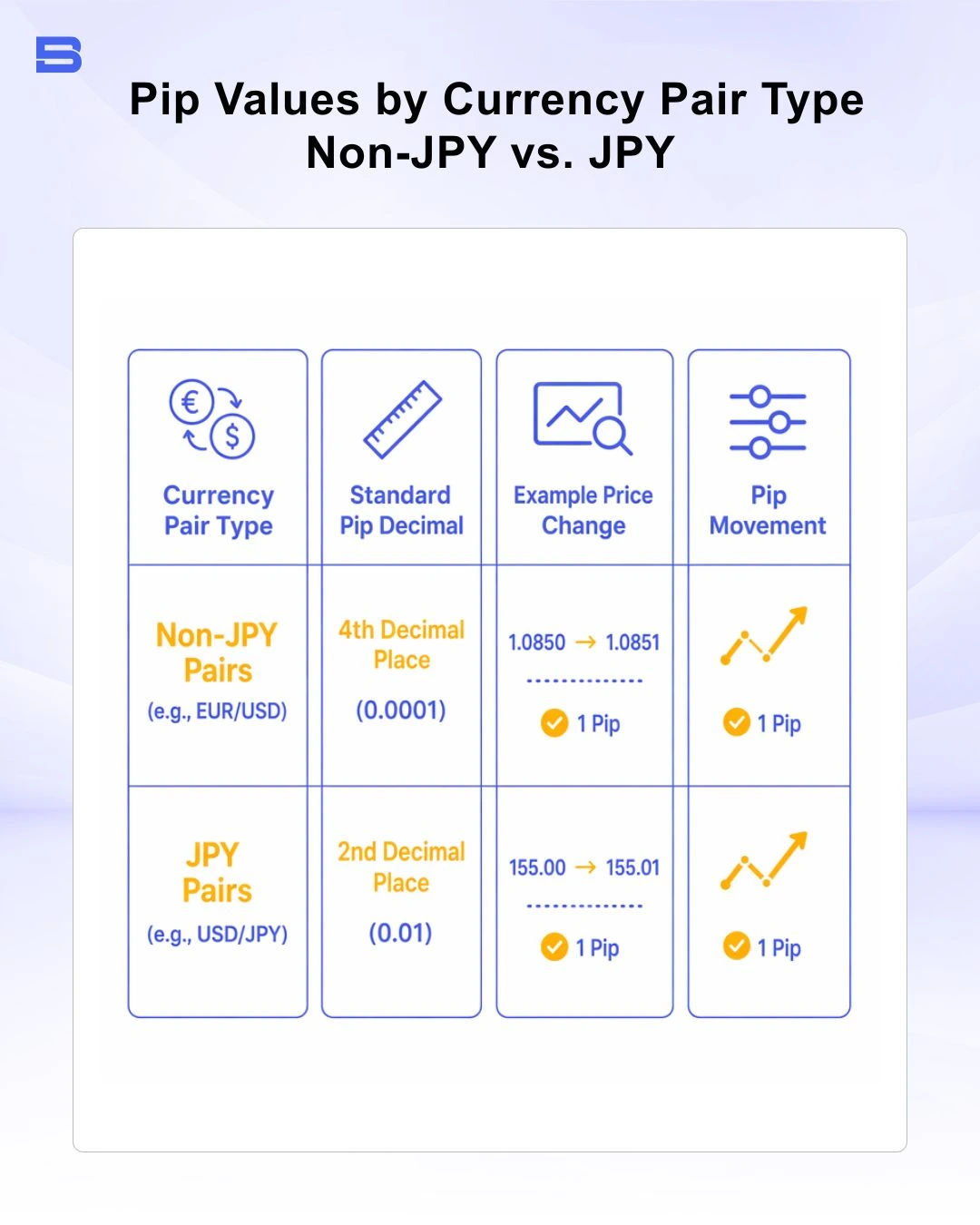
For most currency pairs, a pip in forex is represented by the fourth decimal place (0.0001). For example, if the GBP/USD (British Pound/US Dollar) moves from 1.0850 to 1.0851, that 0.0001 increase is a one-pip movement.
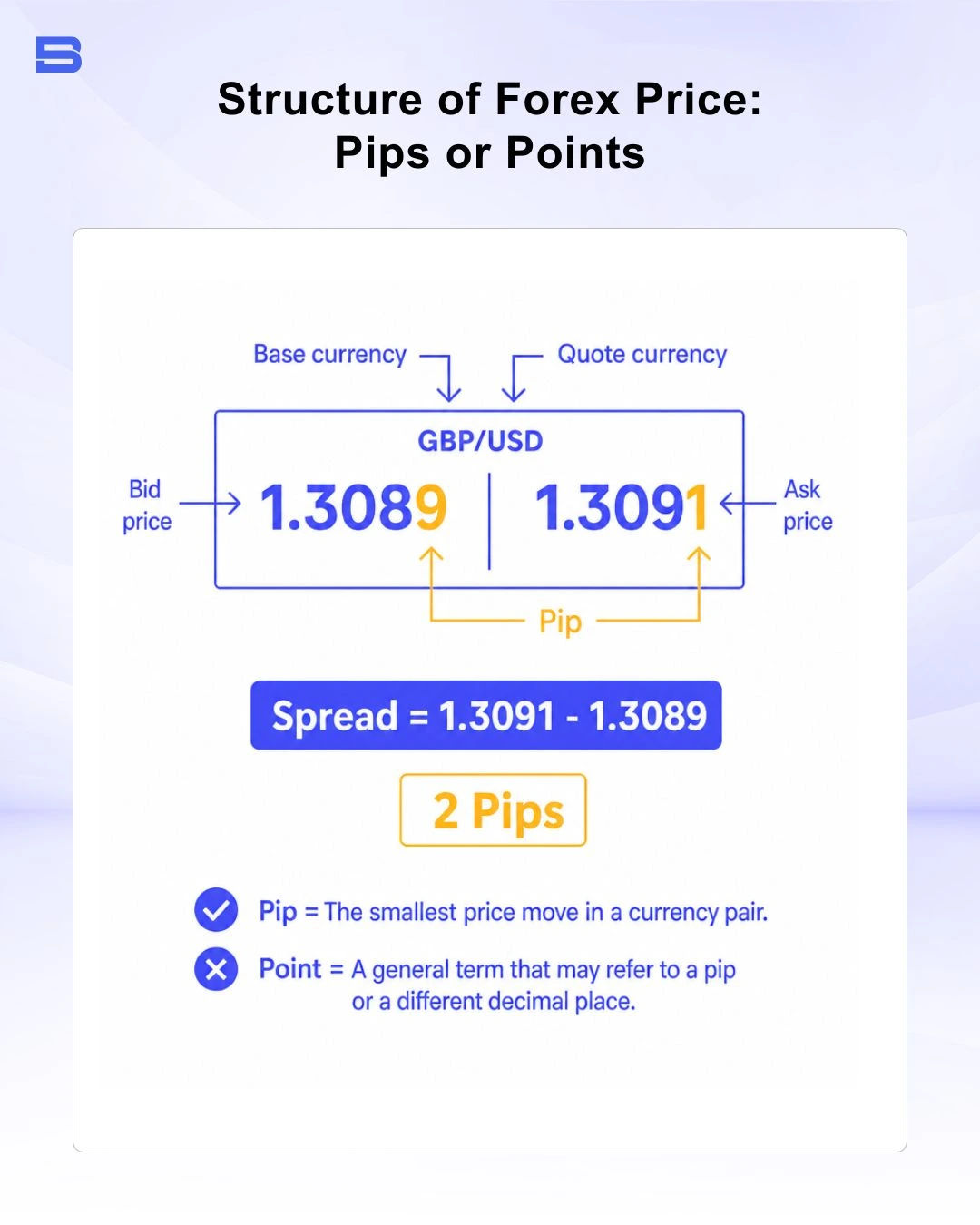
However, there is a major exception to this rule: the Japanese Yen (JPY). Because the Yen is valued at a much lower unit scale compared to other major currencies, pairs containing the Japanese Yen are quoted to two decimal places. For pairs like USD/JPY or EUR/JPY (Euro/Japanese Yen), a pip is the second decimal place (0.01).
Pips vs. Pipettes: Understanding Fractional Pips
When reviewing modern trading platforms, you will almost certainly see prices quoted to five decimal places (or three for JPY pairs). That extra decimal place is a pipette, or fractional pip.
One pipette represents one-tenth of a pip (0.1 pip). If EUR/USD moves from 1.08500 to 1.08505, the price has moved five pipettes, or half a pip. Brokers use pips to offer tighter spreads and more precise order execution, but trading targets are still generally discussed in whole pips.
How to Calculate Pip Value
Knowing how many pips a pair has moved is only half the battle. To manage your account balance, you need to know what those pips are actually worth in dollars, euros, or pounds.
The monetary value of a pip depends on three core variables:
- The currency pair being traded
- The exchange rate of the pair
- The trade size (lot size)
The Impact of Lot Sizes
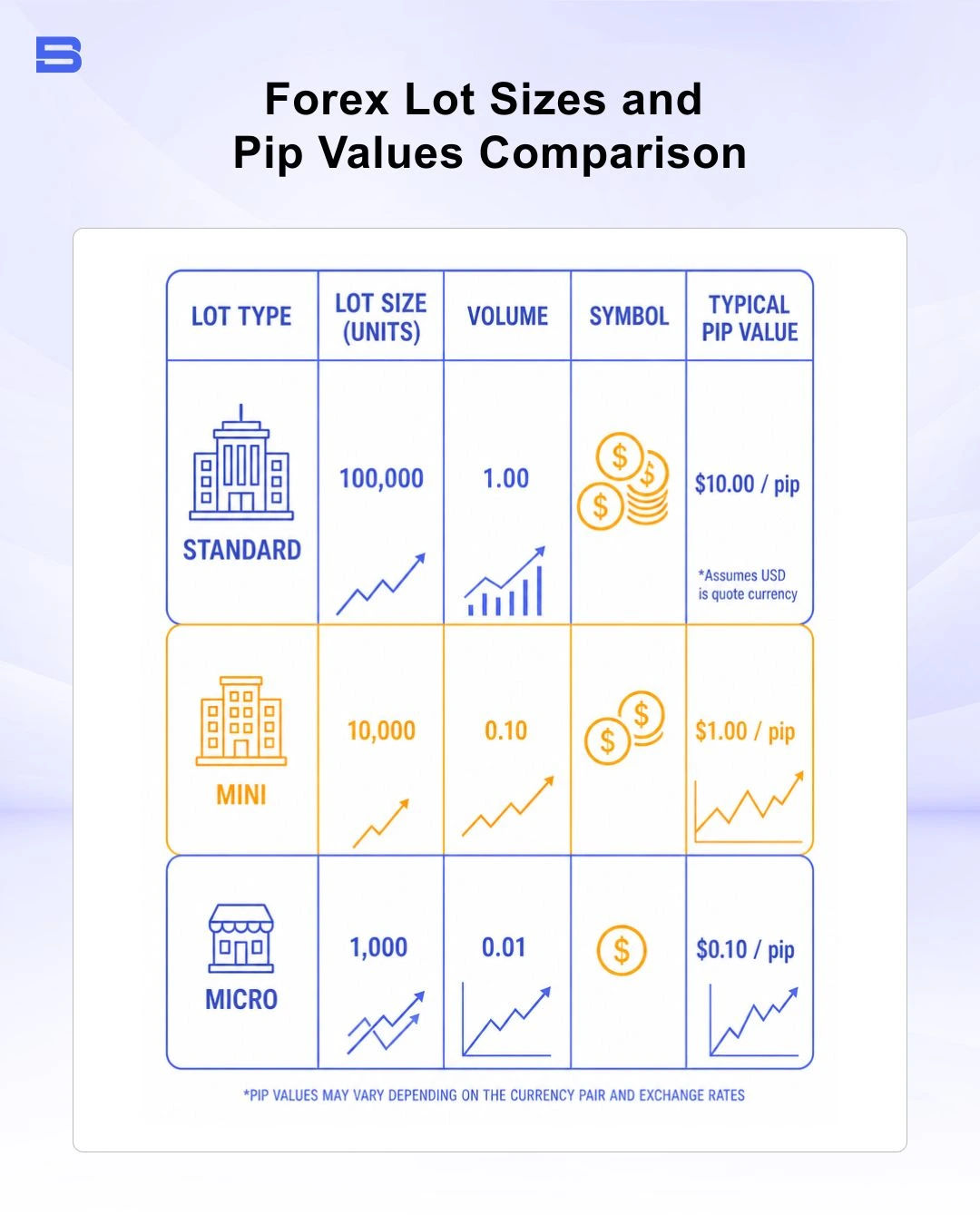
In forex, trades are executed in standardized units called lots. The three primary lot sizes you will encounter are:
- Standard Lot: 100,000 units of the base currency
- Mini Lot: 10,000 units of the base currency
- Micro Lot: 1,000 units of the base currency
When trading a pair where the quote currency (the second currency in the pair) is USD—such as EUR/USD, GBP/USD, or AUD/USD (Australian Dollar/US Dollar)—the pip values are fixed:
- One Standard Lot: 1 pip = $10
- One Mini Lot: 1 pip = $1
- One Micro Lot: 1 pip = $0.10
Worked Example: Calculating Pip Value Step-by-Step
Let's look at how pip value calculation works in practice using two distinct scenarios: one standard USD quote pair and one Japanese Yen pair.
Scenario 1: Trading EUR/USD (USD Quote Currency)
Suppose you open one Standard Lot (100,000 units) trade on EUR/USD.
- Identify the Pip Size: For EUR/USD, $1 pip = 0.0001
- Apply the Formula: Pip Value = Trade Size x Pip Size
- Calculate: Pip Value = 100,000 x 0.0001 = $10
If the price moves in your favor by 35 pips, your total profit is:
35 pips times $10 = $350
Scenario 2: Trading USD/JPY (Non-USD Quote Currency)
Suppose you buy one Mini Lot of 10,000 units of USD/JPY when the rate is 155.00.
- Identify the Pip Size: For USD/JPY, 1= 0.01
- Calculate in Quote Currency (JPY): Pip Value (JPY) = 10,000 x 0.01 = 100 JPY
- Convert to Base Currency (USD): Pip Value USD = 100 JPY/Exchange Rate (155.00) approx $0.65
In this scenario, every pip move on your mini lot is worth approximately $0.65. While most modern trading software calculates this automatically in real time, understanding the math ensures you are never surprised by market volatility.
Why Pip Value Matters for Risk Management
Calculating pips is not just a math exercise—it is the foundation of capital preservation. Without knowing your pip value, setting a proper stop-loss order is purely dynamic guesswork.
For example, imagine you have a $1,000 trading account and follow a strict risk management rule: never risk more than 2% of your account on a single trade (20).
If your analysis suggests placing a 40-pip stop-loss on a trade:
- Using a Standard Lot ($10/pip): A 40-pip loss equals $400 (40% of your account—catastrophic risk).
- Using a Mini Lot ($1/pip): A 40-pip loss equals $40 (4% of your account—double your risk limit).
- Using a Micro Lot ($0.10/pip): A 40-pip loss equals $4 (0.4% of your account—well within your $20 limit).
By scaling down to two micro lots ($0.20/pip), a 40-pip loss equals exactly $8, keeping your risk under control. Position sizing driven by pip value is what separates consistent traders from those who blow up their accounts.
Whether you are a beginner or refining your strategy, understanding a pip in forex is the single most important building block for managing trade risk with confidence.
Key Takeaways: Mastering Pip Value in Forex
Pips are the core currency of forex trading. They serve as the standardized language through which price movements, market volatility, trade profits, and stop-loss limits are measured. By taking the time to master pip calculations and linking them directly to your lot sizing, you transform risk management from a theoretical concept into a practical tool that protects your trading capital.
- What Is Trading and How Does Trading Work?
- Trading Fundamentals: A Guide for Beginners
- Trading vs. Investing: What Are the Key Differences?
- Trading Terms and Terminologies Every Beginner Should Know
- Common Trading Mistakes Beginners Make and How to Avoid
- Understanding Risk and Reward in Trading: A Complete Guide
- Guide to the Different Types of Financial Markets
- Investment Basics: Definition, Strategies, and How to Invest
- Benefits of Investing: Financial Growth and Security
- What Is Swing Trading? A Practical Guide For Beginners
- What Is Spot Trading? A Guide for Beginners
- What Are Futures in Trading? A Guide for Beginners
- Understanding Bull Markets: Growth & Strategy
- How to Read a Candlestick Chart: A Guide for Beginners
- Is Trading Gambling? The Truth About Risk
- Pip in Forex: How It Works & How to Calculate It
- What Is the Bid-Ask Spread in Trading? A Guide for Beginners
- What Is a Margin Call? A Guide for Beginners
- Market Volatility Explained: What It Is and How to Trade It
- Drawdown in Trading: Meaning, Math, and Risk
- Understanding Slippage in Trading: Causes and Control
- Forex Lot Size Explained: Standard, Mini & Micro
- Trailing Stop vs Stop Loss: Essential Risk Strategy
- How Asset Allocation Works: Strategies Explained
- Understanding Market Trading Hours & Sessions
- Market Makers Explained: A Trader's Guide
- Portfolio Diversification: A Strategy Guide
- Capital Gains Explained: How Investment Taxes Work
- Stock Market Circuit Breakers: How Trading Halts Work
- What Is an IPO? How Initial Public Offerings Work
- What Is a Secondary Market? A Complete Guide
- What Is a Stock Exchange? Functions and Overview Explained
- Understanding Ticker Symbols: A Market Guide
- How Clearing Houses Work in Financial Markets
- Stock Market After Labor Day: Trends and What To Expect
Disclaimer: The content on this page is intended for educational and informational purposes only. It does not constitute financial, investment, tax, or legal advice, and should not be interpreted as a recommendation to buy, sell, or hold any financial instrument or asset. Trading and investing involve significant risk, including the possible loss of your entire capital. Products such as forex, CFDs, and cryptocurrencies carry additional risks due to leverage, high volatility, and limited regulatory protection in some jurisdictions. Past performance of any financial instrument does not guarantee future results. Any market views, forecasts, or opinions expressed are those of the author at the time of writing and may not reflect current market conditions. Platform features, fees, and regulatory status are subject to change — always verify information directly with the relevant provider or regulator before making any financial decision. BrokerSpecs may receive compensation from third parties featured on this site. Always conduct your own due diligence and consider seeking advice from a licensed financial professional before investing. Portions of this article were prepared with the assistance of AI tools and reviewed by our editorial team before publication.