


- What Is Trading and How Does Trading Work?
- Trading Fundamentals: A Guide for Beginners
- Trading vs. Investing: What Are the Key Differences?
- Trading Terms and Terminologies Every Beginner Should Know
- Common Trading Mistakes Beginners Make and How to Avoid
- Understanding Risk and Reward in Trading: A Complete Guide
- Guide to the Different Types of Financial Markets
- Investment Basics: Definition, Strategies, and How to Invest
- Benefits of Investing: Financial Growth and Security
- What Is Swing Trading? A Practical Guide For Beginners
- What Is Spot Trading? A Guide for Beginners
- What Are Futures in Trading? A Guide for Beginners
- Understanding Bull Markets: Growth & Strategy
- How to Read a Candlestick Chart: A Guide for Beginners
- Is Trading Gambling? The Truth About Risk
- Pip in Forex: How It Works & How to Calculate It
- What Is the Bid-Ask Spread in Trading? A Guide for Beginners
- What Is a Margin Call? A Guide for Beginners
- Market Volatility Explained: What It Is and How to Trade It
- Drawdown in Trading: Meaning, Math, and Risk
- Understanding Slippage in Trading: Causes and Control
- Forex Lot Size Explained: Standard, Mini & Micro
- Trailing Stop vs Stop Loss: Essential Risk Strategy
- How Asset Allocation Works: Strategies Explained
- Understanding Market Trading Hours & Sessions
- Market Makers Explained: A Trader's Guide
- Portfolio Diversification: A Strategy Guide
- Capital Gains Explained: How Investment Taxes Work
- Stock Market Circuit Breakers: How Trading Halts Work
- What Is an IPO? How Initial Public Offerings Work
- What Is a Secondary Market? A Complete Guide
- What Is a Stock Exchange? Functions and Overview Explained
- Understanding Ticker Symbols: A Market Guide
- How Clearing Houses Work in Financial Markets
- Stock Market After Labor Day: Trends and What To Expect
You have mapped out your strategy, analyzed the chart patterns, and identified a high-probability entry point on EUR/USD (Euro and US Dollar). You open your trading terminal, click buy, and watch the market move 20 pips in your favor—only to realize you made $2 instead of the $200 you expected. Or worse, the market drops 10 pips and takes half your account balance with it.
This dramatic gap between expectation and reality almost always stems from a single misunderstanding: position sizing. In financial markets, controlling your exposure comes down to understanding lot size.
What Is Lot Size in Forex Trading?
In forex trading, currencies are not bought or sold in single units like shares of a stock. Instead, trades are executed in standardized batches known as "lots." A lot represents the standard unit quantity of a currency pair you are buying or selling.
When you place an order, the lot size dictates your total market exposure and determines exactly how much money you win or lose per pip movement. Standardized lot sizes exist to allow institutional liquidity providers (banks and large financial institutions that supply the buy/sell prices in the market) and retail traders to execute transactions efficiently across global networks.
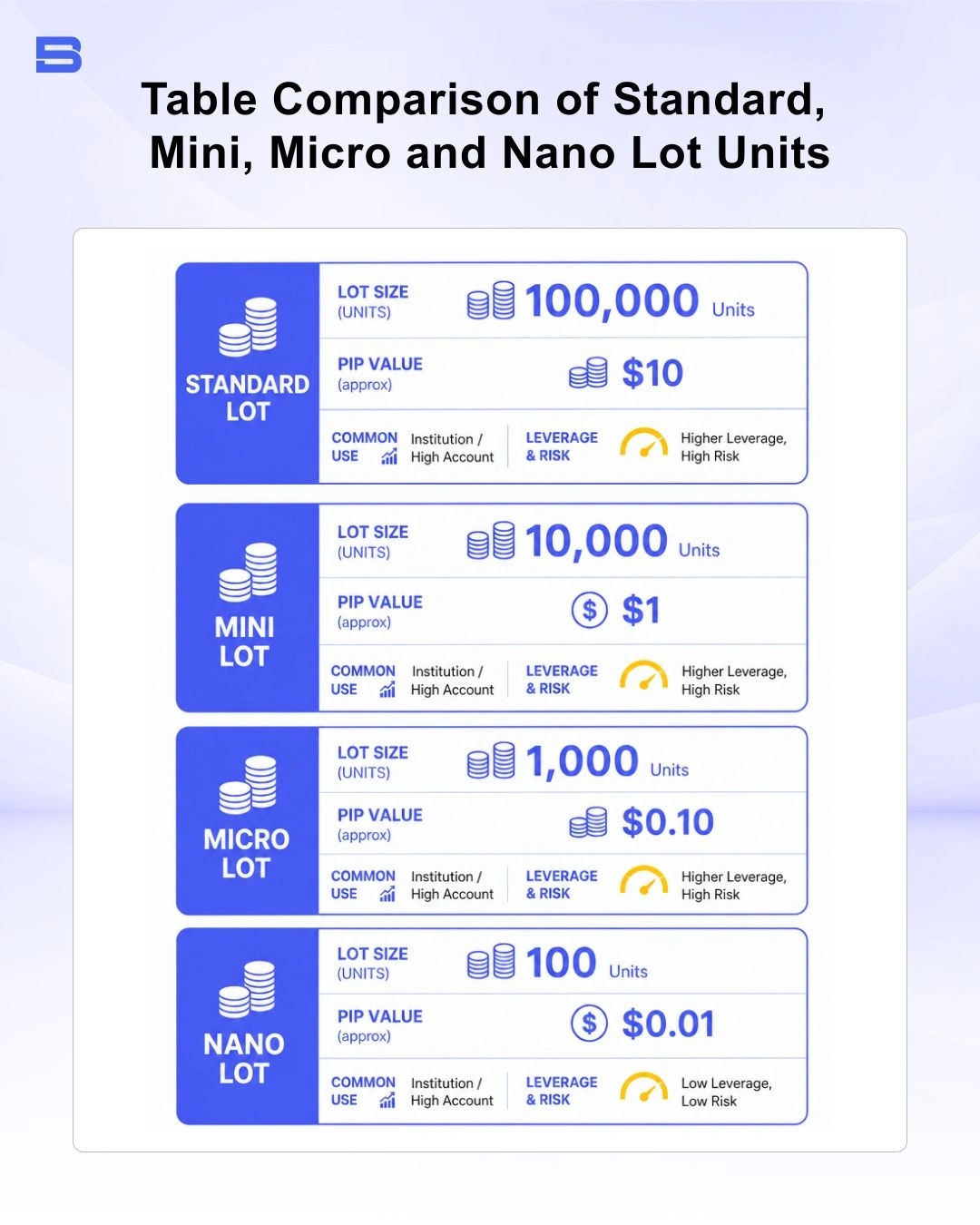
To choose the right size for your risk strategy, you must understand the four primary lot classifications used across trading platforms:
- Standard Lot (1.00): Consists of 100,000 units of the base currency. For USD-denominated accounts, trading 1.0 standard lot on EUR/USD means a single pip move is worth approximately $10.
- Mini Lot (0.10): Represents 10,000 units of the base currency, or 10% of a standard lot. A one-pip move on EUR/USD equals roughly $1.
- Micro Lot (0.01): Equals 1,000 units of the base currency, or 1% of a standard lot. Moving one pip generates a value change of around $0.10.
- Nano Lot (0.001): Equals 100 units of the base currency. While rarer, some retail brokers offer nano lots where a pip is worth $0.01, allowing traders to test real-money environments with minimal capital.
Matching your trade volume to these standardized units gives you predictable control over your open positions. Proper lot sizing controls your risk pip in forex and protects your account from a margin call.
What Is a 0.01 Lot Size?
A 0.01 lot size—commonly referred to as a micro lot—represents 1,000 units of the base currency in a forex trade. If you buy a 0.01 lot on EUR/USD when the rate is 1.0800, you are controlling €1,000 worth of currency.
For beginners, the 0.01 lot size is the most critical starting point in retail trading. It scales down market volatility to a manageable level where mistakes are cheap, but the mechanics of real-money trading remain intact.
1 Micro Lot (0.01) = 1,000 Units
Pip Value (EUR/USD) = ~$0.10 per pip
50-Pip Stop Loss Risk = $5.00
When trading a 0.01 lot on EUR/USD:
- Each pip (the fourth decimal place movement) is worth approximately $0.10.
- A 10-pip move in your favor results in a $1.00 profit.
- A 50-pip drawdown (a temporary drop in your account balance from an open loss) results in a $5.00 loss.
Starting with 0.01 lots allows you to focus on mastering risk management and platform mechanics without exposing your capital to destructive account swings.
How to Calculate Lot Size for Proper Risk Management
Rather than picking an arbitrary volume number like 0.10 or 0.50, professional traders work backward: they determine the maximum dollar amount they are willing to lose on a trade first, then calculate the precise lot size that matches that threshold.
To figure out your proper position size, use this practical formula:
Position Size (Lots) = Account Capital times x Risk Percentage / Stop Loss (Pips) x Pip Value per Lot
Worked Example: Sizing a Trade Step-by-Step
Let's walk through a practical scenario to see how this calculation protects your capital in real time.
- Account Capital: $1,000
- Risk Limit Per Trade: 2% ($20 max risk)
- Currency Pair: EUR/USD
- Stop Loss Distance: 40 pips
- Standard Pip Value (1.0 Lot): $10 per pip
Step 1: Calculate your total dollar risk limit.
Dollar Risk = $1,000 x 0.02 = $20
Step 2: Determine your maximum allowed loss per pip.
Max Loss Per Pip = $20 / 40 pip = $0.50 per pip
Step 3: Convert the pip risk into lot units.
Since a $1.00 lot equals $10/pip, dividing your target pip value ($0.50) by the standard lot pip value ($10.00) gives:
Lot Size = $0.50 / $10.00 = 0.05 lots
By executing this trade at 0.05 lots, even if price triggers your 40-pip stop loss, your account loses exactly $20 (or 2%).
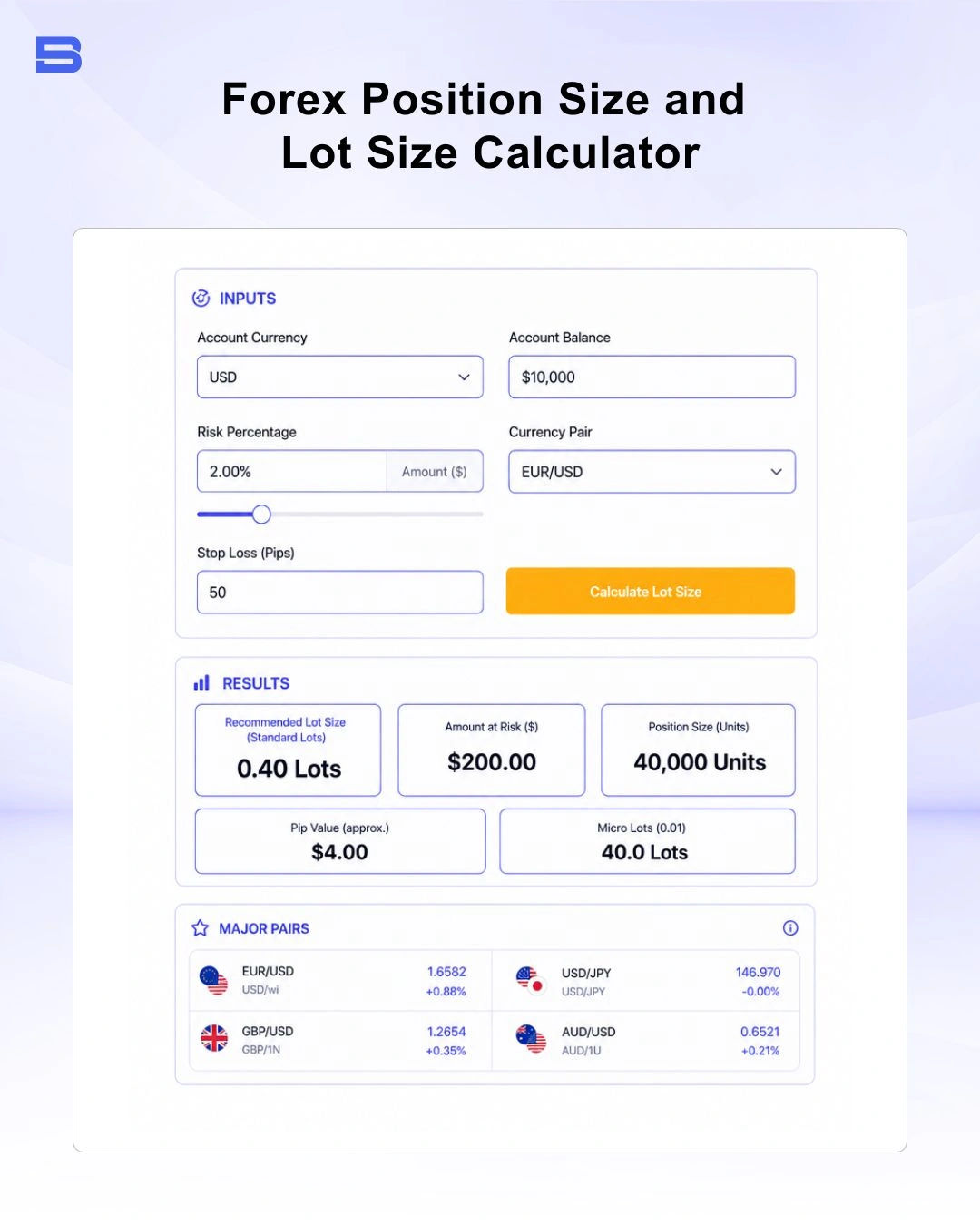
While doing manual math is essential for understanding the underlying mechanics, most traders streamline execution using an online lot size calculator or custom MetaTrader script to avoid manual mistakes during fast-moving market conditions.
The Bottom Line
Lot size is not a decorative parameter on your execution order window—it is the direct accelerator pedal of your portfolio's leverage and risk exposure. Standard, mini, and micro options exist so traders can scale position sizes dynamically based on account size and market volatility. By basing your trade volume on fixed percentage risk limits rather than dynamic emotion, you ensure that no single trade ever endangers your financial survival.
Disclaimer: The content on this page is intended for educational and informational purposes only. It does not constitute financial, investment, tax, or legal advice, and should not be interpreted as a recommendation to buy, sell, or hold any financial instrument or asset. Trading and investing involve significant risk, including the possible loss of your entire capital. Products such as forex, CFDs, and cryptocurrencies carry additional risks due to leverage, high volatility, and limited regulatory protection in some jurisdictions. Past performance of any financial instrument does not guarantee future results. Any market views, forecasts, or opinions expressed are those of the author at the time of writing and may not reflect current market conditions. Platform features, fees, and regulatory status are subject to change — always verify information directly with the relevant provider or regulator before making any financial decision. BrokerSpecs may receive compensation from third parties featured on this site. Always conduct your own due diligence and consider seeking advice from a licensed financial professional before investing.