


Related Tags
You open your trading platform, and almost everything in your watchlist is glowing green. Major stock indices are hitting new all-time highs week after week, news headlines are buzzing with optimism, and even casual acquaintances are suddenly asking about equity investments. It feels like everyone is making money, and the momentum seems unstoppable.
This sustained wave of rising prices and widespread investor confidence is what the financial world calls a bull market. While riding an upward trend feels exhilarating, navigating it successfully requires understanding what drives the momentum, how long it typically lasts, and how to protect your portfolio when the sentiment inevitably shifts.
What Is a Bull Market?
A bull market refers to a prolonged period in financial markets where asset prices are rising or expected to rise. While the term is most frequently applied to the stock market, bull markets occur across various asset classes, including commodities, real estate, forex, and cryptocurrency.
To qualify as a technical bull market in stock indices (like the S&P 500 or the Dow Jones Industrial Average), market prices generally need to rise by 20% or more from a recent low point, typically following a decline of 20% or more. However, a bull market is defined by more than just percentages—it is characterized by robust economic growth, strong corporate profits, and high investor confidence.

Where Does the Term Come From?
Financial folklore suggests the term "bull" comes from the way the animal attacks—thrusting its horns upward into the air. Conversely, a "bear" attacks by swiping its paws downward. Thus, bulls represent upward price trajectory, while bears represent falling markets.
Key Characteristics of a Bull Market
Recognizing a bull market involves looking at a combination of market sentiment, economic indicators, and asset performance.
- Sustained Price Growth: Prices rise steadily over months or years. While short-term pullbacks (minor price dips) still occur, the primary direction of the trend remains upward.
- Strong Economic Indicators: Bull markets rarely happen in isolation. They are typically backed by a strong gross domestic product (GDP), low unemployment rates, and solid corporate earnings reports.
- High Investor Confidence: Market psychology plays a massive role. During a bull market, investor demand is high, buy-and-hold strategies thrive, and market participation expands as risk appetite increases.
- Increased Trading Volume: Widespread enthusiasm leads to higher trading activity as institutional and retail investors actively seek capital appreciation.
Bull Market vs. Bear Market: Key Differences
Many investors ask, "what is a bear market?" — in short, it's the mirror opposite of a bull market: a sustained period of falling prices, typically defined by a 20% or greater decline from recent highs.
Understanding the contrast between bull and bear markets helps you adjust your trading and risk management strategies depending on market conditions.
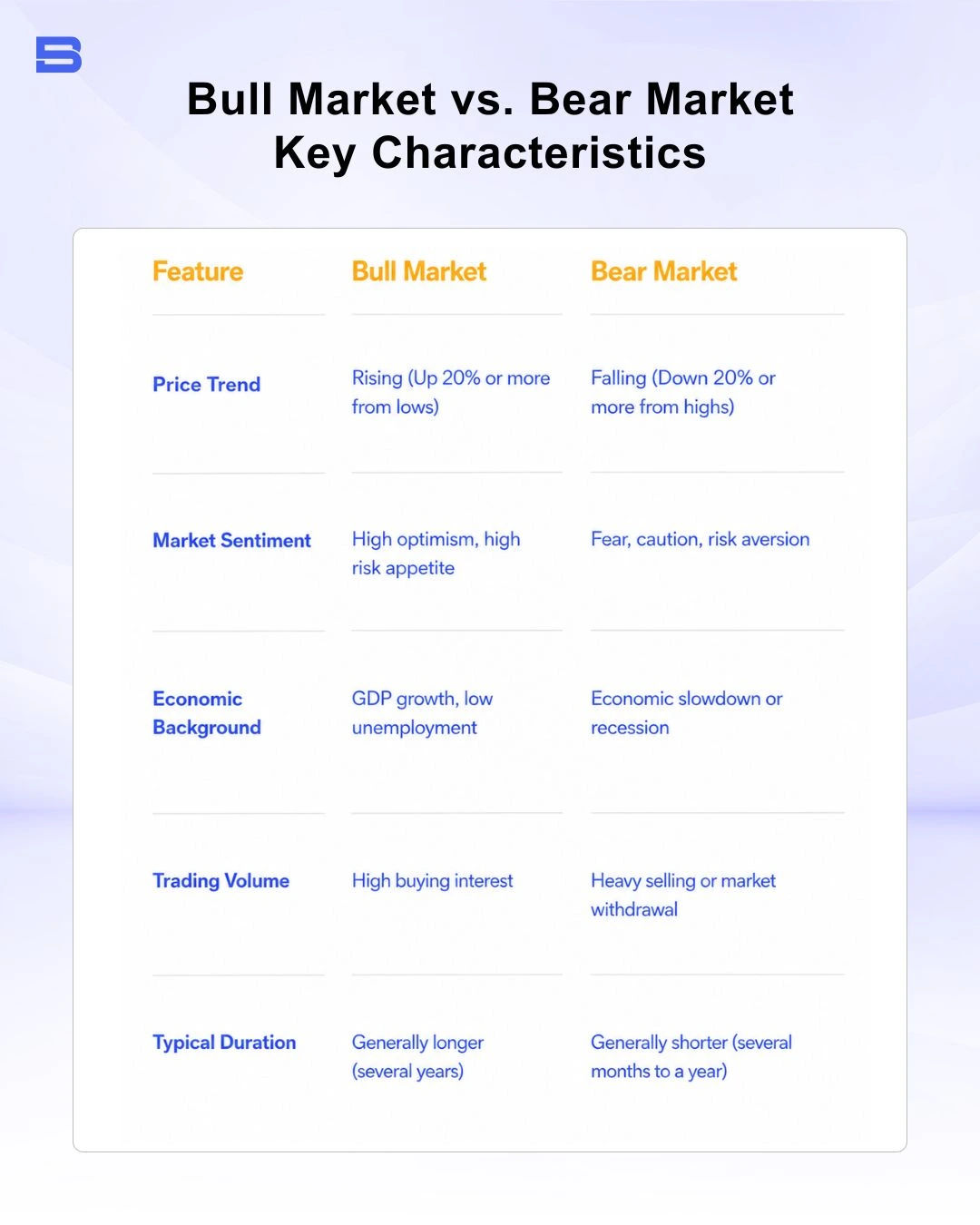
While a bull market relies on corporate growth and economic expansion, a bear market is often driven by economic contraction, rising unemployment, or sudden systemic shocks.
What Causes a Bull Market?
Bull markets do not happen by chance; they are driven by macroeconomic forces and human behavior working together.
1. Robust Economic Growth
When businesses report rising profits and consumer spending remains strong, economic output expands. Strong earnings reports give investors a tangible reason to bid share prices higher.
2. Low Interest Rates and Easy Liquidity
Central banks, such as the Federal Reserve, influence market cycles. When interest rates are low, borrowing costs for businesses and consumers drop. Furthermore, low yields on bonds prompt investors to move capital into stocks and higher-yielding assets to seek better returns through central bank monetary policy.
3. Market Psychology and FOMO
Investor sentiment creates a self-fulfilling loop. As prices rise, investors fear missing out (FOMO) on further gains, driving more capital into the market, which pushes prices even higher.
The Phases of a Bull Market
A classic bull market does not move upward in a single straight line. It generally progresses through four distinct phases:
The Accumulation Phase: Occurs at the tail end of a bear market. Prices are low, sentiment is still pessimistic, but smart money (experienced institutional investors) begins buying up undervalued assets.
The Public Participation Phase: Economic indicators improve, corporate earnings recover, and mainstream investors re-enter the market. Prices begin a steady, clear upward trend.
The Excess Phase: Speculation reaches its peak. Valuations become stretched, retail participation skyrockets, and positive news dominates media headlines. Caution is often ignored.
The Distribution Phase: Experienced investors recognize that asset prices have become overvalued relative to fundamentals. They begin selling off holdings to lock in gains, paving the way for a potential trend reversal.
How Long Does a Bull Market Last?
One of the most frequent questions investors ask is how long a bull run can continue. According to historical S&P 500 cycle data from FRED (Federal Reserve Economic Data), bull markets have historically lasted significantly longer than bear markets, with expansions often spanning several years compared to shorter, sharper bear-market downturns.
However, duration varies greatly across different asset classes. For example, a crypto bull market tends to move in shorter, more volatile cycles, often influenced by Bitcoin block reward halving events, technological adoption waves, and shifts in global liquidity and crypto market cycles.
Understanding a Crypto Bull Market
While stock bull markets are heavily grounded in earnings per share (EPS) and GDP figures, a crypto bull market operates under unique market dynamics.
Crypto bull runs are characterized by rapid price appreciation, extreme trading volume, and heightened volatility. Key drivers include:
- Supply Dynamics: Halving events reduce the rate at which new supply enters circulation.
- Technological & Institutional Adoption: Approval of spot ETFs, regulatory clarity, or integration into traditional financial systems.
- Global Liquidity Shifts: Speculative assets like digital currencies benefit strongly when global fiat liquidity increases.
Due to the lack of traditional valuation metrics like cash flow, price swings in crypto bull runs can be far more extreme than in equity markets, demanding strict risk management.
Worked Example: Profit and Risk in a Bull Market
Let's walk through a realistic scenario to demonstrate how portfolio management works in an ascending market—and why over-leveraging can be dangerous even when the market is rising.
The Scenario
Suppose you have a $10,000 trading account during an established bull market. You decide to purchase an index ETF trading at $100 per share.
Standard Position (No Leverage):
You buy 100 shares for $10,000.
The market rises 15% over six months to $115 per share.
Result: Your position is now worth $11,500. You earned a net profit of $1,500 (a 15% return on capital).
Leveraged Position (5:1 Leverage):
Using 5:1 leverage, your $10,000 margin allows you to control $50,000 worth of shares (500 shares at $100).
Outcome A (Market Rises): The index rises 15% to $115. Your 500 shares are now worth $57,500. After accounting for the initial loan, your profit is $7,500 (a 75% return on capital).
Outcome B (Normal Market Correction): Bull markets do not go up in a straight line. Suppose the index undergoes a routine 10% pullback to $90 before resuming its upward trend. Your 500 shares drop to $45,000. You lose $5,000 of your balance—wiping out 50% of your total account margin on a temporary dip.
Takeaway for Traders: Even in a healthy bull market, short-term pullbacks of 5% to 15% are completely normal. Excessive leverage can trigger a margin call or wipe out your balance during a routine pullback before the broader uptrend continues the risk management strategies.
Strategies for Investing in a Bull Market
- Dollar-Cost Averaging (DCA): Rather than trying to time the absolute bottom, invest a fixed amount of money at regular intervals. This helps smooth out purchase prices across market fluctuations.
- Buy and Hold: In a long-term bull trend, holding quality assets often outperforms frequent short-term buying and selling, which accrues transaction fees and short-term capital gains taxes.
- Rebalancing: As certain assets skyrocket in value, they may account for an uncomfortably large portion of your total portfolio. Periodically taking partial profits and rebalancing maintains your target risk level.
- Set Stop-Loss Orders: Protecting capital is just as vital during a bull run as it is in a downturn. Using trailing stop-loss orders allows you to lock in gains as prices climb while setting an automatic exit if the market turns.
Bull Market Takeaways: Investing Wisely in Rising Markets
A bull market presents significant opportunities for investors to build wealth as rising stock prices reflect broader economic health and corporate profitability. However, sustained price increases can easily breed complacency. Successful long-term investors recognize that bull markets do not last forever—they stick to disciplined entry strategies, maintain proper diversification, and manage risk carefully, ensuring their portfolios remain resilient whenever the market cycle eventually turns.
- What Is Trading and How Does Trading Work?
- Trading Fundamentals: A Guide for Beginners
- Trading vs. Investing: What Are the Key Differences?
- Trading Terms and Terminologies Every Beginner Should Know
- Common Trading Mistakes Beginners Make and How to Avoid
- Understanding Risk and Reward in Trading: A Complete Guide
- Guide to the Different Types of Financial Markets
- Investment Basics: Definition, Strategies, and How to Invest
- Benefits of Investing: Financial Growth and Security
- What Is Swing Trading? A Practical Guide For Beginners
- What Is Spot Trading? A Guide for Beginners
- What Are Futures in Trading? A Guide for Beginners
- Understanding Bull Markets: Growth & Strategy
- How to Read a Candlestick Chart: A Guide for Beginners
- Is Trading Gambling? The Truth About Risk
- Pip in Forex: How It Works & How to Calculate It
- What Is the Bid-Ask Spread in Trading? A Guide for Beginners
- What Is a Margin Call? A Guide for Beginners
- Market Volatility Explained: What It Is and How to Trade It
- Drawdown in Trading: Meaning, Math, and Risk
- Understanding Slippage in Trading: Causes and Control
- Forex Lot Size Explained: Standard, Mini & Micro
- Trailing Stop vs Stop Loss: Essential Risk Strategy
- How Asset Allocation Works: Strategies Explained
- Understanding Market Trading Hours & Sessions
- Market Makers Explained: A Trader's Guide
- Portfolio Diversification: A Strategy Guide
- Capital Gains Explained: How Investment Taxes Work
- Stock Market Circuit Breakers: How Trading Halts Work
- What Is an IPO? How Initial Public Offerings Work
- What Is a Secondary Market? A Complete Guide
- What Is a Stock Exchange? Functions and Overview Explained
- Understanding Ticker Symbols: A Market Guide
- How Clearing Houses Work in Financial Markets
- Stock Market After Labor Day: Trends and What To Expect
Disclaimer: The content on this page is intended for educational and informational purposes only. It does not constitute financial, investment, tax, or legal advice, and should not be interpreted as a recommendation to buy, sell, or hold any financial instrument or asset. Trading and investing involve significant risk, including the possible loss of your entire capital. Products such as forex, CFDs, and cryptocurrencies carry additional risks due to leverage, high volatility, and limited regulatory protection in some jurisdictions. Past performance of any financial instrument does not guarantee future results. Any market views, forecasts, or opinions expressed are those of the author at the time of writing and may not reflect current market conditions. Platform features, fees, and regulatory status are subject to change — always verify information directly with the relevant provider or regulator before making any financial decision. BrokerSpecs may receive compensation from third parties featured on this site. Always conduct your own due diligence and consider seeking advice from a licensed financial professional before investing. Portions of this article were prepared with the assistance of AI tools and reviewed by our editorial team before publication.