


- What Is Trading and How Does Trading Work?
- Trading Fundamentals: A Guide for Beginners
- Trading vs. Investing: What Are the Key Differences?
- Trading Terms and Terminologies Every Beginner Should Know
- Common Trading Mistakes Beginners Make and How to Avoid
- Understanding Risk and Reward in Trading: A Complete Guide
- Guide to the Different Types of Financial Markets
- Investment Basics: Definition, Strategies, and How to Invest
- Benefits of Investing: Financial Growth and Security
- What Is Swing Trading? A Practical Guide For Beginners
- What Is Spot Trading? A Guide for Beginners
- What Are Futures in Trading? A Guide for Beginners
- Understanding Bull Markets: Growth & Strategy
- How to Read a Candlestick Chart: A Guide for Beginners
- Is Trading Gambling? The Truth About Risk
- Pip in Forex: How It Works & How to Calculate It
- What Is the Bid-Ask Spread in Trading? A Guide for Beginners
- What Is a Margin Call? A Guide for Beginners
- Market Volatility Explained: What It Is and How to Trade It
- Drawdown in Trading: Meaning, Math, and Risk
- Understanding Slippage in Trading: Causes and Control
- Forex Lot Size Explained: Standard, Mini & Micro
- Trailing Stop vs Stop Loss: Essential Risk Strategy
- How Asset Allocation Works: Strategies Explained
- Understanding Market Trading Hours & Sessions
- Market Makers Explained: A Trader's Guide
- Portfolio Diversification: A Strategy Guide
- Capital Gains Explained: How Investment Taxes Work
- Stock Market Circuit Breakers: How Trading Halts Work
- What Is an IPO? How Initial Public Offerings Work
- What Is a Secondary Market? A Complete Guide
- What Is a Stock Exchange? Functions and Overview Explained
- Understanding Ticker Symbols: A Market Guide
- How Clearing Houses Work in Financial Markets
- Stock Market After Labor Day: Trends and What To Expect
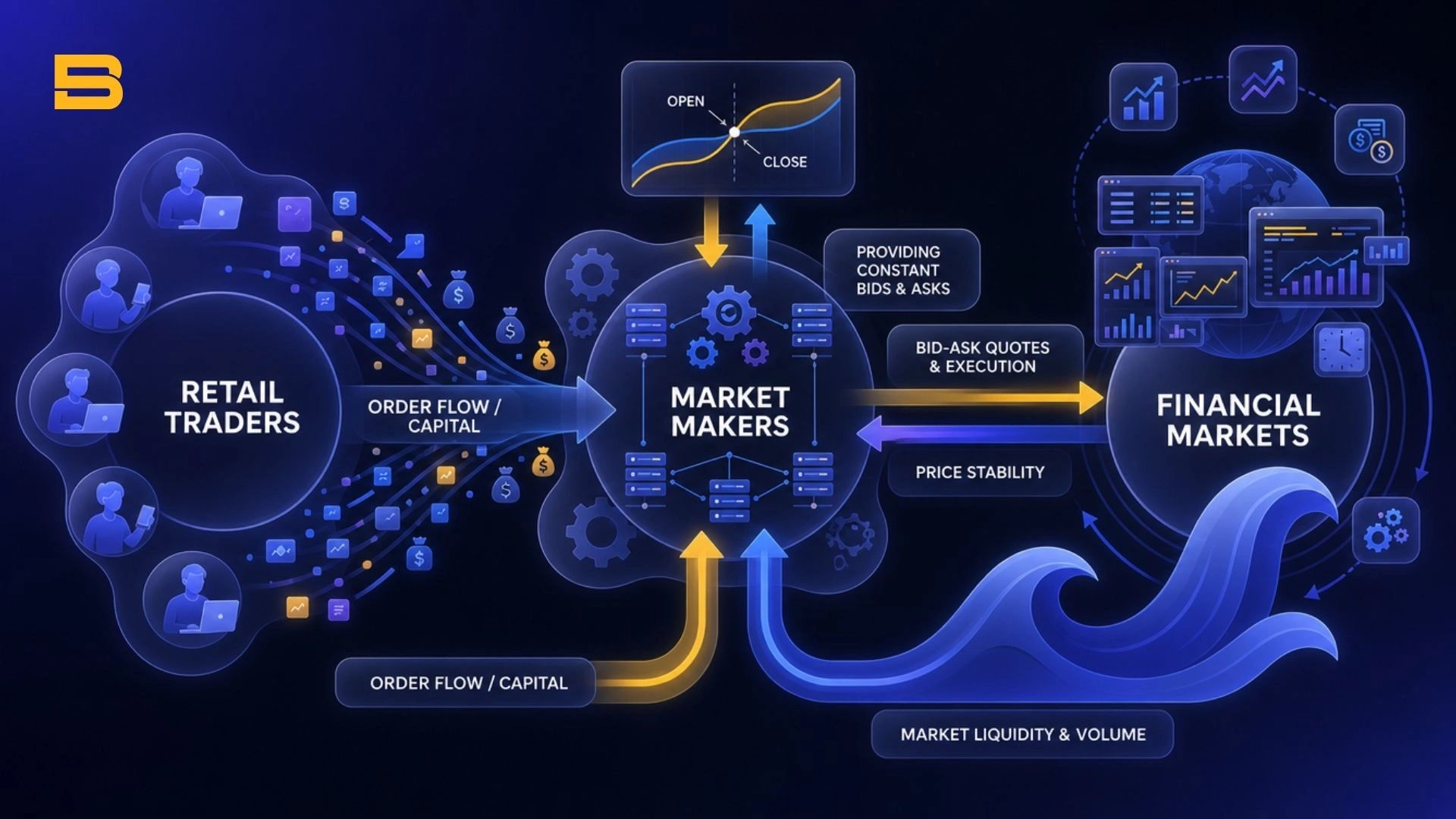
You click the buy button on your trading platform, and the order fills almost instantaneously. You rarely stop to think about who was sitting on the other side of that trade, ready to sell to you at that exact microsecond. In a market with millions of moving parts, the odds of an individual seller waiting for your precise quantity at that exact instant are surprisingly low.
That seamless execution isn't magic—it is the direct result of market makers working behind the scenes. Market makers act as the financial system's central counterparties, continually standing ready to buy and sell assets so the wheels of global trading keep turning smoothly.
What Is a Market Maker and How Does It Work?
A market maker is a financial institution, bank, or brokerage firm that actively quotes both a buy and a sell price for a specific financial asset. By constantly offering to purchase securities from sellers and sell securities to buyers, they inject continuous liquidity into the market.
In traditional order-driven markets, a buyer must wait for a seller to agree on a price. If no seller exists, the buyer is left stranded.
Market makers solve this problem by taking the opposite side of your transaction immediately. When you buy a currency pair or stock, you are often buying directly from the market maker's inventory. When you sell, they absorb those shares or contracts into their portfolio.
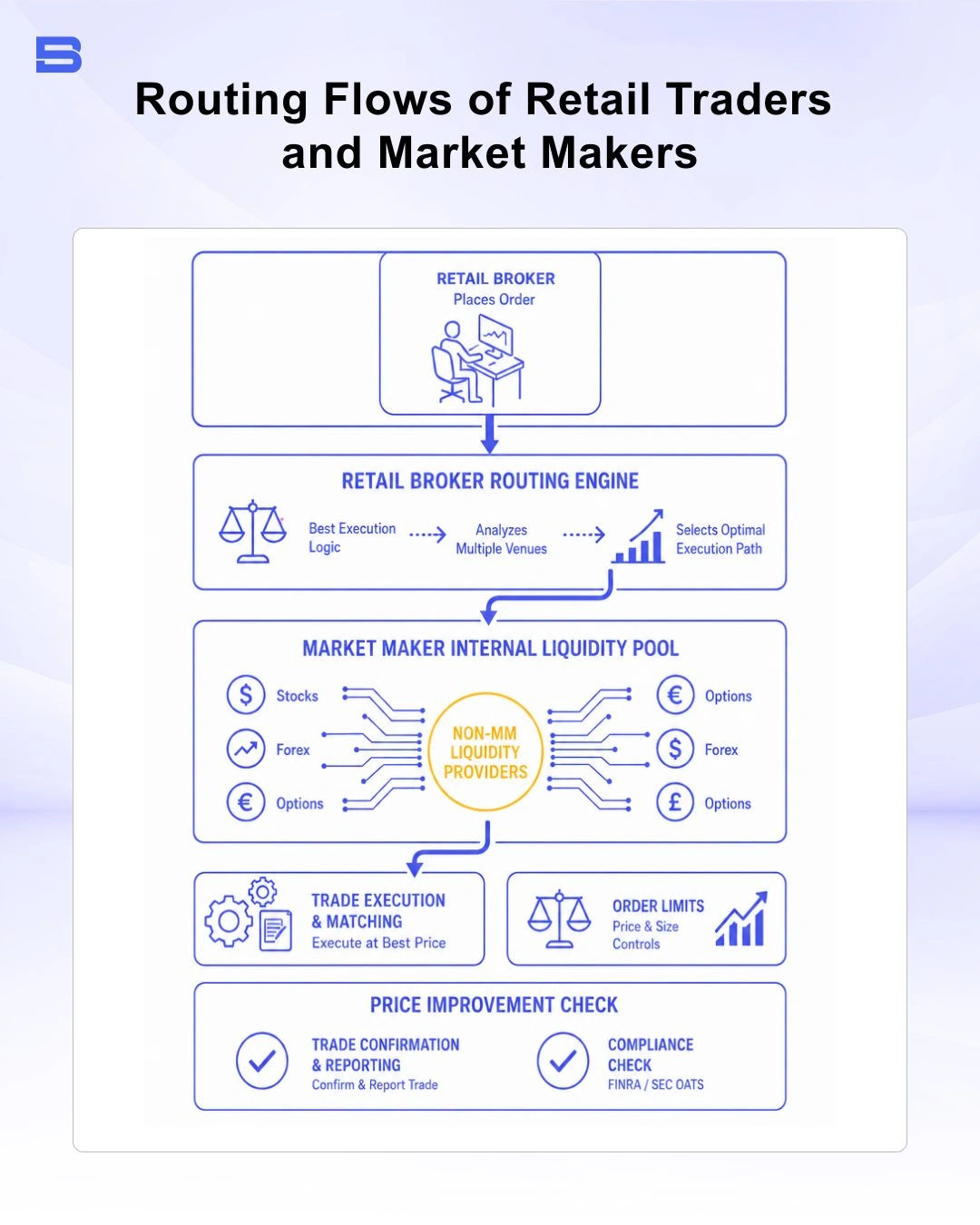
While retail brokers act as agents that route your order to external venues, market maker brokers act as principal traders. They hold inventory, bear the risk of price fluctuations, and ensure that regardless of market conditions, trading volume remains fluid.
How Market Makers Earn Revenue (The Bid-Ask Spread)
Market makers do not typically make money by betting on whether an asset’s price will go up or down. Instead, their primary revenue engine relies on the bid-ask spread—the difference between the price at which they are willing to buy an asset (the bid) and the price at which they are willing to sell it (the ask).
To understand how this operates in practice, consider an active currency market scenario:
- Asset: EUR/USD (Euro and US Dollar)
- Market Maker Bid Price (Buy from you): $1.0850
- Market Maker Ask Price (Sell to you): $1.0852
- The Spread: $0.0002 (two pips — a 'pip' being the smallest standard price increment in forex, typically the fourth decimal place for pairs like EUR/USD)
Imagine two traders execute orders with the market maker at the same moment:
- Trader A buys one standard lot (100,000 units) at the Ask price of $1.0852.
- Trader B sells one standard lot (100,000 units) at the Bid price of $1.0850.
The market maker buys 100,000 units from Trader B for $108,500 and immediately sells 100,000 units to Trader A for $108,520.
Gross Profit = $108,520 − $108,500 = $20
By completing both sides of the transaction, the market maker neutralizes their net position risk while capturing a $20 profit on the spread. When scaled across millions of transactions daily, these small micro-margins aggregate into significant institutional revenue.
Market makers keep markets liquid by matching buy and sell orders, while order books display the available bids and asks that help shape pricing.
Market Makers vs. Liquidity Providers: What Is the Difference?
While the terms are frequently used interchangeably in retail trading forums, market makers and institutional liquidity providers serve distinct operational roles in market architecture.
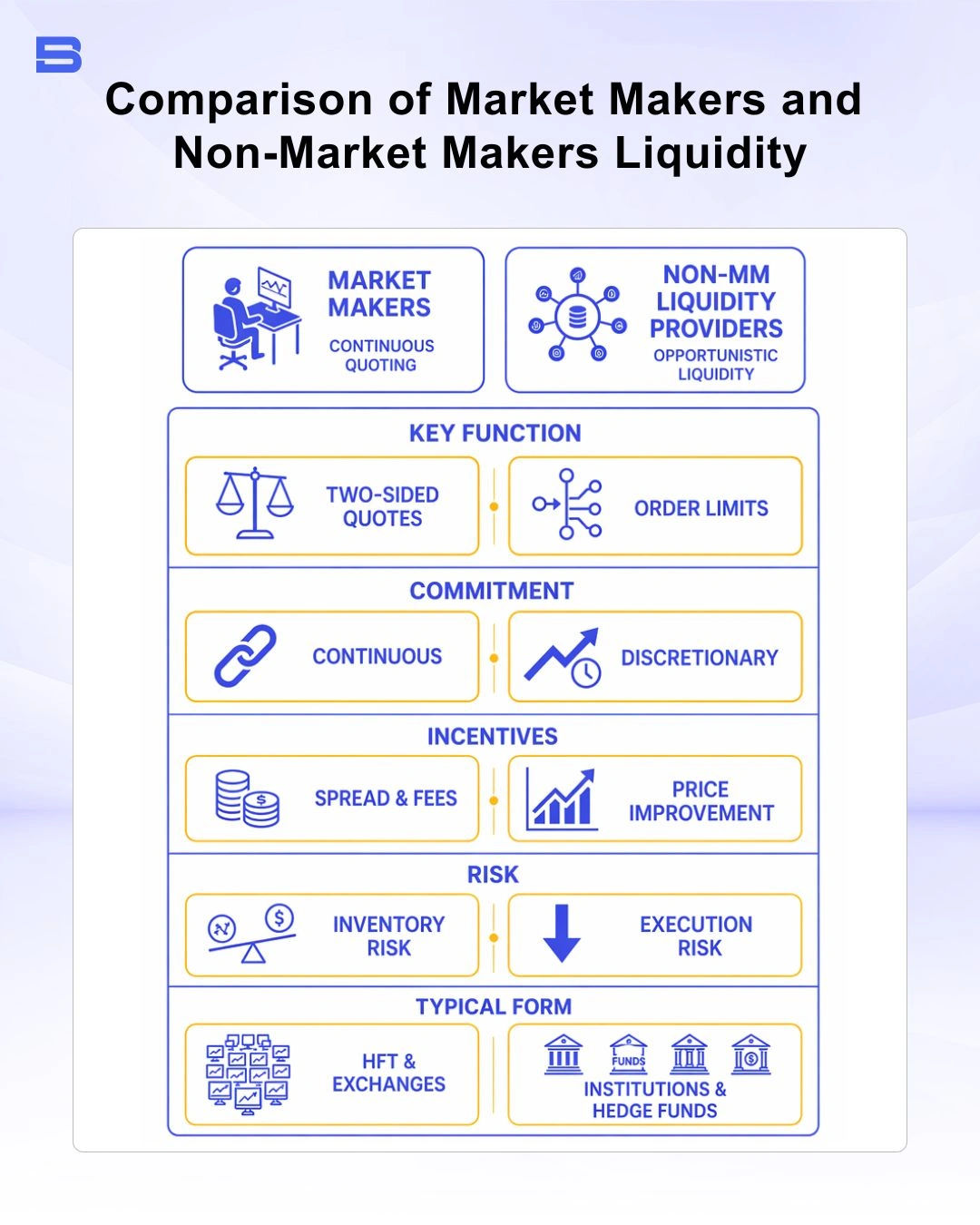
- Market Makers (Primary / Desk Brokers): These entities directly quote two-sided markets, often holding internal dealing desks (B-Book models in forex). They actively manage risk by internalizing customer orders, matching offsetting buyer and seller positions within their own client base before hedging excess exposure in global markets.
- Institutional Liquidity Providers (LPs): These are Tier-1 investment banks such as JPMorgan, Citi, or UBS, or non-bank market makers like Citadel Securities or XTX Markets. They aggregate massive blocks of capital and supply raw price feeds directly to brokers, ECNs (Electronic Communication Networks), and exchanges.
In short, every market maker functions as a liquidity provider, but not every liquidity provider operates as a retail market maker.
Are Market Makers Good or Bad for Retail Traders?
The presence of market makers in financial markets gives rise to a double-edged sword. Understanding both sides helps traders navigate execution choices effectively.
The Advantages
Guaranteed Execution: Market makers ensure that you can enter or exit a trade almost instantaneously, even during periods of low market interest.
Tighter Spreads in Normal Conditions: High competition among market makers forces spreads down on major assets like EUR/USD or S&P 500 index funds, lowering baseline transaction costs.
Price Stability: By absorbing sudden influxes of buying or selling pressure, market makers help smooth out chaotic price gaps during typical trading hours.
The Disadvantages and Risks
Conflict of Interest: In B-Book brokerage models, when you lose money on a trade, the market maker taking the opposite side profits. This structural setup creates an inherent conflict of interest.
Slippage and Spread Widening: During major economic announcements or black swan events, market makers may widen spreads drastically or delay execution to protect their own balance sheets from toxic order flow.
Myth vs. Reality of "Stop-Loss Hunting": Traders often blame market makers for artificially moving prices to hit stop-loss clusters. While predatory practices existed historically in unregulated environments, many market analysts attribute most modern price spikes near stop levels to collective market liquidity pools drying up rather than individual broker manipulation.
For retail participants, using regulated brokers that utilize top-tier liquidity providers and offer transparent execution practices can generally help reduce, though not eliminate, potential operational risks — the right approach still depends on each trader's own situation and risk tolerance.
The Bottom Line
Market makers form the backbone of modern financial infrastructure. Without their continuous presence and willingness to absorb inventory risk, global markets would suffer from severe illiquidity, wider transaction costs, and frequent order execution delays.
By understanding how market makers operate—and how they profit from the bid-ask spread—you can evaluate your broker’s execution model, structure your risk management better, and make more informed decisions when placing trades in any market environment.
Disclaimer: The content on this page is intended for educational and informational purposes only. It does not constitute financial, investment, tax, or legal advice, and should not be interpreted as a recommendation to buy, sell, or hold any financial instrument or asset. Trading and investing involve significant risk, including the possible loss of your entire capital. Products such as forex, CFDs, and cryptocurrencies carry additional risks due to leverage, high volatility, and limited regulatory protection in some jurisdictions. Past performance of any financial instrument does not guarantee future results. Any market views, forecasts, or opinions expressed are those of the author at the time of writing and may not reflect current market conditions. Platform features, fees, and regulatory status are subject to change — always verify information directly with the relevant provider or regulator before making any financial decision. BrokerSpecs may receive compensation from third parties featured on this site. Always conduct your own due diligence and consider seeking advice from a licensed financial professional before investing.