


- What Is Trading and How Does Trading Work?
- Trading Fundamentals: A Guide for Beginners
- Trading vs. Investing: What Are the Key Differences?
- Trading Terms and Terminologies Every Beginner Should Know
- Common Trading Mistakes Beginners Make and How to Avoid
- Understanding Risk and Reward in Trading: A Complete Guide
- Guide to the Different Types of Financial Markets
- Investment Basics: Definition, Strategies, and How to Invest
- Benefits of Investing: Financial Growth and Security
- What Is Swing Trading? A Practical Guide For Beginners
- What Is Spot Trading? A Guide for Beginners
- What Are Futures in Trading? A Guide for Beginners
- Understanding Bull Markets: Growth & Strategy
- How to Read a Candlestick Chart: A Guide for Beginners
- Is Trading Gambling? The Truth About Risk
- Pip in Forex: How It Works & How to Calculate It
- What Is the Bid-Ask Spread in Trading? A Guide for Beginners
- What Is a Margin Call? A Guide for Beginners
- Market Volatility Explained: What It Is and How to Trade It
- Drawdown in Trading: Meaning, Math, and Risk
- Understanding Slippage in Trading: Causes and Control
- Forex Lot Size Explained: Standard, Mini & Micro
- Trailing Stop vs Stop Loss: Essential Risk Strategy
- How Asset Allocation Works: Strategies Explained
- Understanding Market Trading Hours & Sessions
- Market Makers Explained: A Trader's Guide
- Portfolio Diversification: A Strategy Guide
- Capital Gains Explained: How Investment Taxes Work
- Stock Market Circuit Breakers: How Trading Halts Work
- What Is an IPO? How Initial Public Offerings Work
- What Is a Secondary Market? A Complete Guide
- What Is a Stock Exchange? Functions and Overview Explained
- Understanding Ticker Symbols: A Market Guide
- How Clearing Houses Work in Financial Markets
- Stock Market After Labor Day: Trends and What To Expect
Imagine executing a multi-million-dollar trade across the world with a counterparty whose name, balance sheet, and financial stability are completely unknown to you. You push a button, the trade fills instantly, and you move on to your next setup. You do not spend the afternoon stressing over whether that unknown trader across the screen will actually hand over the cash or deliver the asset when payment comes due.
This silent confidence is not built on mutual trust between individual traders. It rests entirely on an unseen pillar of the global financial system: the central clearing house.
1. What Is a Clearing House and Why Does It Exist?
At its core, a clearing house—often referred to as a Central Counterparty (CCP)—is an intermediary that stands between buyers and sellers in financial markets. Its fundamental mission is simple: to ensure that every participant fulfills their trade obligations, regardless of market volatility or market participant defaults.
Without a central entity absorbing market risk, financial networks would rely on bilateral clearing. In a bilateral market, if Firm A trades directly with Firm B, Firm A absorbs the full financial impact if Firm B goes bankrupt before settling the transaction. Multiply that by millions of trades per day, and a single corporate failure can create a catastrophic systemic chain reaction.
To eliminate counterparty risk, central clearing houses utilize a legal process known as novation. The moment a trade is executed on an exchange, the original contract between the buyer and seller is legally canceled. The clearing house steps in to substitute two new contracts:
- The clearing house becomes the buyer for the original seller.
- The clearing house becomes the seller to the original buyer.
By placing itself in the middle of every cleared transaction, the clearing house guarantees performance. If a seller fails to deliver the underlying asset or a buyer fails to provide cash, the clearing house absorbs the immediate failure and uses its financial safeguards to complete the trade smoothly. For traders, this infrastructure turns credit risk into standard operational certainty.
2. How the Clearing Process Works (Step-by-Step)
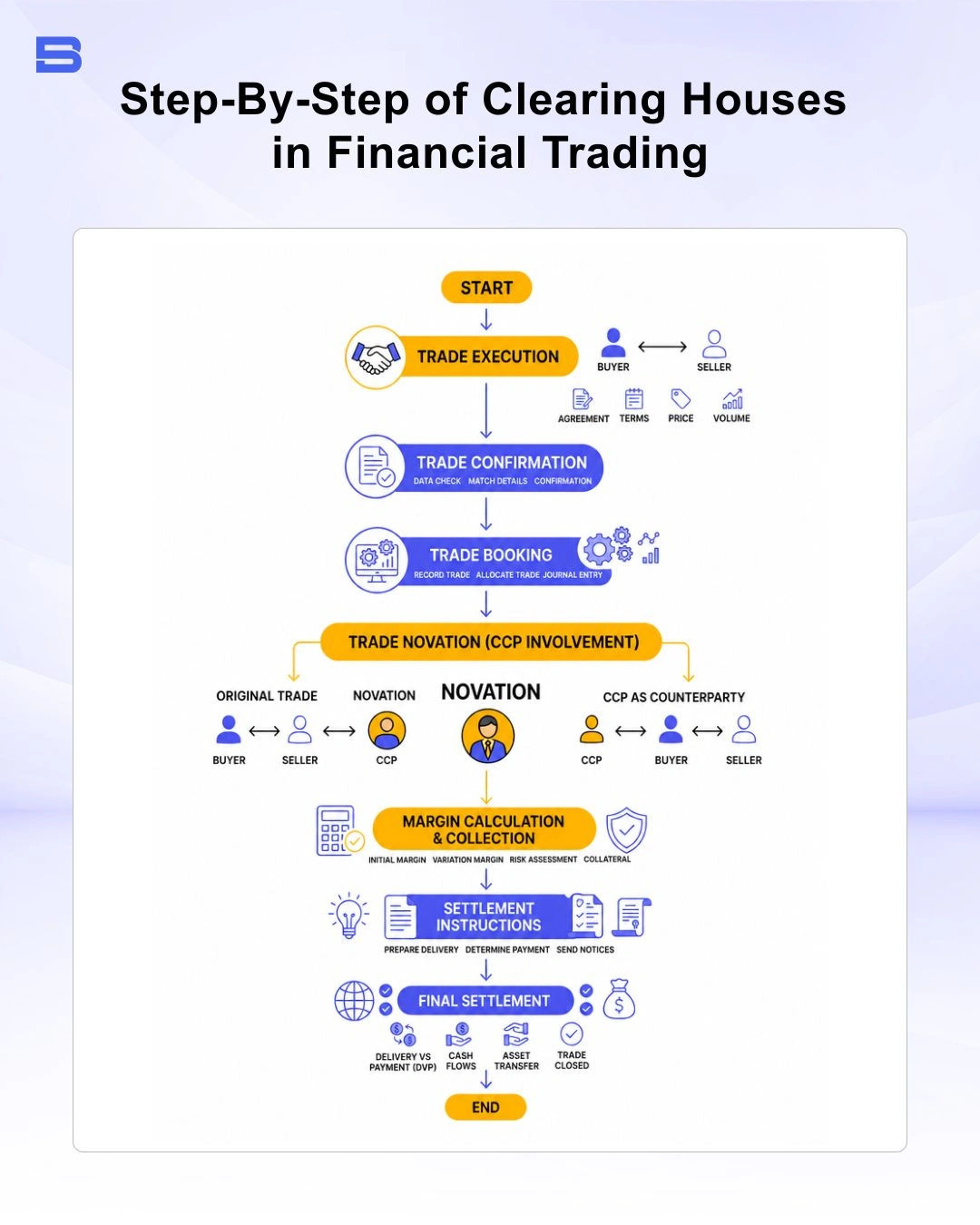
The journey of a transaction from execution to final settlement involves precise, real-time coordination between exchanges, clearing members, and the clearing house itself.
Step 1: Trade Matching & Confirmation
The process begins on the exchange floor or electronic matching engine. The buyer's broker and the seller's broker submit matching orders. Once the exchange verifies that prices, quantities, and asset specifications match perfectly, trade details are transmitted electronically to the clearing house.
Step 2: Novation
Upon receiving the trade details, the clearing house performs novation. The original counterparty connection is cut, and it becomes the central legal counterparty to both sides of the transaction.
Step 3: Margin Calculation & Collateral Collection
To protect the ecosystem against default risk, the clearing house calculates precise collateral requirements. Both participating sides must post initial margin before entering the trade. Throughout the trading day, positions are revalued using live market data (mark-to-market). If a position moves into a loss, it will collect variation margin to cover real-time open losses.
Step 4: Settlement & Netting
At the end of the settlement cycle (such as T+1 or real-time settlement depending on the market), the CCP oversees the final transfer of cash and assets. To maximize efficiency, clearing houses utilize multilateral netting—consolidating thousands of individual transactions into a single net cash or asset movement for each participant.
Understanding this chain gives you clarity on why market orders clear seamlessly. The underlying infrastructure continuously manages default risk so that price execution remains your primary concern.
3. Real-World Scenario: Risk Mitigation in Action
To understand how a clearing firm and central counterparty manage risk during extreme market moves, let us walk through a practical scenario involving derivative clearing.
The Setup
Suppose Trader A purchases 10 CME WTI Crude Oil futures contracts (1,000 barrels per contract) at $70.00 per barrel through Clearing Firm X. Simultaneously, Trader B sells 10 contracts at $70.00 through Clearing Firm Y.
- Contract Size: 1,000 barrels
- Number of Contracts: 10
- Total Notional Value: 10 × 1,000 × $70.00 = $700,000
- Initial Margin (10%): $70,000 per trader
The Calculation
Overnight, a geopolitical disruption occurs, causing the price of Crude Oil to plunge suddenly to $63.00 per barrel.
- Trader A's Position Value: 10 x 1000 x $63.00 = $630,000
- Price Change: $63.00 − $70.00 = −$7.00 per barrel
- Trader A's Unrealized Loss: 10 × 1,000 × ($70.00 − $63.00) = −$70,000
- Trader B's Unrealized Gain: +$70,000
Trader A's $70,000 initial margin is completely exhausted by the overnight loss.
- Initial Margin: $70,000
- Overnight Mark-to-Market Loss: −$70,000
- Remaining Margin Balance: $0
- Variation Margin Call: +$70,000 (required to keep the position open)
The Result & Risk Waterfall
The CCP marks both accounts to market automatically:
- Variation Margin Call: The clearing house demands an immediate $70,000 variation margin payment from Clearing Firm X (representing Trader A) to cover the daily mark-to-market loss
- Trader B Paid: The clearing house transfers that $70,000 directly to Clearing Firm Y (for Trader B), allowing Trader B to realize their profit immediately without waiting for the contract to expire.
If Trader A defaults and cannot meet the variation margin call, Clearing Firm X must cover the loss using its corporate balance sheet. If Clearing Firm X defaults, the clearing house deploys its structured loss waterfall:
- Defaulting member's margin and collateral.
- Defaulting member's clearing fund contributions.
- The clearing house's dedicated equity ("skin in the game").
- Non-defaulting clearing members' mutualized clearing fund resources.
Because of this pre-funded waterfall structure, market participants continue trading safely even when major individual firms experience sudden defaults.
4. Direct Clearing vs. Clearing Firms: Where Do Retail Traders Fit In?
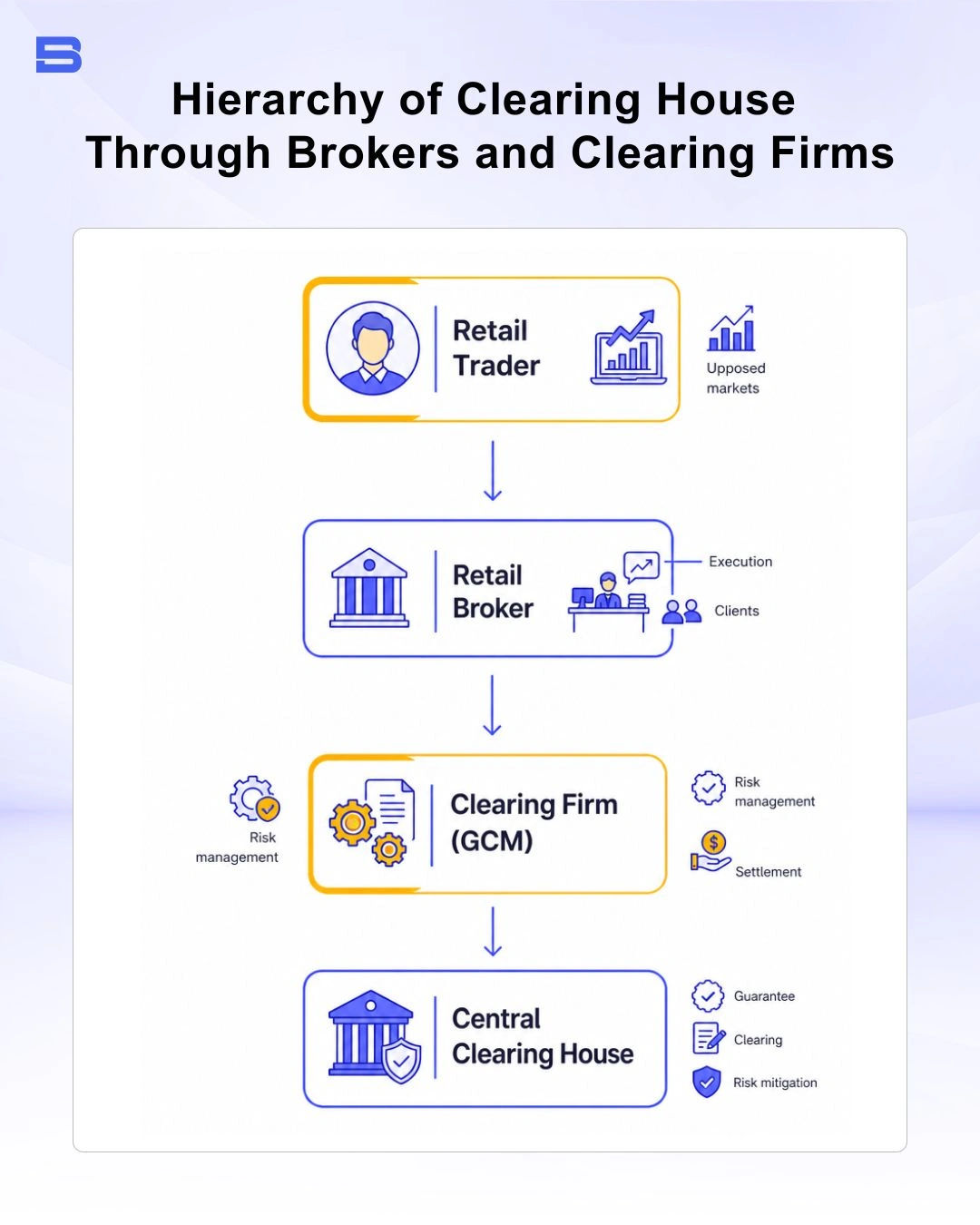
Retail traders do not interface directly with central clearing houses. Becoming a direct member of an entity like the Options Clearing Corporation (OCC) or Chicago Mercantile Exchange (CME) clearing requires tens of millions of dollars in capital reserves and rigorous regulatory oversight.
Instead, the market operates on a tiered structure.
General Clearing Members (GCMs) vs. Individual Clearing Members (ICMs)
- General Clearing Members (GCMs): Large institutional banks and specialized clearing firms that clear transactions for their own accounts, for other non-clearing brokers, and for institutional clients.
- Individual Clearing Members (ICMs): Firms that hold clearing privileges strictly for their own proprietary trading operations.
How Retail Brokers Interface with Clearing Firms
When you open an account with a retail broker, that broker usually operates under one of two arrangements:
- Clearing Broker-Dealer: The broker is large enough to maintain a general clearing membership directly with market clearing houses. They manage trade execution, clearing, custody of client funds, and regulatory reporting in-house.
- Introducing Broker (IB): The broker focuses purely on trade execution and platform interface. They partner with an omnibus or fully disclosed carrying clearing firm to clear trades, maintain customer funds, and process margin requirements on their behalf.
For retail investors, knowing your broker's clearing arrangement matters. Regulated clearing firms are legally mandated to keep client funds segregated from operating accounts. Should your retail broker face financial distress, your assets held at the clearing firm level remain protected and segregated from broker claims.
Final Thoughts
A clearing house is a cornerstone of modern financial markets, helping trades settle safely and efficiently while protecting participants from counterparty risk. Together with safeguards such as circuit breakers, it strengthens confidence in the secondary market and helps maintain orderly trading during periods of heightened volatility.
As a trader, understanding how your orders pass through clearing firms and CCPs provides a clearer view of market mechanics—reassuring you that when your trade executes, your capital is backed by decades of battle-tested financial architecture.
Disclaimer: The content on this page is intended for educational and informational purposes only. It does not constitute financial, investment, tax, or legal advice, and should not be interpreted as a recommendation to buy, sell, or hold any financial instrument or asset. Trading and investing involve significant risk, including the possible loss of your entire capital. Products such as forex, CFDs, and cryptocurrencies carry additional risks due to leverage, high volatility, and limited regulatory protection in some jurisdictions. Past performance of any financial instrument does not guarantee future results. Any market views, forecasts, or opinions expressed are those of the author at the time of writing and may not reflect current market conditions. Platform features, fees, and regulatory status are subject to change — always verify information directly with the relevant provider or regulator before making any financial decision. BrokerSpecs may receive compensation from third parties featured on this site. Always conduct your own due diligence and consider seeking advice from a licensed financial professional before investing.