


- What Is Trading and How Does Trading Work?
- Trading Fundamentals: A Guide for Beginners
- Trading vs. Investing: What Are the Key Differences?
- Trading Terms and Terminologies Every Beginner Should Know
- Common Trading Mistakes Beginners Make and How to Avoid
- Understanding Risk and Reward in Trading: A Complete Guide
- Guide to the Different Types of Financial Markets
- Investment Basics: Definition, Strategies, and How to Invest
- Benefits of Investing: Financial Growth and Security
- What Is Swing Trading? A Practical Guide For Beginners
- What Is Spot Trading? A Guide for Beginners
- What Are Futures in Trading? A Guide for Beginners
- Understanding Bull Markets: Growth & Strategy
- How to Read a Candlestick Chart: A Guide for Beginners
- Is Trading Gambling? The Truth About Risk
- Pip in Forex: How It Works & How to Calculate It
- What Is the Bid-Ask Spread in Trading? A Guide for Beginners
- What Is a Margin Call? A Guide for Beginners
- Market Volatility Explained: What It Is and How to Trade It
- Drawdown in Trading: Meaning, Math, and Risk
- Understanding Slippage in Trading: Causes and Control
- Forex Lot Size Explained: Standard, Mini & Micro
- Trailing Stop vs Stop Loss: Essential Risk Strategy
- How Asset Allocation Works: Strategies Explained
- Understanding Market Trading Hours & Sessions
- Market Makers Explained: A Trader's Guide
- Portfolio Diversification: A Strategy Guide
- Capital Gains Explained: How Investment Taxes Work
- Stock Market Circuit Breakers: How Trading Halts Work
- What Is an IPO? How Initial Public Offerings Work
- What Is a Secondary Market? A Complete Guide
- What Is a Stock Exchange? Functions and Overview Explained
- Understanding Ticker Symbols: A Market Guide
- How Clearing Houses Work in Financial Markets
- Stock Market After Labor Day: Trends and What To Expect
You open a position, watch the chart move steadily in your direction, and feel that familiar surge of satisfaction. Your trade is deep in profit. But then a sudden market reversal wipes out your gains before you can manually close the order—turning what should have been a winning trade into a frustrating loss.
Managing exits in volatile markets is one of the hardest emotional challenges in trading. Set a fixed target, and you might exit too early, leaving substantial gains on the table. Leave the trade open, and you risk watching your profits evaporate. A trailing stop solves this dilemma by automatically adjusting as the market moves in your favor, helping you capture upside while protecting your accrued gains.
What Is a Trailing Stop and How Does It Work?
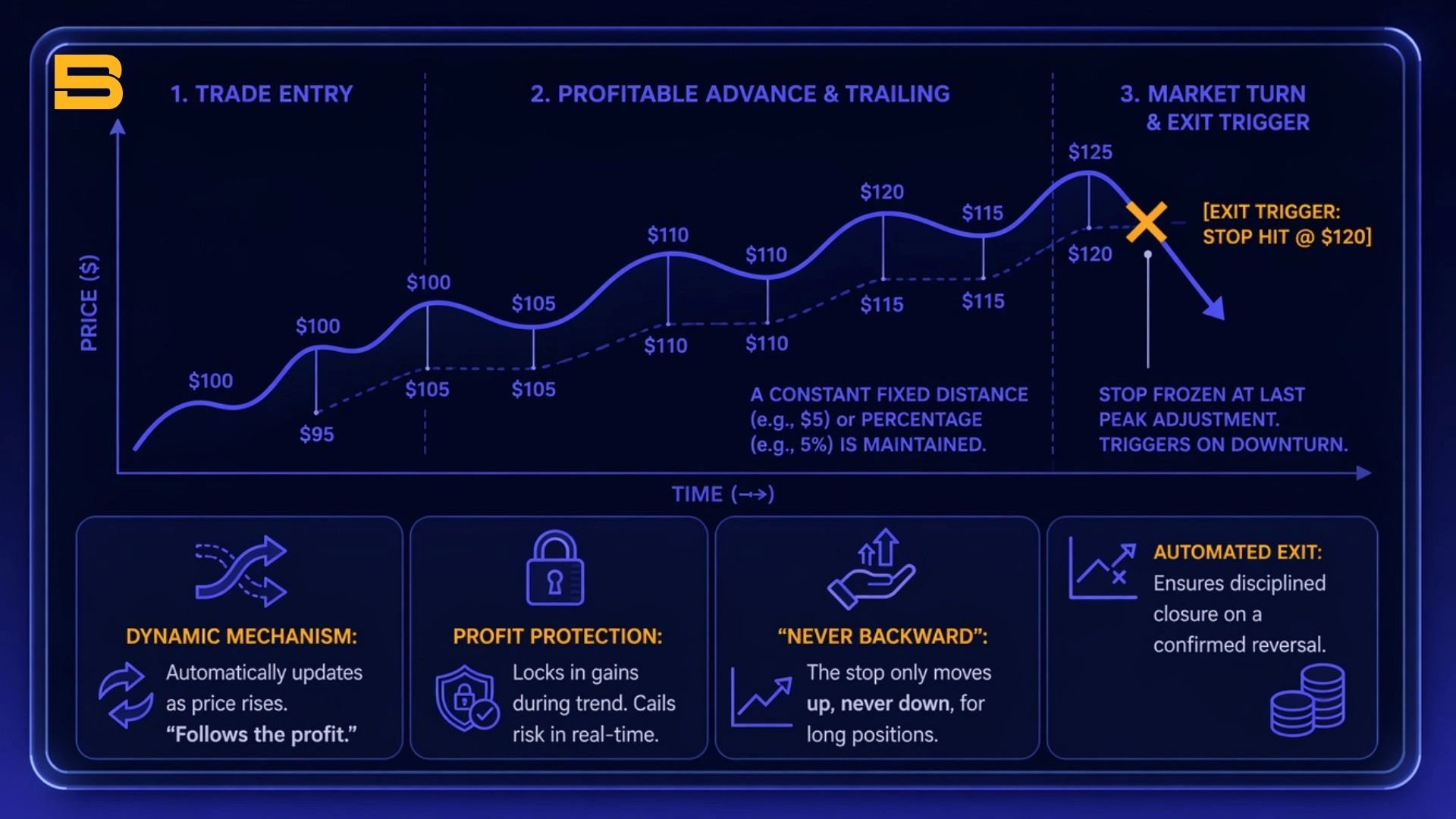
A trailing stop is a dynamic variation of the standard stop-loss order designed to protect profits while keeping a trade open as long as the price moves in a favorable direction. It also offers a flexible alternative to a fixed stop-loss and take-profit strategy.
Unlike a traditional fixed stop loss, which remains stationary at the exact price level you select, a trailing stop automatically resets its position higher (for long trades) or lower (for short trades) as the market advances.
The key feature of a trailing stop loss is that it only moves in one direction: toward profit. If the market swings in your favor, the stop trails behind at a predetermined distance—set as a fixed dollar amount, a specific percentage, or a pips/points value. However, if the market reverses and moves against your position, the trailing stop remains frozen at its highest (or lowest) achieved level.
If the price pulls back and hits that locked-in level, your position closes automatically. This dynamic mechanism allows you to lock in profit without requiring constant manual adjustment, removing emotional bias from your trade management.
Trailing Stop vs Stop Loss: Key Differences
While both order types serve as critical risk-management tools, they function differently in active market environments. Before setting one up, keep in mind: a trailing stop doesn't eliminate risk. It can still be triggered by normal market noise if set too tight, may not track properly if your platform disconnects, and — like any stop order — can suffer slippage in fast-moving markets.
A traditional stop loss is static. When placed, it stays fixed at its initial entry level regardless of how far the price moves in your favor. Its primary role is capital preservation—limiting the maximum amount you can lose if the trade fails immediately.
Conversely, a trailing stop loss is dynamic. It fulfills the double duty of protecting initial capital while acting as a profit-locking tool as the market trends.
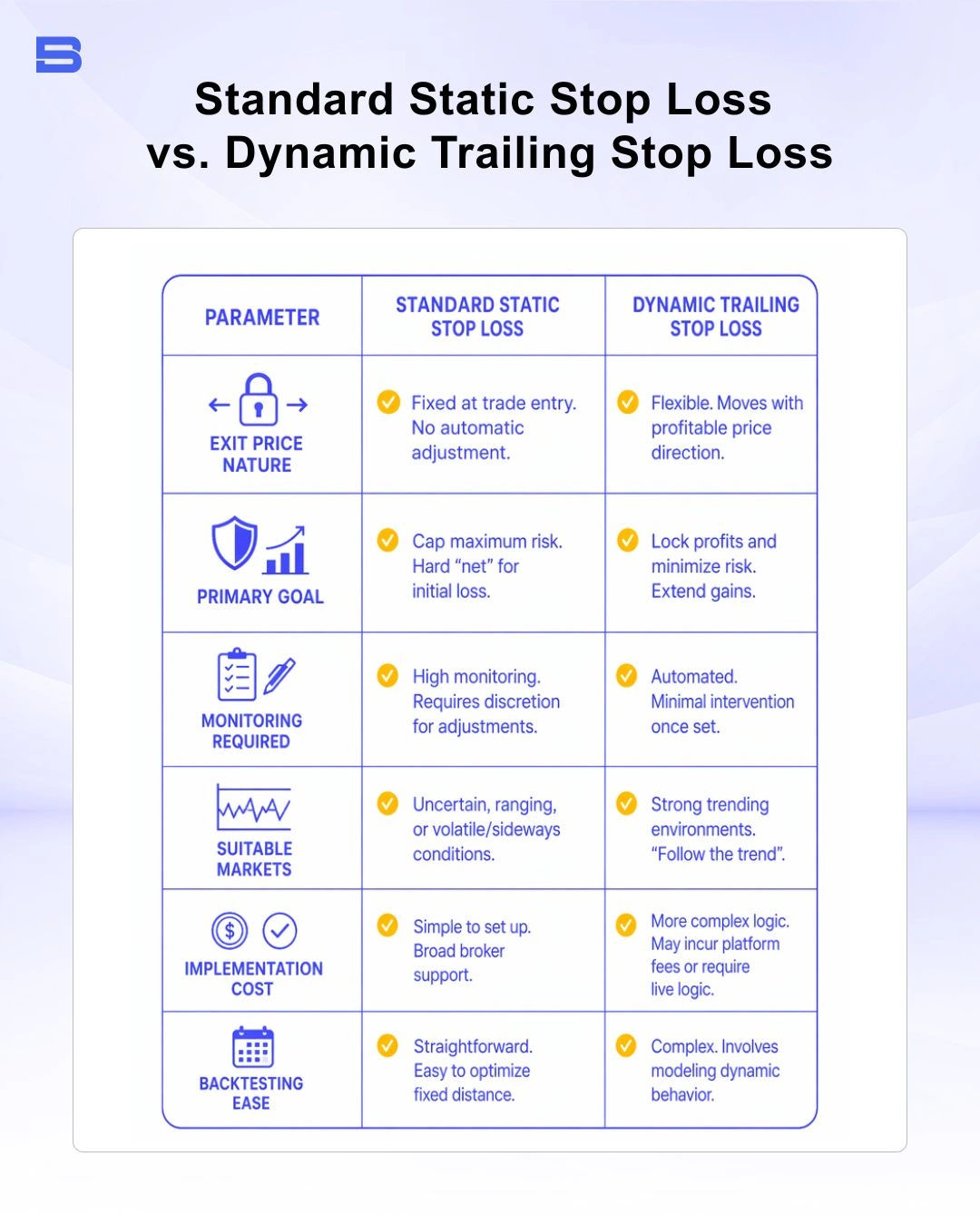
- Static Stop Loss: Remains fixed at the set target; best for range-bound markets or strict risk-to-reward targets.
- Trailing Stop Loss: Moves dynamically as profits grow; best for capturing sustained trends while securing accrued gains.
Understanding this distinction enables you to deploy the right exit strategy depending on whether the market is trending smoothly or consolidating in a tight range.
How to Set a Trailing Stop Step-by-Step
Setting up a trailing stop requires deciding on the appropriate distance or parameter to maintain between the current price and your exit order.
1. Fixed Distance (Points or Pips)
In forex trailing stop strategies or index trading, you can set the stop at a fixed distance—such as 20 pips or 50 points—behind the market price. For instance, if you buy EUR/USD at 1.0800 with a 30-pip trailing stop, your exit sits at 1.0770. If EUR/USD rises to 1.0850, the stop automatically moves up to 1.0820.
2. Percentage Distance
Common in equity and cryptocurrency trading, percentage trailing stops trail the asset's peak price by a specified percentage (e.g., 5%). If a stock climbs from $100 to $150, a 5% trailing stop moves from $95 up to $142.50.
3. Technical Indicator-Based Distance
Traders frequently use technical indicators like the Average True Range (ATR) or moving averages to establish dynamic stop levels based on current market volatility. Using 2x ATR ensures your trailing stop expands during high volatility and contracts when markets quiet down, reducing premature exits caused by routine market noise.
Worked Example: Real-World Trailing Stop Trade
To see how a dynamic stop loss operates in practice, consider a long trade on a volatile equity index stock.
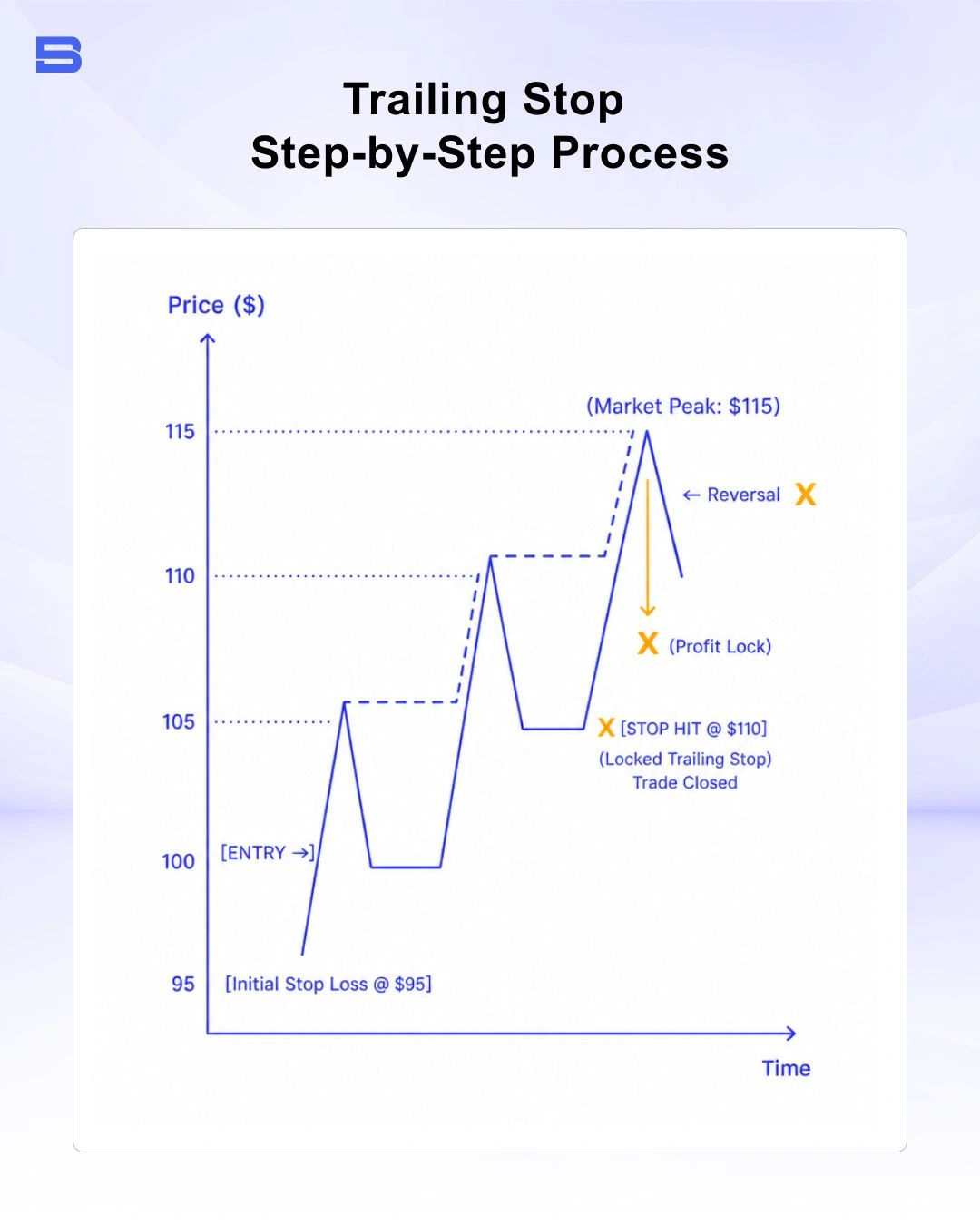
- Trade Setup: You buy 100 shares of Company XYZ at $100 per share.
- Initial Risk: You configure a 5% trailing stop, placing your initial stop loss at $95 ($100 - 5%).
- Price Movement (Phase 1): The stock rises steadily to $110. Your trailing stop automatically adjusts upward to $104.50 ($110 - 5%). Your trailing stop has now moved up to $104.50, which means that if the stop is triggered from here, your position would close with a profit of at least $4.50 per share — though the exact fill price can still vary slightly due to slippage.
- Price Movement (Phase 2): The stock surges further to a peak of $120. The trailing stop automatically adjusts higher to $114.00 ($120 - 5%).
- Market Reversal: A sudden negative news catalyst hits the market, and the stock price drops sharply from $120 to $112.
The Result:
As the price falls through $114.00, your trailing stop triggers, automatically closing your position at $114.
- Final Profit: $14.00 per share ($1,400 total gain).
- Takeaway: Even though you did not sell at the absolute top of $120, you protected $14 of gain from the initial $100 entry price—completely avoiding the fall back toward your original purchase price.
Common Pitfalls and How to Avoid Them
While dynamic stop losses are powerful, improper execution can limit their effectiveness.
Setting the Stop Too Tight
A primary mistake made by beginners is setting the trailing stop distance too close to the entry price. Normal market noise and minor pullbacks will easily trigger a tight stop, kicking you out of a profitable trend prematurely before the primary movement continues.
Platform Disconnections
Depending on your broker and platform such as MetaTrader 4/5, local trailing stops may require your trading software to remain running and connected to the server. If your platform closes or loses internet connection, a client-side trailing stop may cease tracking. Always verify whether your broker handles trailing stops on the server side or client side, or consider using a VPS (Virtual Private Server) for continuous operation.
Slippage During Extreme Volatility
A trailing stop converts into a market order once triggered. During sudden market gaps or liquidity shortages, your final execution price may suffer from slippage, filling slightly lower than your exact stop trigger level.
The Bottom Line
A trailing stop loss bridges the gap between protecting capital and allowing winning trades room to run. By replacing guesswork with an automated rule, it helps remove the hesitation and emotion that often undermine trade execution. Whether you are navigating dynamic forex markets or riding extended equity trends, integrating trailing stops into your strategy gives you a systematic way to safeguard gains while staying aligned with the market's direction.
Disclaimer: The content on this page is intended for educational and informational purposes only. It does not constitute financial, investment, tax, or legal advice, and should not be interpreted as a recommendation to buy, sell, or hold any financial instrument or asset. Trading and investing involve significant risk, including the possible loss of your entire capital. Products such as forex, CFDs, and cryptocurrencies carry additional risks due to leverage, high volatility, and limited regulatory protection in some jurisdictions. Past performance of any financial instrument does not guarantee future results. Any market views, forecasts, or opinions expressed are those of the author at the time of writing and may not reflect current market conditions. Platform features, fees, and regulatory status are subject to change — always verify information directly with the relevant provider or regulator before making any financial decision. BrokerSpecs may receive compensation from third parties featured on this site. Always conduct your own due diligence and consider seeking advice from a licensed financial professional before investing.