



Related Tags
Imagine checking your brokerage app and seeing a notice that a company you own just spent millions buying back its own stock. Instead of building a new factory or paying out cash to shareholders, management chose to repurchase shares directly from the market. Those repurchased shares are held by the company, and understanding how they work helps you judge whether a buyback actually strengthens your investment.
Treasury Shares Meaning: How Reacquired Stock Works
Treasury shares are a company's own previously issued shares that it has repurchased from the open market and holds in its corporate treasury. If you have ever searched for "what is treasury shares," the short answer is that they are repurchased stock the company holds instead of canceling. Rather than disappearing immediately, these shares sit in a dormant state under the company's control.
To see where they fit, it helps to separate a company's share count into three layers. Authorized shares represent the maximum number of shares a company can legally create under its corporate charter, while issued shares are the total shares ever sold or distributed to investors. Outstanding shares equal issued shares minus the shares the company has repurchased, meaning only the shares currently held by outside investors count toward active market ownership.
On a balance sheet, treasury stock is recorded as a contra-equity account (an account that reduces total equity) rather than a corporate asset under standard accounting rules. Because a company cannot own itself or profit from trading its own stock, the cost of repurchased shares is deducted directly from total shareholders' equity. This reduction lowers the company's net equity base and affects its overall market cap calculation, which only multiplies the current share price by active outstanding shares.
Treasury Shares Meaning: Retirement, Dividends, and Voting Rights
Treasury Shares vs Retired Shares: What Is the Difference?
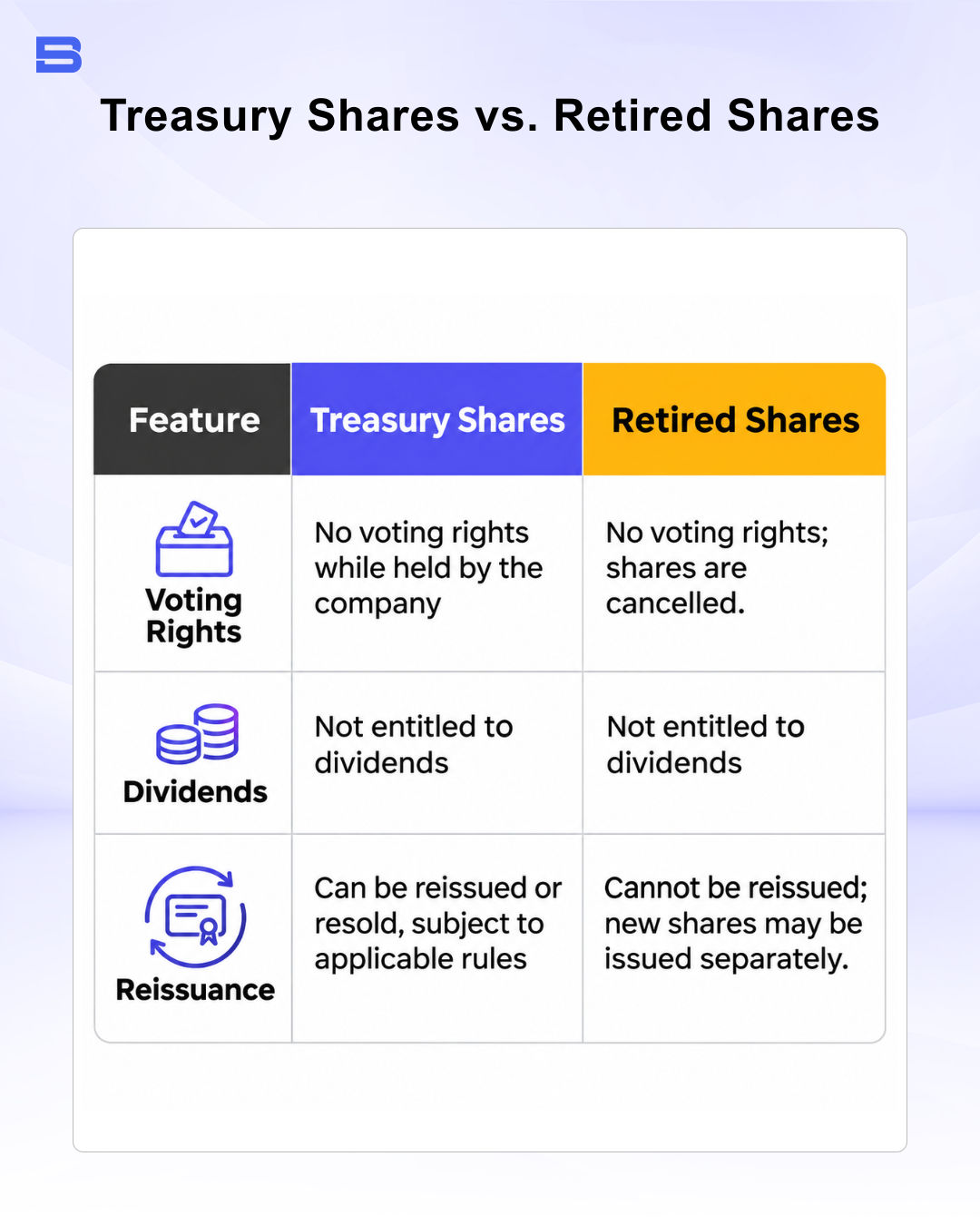
When a company buys back stock, management must decide whether to keep those shares in treasury or permanently cancel them. Shares kept in treasury remain legally issued and can be reissued later if the company needs shares for employee compensation or acquisitions. Retired shares, by contrast, are permanently canceled and removed from the issued share count, so the company cannot reissue those specific shares later.
Do Treasury Shares Receive Dividends or Voting Rights?
No, treasury shares do not receive dividends, carry voting rights, or hold any claim on assets if a company liquidates. Because the company itself holds these shares, paying a dividend to its own treasury would simply move cash from one corporate pocket to another.
For active shareholders, this suspension of rights has practical effects around corporate payouts. When a board declares a cash distribution and sets an ex-dividend date, the total payout pool is divided only among outside investors holding outstanding shares. Similarly, these shares cannot participate in a dividend reinvestment plan, nor can they be used by management to sway shareholder votes during annual general meetings.
How Treasury Shares Affect EPS, Share Count, and Ownership
Because the repurchased shares are excluded from the outstanding share count, a share buyback changes key per-share financial ratios even if the underlying business earns the exact same profit. Walking through a simple example shows how the math works in practice.
Suppose a Bursa-listed company generates RM10 million in annual net profit and has 10 million outstanding shares, giving it an earnings per share (EPS) of RM1.00. If you own 10,000 shares, your stake equals 0.10% of the company.
Now imagine the company uses excess cash to buy back 1 million shares and holds them in treasury, reducing the outstanding share count to 9 million. Even if net profit stays flat at RM10 million, EPS climbs by 11.1% to RM1.11 per share because the same profit is spread across fewer shares. At the same time, your 10,000 shares now represent 0.111% ownership of the company without you spending an extra ringgit.
This dynamic works in the opposite direction of corporate actions that expand the share base. Unlike a bonus issue, which distributes free new shares to existing investors and lowers the share price proportionally, a buyback shrinks the active float and concentrates each remaining share's claim on future earnings.
Why Companies Hold Treasury Shares and Key Share Buyback Risks
Companies repurchase and hold their own shares for several strategic reasons. Management often uses treasury stock to fulfill employee stock option plans without diluting existing shareholders through brand-new share issuance, or uses the shares as currency to help fund acquisitions.
Buybacks can also signal that leadership believes the stock is undervalued, and they offer a flexible way to return surplus cash. Capital-raising moves do the opposite by bringing in new money, such as a rights issue (new shares offered to existing shareholders) or a private placement (new shares sold to selected investors).
However, share buybacks carry real financial risks that everyday investors should weigh just as carefully as the potential upside. If a company borrows heavily to fund repurchases, higher debt levels and interest expenses can strain cash flow when business conditions slow down. Some management teams may buy back stock aggressively when profits and share prices are near cyclical peaks, which can destroy value if the stock later falls.
Investors should also watch for artificial EPS growth, where a shrinking share count makes earnings per share look healthier even though revenue and operating profit are stagnating. Because shares held in treasury are not permanently canceled, management can also reissue them later, which reintroduces dilution down the road.
Stock exchanges and regulators place clear boundaries on how companies execute these programs. On Bursa Malaysia, Main Market Listing Requirements cap the total shares a listed company may purchase or hold in treasury at 10% of its total issued shares. In the United States, U.S. Securities and Exchange Commission (SEC) Rule 10b-18 sets safe-harbor conditions governing the timing, price, and daily volume of corporate share repurchases.
A Buyback Is Only as Good as Its Price and Funding
Treasury shares shrink a company's active share count, concentrating earnings and ownership for remaining shareholders while giving management flexibility for future corporate needs. Before treating a buyback announcement as automatic good news, always check whether the company is paying a reasonable valuation and funding the purchases from healthy cash flow rather than debt.
- What Is Trading and How Does Trading Work?
- Trading Fundamentals: A Guide for Beginners
- Trading vs. Investing: What Are the Key Differences?
- Trading Terms and Terminologies Every Beginner Should Know
- Common Trading Mistakes Beginners Make and How to Avoid
- Understanding Risk and Reward in Trading: A Complete Guide
- Guide to the Different Types of Financial Markets
- Investment Basics: Definition, Strategies, and How to Invest
- Benefits of Investing: Financial Growth and Security
- What Is Swing Trading? A Practical Guide For Beginners
- What Is Spot Trading? A Guide for Beginners
- What Are Futures in Trading? A Guide for Beginners
- Understanding Bull Markets: Growth & Strategy
- How to Read a Candlestick Chart: A Guide for Beginners
- Is Trading Gambling? The Truth About Risk
- Pip in Forex: How It Works & How to Calculate It
- What Is the Bid-Ask Spread in Trading? A Guide for Beginners
- What Is a Margin Call? A Guide for Beginners
- Market Volatility Explained: What It Is and How to Trade It
- Drawdown in Trading: Meaning, Math, and Risk
- Understanding Slippage in Trading: Causes and Control
- Forex Lot Size Explained: Standard, Mini & Micro
- Trailing Stop vs Stop Loss: Essential Risk Strategy
- How Asset Allocation Works: Strategies Explained
- Understanding Market Trading Hours & Sessions
- Market Makers Explained: A Trader's Guide
- Portfolio Diversification: A Strategy Guide
- Capital Gains Explained: How Investment Taxes Work
- Stock Market Circuit Breakers: How Trading Halts Work
- What Is an IPO? How Initial Public Offerings Work
- What Is a Secondary Market? A Complete Guide
- What Is a Stock Exchange? Functions and Overview Explained
- Understanding Ticker Symbols: A Market Guide
- How Clearing Houses Work in Financial Markets
- Stock Market After Labor Day: Trends and What To Expect
Disclaimer: The content on this page is intended for educational and informational purposes only. It does not constitute financial, investment, tax, or legal advice, and should not be interpreted as a recommendation to buy, sell, or hold any financial instrument or asset. Trading and investing involve significant risk, including the possible loss of your entire capital. Products such as forex, CFDs, and cryptocurrencies carry additional risks due to leverage, high volatility, and limited regulatory protection in some jurisdictions. Past performance of any financial instrument does not guarantee future results. Any market views, forecasts, or opinions expressed are those of the author at the time of writing and may not reflect current market conditions. Platform features, fees, and regulatory status are subject to change — always verify information directly with the relevant provider or regulator before making any financial decision. BrokerSpecs may receive compensation from third parties featured on this site. Always conduct your own due diligence and consider seeking advice from a licensed financial professional before investing. Portions of this article were prepared with the assistance of AI tools and reviewed by our editorial team before publication.