



Related Tags
Entering a trade for the first time can be thrilling, until an unexpected market spike moves against your position and causes large, compounding account drawdowns. In that single moment, your heart rate spikes, your palms sweat, and the sudden urge to abandon your strategy takes over.
How you respond in this split second determines whether you survive in the financial markets or join the majority of retail traders who deplete their accounts.
A successful approach to the market does not rely on predicting every price turn with absolute certainty. Instead, long-term performance hinges on developing a structured internal system—a trading mindset that prioritizes statistical probability, strict emotional governance, and unyielding risk discipline over the urge to be right.
What Is a Trading Mindset and Why It Dictates Execution
A professional trading mindset is the psychological framework that allows a trader to execute a systematic plan consistently, manage probabilistic risk, and remain emotionally neutral during wins and losses.
When the transition from paper trading to live capital occurs, the primary obstacle is rarely a lack of technical knowledge. Most beginners understand chart patterns, moving averages, and economic indicators. The failure occurs during live execution, where financial risk triggers cognitive biases hardwired into human evolutionary biology.
In daily life, seeking certainty and avoiding pain are healthy survival instincts. In modern financial markets, however, seeking absolute certainty causes traders to hesitate on valid trade setups, while avoiding the short-term pain of a small loss leads to holding failing positions until they cause catastrophic account drawdowns.
Establishing operational discipline—a core component of trading discipline—means overriding these natural biological impulses with a probability-based process.
According to professional market standards set by bodies like the CFA Institute, maintaining ethical and disciplined execution requires adhering strictly to systematic risk guidelines rather than reactive emotional impulses.
How Psychology Shapes Execution in the Markets
A strong trading mindset starts with recognizing how psychological biases influence your decisions and trading performance. Understanding how these mental shortcuts affect order execution is the first step toward building discipline and making more objective trading decisions.
Loss Aversion: Why Holding Losers Destroys Accounts
Behavioral finance research originating from Nobel laureates Daniel Kahneman and Amos Tversky's prospect theory demonstrates that humans feel the emotional pain of a financial loss roughly twice as intensely as the pleasure of an equivalent gain. This cognitive bias, known as loss aversion, causes retail traders to treat a temporary paper loss as an existential threat.
When a trade hits a negative balance, loss aversion prompts you to invent reasons why the market will turn back in your favor. You might widen or remove your stop-loss order entirely, transforming a routine 1% account risk into a 20% drawdown. Professional traders accept that losses are simply a cost of doing business—no different from a retail store paying rent or inventory costs.
Fear of Missing Out (FOMO) and Chasing the Market
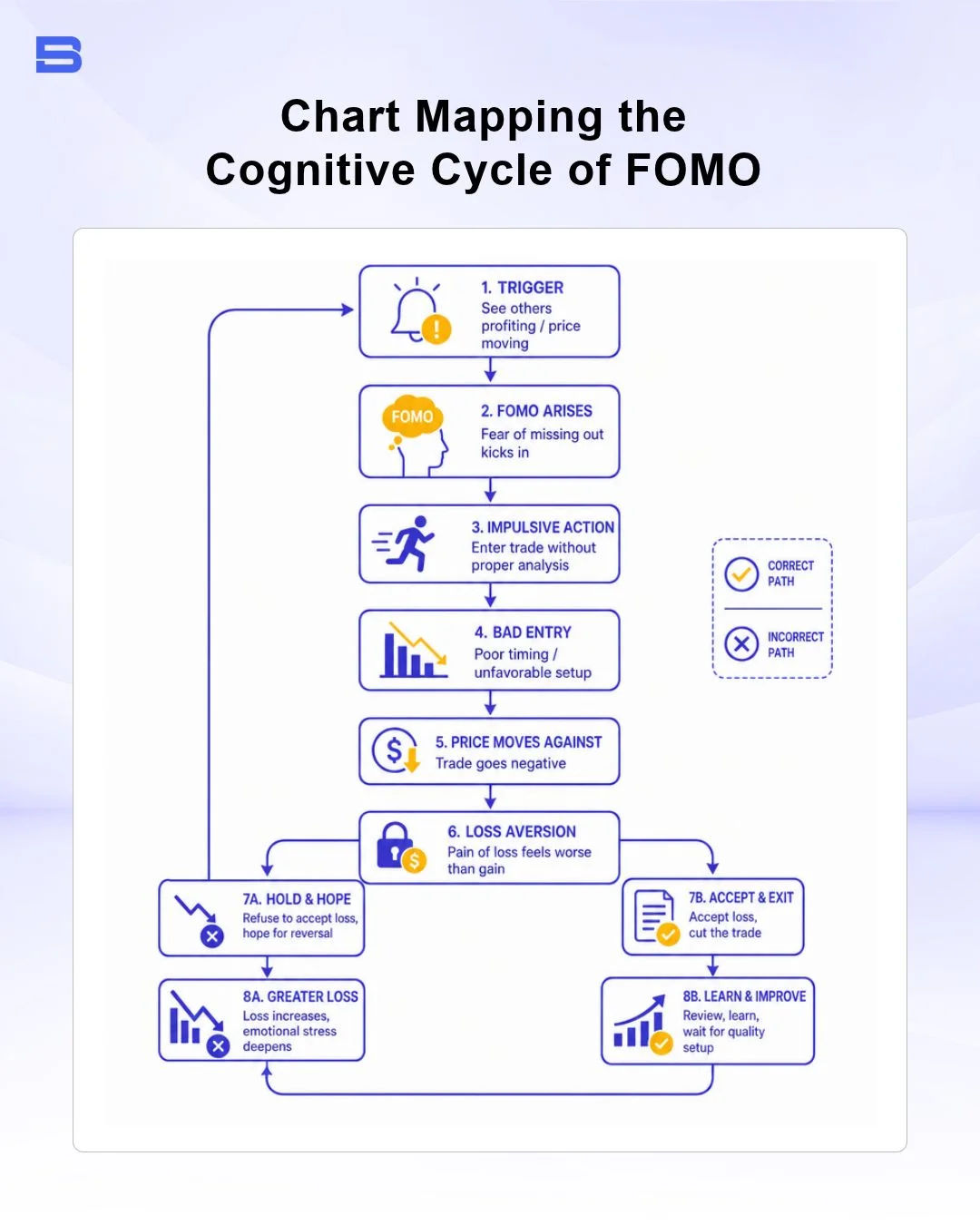
The counterpart to loss aversion is the Fear of Missing Out (FOMO). When an asset experiences a sudden, rapid price spike, emotional traders experience anxiety that others are profiting while they sit on the sidelines.
This emotional pressure causes traders to enter positions using a market-at-best order (an order guaranteed to fill immediately at the best available price) at the top of an extended move, placing orders with terrible risk-to-reward ratios. Chasing extended rallies frequently leads directly into overtrading, where trade frequency increases as rule adherence collapses.
Practical Strategies for Building Trading Discipline
A disciplined trading mindset relies on structured rules rather than willpower alone to navigate market volatility. Since stress and fatigue can impair decision-making, establishing clear trading rules and consistent daily routines helps maintain discipline and reduce emotional trading.
Practical Techniques: How to Control Emotions in Trading
To master how to control emotions in trading, you must remove emotional choice at the moment of execution:
- Pre-Set Hard Stop-Losses: Always place your stop-loss order on the platform at the exact moment you enter a position. Never adjust a stop-loss further away from your entry price once the trade is live.
- Implement a Circuit-Breaker Rule: Define a maximum daily loss threshold (e.g., 3% of total equity). If market conditions or poor execution hit this limit, close your trading terminal for the rest of the session. This enforced cooling-off period prevents the dangerous cycle of revenge trading, where a trader impulsively doubles position sizes to win back lost funds.
- Decouple Equity from Emotion: Focus execution metrics on process adherence percentage rather than daily dollar gains.
Keeping a Trading Journal to Automate Consistency
A structured journal translates abstract psychological goals into clear, actionable performance data. A comprehensive trading journal should log operational parameters alongside subjective emotional states.
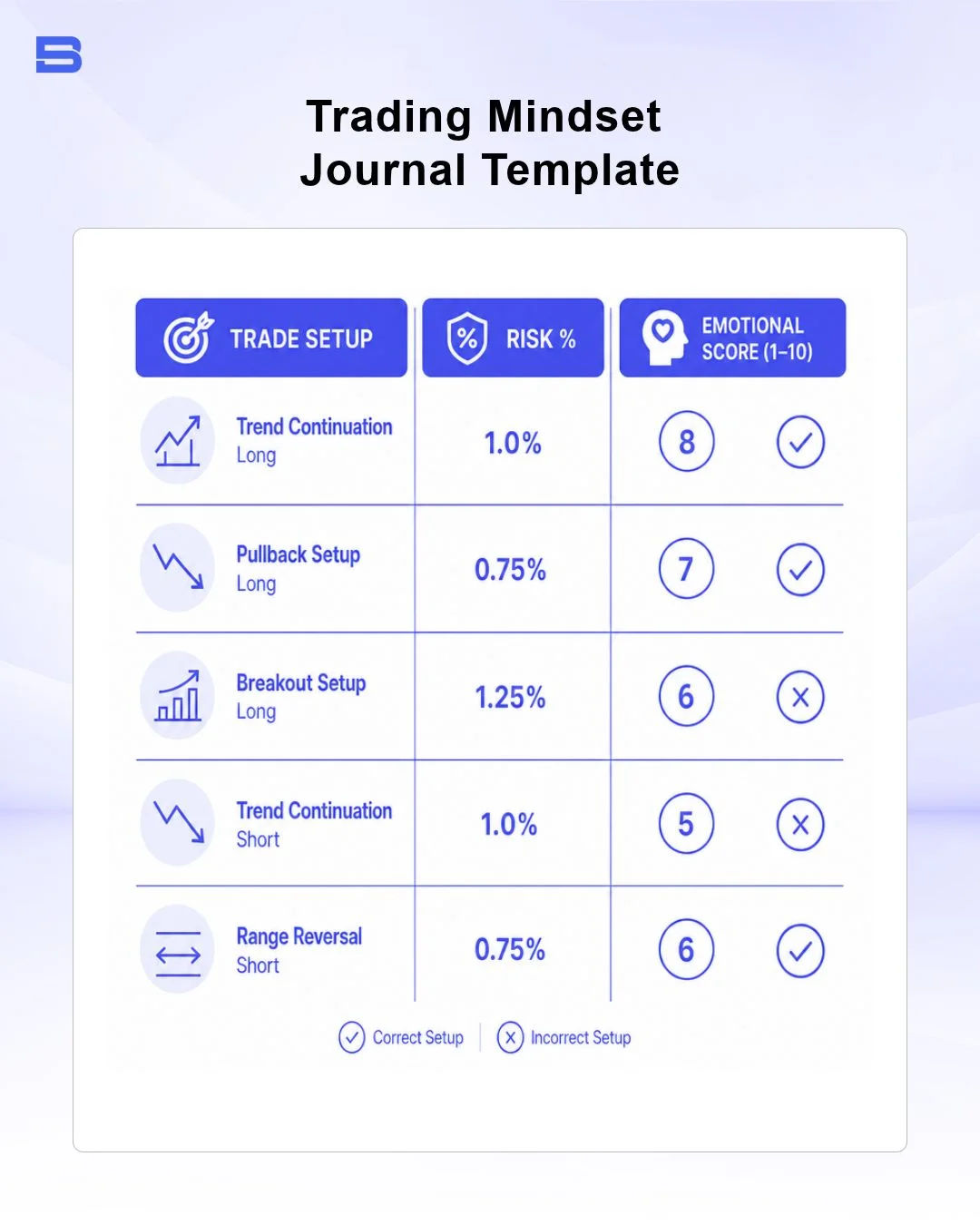
Reviewing this log weekly helps identify negative behavioral triggers, such as entering low-probability trades when tired or expanding lot sizes after a losing trade.
Embedding Risk Management into Your Daily Process
A disciplined trading mindset cannot preserve capital if your underlying structural risk management is flawed. Risk rules provide the physical boundaries within which psychological control operates.
Regulatory bodies such as the Securities Commission Malaysia (SC) repeatedly emphasize investor awareness regarding leverage risks and structural capital management before participating in active trading environments.
Consider a concrete position sizing scenario: Suppose you manage an account capital of RM10,000 and establish a strict 1.5% maximum risk cap per trade.
- Account Capital: RM10,000
- Max Risk Cap per Trade (1.5%): RM150
- Selected Setup: Buy Stock A at RM5.00 with a technical stop-loss placed at RM4.70 (RM0.30 risk per share).
To calculate your maximum permitted position size:
Position Size = Max Dollar Risk / Risk Per Share = RM150 / RM0.30 = 500 shares
Leverage amplifies your returns when the market moves in your favor, but it accelerates capital destruction just as quickly when prices turn against you. By capping risk at RM150 through disciplined position sizing, a sequence of five consecutive losing trades reduces your account by only 7.5%, preserving 92.5% of your total capital to execute future opportunities.
Without position sizing rules, an emotional trader risking 10% or 20% per trade faces near-certain account destruction during routine drawdown periods.
Conclusion
Building a resilient trading mindset is not about suppressing human emotion entirely; it is about establishing systematic operational boundaries that prevent emotion from dictating order execution.
By enforcing strict risk-per-trade limits, maintaining an accurate trading journal, and accepting losses as standard operating costs, you transition from a reactive retail trader into a disciplined risk manager.
- How to Start Trading: A Step-by-Step Guide for Beginners
- Demo Trading Accounts: Safe Practice for Beginners
- Understanding How Much Capital You Need to Start Trading
- How to Set Realistic Trading Goals as a New Trader
- How to Open a Trading Account in Malaysia (Step-by-Step)
- How to Start Trading in Malaysia: A Guide for Beginners
- How to Create a Trading Plan Before You Start Trading
- What Is a Trading Account? Everything You Need to Know
- How to Learn Trading: Step-by-Step Beginner Roadmap
- What Is Stop Loss in Trading and How Does It Work?
- Why Every Trader Needs a Trading Journal
- Islamic Forex Account Explained: How Swap-Free Trading Works
- Funded Trading Account: Rules, Splits & Risks
- Master Money Management: Practical Capital Protection Rules
- Overtrading Explained: Common Causes, Signs, and How to Stop
- How Risk-Reward Ratio Works: A Guide to Trading Risk
- How to Open a Brokerage Account as a Beginner
- What Is a Cent Account Forex and How Does It Work?
- What Is an ECN Account and How Does It Work?
- What Is Cashback Forex and How Does It Work?
- Fixed Deposit vs Unit Trust: Key Differences for Investors
- Welcome Bonus Forex: What It Is and What to Watch For
- Forex Deposit Bonus: How It Works
- What Is Forex Rebate and How Does It Work?
- What Is Forex Free Credit and How Does It Work?
- Trading Webinars: Are They Worth Attending?
- Trading for Beginners PDF: What to Look For in a Good Guide
- Trading 101: How to Start Trading Safely and Effectively
Disclaimer: The content on this page is intended for educational and informational purposes only. It does not constitute financial, investment, tax, or legal advice, and should not be interpreted as a recommendation to buy, sell, or hold any financial instrument or asset. Trading and investing involve significant risk, including the possible loss of your entire capital. Products such as forex, CFDs, and cryptocurrencies carry additional risks due to leverage, high volatility, and limited regulatory protection in some jurisdictions. Past performance of any financial instrument does not guarantee future results. Any market views, forecasts, or opinions expressed are those of the author at the time of writing and may not reflect current market conditions. Platform features, fees, and regulatory status are subject to change — always verify information directly with the relevant provider or regulator before making any financial decision. BrokerSpecs may receive compensation from third parties featured on this site. Always conduct your own due diligence and consider seeking advice from a licensed financial professional before investing. Portions of this article were prepared with the assistance of AI tools and reviewed by our editorial team before publication.