


Related Tags
Picture this: you sign up for a free "Masterclass" on online trading, eager to learn actionable technical analysis strategies. The host spends the first 30 minutes sharing their luxurious lifestyle, followed by 45 minutes of surface-level charting tools you could have found on YouTube. Then comes the climax: a high-pressure, 45-minute sales pitch urging you to buy a $2,000 "exclusive mentorship program" before the limited seats run out.
If this scenario sounds familiar, you are not alone. Online trading webinars have exploded in popularity as retail participation grows across global markets. While live online instruction can accelerate your learning curve, separating genuine education from aggressive sales funnels requires a critical eye.
What Is a Trading Webinar and How Does It Work?
A trading webinar is a live or pre-recorded web-based seminar designed to teach market concepts, platform navigation, or specific trading strategies. Hosted via video conferencing software, these sessions typically feature a presenter sharing their screen, analyzing live price charts, and answering audience questions through a chat interface.
To evaluate whether a session is worth your time, it helps to understand who is hosting it and what their primary business model is:
- Broker-Hosted Educational Webinars: Offered directly by regulated brokers to educate existing or potential clients. Their primary incentive is client retention; brokers profit from transaction spreads or commissions when traders remain active and manage their risk properly over the long term. If you are learning trading 101 concepts or figuring out how to start trading in Malaysia, broker sessions usually focus on platform functionality, risk types, and market execution.
- Independent Educator & "Guru" Webinars: Hosted by third-party trading academies, social media influencers, or private signal providers. Because these hosts do not earn revenue from trading spreads, their primary goal is selling information, proprietary indicator tools, or paid community access.
Consider the practical difference between the two models:
Scenario A (Broker Walkthrough): A host demonstrates how to execute a limit order on MetaTrader 5, explains the mechanics of slippage during economic news events, and shows how to set a stop-loss order to cap potential drawdown.
Scenario B (Unregulated Pitch): A host displays a cherry-picked historical chart where a proprietary "green-arrow, red-arrow" indicator caught a major market trend, claiming the tool yields a 90% win rate if you register for their premium software suite today.
Are Trading Webinars Free or Just Sales Funnels?
A frequent question among newcomers is whether free webinars carry hidden costs. The short answer is that while many trading webinars cost nothing upfront, their ultimate purpose depends entirely on the host's business model.
Regulated brokers often provide legitimately free, ongoing education as a value-add service. They benefit when you become an informed, active market participant who understands capital preservation. Conversely, unregulated entities frequently use free webinars as "lead magnets" to capture your email address and phone number, funneling you into an aggressive sales pipeline.
Free vs. Paid Webinars: Which Should You Choose?
Paying for education does not automatically guarantee high quality, just as a free webinar is not automatically useless. High prices in the financial education space are often spent on marketing campaigns rather than superior research.
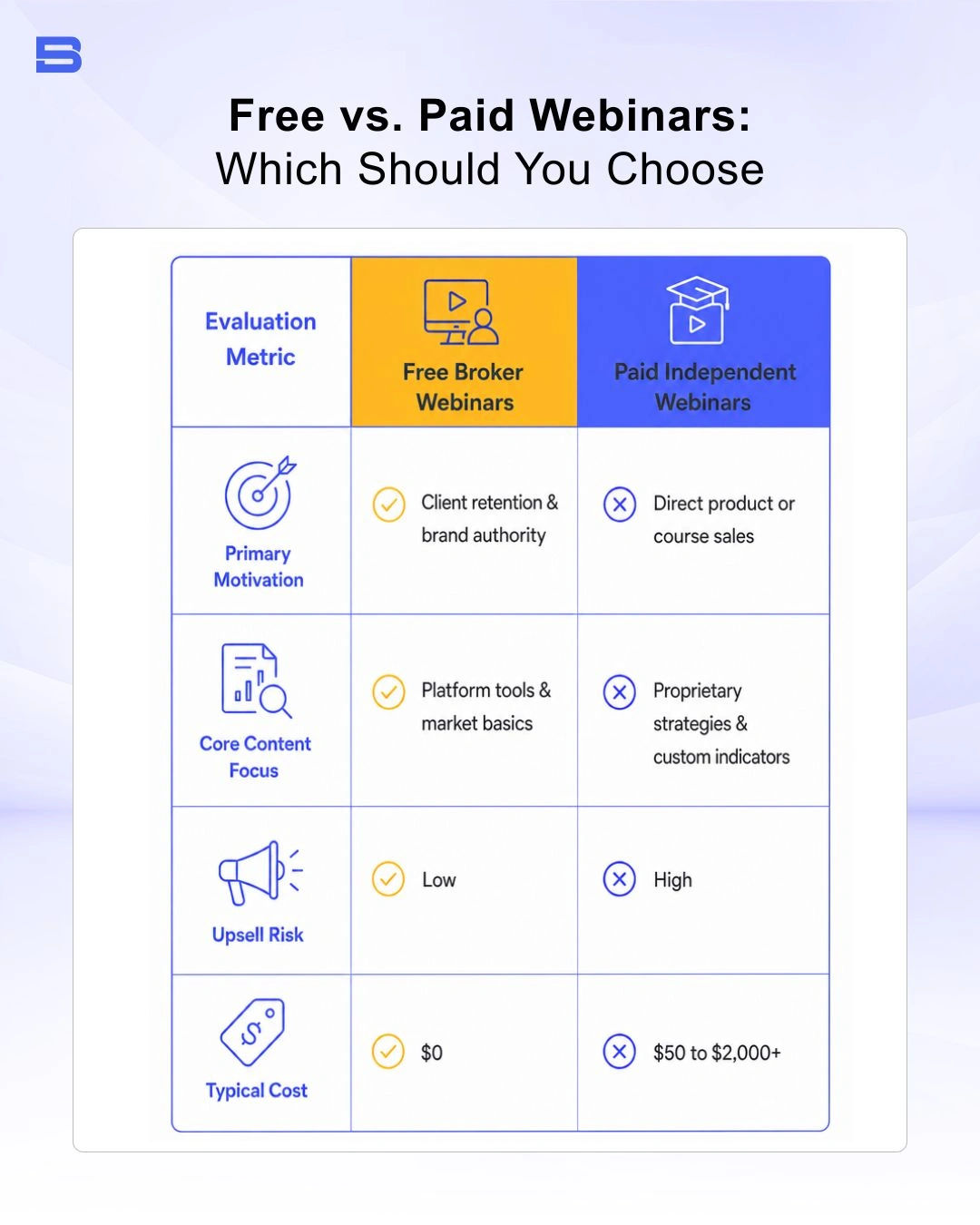
For beginners, free resources—including regulated broker sessions, structured documentation, and building a disciplined trading plan—provide more than enough foundational knowledge. Paying thousands of dollars for a "secret strategy" before mastering basic risk management is an unnecessary expenditure.
Red Flags and Upsell Pitfalls to Watch Out For
Navigating the financial education space requires healthy skepticism. Low-quality webinar hosts rely on psychological triggers to encourage impulsive purchases. Watch out for these common warning signs:
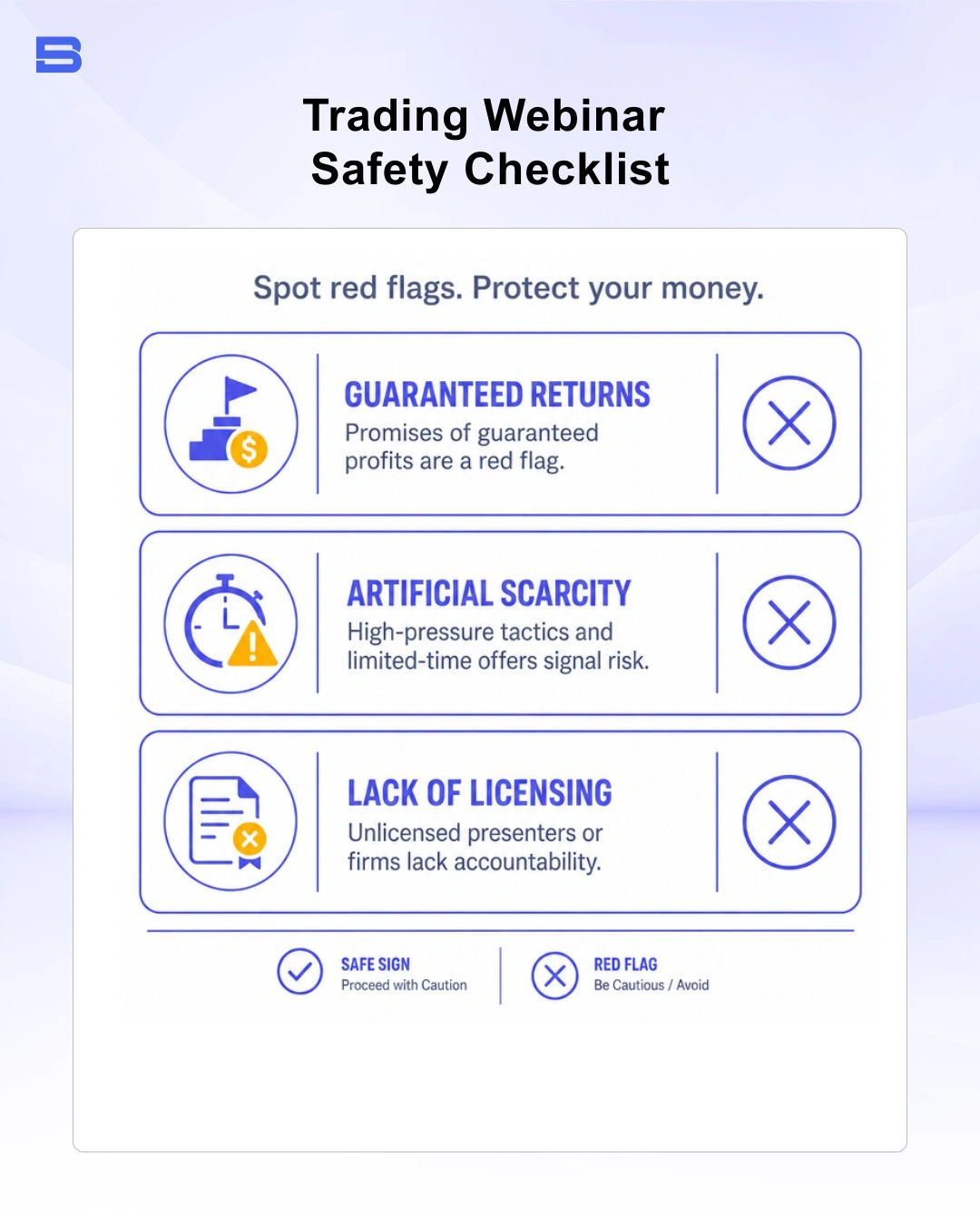
- Guarantees of Specific Returns: No trader, algorithm, or strategy can guarantee market profits. The financial markets carry inherent uncertainty, and any host claiming "guaranteed daily returns" or "zero-risk strategies" is misleading their audience.
- Cherry-Picked Backtest Results: Be wary of presenters showing static screenshots of winning trades without showing live execution logs or continuous equity curves. Anyone can highlight historical chart setups that played out perfectly after the fact.
- Artificial Scarcity and FOMO (Fear of Missing Out): Phrases such as "Only 5 spots left at this price" or "Offer expires when this webinar ends" are artificial pressure tactics designed to bypass your rational risk assessment.
- Over-Reliance on Single Indicators: If a session claims that a single custom indicator eliminates the need for market context, position sizing, or macroeconomic awareness, exercise extreme caution.
How to Choose a Legitimate Trading Webinar
Before committing your time or capital to an online trading session, run through this simple verification checklist to ensure the host operates transparently:
- Verify Credentials and Licensing: Check if the host or sponsoring firm is registered with reputable Tier 1 or Tier 1B regulatory bodies, such as the Securities Commission Malaysia (SC), Bank Negara Malaysia (BNM), the Financial Conduct Authority (FCA) in the UK, or the U.S. Commodity Futures Trading Commission (CFTC). Regulated entities are held to strict standards regarding fair dealing and marketing disclosures.
- Inspect Risk Disclaimers: Legitimate educators present risk disclaimers prominently. If a host glosses over the potential for capital loss, they are failing to provide a balanced prospective view of market participation.
- Look for Actionable, Rule-Based Concepts: A quality educational session focuses on risk parameters, position sizing calculations, and objective chart mechanics—not emotional hype.
- Cross-Reference Free Guides: Supplement live webinars with downloadable educational literature, such as a trading for beginners PDF, allowing you to verify concepts independently at your own pace.
The Bottom Line
Trading webinars can serve as a valuable, interactive gateway for learning platform mechanics and chart analysis when hosted by transparent, regulated entities. However, they are learning aids—not silver bullets. Real trading consistency stems from rigorous risk control, disciplined execution, and continuous practice rather than high-priced shortcuts.
- How to Start Trading: A Step-by-Step Guide for Beginners
- Demo Trading Accounts: Safe Practice for Beginners
- Understanding How Much Capital You Need to Start Trading
- How to Set Realistic Trading Goals as a New Trader
- How to Open a Trading Account in Malaysia (Step-by-Step)
- How to Start Trading in Malaysia: A Guide for Beginners
- How to Create a Trading Plan Before You Start Trading
- What Is a Trading Account? Everything You Need to Know
- How to Learn Trading: Step-by-Step Beginner Roadmap
- What Is Stop Loss in Trading and How Does It Work?
- Why Every Trader Needs a Trading Journal
- Islamic Forex Account Explained: How Swap-Free Trading Works
- Funded Trading Account: Rules, Splits & Risks
- Master Money Management: Practical Capital Protection Rules
- Overtrading Explained: Common Causes, Signs, and How to Stop
- How Risk-Reward Ratio Works: A Guide to Trading Risk
- How to Open a Brokerage Account as a Beginner
- What Is a Cent Account Forex and How Does It Work?
- What Is an ECN Account and How Does It Work?
- What Is Cashback Forex and How Does It Work?
- Fixed Deposit vs Unit Trust: Key Differences for Investors
- Welcome Bonus Forex: What It Is and What to Watch For
- Forex Deposit Bonus: How It Works
- What Is Forex Rebate and How Does It Work?
- What Is Forex Free Credit and How Does It Work?
- Trading Webinars: Are They Worth Attending?
- Trading for Beginners PDF: What to Look For in a Good Guide
- Trading 101: How to Start Trading Safely and Effectively
Disclaimer: The content on this page is intended for educational and informational purposes only. It does not constitute financial, investment, tax, or legal advice, and should not be interpreted as a recommendation to buy, sell, or hold any financial instrument or asset. Trading and investing involve significant risk, including the possible loss of your entire capital. Products such as forex, CFDs, and cryptocurrencies carry additional risks due to leverage, high volatility, and limited regulatory protection in some jurisdictions. Past performance of any financial instrument does not guarantee future results. Any market views, forecasts, or opinions expressed are those of the author at the time of writing and may not reflect current market conditions. Platform features, fees, and regulatory status are subject to change — always verify information directly with the relevant provider or regulator before making any financial decision. BrokerSpecs may receive compensation from third parties featured on this site. Always conduct your own due diligence and consider seeking advice from a licensed financial professional before investing.