


- How to Start Trading: A Step-by-Step Guide for Beginners
- Demo Trading Accounts: Safe Practice for Beginners
- Understanding How Much Capital You Need to Start Trading
- How to Set Realistic Trading Goals as a New Trader
- How to Open a Trading Account in Malaysia (Step-by-Step)
- How to Start Trading in Malaysia: A Guide for Beginners
- How to Create a Trading Plan Before You Start Trading
- What Is a Trading Account? Everything You Need to Know
- How to Learn Trading: Step-by-Step Beginner Roadmap
- What Is Stop Loss in Trading and How Does It Work?
- Why Every Trader Needs a Trading Journal
- Islamic Forex Account Explained: How Swap-Free Trading Works
- Funded Trading Account: Rules, Splits & Risks
- Master Money Management: Practical Capital Protection Rules
- Overtrading Explained: Common Causes, Signs, and How to Stop
- How Risk-Reward Ratio Works: A Guide to Trading Risk
- How to Open a Brokerage Account as a Beginner
- What Is a Cent Account Forex and How Does It Work?
- What Is an ECN Account and How Does It Work?
- What Is Cashback Forex and How Does It Work?
- Fixed Deposit vs Unit Trust: Key Differences for Investors
- Welcome Bonus Forex: What It Is and What to Watch For
- Forex Deposit Bonus: How It Works
- What Is Forex Rebate and How Does It Work?
- What Is Forex Free Credit and How Does It Work?
- Trading Webinars: Are They Worth Attending?
- Trading for Beginners PDF: What to Look For in a Good Guide
- Trading 101: How to Start Trading Safely and Effectively
You have tracked the performance of local equities on Bursa Malaysia, studied global market shifts, and set aside a dedicated pool of investment capital. Yet, the transition from observer to active participant often hits an immediate roadblock: navigating the account opening process. Facing unfamiliar regulatory terms like CDS accounts, e-KYC steps, and brokerage fee tiers can easily freeze your momentum before you even place your first order.
Opening a trading account in Malaysia is significantly simpler than it used to be. Digitized onboarding now allows Malaysian residents and international investors to complete registration within minutes from a smartphone.
Learning how to open a trading account in Malaysia is the first step toward investing in stocks, Exchanged-Traded Funds (ETFs), or other financial products. By understanding the account types, required documents, fees, and verification process, you can complete your application with confidence and begin trading through a regulated broker.
This step-by-step guide walks you through account types, document requirements, broker selection, application steps, and funding your account to start trading confidently.
Step 1: Understand the CDS Account Types (Direct vs. Nominee)
Before submitting personal documents to a broker, you need to understand how shares are registered and held in Malaysia. Every stock investor on Bursa Malaysia requires access to a Central Depository System (CDS) account managed by Bursa Malaysia Depository Sdn Bhd. This system records your share ownership electronically rather than through physical certificates.
Malaysian brokerages offer two distinct structures for holding your shares: Direct CDS accounts and Nominee CDS accounts.
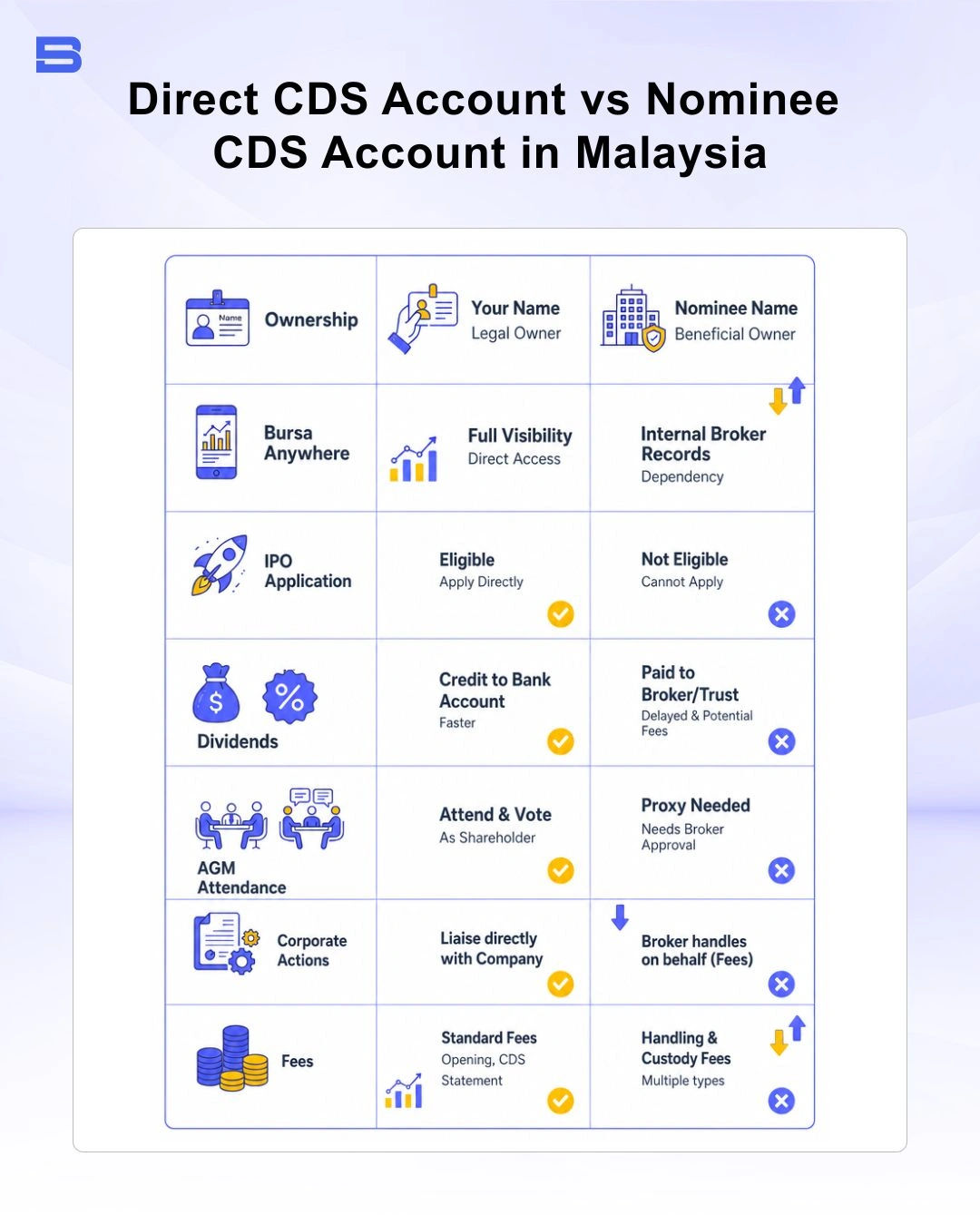
Direct CDS Account
A Direct CDS account is registered explicitly under your full legal name and MyKad or Passport number. You hold direct legal ownership of every share purchased on Bursa Malaysia.
- Corporate Rights: You receive annual reports, physical or digital corporate notices, and voting rights at Annual General Meetings (AGMs) directly from the listed company.
- Direct Dividend Payouts: Cash dividends are deposited straight into your linked Malaysian bank account via eDividend without intermediary handling.
- Rights Issues & eIPO: You can apply directly for Initial Public Offerings (IPOs) through local Automated Teller Machine (ATM) banking portals or the Bursa Anywhere mobile application.
- Fee Structure: Clearing fees and trading commissions are typically straightforward, but manual processing fees for corporate actions may apply depending on the brokerage.
Nominee CDS Account
Under a Nominee CDS account, the brokerage or its designated custodian entity holds the shares on your behalf. You remain the beneficial owner, but the broker's name appears on the company’s official register of members.
- Automated Corporate Actions: The broker handles rights issues, dividend distributions, and stock splits automatically, crediting net proceeds to your trading ledger.
- Lower Transaction Costs: Nominee accounts are frequently offered by digital and discount brokerages, featuring lower minimum commission rates and zero direct account management fees.
- Simplified Global Trading: If you intend to trade foreign shares (such as United States or Hong Kong equities), brokerages almost universally utilize nominee account structures to clear international transactions.
- Limitations: You generally forfeit direct AGM voting rights and cannot use the account to apply for IPOs directly via Bursa Anywhere.
Choosing between the two depends on your primary strategy. If you prioritize long-term corporate governance rights and eIPO applications for local stocks, a Direct CDS account is ideal. If you prioritize low transaction costs, automated administration, and seamless international market access, a Nominee structure is usually more practical.
Step 2: Prepare Your Required Identification Documents
Digital onboarding systems rely on electronic Know-Your-Customer (e-KYC) technology to verify your identity against central databases. Having your documentation prepared in advance ensures your application moves smoothly through automated screening without manual flags or requests for resubmission.
Identification Requirements
- Malaysian Citizens: An original MyKad (front and back). Temporary identification slips or damaged cards with unreadable chips or blurred details are typically rejected.
- Foreign Residents in Malaysia: A valid passport is typically required for foreign applicants, and brokers may also request proof of legal residence or immigration status (such as an Employment Pass, Malaysia My Second Home (MM2H) pass, or Student Pass) to satisfy KYC and Anti-Money Laundering/Counter Financing of Terrorism (AML/CFT) requirements by the Immigration Department. Exact documentation varies by broker and the applicant's residency status.
Supporting Documents Checklist
- Proof of Active Bank Account: A recent bank account statement, e-statement header, or digital banking screenshot displaying your full legal name and account number clearly. The bank account must be held with a licensed Malaysian financial institution registered under your own name (third-party bank accounts are strictly prohibited).
- Proof of Income / Employment: If you apply for a margin trading or margin financing account, brokers will typically require proof of income—such as recent payslips, an EA Form, Form BE/B, an EPF statement, or bank statements—to assess your financial capacity and creditworthiness. The exact documents required vary by broker.
- Proof of Residential Address: If your current residential address differs from the one on your official identification, you may be asked to provide proof of address, such as a recent utility bill (electricity, water, or internet) or a bank statement issued within the past three months.
Ensure all uploaded photos or scans are captured in high resolution under strong lighting. Avoid reflections or flash glare over your photo ID, and do not crop out any of the document corners.
Step 3: Select a Licensed Brokerage Platform
Security of capital should be your highest priority when choosing where to open a trading account. In Malaysia, stockbrokers must be licensed by the Securities Commission Malaysia (SC) and hold Participating Organisation status with Bursa Malaysia.
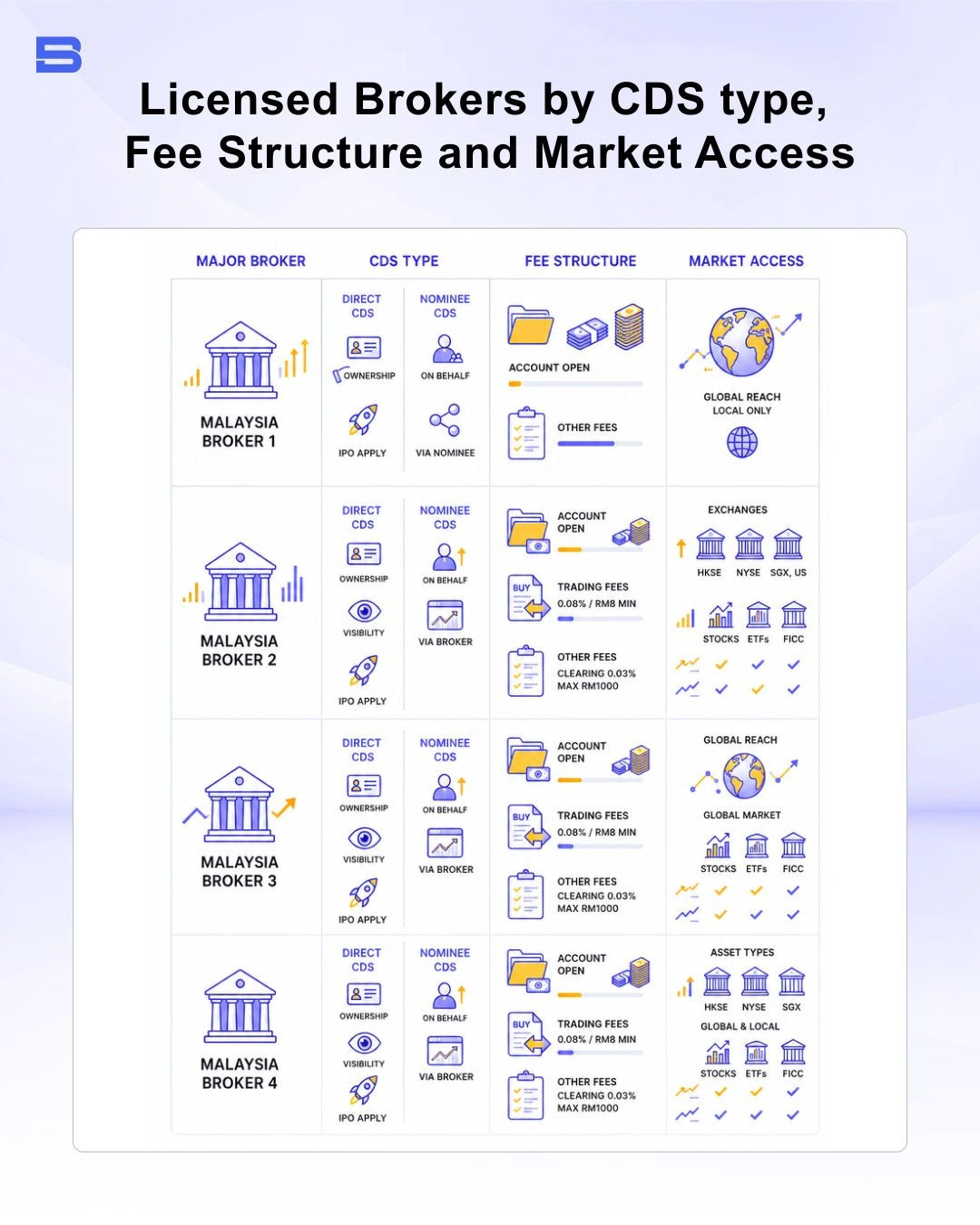
Brokers operating in the Malaysian market generally fall into two broad categories:
1. Investment Bank Brokers
Established investment banks—such as Maybank Investment Bank, CGS International, CIMB Securities, Kenanga Investment Bank, and Hong Leong Investment Bank—offer full-service brokerage infrastructure.
- Strengths: Access to institutional-grade research reports, extensive physical branch networks, dedicated remisiers (licensed dealer's representatives), and native Direct CDS account integration.
- Best For: Investors who value traditional advisory services, direct corporate participation, or integrated banking ecosystem rewards.
2. Digital & Discount Brokers
Modern digital platforms—such as Moomoo MY, Webull MY, and Rakuten Trade—have altered the local brokerage environment by offering low-cost, fully digital account setup.
- Strengths: Ultra-competitive brokerage fees, fast e-KYC approval, zero physical paperwork, advanced charting tools, and consolidated access to global markets (e.g., US, Hong Kong, Singapore) alongside Bursa Malaysia.
- Best For: Self-directed retail investors, high-frequency traders, and tech-savvy beginners seeking low friction and cost efficiency.
When picking a platform, evaluate the fee tier against your planned trade sizing. Fixed minimum brokerage fees can eat heavily into small capital bases, while percentage-based structures without high minimum caps benefit smaller accounts.
Step 4: Complete the Online Application Process
Once you have chosen your preferred broker and prepared your identification, you can complete the online application. Modern onboarding takes approximately 10 to 15 minutes.
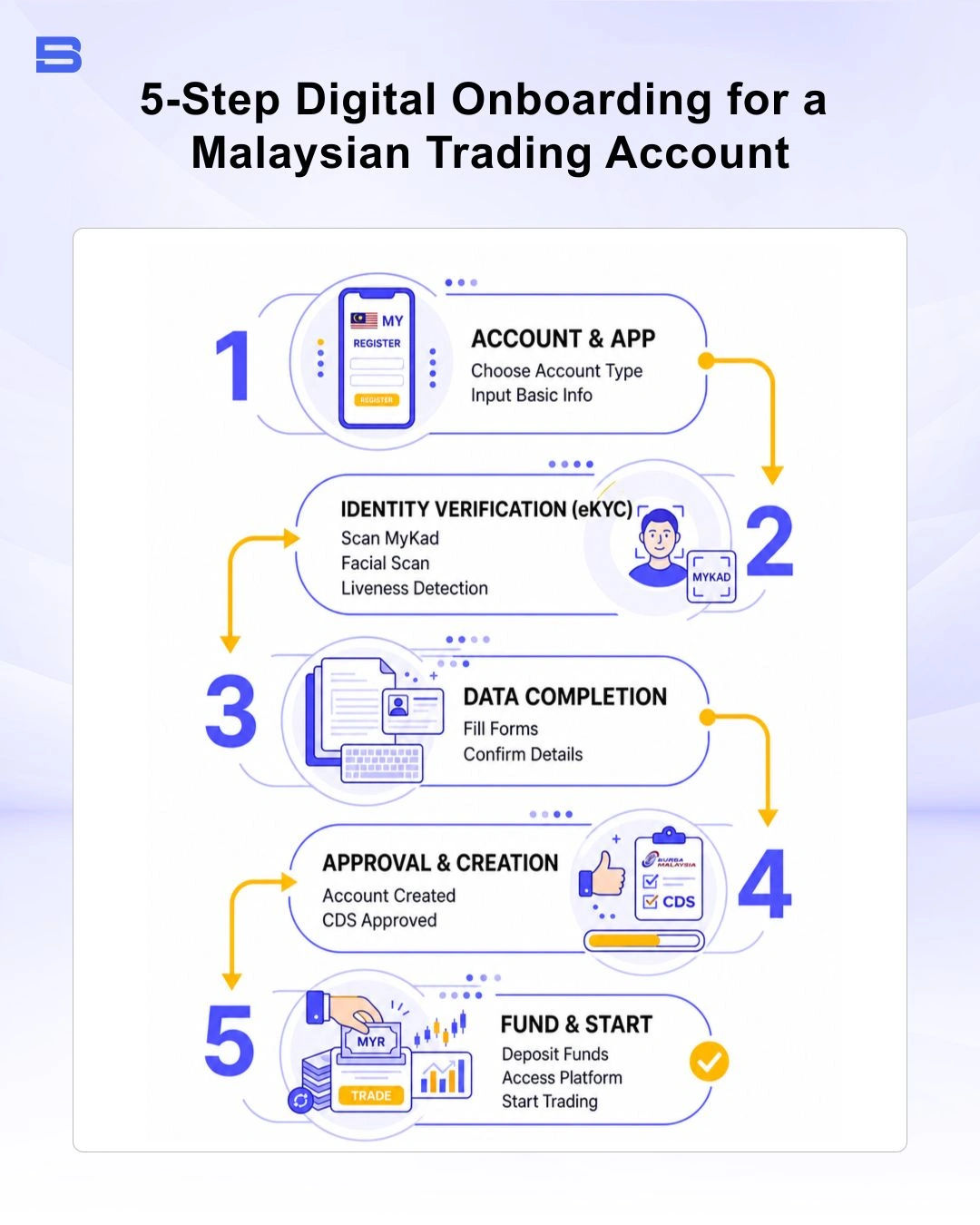
Walkthrough of the Onboarding Steps
- Download the Official Application: Access the broker’s official web portal or download their licensed mobile app from verified app stores (Apple App Store, Google Play Store, or Huawei AppGallery). Always verify the platform developer to avoid phishing apps.
- Account Registration & Contact Verification: Register using your primary email address and Malaysian mobile number. Enter the One-Time Password (OTP) or Transaction Authorization Code (TAC) code sent via Short Message Service (SMS) to verify your mobile identity.
- Execute e-KYC Verification: Follow the on-screen prompts to capture clear images of the front and back of your MyKad or Passport. Complete the dynamic facial recognition scan (liveness test) by holding your camera at eye level and performing simple head movements as instructed.
- Fill Personal and Financial Profiles: Input your employment status, residential address, estimated monthly income, and investment objectives. Then, select your preferred account category (Direct CDS or Nominee CDS). If you choose a Direct CDS account, you will generally be required to pay Bursa Malaysia's standard RM10 CDS account opening fee, although some brokers may waive this fee as part of promotional offers.
- Link Your Deposit and Withdrawal Bank Account: Enter your local bank account details for seamless electronic fund transfers and dividend payouts. The name on your trading account must match the bank account holder name exactly.
- Review and Submit: Digitally sign the customer agreement, tax declaration forms (including Foreign Account Tax Compliance Act/Common Reporting Standard (FATCA/CRS) declarations), and submit the application for review.
Standard digital applications are reviewed automatically or semi-automatically. Approval typically takes between a few hours and a few business days, depending on compliance processing loads.
Step 5: Deposit Funds and Calculate Total Acquisition Costs
Once your application is approved, your broker will issue a unique account number and CDS account details via email or app notification. To begin trading, you must transfer working capital into your trading ledger.
Funding Options
- FPX (Financial Process Exchange): The fastest and most common method. FPX allows instant real-time transfers directly from your Malaysian online banking portal to your brokerage ledger.
- DuitNow / Bank Transfer: Many brokers assign a dedicated virtual account number (VA) to your profile. Transfers made via DuitNow or telegraphic transfer reflect within minutes to a few hours.
Understanding Malaysian Transaction Costs
When buying or selling shares on Bursa Malaysia, your total transaction cost extends beyond the base price of the stock. Every trade incurs regulatory and service charges that impact your breakeven point.
- Brokerage Fee: Charged by your broker as a flat fee or a percentage of the total transaction value — rates vary by broker and execution model, so always confirm the exact current rate on your chosen broker's official fee schedule before trading.
- Clearing Fee: Standardized by Bursa Malaysia at 0.03% of the transaction value, subject to a maximum clearing fee of RM1,000 per contract (trade). Always confirm the current rate directly with Bursa Malaysia, as clearing fee schedules can be revised.
- Stamp Duty: Payable to the Malaysian Government at a rate of RM1.00 for every RM1,000 (or fractional part) of transaction value, capped at a maximum of RM1,000 per contract. Always verify the latest rate with the Inland Revenue Board of Malaysia (IRBM) or your broker before trading, as fee schedules can change.
- Service Tax (SST): An 8% SST applies to taxable service fees charged by brokers, such as brokerage commissions and certain CDS-related administration or account service fees. It does not apply to the value of the shares being bought or sold, although other statutory charges such as stamp duty and clearing fees may still apply. Always verify the latest rate with the Inland Revenue Board of Malaysia (IRBM) or your broker before trading, as the SST can be revised.
Now that you know how to open a trading account in Malaysia, you can avoid unnecessary delays and choose an account that suits your investment goals.
Worked Example: Calculating Total Trade Cost
Suppose you decide to buy 2,000 shares of a Malaysian public company trading at RM2.50 per share using a digital broker offering a 0.05% brokerage fee (minimum RM8.00).
1. Base Share Value:
2,000 shares × RM2.50 = RM5,000.00
2. Brokerage Fee Calculation:
RM5,000.00 × 0.05% = RM2.50.
Since RM2.50 is below the minimum fee threshold, the minimum fee applies:
Brokerage Fee = RM8.00
3. Service Tax (SST @ 8%) on Brokerage Fee:
RM8.00 × 8% = RM0.64
4. Clearing Fee (0.03%):
RM5,000.00 × 0.03% = RM1.50
5. Stamp Duty (RM1.00 per RM1,000 value):
RM5,000.00 / RM1,000 = 5 units 5 × RM1.00 = RM5.00
6. Total Acquisition Cost:
RM5,000.00 (Shares) + RM8.00 (Brokerage) + RM0.64 (SST) + RM1.50 (Clearing) + RM5.00 (Stamp Duty) = RM5,015.14
In this setup, your total friction cost to execute the trade is RM15.14. To break even, your position value needs to gain at least RM15.14 (plus estimated exit fees) before you sell.
Conclusion
Knowing how to open a trading account in Malaysia helps you avoid unnecessary delays and choose an account that suits your investment goals. Once your account is approved and funded, you can start trading while following sound risk management and building a long-term investment strategy.
Take time to evaluate whether a Direct CDS or Nominee CDS structure aligns best with your investment style. Check fee schedules against your initial trade sizing, keep your tax and bank documents organized, and ensure your chosen brokerage holds a valid license from the Securities Commission Malaysia. Establishing your trading account properly ensures your focus remains where it belongs: analyzing market opportunities and managing risk prudently.
Disclaimer: The content on this page is intended for educational and informational purposes only. It does not constitute financial, investment, tax, or legal advice, and should not be interpreted as a recommendation to buy, sell, or hold any financial instrument or asset. Trading and investing involve significant risk, including the possible loss of your entire capital. Products such as forex, CFDs, and cryptocurrencies carry additional risks due to leverage, high volatility, and limited regulatory protection in some jurisdictions. Past performance of any financial instrument does not guarantee future results. Any market views, forecasts, or opinions expressed are those of the author at the time of writing and may not reflect current market conditions. Platform features, fees, and regulatory status are subject to change — always verify information directly with the relevant provider or regulator before making any financial decision. BrokerSpecs may receive compensation from third parties featured on this site. Always conduct your own due diligence and consider seeking advice from a licensed financial professional before investing.