


- How to Start Trading: A Step-by-Step Guide for Beginners
- Demo Trading Accounts: Safe Practice for Beginners
- Understanding How Much Capital You Need to Start Trading
- How to Set Realistic Trading Goals as a New Trader
- How to Open a Trading Account in Malaysia (Step-by-Step)
- How to Start Trading in Malaysia: A Guide for Beginners
- How to Create a Trading Plan Before You Start Trading
- What Is a Trading Account? Everything You Need to Know
- How to Learn Trading: Step-by-Step Beginner Roadmap
- What Is Stop Loss in Trading and How Does It Work?
- Why Every Trader Needs a Trading Journal
- Islamic Forex Account Explained: How Swap-Free Trading Works
- Funded Trading Account: Rules, Splits & Risks
- Master Money Management: Practical Capital Protection Rules
- Overtrading Explained: Common Causes, Signs, and How to Stop
- How Risk-Reward Ratio Works: A Guide to Trading Risk
- How to Open a Brokerage Account as a Beginner
- What Is a Cent Account Forex and How Does It Work?
- What Is an ECN Account and How Does It Work?
- What Is Cashback Forex and How Does It Work?
- Fixed Deposit vs Unit Trust: Key Differences for Investors
- Welcome Bonus Forex: What It Is and What to Watch For
- Forex Deposit Bonus: How It Works
- What Is Forex Rebate and How Does It Work?
- What Is Forex Free Credit and How Does It Work?
- Trading Webinars: Are They Worth Attending?
- Trading for Beginners PDF: What to Look For in a Good Guide
- Trading 101: How to Start Trading Safely and Effectively

Entering the financial markets with personal savings often restricts a trader's growth potential. Limited capital means taking smaller position sizes or accepting elevated account risk to make meaningful returns. A funded trading account bridges this gap by offering access to firm equity ranging from $5,000 to over $200,000.
In exchange, proprietary trading firms, also known as prop trading firms, share in the profits generated by the trader. While the idea of trading substantial capital without risking your life savings is compelling, accessing this capital requires passing rigorous evaluations, managing drawdown rules, and executing strategies under strict capital allocations.
What Is a Funded Trading Account and How Does It Work?
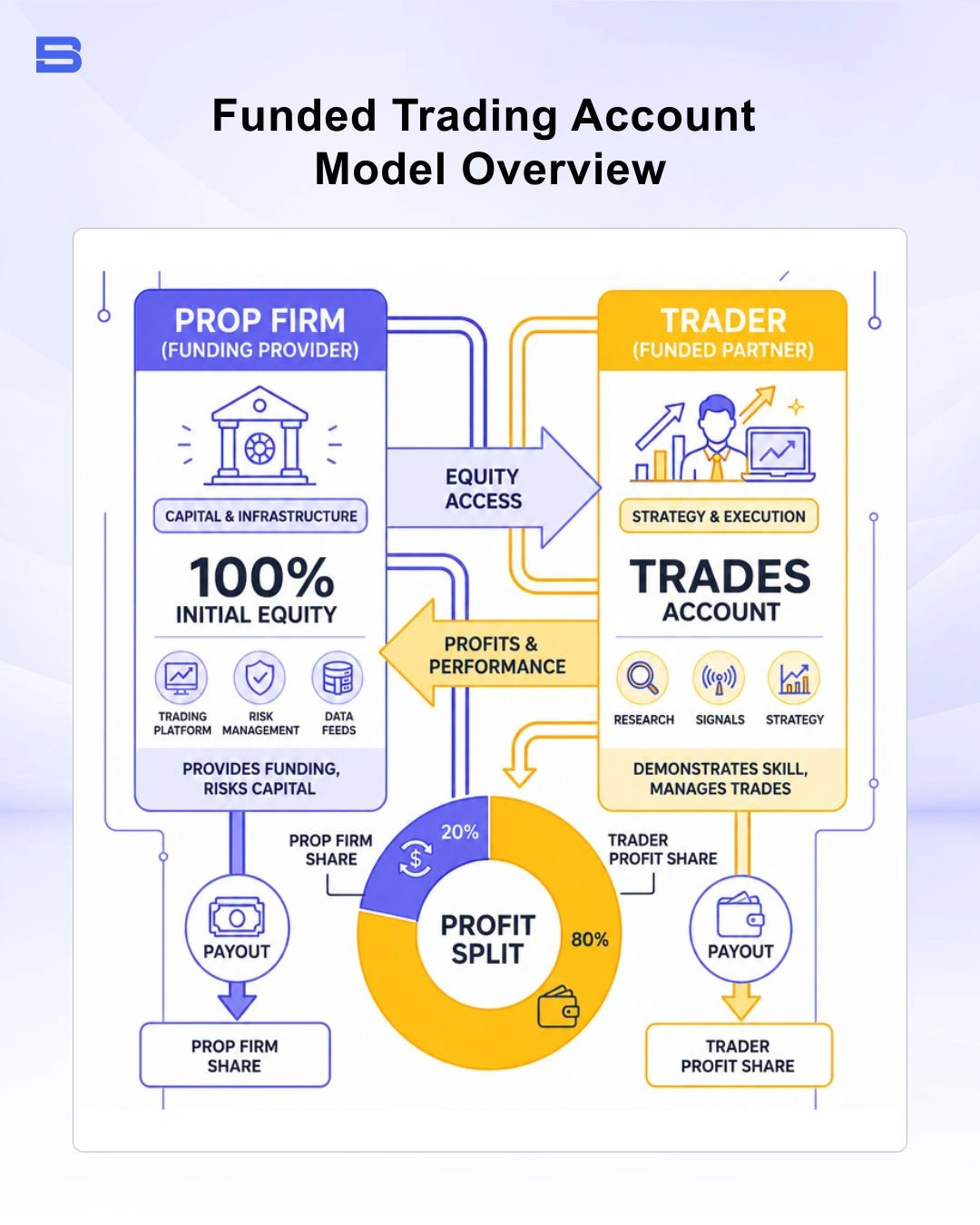
A funded trading account is an arrangement offered by a proprietary trading firm that allows traders to execute trades using the firm's allocated capital in either simulated or live market environments. In return, traders typically receive 70% to more than 90% of the profits they generate while risking only the initial evaluation or account purchase fee.
Many proprietary trading firms operate simulated trading environments and compensate successful traders based on performance rather than requiring a funded personal brokerage account. Regulators such as the US Commodity Futures Trading Commission (CFTC) have published customer advisories encouraging traders to understand how these programs are structured before participating.
Unlike a standard brokerage account, a funded trading account does not require you to deposit your own trading capital. Instead, the proprietary trading firm grants access to its trading platform under a performance-based agreement.
Traders must follow predefined risk rules, such as maximum drawdown and daily loss limits, while the firm provides the trading capital and shares a percentage of any eligible profits earned.
However, funded capital is provided strictly under firm-enforced operational limits. If your portfolio balance or open equity breaches a single daily or total maximum loss parameter, the prop firm immediately terminates the account allocation.
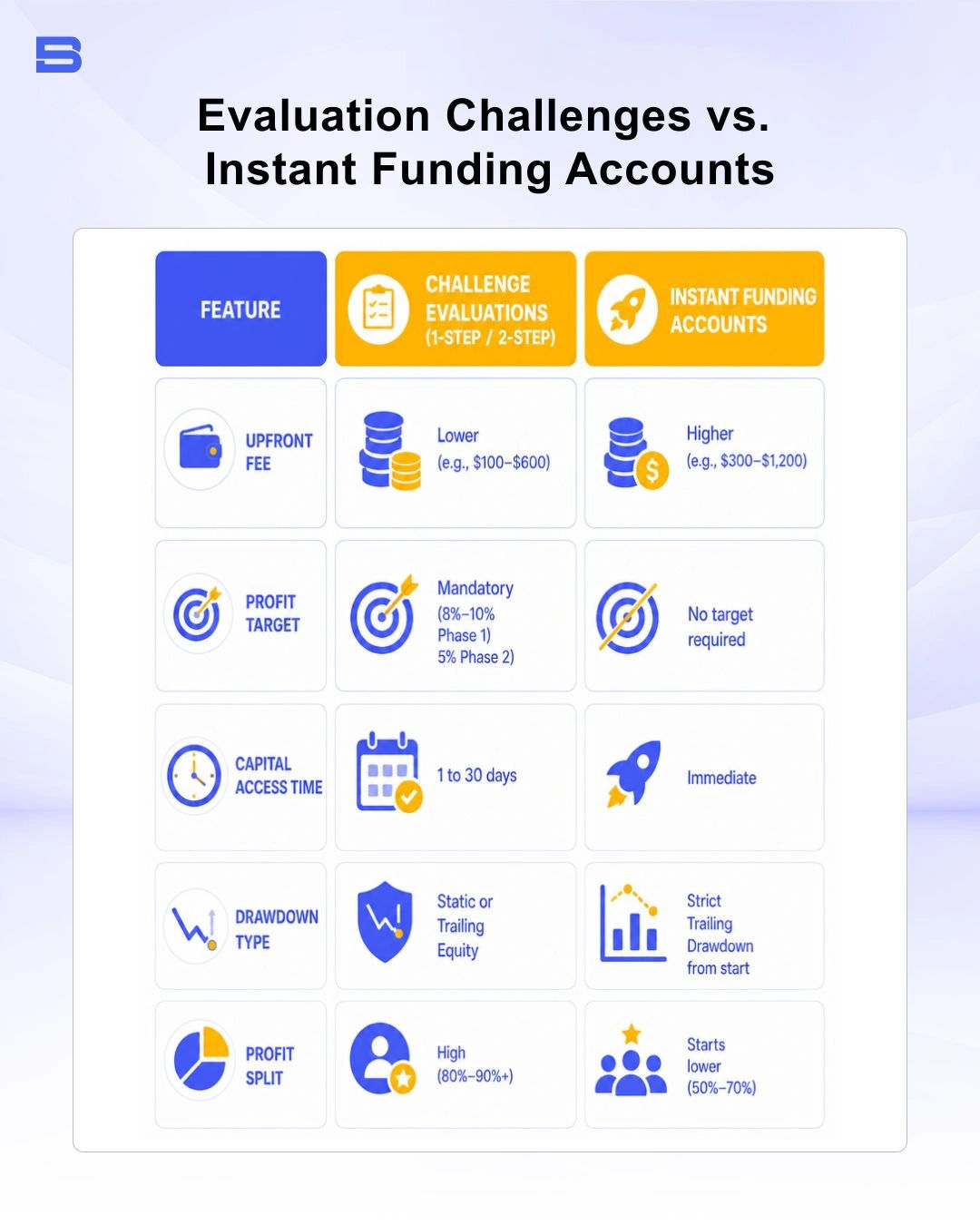
Evaluation Challenges vs. Instant Funding Accounts
Traders generally choose between multi-step challenge evaluations and direct instant funding models:
How the Funded Trading Account Evaluation Process Works
Securing a funded trading account evaluation requires passing an evaluation challenge designed to test risk discipline and consistency.
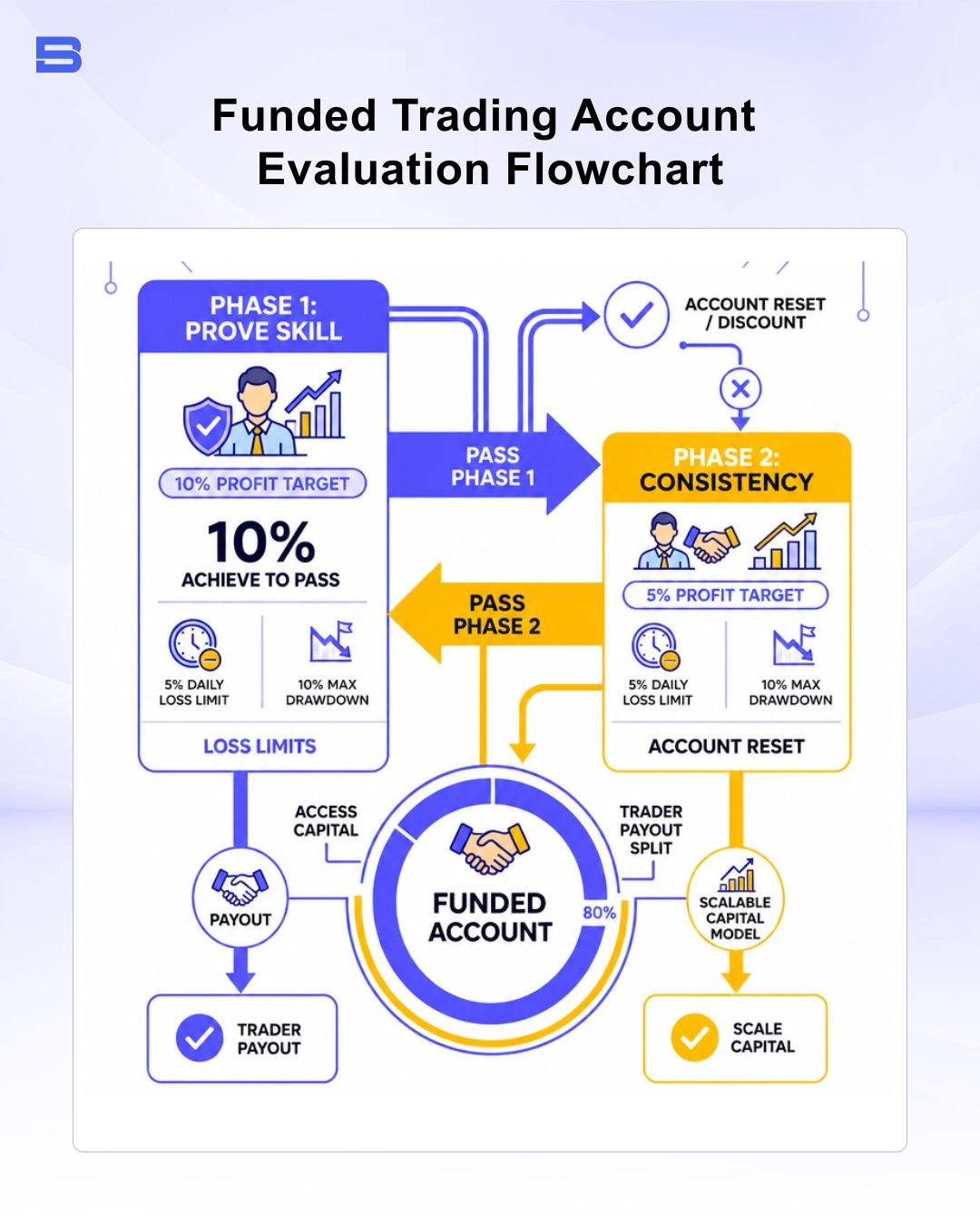
The process typically consists of two distinct testing phases:
- Phase 1 (The Challenge): You must reach a specified profit target (usually 8% to 10%) without breaching daily or maximum loss limits within a set timeframe or open-ended period.
- Phase 2 (Verification): Upon completing Phase 1, you confirm consistency by reaching a reduced target (typically 5%) under identical loss restrictions.
- Funded Status: After passing verification and completing identity verification (KYC), you sign a performance contract and receive your live or simulated funded account.
Worked Example: $100,000 Challenge Parameters
Consider an applicant undertaking a $100,000 evaluation account with standard risk rules:
- Initial Balance: $100,000
- Phase 1 Profit Target (8%): $8,000 (Target Balance: $108,000)
- Daily Loss Limit (5%): $5,000 (Calculated from daily starting equity)
- Maximum Total Drawdown (10%): $10,000 (Account balance/equity must not drop below $90,000)
If a trader makes $3,000 on Day 1, their balance becomes $103,000. On Day 2, their new daily drawdown limit is calculated from $103,000 equity, meaning equity cannot drop below $97,850 ($103,000 minus 5% daily limit) on that specific day.
Profit Splits and Payout Mechanisms
Proprietary accounts structure payouts using a performance-based funded account profit split. Most reputable firms offer an initial 70% to 80% split to the trader, which can scale up to 90% or 95% after consecutive profitable months.
Payouts are processed bi-weekly or monthly via bank transfers, crypto, or third-party payment rails. Additionally, firms often refund the initial evaluation fee along with your first performance payout.
Drawdown Limits and Risk Parameters Explained
Understanding funded account drawdown rules is critical, as risk parameter breaches trigger immediate automated account liquidations. Proprietary firms enforce two main drawdown structures:
Static Max Drawdown vs. Trailing Max Drawdown
- Static Maximum Drawdown: The overall loss threshold remains fixed to the initial starting account balance. On a $100,000 balance with a 10% static drawdown limit, your hard floor stays at $90,000 forever, regardless of how much profit you accumulate.
- Trailing Maximum Drawdown: The drawdown floor trails upward as your closed profits or open floating equity increase. If your $100,000 account gains $4,000, a 10% trailing drawdown threshold moves from $90,000 up to $94,000. If your balance later falls back to $93,900, the account breaches execution rules, even though you are still above the initial $90,000 baseline. The Financial Conduct Authority (FCA) emphasizes that traders should fully understand a firm's risk management rules and contractual terms before participating in trading activities.
Daily Loss Limits (Equity vs. Balance)
Firms calculate daily loss limits based on either balance (closed trades) or equity (including open floating profits/losses). An equity-based calculation means floating drawdowns during volatile swings count toward your daily loss limit, even if you do not close the trades.
Unlike operating direct liquidity through personal execution accounts such as an ECN (Electronic Communication Network) account, where position maintenance relies on total margin cover, prop accounts enforce strict drawdown triggers well before margin calls occur.
Common Rules That Cause Traders to Fail
Industry data reported by several prop trading firms suggests that a large majority of retail applicants do not pass evaluation challenges on their first attempt. High failure rates are driven by tight parameters and funded account rule traps:
- Trailing Daily Drawdown Traps: Many traders focus exclusively on overall drawdown while failing to calculate how open floating profits raise their daily loss threshold.
- High Impact News Restrictions: Trading within 2 to 5 minutes before or after major macroeconomic releases such as US Non-Farm Payrolls or Consumer Price Index (CPI) can breach rules or cause profits from those trades to be voided.
- Weekend Position Holding: Certain programs require all open positions to be liquidated before the market closes on Friday evening to prevent weekend gap exposure.
- Lot Size Consistency Rules: To stop traders from gambling large lot sizes on single setups, firms may mandate that no single trade can account for more than 30% to 50% of total target profits.
For beginners learning order flow and market dynamics, managing strict funded rules while building execution skills can add unnecessary pressure. Practicing market mechanics on small capital balances using a cent account offers a low-risk alternative path before paying challenge fees.
How to Choose a Reliable Funded Account Program
Evaluating prop firms requires analyzing platform terms beyond promotional marketing headlines:
- Verifiable Payout Proof: Confirm that the firm regularly pays out traders by checking verified third-party review platforms and trader communities.
- Transparent Drawdown Calculations: Verify whether daily drawdown is based on equity or balance, and ensure trailing thresholds freeze once the initial balance is reached.
- Platform Pricing and Execution: Check spread widening, commission charges per lot, and slippage during volatile sessions.
- Regulatory & Operational Transparency: Verify corporate registration details, underlying platform infrastructure, and swap-free availability for traders requiring Shariah-compliant conditions, as detailed in our guide on Islamic trading accounts.
Before purchasing a challenge fee, make sure your execution process is solid. Transitioning from personal setups, such as learning how to open a brokerage account, to managing prop accounts requires transitioning from simple leverage management to strict adherence to firm risk guidelines.
Conclusion
Funded trading accounts offer skilled traders access to institutional-sized capital without risking personal wealth. However, achieving consistent payouts requires managing strict risk limits, trailing drawdowns, and firm evaluation rules. By approaching prop trading with disciplined risk parameters rather than a get-rich-quick mindset, you can evaluate prop programs effectively and protect your trading capital.
Disclaimer: The content on this page is intended for educational and informational purposes only. It does not constitute financial, investment, tax, or legal advice, and should not be interpreted as a recommendation to buy, sell, or hold any financial instrument or asset. Trading and investing involve significant risk, including the possible loss of your entire capital. Products such as forex, CFDs, and cryptocurrencies carry additional risks due to leverage, high volatility, and limited regulatory protection in some jurisdictions. Past performance of any financial instrument does not guarantee future results. Any market views, forecasts, or opinions expressed are those of the author at the time of writing and may not reflect current market conditions. Platform features, fees, and regulatory status are subject to change — always verify information directly with the relevant provider or regulator before making any financial decision. BrokerSpecs may receive compensation from third parties featured on this site. Always conduct your own due diligence and consider seeking advice from a licensed financial professional before investing.