



Related Tags
Choosing where to place your savings is an important step in your financial journey. For many Malaysian investors, the crossroads often comes down to two foundational vehicles: placing funds in a traditional bank Fixed Deposit (FD) or investing in managed pooled funds known as Unit Trusts.
While both options allow you to put capital to work, they operate on fundamental principles that yield vastly different risk profiles, potential returns, and liquidity terms. Understanding these mechanical differences ensures you structure a portfolio that aligns with your timeline, inflation expectations, and tolerance for market volatility.
Ultimately, the fixed deposit vs unit trust decision comes down to how much short-term price fluctuation you're willing to accept in exchange for higher long-term growth potential.
What Is a Fixed Deposit and How Does It Work?
A Fixed Deposit (FD) is a low-risk financial instrument offered by commercial banks and financial institutions. When you open a Fixed Deposit, you agree to deposit a specific sum of money with the bank for a predetermined tenure—ranging anywhere from one month to several years. In exchange for locking away your liquidity, the bank pays you a fixed rate of interest over that duration.
Fixed Deposit Rates and Lock-In Penalties
Fixed deposit interest rates in Malaysia are directly influenced by the Overnight Policy Rate (OPR) set by Bank Negara Malaysia (BNM). When monetary policy tightens, FD board rates generally adjust upward, whereas rate cuts reduce the yield offered on new placements.
The primary characteristic of an FD is predictability: your principal and interest yield are locked in at the time of placement. However, this predictability comes with strict tenure commitments. If you choose an early withdrawal before the agreed maturity date, banks traditionally levy penalties—often forfeiting any accrued interest entirely or offering only a reduced prorated return.
PIDM Protection for Fixed Deposits
A major appeal of placing money in a Malaysian bank deposit is capital safety. Eligible Ringgit-denominated Fixed Deposits held with commercial and Islamic banks are automatically insured by Perbadanan Insurans Deposit Malaysia (PIDM).
What Is a Unit Trust and How Does It Work in Malaysia?
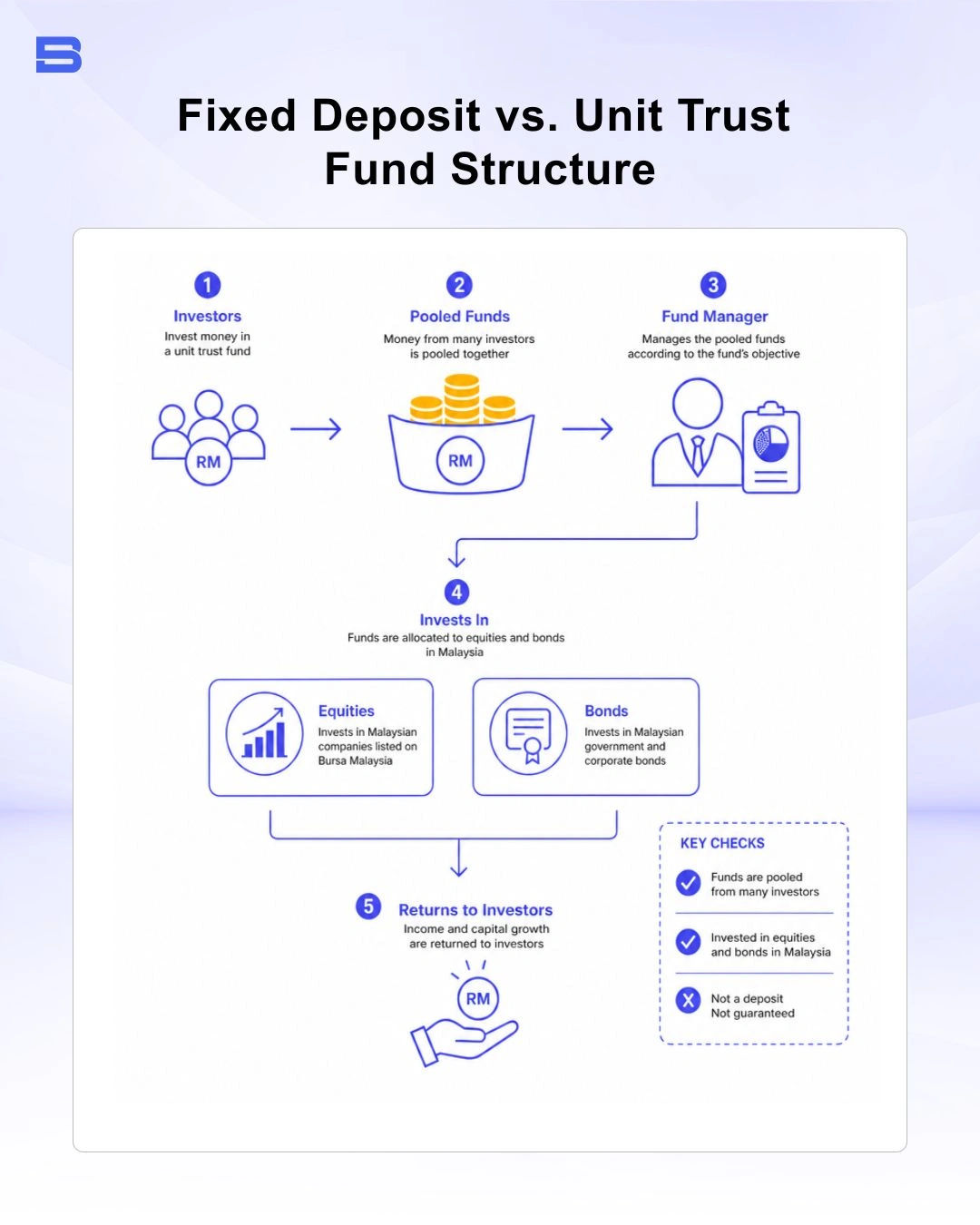
A Unit Trust is a collective investment scheme that pools capital from thousands of individual retail investors into a single large fund. This combined fund is then professionally managed by a licensed fund management company governed by the Securities Commission Malaysia (SC).
When you invest in a unit trust, your money purchases "units" in the fund. The value of each unit is called the Net Asset Value (NAV), which fluctuates daily based on the market value of the underlying assets held within the portfolio.
Depending on your risk tolerance, unit trusts in Malaysia fall into several primary categories:
- Equity Funds: Invest primarily in publicly traded stocks to seek long-term capital growth.
- Fixed Income / Bond Funds: Invest in government securities and corporate bonds to generate regular yield.
- Balanced Funds: Blend equities and fixed income to moderate portfolio volatility.
- Money Market Funds: Focus on ultra-short-term bank deposits and liquid debt instruments.
Malaysian investors can access unit trusts through various distribution channels, including institutional agents, direct fund management portals, digital platforms like robo-advisors, and the Employees Provident Fund (EPF) i-Invest portal, which allows eligible account holders to transfer a portion of their EPF Account 1 funds into approved unit trust schemes.
Fixed Deposit vs Unit Trust: Core Differences Compared
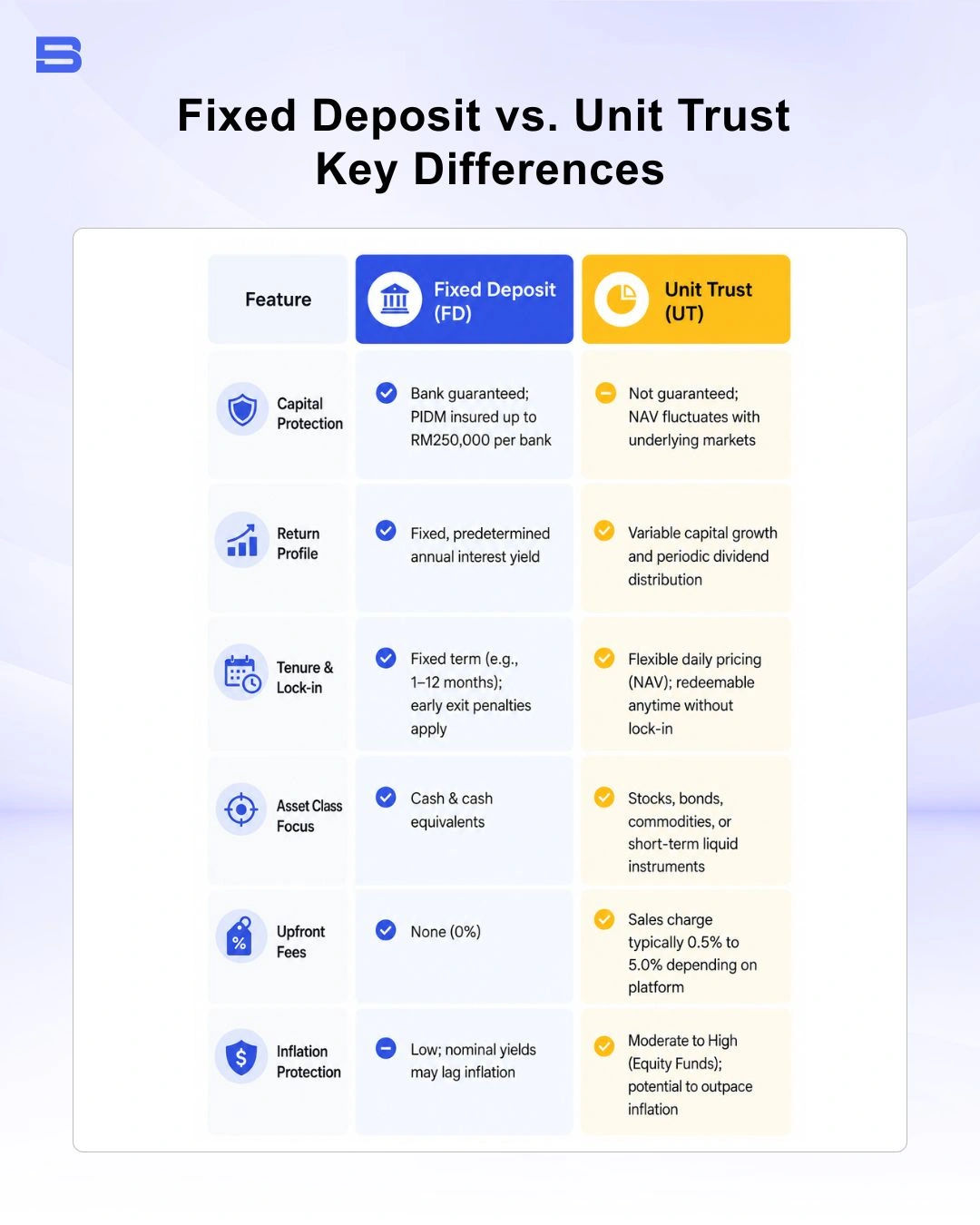
To evaluate whether a fixed deposit vs unit trust better suits your portfolio, compare their primary structural parameters side by side:
Safety, Risk, and PIDM Protection Explained
A frequent question among beginners asks: is a unit trust safer than a fixed deposit?
From a structural perspective, a Fixed Deposit is safer regarding short-term capital preservation. An FD guarantees your nominal principal upon maturity, backed by PIDM coverage.
Conversely, a Unit Trust is not capital-guaranteed. Because unit trusts purchase market-traded assets, your capital fluctuates daily based on market sentiment, economic conditions, and corporate performance. While equity unit trusts offer capital growth potential that can protect your purchasing power against long-term inflation, they expose you to market drawdown risks that do not exist in standard fixed deposits.
Fee Structures and Net Yield Breakdown
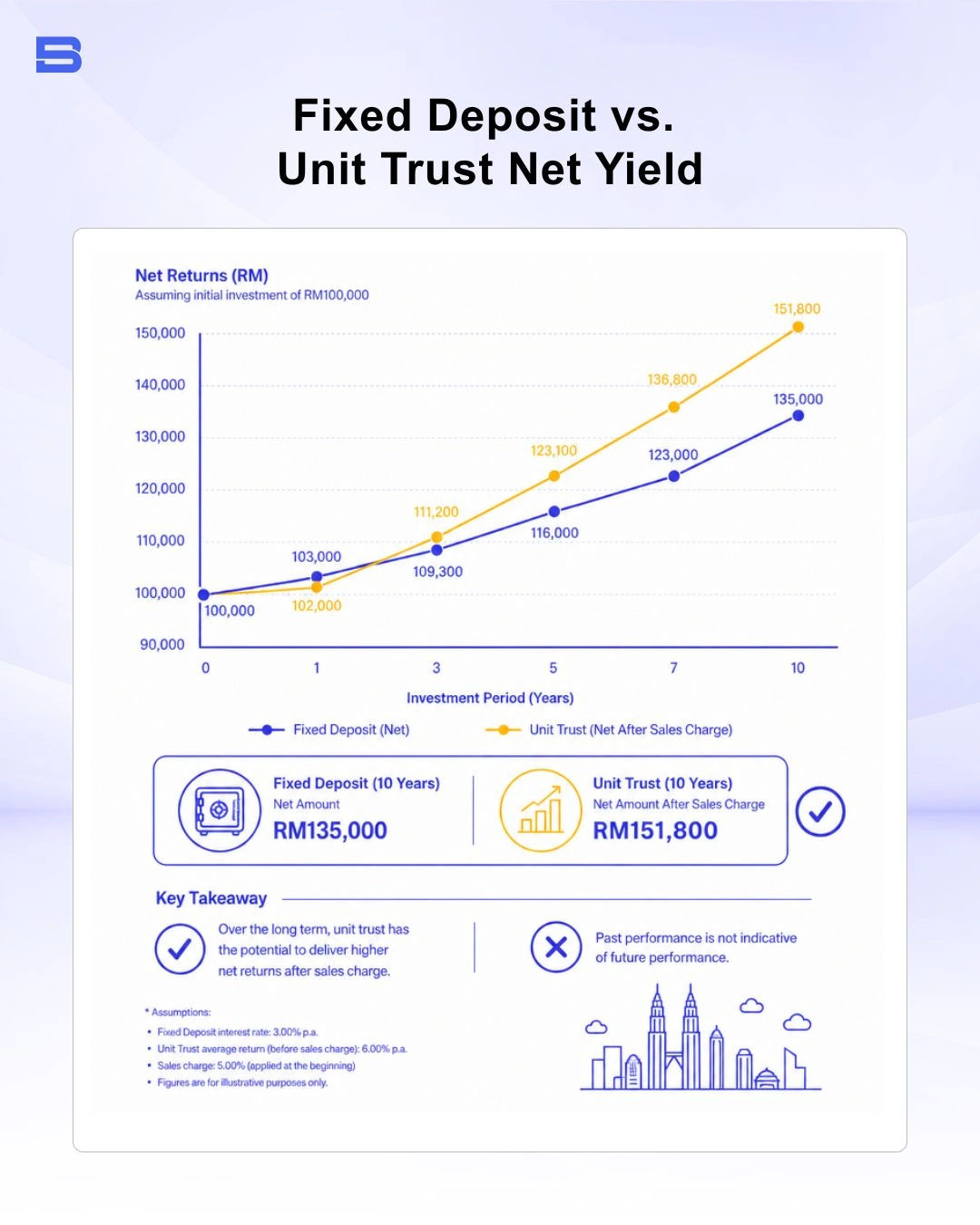
When evaluating potential investments, comparing gross yields alone can be misleading. Unit trusts incur operational and management expenses that directly impact your net realized returns.
Understanding Unit Trust Charges
- Sales Charge (Upfront Fee): An entry fee charged when purchasing units, ranging from 0% to 2% on digital platforms and up to 5% when bought through traditional agency channels.
- Management Expense Ratio (MER): An annual fee covering fund management, administration, and marketing expenses, usually ranging between 0.5% and 1.5% per annum, deducted directly from the fund's NAV.
- Trustee Fee: A small annual fee paid to an independent custodian trustee safeguarding the fund's assets, typically between 0.03% and 0.08% per annum.
Worked Net Yield Comparison Scenario
Consider an initial capital placement of RM10,000 held over a 3-year horizon:
SCENARIO A: Fixed Deposit at 3.50% p.a. Guaranteed Rate
- Initial Capital: RM10,000
- Gross Annual Interest: 3.50%
- Upfront / Annual Fees: RM0
- Year 1 Ending Balance: RM10,350
- Year 2 Ending Balance: RM10,712
- Year 3 Ending Value: RM11,087
Net Total Gain: +RM1,087 (+10.87% cumulative return)
SCENARIO B: Equity Unit Trust (Gross Growth 7.00% p.a.)
- Initial Capital: RM10,000 (-) 2.0%
- Upfront Sales Charge: -RM200
- Net Invested Principal: RM9,800
- Annual Gross Market Growth: 7.00% (-) 1.50%
- Annual MER: -1.50%
- Net Annual Fund Compound: 5.50% p.a.
- Year 1 Fund Value: RM10,339
- Year 2 Fund Value: RM10,908
- Year 3 Ending Value: RM11,508
Net Total Gain: +RM1,508 (+15.08% cumulative return)
As illustrated above, while the equity unit trust generated higher total capital over three years, its net performance was affected by the initial sales charge and ongoing MER. If market growth slows down or turns negative, high fee structures can lead to net performance falling below fixed deposit rates.
Alternative Low-Risk Options: ASB and Money Market Funds
Investors looking for low-risk alternatives beyond standard bank deposits can consider intermediate vehicles that balance capital preservation with flexibility.
Money Market Funds as a Cash Alternative
A money market fund in Malaysia is a specific class of unit trust that invests exclusively in ultra-short-term bank deposits, commercial paper, and government treasury bills.
- High Liquidity: Unlike fixed deposits, money market funds generally do not enforce strict lock-in periods, allowing investors to withdraw cash within one to two business days without forfeiting earned returns.
- Low Fee Burden: Most money market funds waive upfront sales charges (0%) and maintain very low annual management fees (often 0.25% to 0.50%).
- Competitive Yields: Yields closely track prevailing interbank deposit rates, making them an attractive option for emergency funds or parking temporary cash reserves.
Fixed-Price Funds (ASB and ASNB)
For eligible Bumiputera investors, an ASB account (Amanah Saham Bumiputera) offers a hybrid investment model managed by Amanah Saham Nasional Berhad (ASNB).
ASB operates on a fixed-price unit mechanism (fixed at RM1.00 per unit), eliminating daily capital fluctuations while distributing annual income dividends. Because capital value does not drop below the RM1.00 purchase price, it functions similarly to a flexible bank deposit that offers a historically competitive annual dividend, while operating under a unit trust Malaysia fund structure.
Applying Dollar-Cost Averaging to Equity Unit Trusts
For investors who want higher potential returns from equity funds but are concerned about poor market timing, Dollar-Cost Averaging (DCA) provides a disciplined strategy.
Instead of deploying a lump sum of RM12,000 at a single price point, a DCA approach invests a fixed sum—such as RM1,000 every month—regardless of market direction. When prices drop, your monthly contribution automatically purchases more units; when prices rise, it buys fewer. Over time, this smooths out your average cost per unit and reduces emotional decision-making during market swings.
Final Thoughts: Matching Assets to Your Financial Goals
Neither Fixed Deposits nor Unit Trusts are universally superior; rather, they serve distinct roles within a well-balanced wealth plan:
- Choose Fixed Deposits for funds you cannot afford to lose over the next one to three years, emergency reserves, or short-term liquidity goals requiring guaranteed capital protection.
- Choose Unit Trusts for long-term financial goals (5+ years away), inflation hedging, and systematic capital building where you can comfortably stomach short-term market fluctuations in pursuit of higher growth potential.
By evaluating your horizon, risk capacity, and net yield after fees, you can allocate your capital intentionally between cash stability and long-term asset growth.
- How to Start Trading: A Step-by-Step Guide for Beginners
- Demo Trading Accounts: Safe Practice for Beginners
- Understanding How Much Capital You Need to Start Trading
- How to Set Realistic Trading Goals as a New Trader
- How to Open a Trading Account in Malaysia (Step-by-Step)
- How to Start Trading in Malaysia: A Guide for Beginners
- How to Create a Trading Plan Before You Start Trading
- What Is a Trading Account? Everything You Need to Know
- How to Learn Trading: Step-by-Step Beginner Roadmap
- What Is Stop Loss in Trading and How Does It Work?
- Why Every Trader Needs a Trading Journal
- Islamic Forex Account Explained: How Swap-Free Trading Works
- Funded Trading Account: Rules, Splits & Risks
- Master Money Management: Practical Capital Protection Rules
- Overtrading Explained: Common Causes, Signs, and How to Stop
- How Risk-Reward Ratio Works: A Guide to Trading Risk
- How to Open a Brokerage Account as a Beginner
- What Is a Cent Account Forex and How Does It Work?
- What Is an ECN Account and How Does It Work?
- What Is Cashback Forex and How Does It Work?
- Fixed Deposit vs Unit Trust: Key Differences for Investors
- Welcome Bonus Forex: What It Is and What to Watch For
- Forex Deposit Bonus: How It Works
- What Is Forex Rebate and How Does It Work?
- What Is Forex Free Credit and How Does It Work?
- Trading Webinars: Are They Worth Attending?
- Trading for Beginners PDF: What to Look For in a Good Guide
- Trading 101: How to Start Trading Safely and Effectively
Disclaimer: The content on this page is intended for educational and informational purposes only. It does not constitute financial, investment, tax, or legal advice, and should not be interpreted as a recommendation to buy, sell, or hold any financial instrument or asset. Trading and investing involve significant risk, including the possible loss of your entire capital. Products such as forex, CFDs, and cryptocurrencies carry additional risks due to leverage, high volatility, and limited regulatory protection in some jurisdictions. Past performance of any financial instrument does not guarantee future results. Any market views, forecasts, or opinions expressed are those of the author at the time of writing and may not reflect current market conditions. Platform features, fees, and regulatory status are subject to change — always verify information directly with the relevant provider or regulator before making any financial decision. BrokerSpecs may receive compensation from third parties featured on this site. Always conduct your own due diligence and consider seeking advice from a licensed financial professional before investing.