


- How to Start Trading: A Step-by-Step Guide for Beginners
- Demo Trading Accounts: Safe Practice for Beginners
- Understanding How Much Capital You Need to Start Trading
- How to Set Realistic Trading Goals as a New Trader
- How to Open a Trading Account in Malaysia (Step-by-Step)
- How to Start Trading in Malaysia: A Guide for Beginners
- How to Create a Trading Plan Before You Start Trading
- What Is a Trading Account? Everything You Need to Know
- How to Learn Trading: Step-by-Step Beginner Roadmap
- What Is Stop Loss in Trading and How Does It Work?
- Why Every Trader Needs a Trading Journal
- Islamic Forex Account Explained: How Swap-Free Trading Works
- Funded Trading Account: Rules, Splits & Risks
- Master Money Management: Practical Capital Protection Rules
- Overtrading Explained: Common Causes, Signs, and How to Stop
- How Risk-Reward Ratio Works: A Guide to Trading Risk
- How to Open a Brokerage Account as a Beginner
- What Is a Cent Account Forex and How Does It Work?
- What Is an ECN Account and How Does It Work?
- What Is Cashback Forex and How Does It Work?
- Fixed Deposit vs Unit Trust: Key Differences for Investors
- Welcome Bonus Forex: What It Is and What to Watch For
- Forex Deposit Bonus: How It Works
- What Is Forex Rebate and How Does It Work?
- What Is Forex Free Credit and How Does It Work?
- Trading Webinars: Are They Worth Attending?
- Trading for Beginners PDF: What to Look For in a Good Guide
- Trading 101: How to Start Trading Safely and Effectively

Entering the financial markets without a structured roadmap is functionally equivalent to navigating unfamiliar waters without navigational instruments. During sudden price swings or severe market volatility, emotional impulses like fear and greed frequently take control of decision-making, leading to premature trade exits, neglected risk thresholds, or reckless position sizes. A trading plan serves as an operational blueprint—a set of non-negotiable rules governing entry parameters, capital exposure, risk limits, and daily routines designed to keep you execution-focused when live capital is on the line.
Trading Plan vs. Trading Strategy: What Is the Real Difference?
It is common for novice traders to confuse a trading plan with a trading strategy, yet they serve distinctly different operational functions. A trading strategy is narrow in scope; it focuses primarily on technical or fundamental triggers for market entry and exit, such as a moving average crossover or a breakout above key support levels.
Conversely, a trading plan is a comprehensive governance framework. It incorporates your trading strategy alongside capital allocation rules, personal risk boundaries, emotional management protocols, pre-market screening routines, and trade logging procedures. In essence, while a strategy tells you when to enter, a plan dictates how you manage your entire trading operations to survive over the long run. To deepen your foundational knowledge of market execution before building your setup, read our comprehensive overview on trading 101.
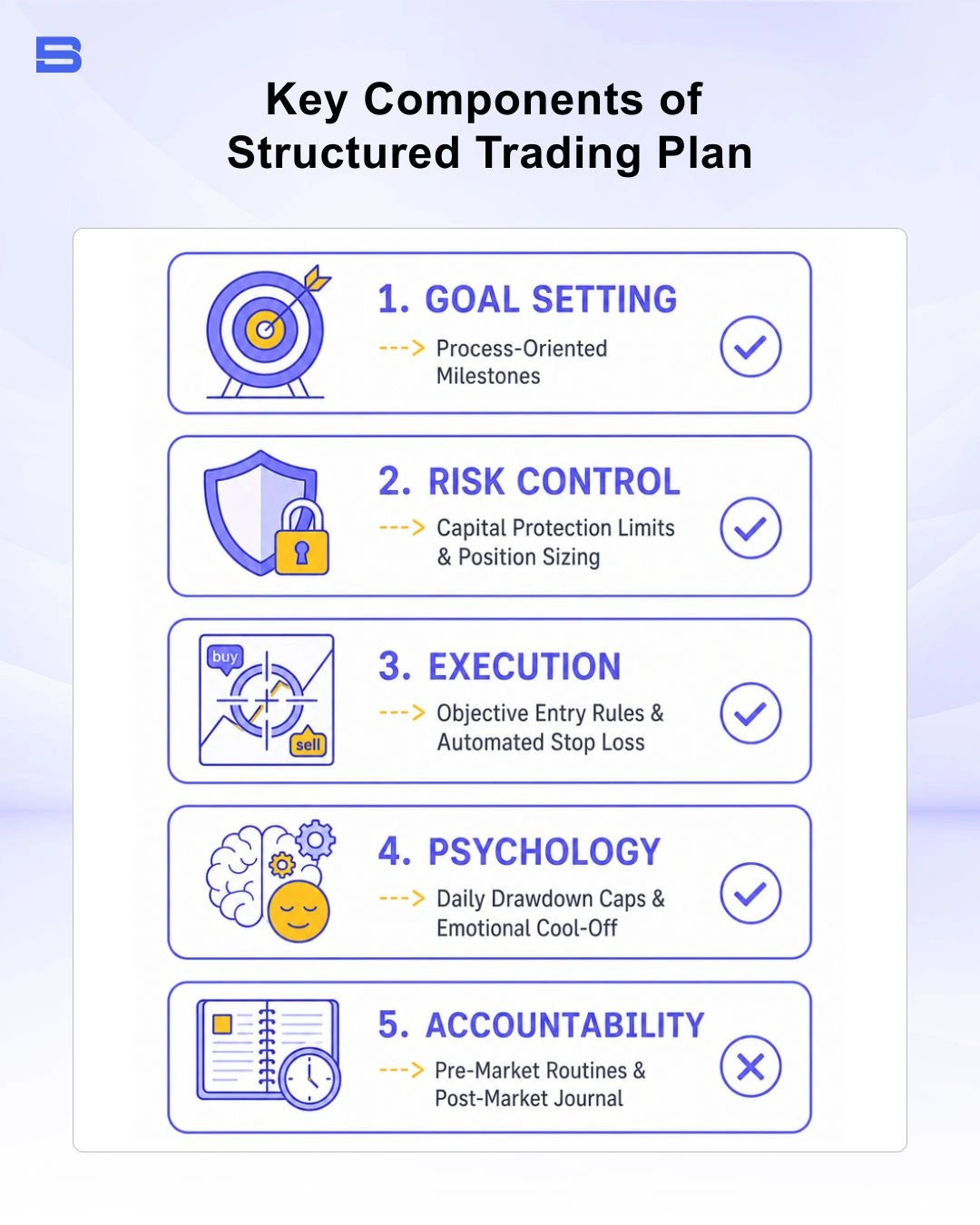
Key Components of a Structured Trading Plan Template
Every resilient trading plan template includes core modules that outline your execution protocols before the market opens. By codifying these elements in advance, you eliminate the need to make stressful, real-time choices during active market hours.
How to Set Realistic Trading Goals for Long-Term Growth
Effective goal setting in trading avoids arbitrary profit targets, such as attempting to double an account within a month. Speculative targets encourage excessive risk-taking and leverage abuse. Instead, focus on process-oriented objectives: maintaining discipline to adhere to your entry rules, keeping losses within strict percentage limits, and executing trades systematically. Sustainable portfolio growth stems from statistical probability, consistent risk control, and compounding small returns over extended time horizons.
Defining Exit Rules: Stop Loss and Take Profit
A robust trading plan requires objective exit criteria before any order is submitted to your execution platform. You must determine the logical point where your market thesis is invalidated and place an automated market order to exit the trade—known as a stop loss.
Relying on manual exits under emotional stress often results in holding onto losing positions in the hope of an immediate rebound. Similarly, take-profit targets should be established at predefined technical levels—such as major supply zones or historical swing highs—to lock in gains systematically rather than attempting to pick absolute market tops.
Setting the Risk-Reward Ratio for Every Trade
To maintain positive expected value over time, your setup criteria must adhere to an acceptable minimum risk-reward ratio. Many retail trading educators use 1:2 as a common illustrative benchmark, meaning the potential reward should be at least twice the amount risked.
Maintaining an adequate risk-to-reward ratio allows a trading system to remain profitable over a sample size of trades even with a win rate below 50%. For instance, out of ten trades with a 1:2 ratio, losing six trades results in six units lost, but winning four trades yields eight units gained, leaving a net profit of two units.
Capital Allocation and Money Management Principles
Capital preservation is the absolute priority of financial market survival. Without rigorous position-sizing rules, even a trading strategy with a high win rate can face severe account drawdowns during natural losing streaks.
Establishing Strict Risk Management Parameters
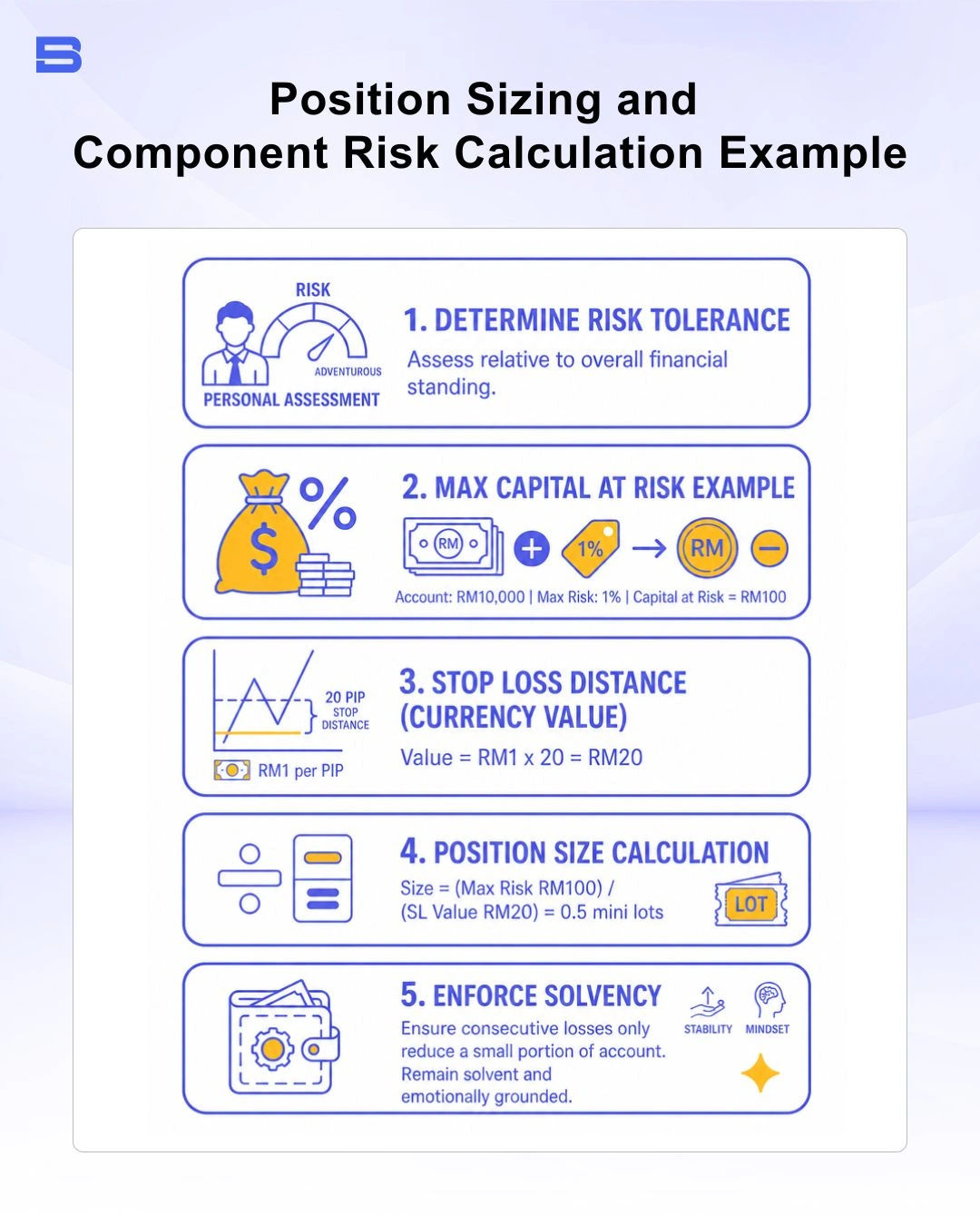
Professional portfolio management dictates capping your capital risk on any single trade to a small percentage of your total balance. A widely followed risk-management convention among retail and professional traders alike is to cap risk at 1% to 2% of total capital per trade. Determining appropriate capital exposure relative to your overall financial standing requires a clear assessment of your personal risk tolerance.
Consider a practical example using Malaysian Ringgit (MYR). Suppose your account balance is RM10,000, and your trading plan sets a maximum risk limit of 1% per trade:
Maximum Capital at Risk = RM10,000 x 0.01 = RM100
If your technical setup requires a stop loss distance of 20 pips on a currency pair (where one pip is worth approximately RM1 per mini lot), your position size is calculated as follows:
Position Size = Maximum Risk ÷ Stop Loss Distance in Currency Value =
RM100 ÷ RM20 = 5 mini lots
By enforcing this formula, a series of consecutive losses will only reduce a small portion of your account balance, ensuring you remain solvent and emotionally grounded to trade another day.
Preparing Your Trading Environment and Brokerage Account
Execution efficiency depends significantly on the structure of your trading environment and the reliability of your execution partner. Malaysian traders entering foreign exchange, global equities, or local derivatives markets must select a properly regulated execution platform.
When choosing a broker, confirm that they adhere to international regulatory standards or are subject to local oversight by regulatory bodies such as the Securities Commission Malaysia (SC) or Bank Negara Malaysia (BNM). Regulated brokers are required to maintain segregated client funds and provide transparent pricing.
Before executing live market orders, ensure you understand the mechanics of operating a brokerage account. If you plan to trade domestic equities listed on Bursa Malaysia, ensure you complete the requirements on how to open a trading account in Malaysia[planned], including setting up a Central Depository System (CDS) account to ensure direct legal ownership of your securities.
Sticking to Your Plan: Overcoming Emotional Biases
The primary failure point for most traders is not a lack of market knowledge, but an inability to adhere to their written plan during live execution. Cognitive biases such as loss aversion (refusing to close a losing trade to avoid realizing a loss) and revenge trading (immediately re-entering the market after a loss to make back money) can quickly destroy an account.
Preventing Overtrading and Fear-Based Execution
To protect your account balance from emotional execution, incorporate clear behavioral rules into your plan to prevent overtrading. Set maximum daily loss limits—such as 3% of your account balance. If market movements trigger this limit on a given day, your plan must enforce an immediate shutdown of your trading platform for the remainder of the trading session. This cooling-off rule prevents emotional decision-making and allows you to return to the market with clarity.
Integrating Education and Market Research Into Your Plan
A comprehensive trading plan establishes a structured schedule for pre-market preparation and continuous professional development. Rather than opening charts and placing immediate market orders, dedicate time before market open to review key economic announcements, such as interest rate decisions, inflation releases, or corporate earnings reports. To structure your ongoing market study and skill enhancement, review our step-by-step roadmap on how to learn trading.
Connecting Your Plan to a Trading Journal for Accountability
A trading plan remains an unverified hypothesis until its performance is tracked and evaluated against empirical market execution data. Maintaining a disciplined trading journal is the primary method for maintaining operational accountability and measuring performance consistency.
Your journal should record specific operational details for every trade executed:
- Pre-Trade Analysis: The structural trigger and rationale for entering the position.
- Execution Metrics: Exact entry price, designated stop loss, take profit target, and position size.
- Post-Trade Review: Whether the trade strictly followed your written plan or involved emotional deviations.
- Market Context: Prevailing market volatility, major news events, and your psychological state during execution.
Reviewing your journal on a weekly or monthly basis allows you to identify systemic execution errors, measure actual performance against target risk-reward ratios, and make data-driven refinements to your trading plan.
The Bottom Line
A well-crafted trading plan bridges the gap between theoretical market analysis and consistent live execution. By establishing clear process goals, enforcing fixed risk management boundaries, choosing a regulated brokerage environment, and systematically logging every transaction, you convert trading from a speculative activity into a structured methodology. Discipline to follow your rules consistently will always remain the defining factor in achieving long-term capital preservation and market sustainability.
Disclaimer: The content on this page is intended for educational and informational purposes only. It does not constitute financial, investment, tax, or legal advice, and should not be interpreted as a recommendation to buy, sell, or hold any financial instrument or asset. Trading and investing involve significant risk, including the possible loss of your entire capital. Products such as forex, CFDs, and cryptocurrencies carry additional risks due to leverage, high volatility, and limited regulatory protection in some jurisdictions. Past performance of any financial instrument does not guarantee future results. Any market views, forecasts, or opinions expressed are those of the author at the time of writing and may not reflect current market conditions. Platform features, fees, and regulatory status are subject to change — always verify information directly with the relevant provider or regulator before making any financial decision. BrokerSpecs may receive compensation from third parties featured on this site. Always conduct your own due diligence and consider seeking advice from a licensed financial professional before investing.